

Plenty of SaaS companies have a genuinely good product and still can't grow predictably. They're running content, paid ads, social, and email all at once — and leads still come in unevenly, revenue still swings quarter to quarter.
Usually the product isn't the problem. The absence of a real strategy is.
Without one, marketing turns into a list of disconnected activities: a campaign here, a blog push there, budget moving toward whatever channel got attention last week. What separates SaaS companies with predictable growth from the ones stuck guessing isn't more tactics — it's a repeatable system for attracting the right audience, converting them, and keeping them.
What is a SaaS Marketing Strategy?
A SaaS marketing strategy is the structured plan a software company uses to attract the right prospects, move them from awareness to paid customer, and keep them subscribed long enough to become profitable. It's different from marketing a one-time purchase in one fundamental way: the sale isn't the finish line. A SaaS customer who signs up and churns in month two often costs more than they generated, so the strategy has to account for onboarding, activation, and retention — not just leads.
That's also why SaaS marketing leans so heavily on content, SEO, and product-led motions rather than one-off campaigns. Recurring revenue rewards trust built over time, not a single persuasive ad.
Also Read: SaaS Security Checklist: What Every Founder Must Know Before Launch
Why a SaaS Marketing Strategy Matters
A clear strategy changes what marketing actually produces:
- Lead generation gets more targeted instead of broad, because you know who you're trying to reach.
- Conversion rates improve because messaging speaks directly to a specific problem instead of a generic pitch.
- Acquisition costs come down as spend concentrates on channels that actually convert instead of being spread thin.
- Churn drops because retention is built into the plan from day one, not bolted on after customers start leaving.
- Growth becomes forecastable — when you know your funnel conversion rates, you can predict next quarter's pipeline instead of hoping for it.
1. Define Your Ideal Customer Profile (ICP)
The most common mistake early-stage SaaS founders make is trying to market to everyone. "Businesses that need project management software" is not an ICP — it's most of the internet. The companies that grow predictably pick a specific segment with a specific, expensive problem and speak directly to it.
A useful test: a project management platform that repositioned itself around marketing agencies specifically — rather than "all businesses" — typically sees messaging land harder and demo requests climb, simply because the copy can name the exact workflow problem the buyer has, instead of speaking in generalities that apply to nobody in particular.
To get there, your team needs real answers to a few questions: who gets the most value from the product, which industries actually convert instead of just sign up for trials, what specific pain point you're solving, and who holds the buying decision — because in B2B SaaS, the person using the product and the person approving the invoice are often not the same person.
2. Build a SaaS Marketing Funnel
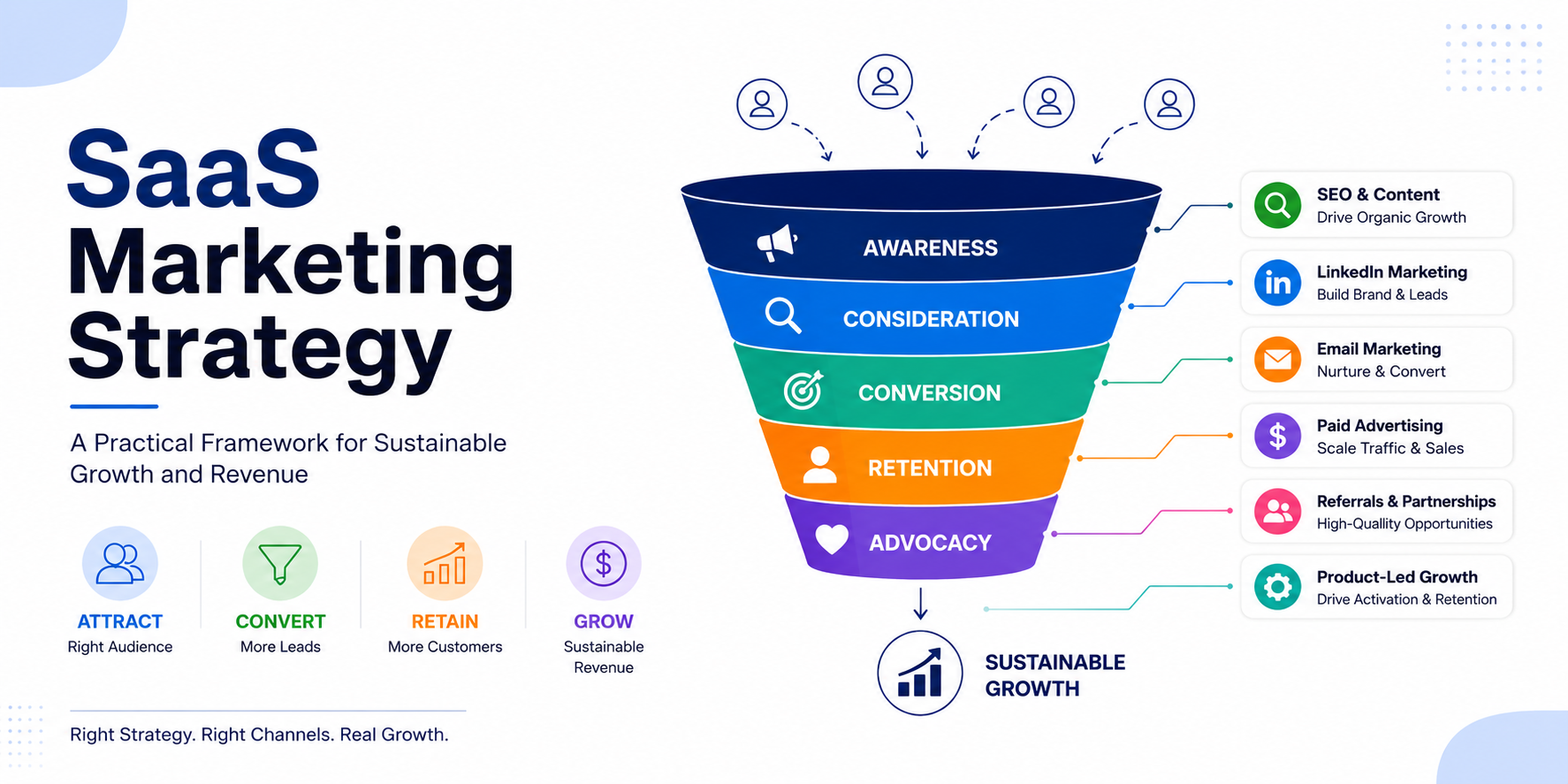
A funnel is just a map of how a stranger becomes a paying, renewing customer. In SaaS, that map has one extra stage most other businesses don't worry about as much: advocacy, because referrals and word-of-mouth compound in a way paid acquisition never does.
| Funnel Stage | What It's For |
|---|---|
| Awareness | Getting found by people who have the problem |
| Consideration | Earning enough trust that they take a demo or trial |
| Conversion | Turning a trial or demo into a paying account |
| Retention | Making sure they're still paying six months later |
| Advocacy | Turning happy customers into referral sources |
The stage worth watching most closely is usually the one nobody tracks: where prospects actually drop off between consideration and conversion. That's almost always a friction problem — a confusing pricing page, a demo that took too long to book — not an awareness problem, even though awareness is where most marketing budget goes by default.
Also Read, AI SaaS Development Guide for Businesses (2026)
3. Build a Content Marketing Strategy That Actually Converts
Content marketing in SaaS isn't about publishing volume — it's about being the answer to the question a prospect is already typing into Google before they've heard of you.
The companies that do this well aren't guessing at topics. Ahrefs, for instance, has built a large share of its customer acquisition around content that directly serves people already searching for the exact problems its product solves — a pattern worth studying regardless of your category. The same logic applies whether you sell CRM software or workflow automation: comparison articles, implementation guides, and "how do I actually do X" tutorials tend to outperform generic thought-leadership posts, because they attract people who are already close to a buying decision, not just browsing.
Build this around clusters, not one-off posts: a pillar page on the core problem you solve, surrounded by supporting articles that link back to it. That structure does double duty — it helps readers, and it signals topical authority to search engines.
4. Build a SaaS SEO Strategy
SEO tends to be the highest-ROI channel in SaaS marketing, mostly because the payoff compounds instead of resetting every month like paid spend does. But it only works if it's built around the assets that actually drive signups, not just blog traffic:
- Product and solution pages — these need to rank for the exact terms someone searches when they already know what category of tool they need.
- Comparison pages ("X vs Y") — these capture people actively deciding between you and a competitor, which is about as high-intent as search traffic gets.
- Industry-specific pages — a generic product page converts worse than one written for "project management for marketing agencies" specifically.
- Educational content — for the prospects who don't know a solution like yours exists yet.
Before investing further, it's worth getting honest answers on three things: which keywords are actually driving signups versus just traffic, whether there are unresolved technical SEO issues quietly capping your rankings, and which competitors are dominating the terms that matter most to you.
5. Build a Multi-Channel Lead Generation System
Relying on one channel is a bet you probably don't want to make — algorithm changes, rising ad costs, or a single platform policy shift can wipe out a pipeline that depends on it entirely.
| Channel | Typical Long-Term ROI |
|---|---|
| SEO | High |
| Content Marketing | High |
| Referrals | High |
| Medium–High | |
| Webinars | Medium |
| Paid Search | Medium |
The point of this table isn't to chase every channel at once — it's to know which ones are worth the patience they require. SEO and content take months to pay off but compound; paid search converts faster but stops the moment you stop paying for it. Most SaaS companies need at least one of each type running simultaneously: a fast channel to keep pipeline flowing now, and a compounding channel building for next year.
Also Read, Custom SaaS Development
6. Put Together a Marketing Plan That Ties to Business Goals
A marketing plan is really just the answer to one question, made specific: what are we trying to achieve, and how will we know if it worked? For a SaaS company, that usually means defining the ICP, picking a primary growth goal (demo requests, trial signups, expansion revenue), naming the channels that support that specific goal, and setting a KPI and budget against it — not against marketing generally, but against that one goal.
The plans that fail are usually the ones written in the abstract, listing every channel and every metric with no owner attached to any of them.
7. Fix Conversion Before You Chase More Traffic
More traffic to a leaky funnel just means more people leaking out of it. Before spending more on acquisition, it's worth checking where prospects actually abandon the journey — and it's often earlier than people expect, on the landing page or signup form itself rather than deeper in the trial.
A pattern that shows up repeatedly across SaaS signup flows: cutting form fields down to the minimum and simplifying page messaging tends to lift signup rates without touching the traffic number at all. That's a cheaper win than almost anything else on this list, and it's usually available immediately.
8. Get Onboarding and Retention Right
Acquiring a SaaS customer is expensive. Losing them in month two means that cost never gets recovered — which makes retention arguably the highest-leverage part of the entire strategy, even though it gets the least marketing attention.
The strongest lever here is usually time-to-value: how fast a new user reaches the moment where the product actually does the thing they signed up for. Products that guide users to that specific activation event early in onboarding — rather than dropping them into an empty dashboard — consistently retain better, because the user has proof the product works before they've had a chance to lose interest.
9. Use Product-Led Growth and Automation to Scale Without Scaling Headcount
Product-led growth means letting the product itself do the convincing — a free trial or freemium tier where someone experiences the value before a sales conversation ever happens. Marketing automation is the other half of scaling: nurture sequences, onboarding emails, and lifecycle campaigns that would be impossible to run manually once you have more than a handful of active trials at once.
The question worth asking isn't "should we automate" — it's which workflows are repetitive enough that automating them frees up real time, versus which ones genuinely need a human's judgment (enterprise deals, at-risk renewals) and shouldn't be automated away.
10. A 90-Day Roadmap to Get Started
Month 1 — Foundation. Define the ICP, run competitor research, get analytics actually tracking the right events, and do the keyword research that everything else depends on.
Month 2 — Acquisition. Start publishing SEO-driven content, launch a LinkedIn presence if that's where your ICP lives, build a lead magnet worth downloading, and tighten up landing pages.
Month 3 — Optimization. Look at where the funnel is actually leaking, fix the biggest conversion gap you find, get basic email automation running, and review which channels are earning their budget.
Ninety days isn't enough to see SEO fully mature — that usually takes longer — but it's enough to know whether the foundation is solid and which channels deserve more investment next quarter.
SaaS Marketing Trends Worth Watching in 2026
AI search optimization. A growing share of buyer research now happens inside AI-generated answers rather than traditional search results, which means content needs to be structured to be cited, not just to rank — clear answers, credible sourcing, and genuine expertise rather than SEO filler.
Product-led growth. Letting prospects experience value before a sales call continues to gain ground, especially in categories where the buyer trusts their own evaluation more than a sales pitch.
Community-led growth. Building an owned audience through communities and events is proving more durable than channels a company doesn't control.
First-party data. As third-party tracking keeps getting harder, owned channels — email lists, community members, product users — are becoming the more reliable growth asset.
Common Mistakes That Quietly Cap SaaS Growth
- Targeting everyone instead of a defined ICP
- Publishing content with no keyword research behind it
- Treating SEO as optional rather than foundational
- Depending on a single acquisition channel
- Under-investing in onboarding while over-investing in acquisition
- Not tracking ROI by channel, so budget never moves toward what's working
- Front-loading paid ad spend before organic channels have time to build
- Ignoring customer feedback that would improve both product and messaging
- Not tracking retention as closely as new signups
- Delaying marketing automation until the team is already overwhelmed
Conclusion
The best SaaS marketing strategy was never a list of tactics — it's a repeatable system. Companies that consistently define who they're targeting, map a real funnel, invest in SEO and content that actually serves buyer intent, fix conversion friction before chasing more traffic, and take retention as seriously as acquisition end up with something most competitors don't have: growth they can actually predict. Start with the ICP, build the plan around one clear goal at a time, and let the channels that prove themselves earn more budget — everything else in this framework builds on getting that first part right.