

UpBusiness
Back to Blog

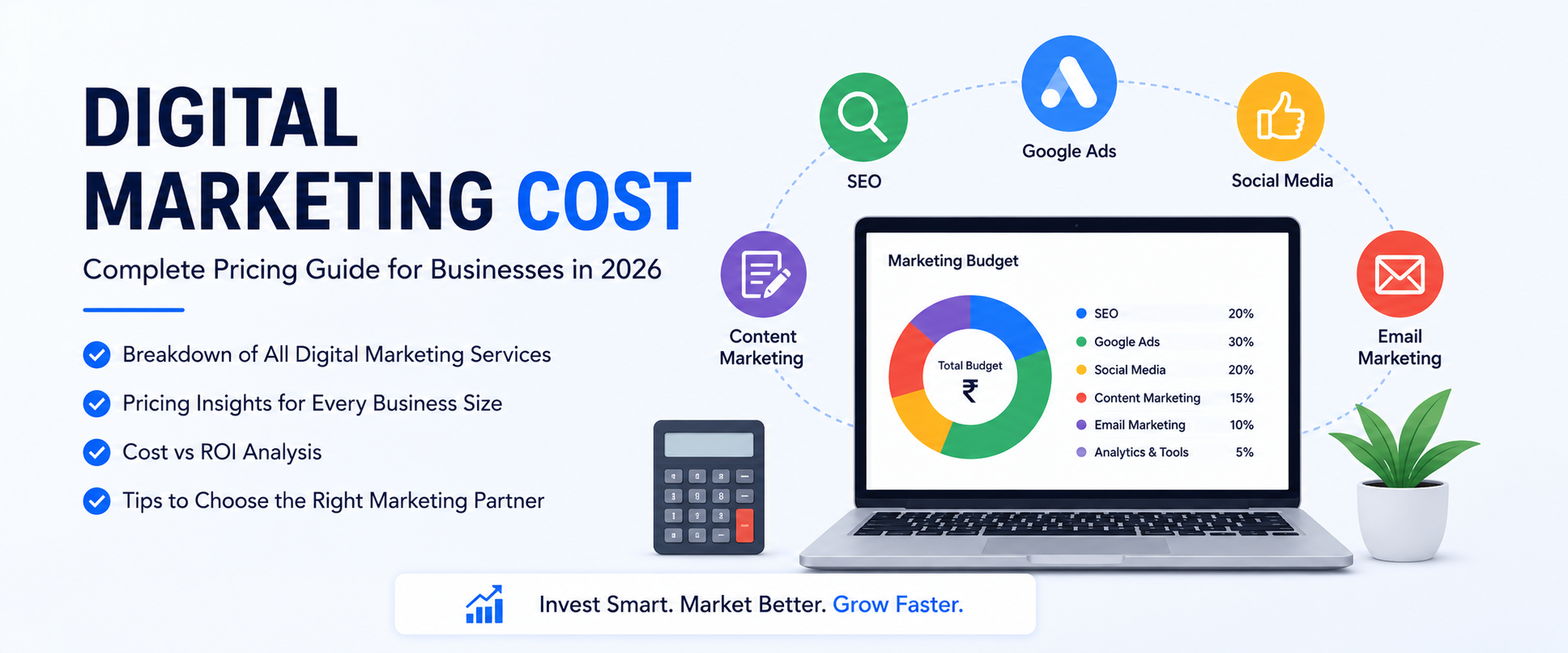
Digital Marketing Cost in 2026: Complete Pricing Guide for Businesses

16 Jun 2026
Digital Marketing Cost in 2026: Complete Pricing Guide for Businesses

Many businesses know they need digital marketing, but very few know how much they should actually spend on it.

One agency quotes ₹15,000 per month. Another proposes ₹2 lakhs. Freelancers offer packages that seem too good to be true. As a result, business owners often struggle to determine what a reasonable digital marketing budget looks like and which services deliver the best return on investment.

Understanding digital marketing cost is no longer optional. Whether you're a startup looking for your first customers, an ecommerce brand scaling sales, or an established company trying to generate more qualified leads, your marketing investment directly affects growth.

The challenge isn't finding digital marketing services. The challenge is understanding what you're paying for and whether the investment will generate measurable business results.

In this guide, we'll break down digital marketing pricing, service costs, ROI expectations, and the factors that influence pricing in 2026.


What Is Digital Marketing Cost?

Digital marketing cost refers to the total investment required to promote a business online through channels such as search engines, social media, paid advertising, email marketing, content marketing, and conversion optimization.

Simple Definition

Digital marketing cost is the amount a business spends to attract, engage, and convert customers through online channels.

Why It Matters in 2026

Customer behavior has changed dramatically.

Before making a purchase, most consumers:

  • Search on Google

  • Visit websites

  • Read reviews

  • Compare competitors

  • Check social media

Businesses that fail to invest in digital marketing often lose visibility during this buying journey.

Example

A local service provider investing ₹50,000 per month in SEO and Google Ads may generate consistent leads and inquiries.

Meanwhile, a competitor relying only on referrals may struggle to maintain predictable growth.

The difference isn't spending more money. It's investing strategically.


How Digital Marketing Pricing Works

Many businesses assume digital marketing follows a fixed pricing model.

In reality, pricing depends on multiple factors.

Step 1: Business Goals

Agencies first identify:

  • Lead generation goals

  • Sales targets

  • Brand awareness objectives

  • Market competition

Higher growth targets usually require larger investments.


Step 2: Channel Selection

Different channels have different costs.

Examples:

  • SEO

  • Google Ads

  • Social Media Marketing

  • Email Marketing

  • Content Marketing

  • Performance Marketing

The chosen mix affects the overall digital marketing pricing structure.


Step 3: Competitive Analysis

Industries with higher competition often require larger budgets.

Examples:

  • Real Estate

  • Finance

  • Healthcare

  • Legal Services

  • SaaS

Competition influences both advertising costs and SEO investment requirements.


Step 4: Resource Allocation

Costs depend on the resources required:

  • Strategists

  • SEO Specialists

  • PPC Experts

  • Designers

  • Content Writers

  • Developers

More resources generally mean better execution but higher pricing.


Step 5: Campaign Execution

Once campaigns launch, agencies:

  • Create content

  • Optimize ads

  • Manage budgets

  • Improve conversions

  • Analyze performance

This ongoing work contributes to monthly digital marketing cost.


Step 6: Reporting and Optimization

Marketing is never a one-time activity.

Regular optimization improves:

  • Lead quality

  • Cost per acquisition

  • Conversion rates

  • Marketing ROI


Key Components of Digital Marketing Cost

Digital marketing packages typically include multiple services.

Component Purpose Business Benefit
SEO Improve search visibility Long-term traffic growth
Google Ads Generate immediate leads Faster results
Social Media Marketing Increase engagement Brand awareness
Content Marketing Build authority Organic lead generation
Email Marketing Nurture prospects Higher retention
CRO Improve conversions Better ROI
Analytics & Reporting Measure performance Data-driven decisions

Search Engine Optimization (SEO)

SEO focuses on improving organic visibility in search engines.

Typical SEO services include:

  • Keyword research

  • Technical SEO

  • Content optimization

  • Link building

  • Local SEO

SEO Services Cost

Business Size Monthly SEO Cost
Small Business ₹15,000 – ₹50,000
Medium Business ₹50,000 – ₹1,50,000
Enterprise ₹1,50,000+

Google Ads Management

Google Ads provides immediate visibility.

Services include:

  • Campaign setup

  • Keyword targeting

  • Bid management

  • Conversion tracking

Google Ads Management Cost

Business Size Monthly Management Cost
Small Business ₹10,000 – ₹40,000
Medium Business ₹40,000 – ₹1,00,000
Enterprise ₹1,00,000+

Advertising spend is separate from management fees.


Social Media Marketing

Social media marketing helps businesses build awareness and engage customers.

Typical services:

  • Content creation

  • Community management

  • Paid social campaigns

  • Analytics

Social Media Marketing Cost

Business Size Monthly Cost
Small Business ₹10,000 – ₹35,000
Medium Business ₹35,000 – ₹1,00,000
Enterprise ₹1,00,000+

Content Marketing

Content remains one of the most effective long-term marketing assets.

Examples:

  • Blog articles

  • Case studies

  • Landing pages

  • Whitepapers

Content Marketing Pricing

Content Type Average Cost
Blog Article ₹2,000 – ₹20,000
Landing Page ₹5,000 – ₹25,000
Case Study ₹10,000 – ₹50,000
Whitepaper ₹20,000 – ₹1,00,000+

Why Businesses Need Digital Marketing

Digital marketing is no longer a competitive advantage.

It's a business requirement.

Revenue Growth

Effective campaigns help businesses:

  • Generate qualified leads

  • Increase online sales

  • Improve customer acquisition

Marketing becomes a predictable growth engine.


Better Customer Experience

Customers expect:

  • Relevant content

  • Fast responses

  • Personalized communication

Digital marketing helps businesses meet those expectations.


Improved Brand Visibility

Businesses appearing consistently across:

  • Google Search

  • Social Media

  • Email

  • Paid Advertising

are more likely to earn customer trust.


Operational Efficiency

Automation tools help reduce manual work through:

  • Lead nurturing

  • Email sequences

  • Customer segmentation

  • Campaign reporting


Long-Term Growth

SEO and content marketing continue generating value long after initial investment.

This creates sustainable growth.


Hidden Costs of Ignoring Digital Marketing

Some businesses focus only on marketing expenses.

The bigger risk is the cost of doing nothing.

Lost Leads

Potential customers often choose competitors they find online first.

Every missed search result can mean lost revenue.


Rising Customer Acquisition Costs

Businesses without strong organic visibility often depend heavily on paid advertising.

This increases acquisition costs over time.


Reduced Brand Trust

Modern consumers expect businesses to have:

  • Professional websites

  • Active social media

  • Helpful content

Without these assets, trust declines.


Missed Market Opportunities

Digital channels reveal customer behavior, trends, and demand patterns.

Businesses ignoring digital marketing often miss valuable insights.

A Practical Example

Imagine two local service providers.

Provider A invests in SEO, Google Ads, and content marketing.

Provider B relies only on referrals.

After 12 months:

  • Provider A dominates search results.

  • Provider A generates predictable leads.

  • Provider A scales faster.

Provider B struggles to maintain growth.

The real cost wasn't the marketing investment.

It was the missed opportunity.


Types of Digital Marketing Services

Different businesses require different marketing approaches.

1. Search Engine Optimization (SEO)

What It Is

Improving visibility in search engines.

Who Needs It

  • Local businesses

  • Ecommerce stores

  • SaaS companies

Benefits

  • Organic traffic

  • Higher authority

  • Lower acquisition costs

Example

A law firm ranking for high-intent keywords generates consistent inquiries without paying for every click.


2. Pay-Per-Click Advertising (PPC)

What It Is

Paid advertising on platforms like Google Ads.

Who Needs It

Businesses seeking immediate traffic and leads.

Benefits

  • Fast visibility

  • Targeted traffic

  • Measurable ROI

Example

An ecommerce store promoting seasonal products.


3. Social Media Marketing

What It Is

Building brand awareness and engagement through social platforms.

Who Needs It

  • Consumer brands

  • Retail businesses

  • Startups

Benefits

  • Community growth

  • Brand recognition

  • Customer engagement


4. Content Marketing

What It Is

Creating valuable content that attracts and educates audiences.

Who Needs It

Businesses focused on long-term growth.

Benefits

  • Trust building

  • Organic visibility

  • Lead generation


5. Email Marketing

What It Is

Direct communication with prospects and customers.

Who Needs It

Businesses with existing customer databases.

Benefits

  • Retention

  • Upselling

  • Customer loyalty


6. Performance Marketing

What It Is

Data-driven campaigns focused on measurable outcomes.

Who Needs It

Businesses focused on lead generation and revenue growth.

Benefits

  • Better attribution

  • Scalable growth

  • Improved ROI

Industry Applications of Digital Marketing

Every industry uses digital marketing differently. Understanding these applications helps businesses allocate budgets more effectively.

Industry Use Case Business Impact
Healthcare Patient acquisition and appointment bookings Increased patient inquiries
Real Estate Property lead generation More qualified leads
Ecommerce Product sales and customer retention Higher revenue
Education Student enrollment campaigns Increased admissions
SaaS Demo bookings and lead nurturing Better conversion rates
Finance Lead generation and trust building Lower acquisition costs
Manufacturing B2B lead generation Improved sales pipeline

Healthcare

Hospitals, clinics, and healthcare providers use SEO, Google Ads, and local search optimization to attract patients searching for services online.

Ecommerce

Ecommerce businesses depend heavily on:

  • Google Shopping Ads

  • SEO

  • Social Media Advertising

  • Email Marketing

This is why digital marketing cost for ecommerce businesses is often higher than other industries.

SaaS

Software companies focus on:

  • Content marketing

  • SEO

  • LinkedIn advertising

  • Marketing automation

These channels help nurture prospects throughout long sales cycles.


Digital Marketing Cost in India: Pricing Breakdown

One of the most common questions businesses ask is:

How much does digital marketing cost in India?

The answer depends on goals, competition, and required services.

Monthly Digital Marketing Cost

Business Size Monthly Investment
Small Business ₹15,000 – ₹75,000
Growing Business ₹75,000 – ₹2,50,000
Mid-Size Company ₹2,50,000 – ₹10,00,000
Enterprise ₹10,00,000+

Digital Marketing Service Pricing

Service Monthly Cost
SEO Services ₹15,000 – ₹1,50,000+
Google Ads Management ₹10,000 – ₹1,00,000+
Social Media Marketing ₹10,000 – ₹1,00,000+
Content Marketing ₹15,000 – ₹2,00,000+
Email Marketing ₹5,000 – ₹50,000+
Performance Marketing ₹25,000 – ₹5,00,000+

Digital Marketing Packages Cost

Package Type Estimated Cost
Basic Package ₹15,000 – ₹40,000
Growth Package ₹40,000 – ₹1,00,000
Advanced Package ₹1,00,000 – ₹3,00,000
Enterprise Package ₹3,00,000+

Cost vs ROI Analysis

Digital marketing should always be evaluated based on returns rather than expenses.

Investment vs Potential Outcomes

Investment Area Cost Potential Benefit
SEO Medium Long-term traffic growth
Google Ads Medium-High Immediate lead generation
Content Marketing Medium Brand authority
Social Media Medium Audience engagement
Performance Marketing High Scalable revenue growth

Example ROI Scenario

A local service business invests:

  • SEO: ₹30,000/month

  • Google Ads: ₹40,000/month

  • Content Marketing: ₹20,000/month

Total Investment: ₹90,000/month

Results after six months:

  • 150 qualified leads

  • 35 new customers

  • Average customer value: ₹25,000

Revenue Generated:

₹8,75,000

ROI:

Nearly 10X return on monthly investment.


Freelancer vs Agency vs In-House Marketing Cost

Businesses often compare these options before making a decision.

Factor Freelancer Agency In-House Team
Cost Low Medium High
Expertise Limited Diverse Depends on hiring
Scalability Moderate High Moderate
Technology Access Limited Advanced Variable
Reporting      

Freelancer

Best for:

  • Small projects

  • Limited budgets

  • Specific tasks


Agency

Best for:

  • Long-term growth

  • Multi-channel campaigns

  • Access to specialists


In-House Team

Best for:

  • Large enterprises

  • Ongoing marketing requirements

For most businesses, digital marketing agency pricing often delivers better value than building an entire internal team.


How to Choose the Right Digital Marketing Agency

Not all agencies deliver the same results.

Use the following criteria before signing a contract.

1. Review Their Portfolio

Look for:

  • Relevant industry experience

  • Case studies

  • Proven outcomes

Ask for measurable results.


2. Evaluate Transparency

A reliable agency should explain:

  • Pricing

  • Deliverables

  • Timelines

  • Reporting methods

Avoid vague promises.


3. Understand Their Process

A structured process typically includes:

  1. Research

  2. Strategy

  3. Execution

  4. Optimization

  5. Reporting


4. Assess Communication

Consistent communication is critical for campaign success.


5. Analyze Reporting

Your agency should provide:

  • Traffic reports

  • Lead reports

  • Conversion metrics

  • ROI analysis


6. Check Scalability

Choose an agency capable of supporting future growth.


Digital Marketing Trends for 2026

Marketing continues to evolve rapidly.

Businesses investing today should prepare for these trends.

AI-Powered Campaign Optimization

AI helps marketers:

  • Improve targeting

  • Automate bidding

  • Predict customer behavior

Result:

Better campaign performance.


First-Party Data Strategies

Privacy regulations are increasing.

Businesses must focus on collecting and using first-party customer data responsibly.


Hyper-Personalization

Consumers expect tailored experiences.

Personalized campaigns often outperform generic messaging.


Video-First Marketing

Short-form and long-form video continue to dominate customer engagement.


Marketing Automation

Automation tools help businesses scale communication and lead nurturing efficiently.


Predictive Analytics

Advanced analytics help forecast:

  • Customer behavior

  • Conversion probability

  • Marketing ROI


Statistics & Market Insights

Key observations shaping digital marketing in 2026:

  • Organic search remains one of the highest ROI marketing channels.

  • Businesses increasingly allocate larger portions of their budget to performance marketing.

  • Video content consistently generates higher engagement than static content.

  • Personalized campaigns often improve conversion rates significantly.

  • Companies investing in marketing automation report improved operational efficiency.

  • Data-driven decision-making continues to outperform intuition-based marketing strategies.


Key Benefits Summary

Benefit Explanation
Increased Visibility Reach more potential customers
Better Lead Generation Attract qualified prospects
Improved Brand Awareness Strengthen market presence
Higher Conversions Turn visitors into customers
Measurable ROI Track campaign performance
Scalability Support business growth
Better Customer Insights Understand audience behavior
Competitive Advantage Stay ahead of competitors
Marketing Efficiency Optimize budgets effectively
Long-Term Growth Build sustainable revenue streams


Conclusion

Understanding digital marketing cost is essential for making smarter growth decisions in 2026.

The right marketing strategy is not about spending the most money. It is about investing in the channels, campaigns, and expertise that generate measurable business outcomes. Whether your focus is SEO, Google Ads, social media marketing, content marketing, or performance marketing, a well-planned digital marketing budget can create predictable growth and long-term competitive advantages.

Businesses that approach marketing strategically often outperform competitors, generate more qualified leads, and achieve stronger customer retention.

Ready to Grow Your Business Online?

At upbusiness, we help startups, small businesses, and enterprises create data-driven marketing strategies that deliver measurable results. From SEO and paid advertising to content marketing and performance campaigns, our team helps businesses maximize ROI and scale sustainably.

Contact upbusiness today for a free digital marketing consultation and customized growth strategy.

Deepak P
Written by
Deepak P
Editorial Team

Deepak Kumar is an experienced Digital Marketing Strategist and SEO Consultant with expertise in search engine optimization, AI-driven marketing, content strategy, and digital growth. He regularly researches emerging technologies, includin… See full profile

Frequently Asked Questions

Digital marketing cost in India typically ranges from ₹15,000 to ₹5,00,000+ per month depending on the business size, industry competition, target audience, and services required. Small businesses usually start with SEO and social media marketing, while larger companies invest in comprehensive digital marketing strategies that include SEO, PPC, content marketing, and marketing automation.
Digital marketing pricing depends on several factors, including business goals, competition level, target market, marketing channels, campaign complexity, and the expertise of the agency. Businesses targeting highly competitive industries often require larger budgets for SEO, Google Ads, and performance marketing campaigns.
A small business should typically allocate 5%–15% of its annual revenue to digital marketing. For most startups and local businesses, a monthly digital marketing cost between ₹20,000 and ₹1,00,000 provides enough budget to build visibility, generate leads, and improve brand awareness.
Most digital marketing packages include SEO, social media marketing, content creation, website optimization, reporting, analytics, and campaign management. Advanced packages may also include Google Ads management, email marketing, conversion rate optimization, and performance marketing services.
Yes. A professional agency provides access to specialists in SEO, paid advertising, content marketing, analytics, and strategy. Compared to building an in-house team, digital marketing agency pricing often delivers better value through expertise, technology, and scalable campaign execution.
SEO services cost in India generally ranges from ₹15,000 to ₹1,50,000+ per month. Pricing varies based on keyword competition, website size, content requirements, local SEO needs, and the overall scope of optimization work required.
Leave a comment
Deepak P

Deepak P

Editorial Team

Deepak Kumar is an experienced Digital Marketing Strategist and SEO Consultant with expertise in search engine optimization, AI-driven marketing, content strategy, and digital growth. He regularly researches emerging technologies, including artificial intelligence, automation, and business transformation, helping organizations leverage digital solutions to improve efficiency and ROI.