
SaaS Product Development 2026
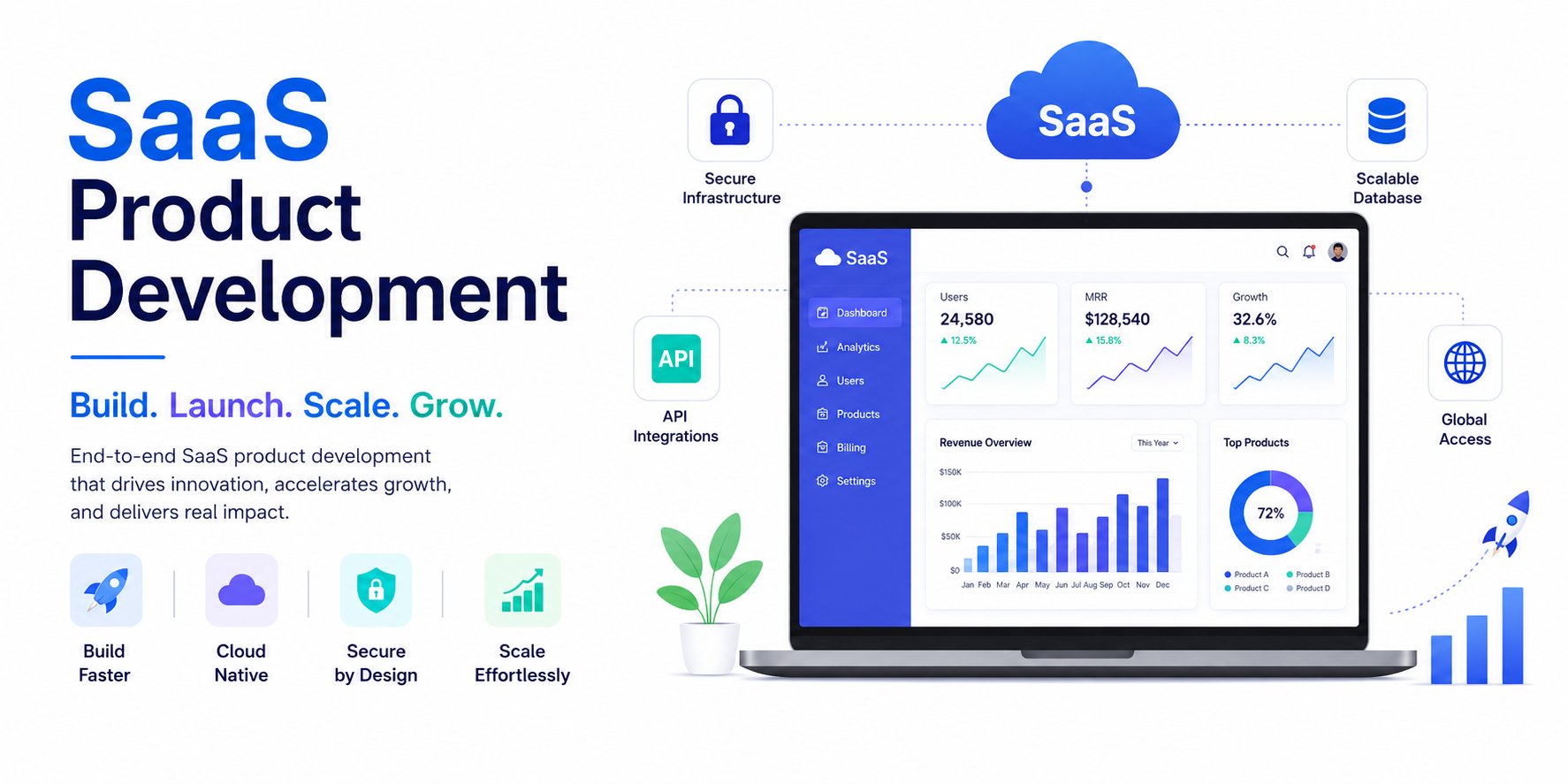
SaaS product development is the process of designing, building, launching, and maintaining cloud-based software delivered on a subscription model. Most successful SaaS products follow the same underlying discipline — validate the market before building, launch a focused MVP rather than a fully-loaded platform, architect for scale from day one, and treat security and retention as ongoing work, not launch-day checkboxes. Costs in 2026 realistically range from $10,000 for a narrow starter product to $500,000+ for an enterprise-grade platform.
Building a SaaS product is one of the most reliable ways to create scalable, recurring revenue — and one of the easiest ways to burn a budget on the wrong thing. Most SaaS projects that fail don't fail on execution; they fail because a team started building before validating that anyone actually wanted the product, or because "the roadmap" was really just a feature wishlist with no strategy underneath it.
This guide covers what SaaS product development actually involves, the real process from idea to live product, where these projects typically break, current 2026 costs, and how to evaluate a development partner without gambling the budget.
What is SaaS Product Development
SaaS product development means building software delivered over the internet rather than installed locally, with customers paying a recurring subscription instead of a one-time license fee — which is exactly why SaaS has become one of the dominant business models in technology: predictable revenue, lower distribution friction, and a product that improves continuously instead of shipping once and going stale.
A working SaaS platform typically needs user authentication, subscription and billing management, cloud infrastructure that scales with demand, data security, analytics dashboards, third-party integrations, and automated update delivery — components that sound straightforward individually but create real complexity once they all have to work together reliably at scale.
Also Read, AI SaaS Development Guide for Businesses (2026)
Why SaaS Keeps Winning as a Business Model
The advantages compound rather than being one-off wins: SaaS platforms scale to more users without proportional infrastructure rebuilds, subscription pricing produces predictable recurring revenue instead of lumpy one-time sales, updates roll out instantly without requiring anything from the customer, cloud hosting removes the capital expense of on-premise systems, and the product is accessible from anywhere with an internet connection — which matters more now than it did five years ago, given how distributed both teams and customers have become.
The Eight Stages From Idea to Live Product
Market validation
Before any code gets written — validate real demand, study competitors, identify the actual pain point, and define exactly who the target user is. Skipping this is the single most common reason a technically well-built product never finds traction.
Product strategy
A real roadmap covering business goals, core feature priorities, the revenue model, and a growth plan — not just a list of features someone thought sounded good.
UI/UX design
Wireframes, user journeys, and interactive prototypes that get tested before a single line of production code gets written, since fixing a confusing flow after launch is far more expensive than catching it in a prototype.
MVP development
Build the smallest version that solves one core problem well. Resist the urge to add "just one more feature" before launch — that instinct is how MVPs quietly turn into six-month builds that still haven't shipped.
Architecture and infrastructure
Security, performance, scalability, and reliability get designed in at this stage — retrofitting any of these after launch is dramatically more expensive than building them in from the start.
Testing and QA
Functionality, security, performance, and cross-device compatibility all need real testing before launch, not just a quick manual click-through.
Product launch
Onboarding flow, analytics tracking, and customer support all need to be ready on day one — a great product with a confusing first-run experience loses users before they ever see the value.
Continuous improvement
SaaS products are never "done." Feedback loops and regular releases based on real usage data are what separate a product that keeps growing from one that plateaus right after launch.
Also Read, SaaS Marketing Strategy: A Practical Growth Framework
Building the Strategy Layer On Top of the Build
Product-market fit has to be confirmed before scaling development spend — a product solving a real, painful problem for a well-defined audience is worth building fast; one still searching for its audience needs more validation, not more features.
Customer retention planning deserves equal weight to acquisition, since in a subscription business, a customer who churns after two months can cost more than they ever paid. The businesses that grow predictably plan for retention from day one, not as a fire drill once churn becomes visible in the numbers.
Growth and scaling strategy means planning feature expansion, infrastructure growth, and new customer segments deliberately, rather than reacting to whatever comes up next.
Analytics and performance tracking — engagement, feature adoption, conversion, and churn — turn "we think it's working" into an actual answer, and the businesses that skip this early tend to find out something was broken only after it's cost them real revenue.
Where SaaS Projects Actually Break
Scope creep is the most common failure mode — adding features before launch because they seem useful, which extends timelines and inflates the budget for a version of the product nobody's validated yet.
Security and compliance gaps left until later create business risk that's expensive to fix retroactively — this needs to be part of the architecture conversation, not a checklist item before launch.
Browse our curated list of Top Companies on UpBusiness
Scalability issues show up exactly when a product starts succeeding — user growth outpacing infrastructure that wasn't built with headroom is a genuinely painful problem to fix while a product is actively growing.
Technical debt from quick fixes made under launch pressure tends to resurface later as maintenance costs nobody budgeted for.
User adoption challenges can sink even a well-built product — strong onboarding and a clear first-run experience matter as much as the underlying engineering, since a product nobody adopts delivers zero value regardless of how well it was built.
Also Read, SaaS Application Development 2026 Cost, Process & Benefits
Three Decisions That Actually Shape the Outcome
Custom SaaS vs. template-based SaaS
| Factor | Custom SaaS | Template-Based SaaS |
|---|---|---|
| Flexibility | High | Limited |
| Scalability | High | Moderate |
| Branding | Fully custom | Restricted |
| Long-term growth | Strong | Limited |
| Competitive advantage | High | Moderate |
Custom development costs more upfront but removes ceilings a template eventually hits. Templates get you to market faster and cheaper — the right call when the product's core value doesn't depend on doing something a template genuinely can't do.
In-house team vs. outsourced development partner
| Factor | In-House Team | Development Partner |
|---|---|---|
| Hiring time | Slow | Fast to engage |
| Expertise access | Limited to hires made | Broad, across specialists |
| Development speed | Moderate | Often faster |
| Cost efficiency | Lower at scale, higher upfront | Higher efficiency early on |
| Scalability | Moderate | High |
An in-house team builds deeper institutional knowledge over time; an outsourced partner gets you moving faster with broader expertise without the hiring runway. Many companies start with a partner and bring pieces in-house as the product and team mature.
Verified vs. unverified development vendors
| Factor | Verified Provider | Unverified Provider |
|---|---|---|
| Background validation | Confirmed | Unknown |
| Review authenticity | Verified | Uncertain |
| Transparency | High | Variable |
| Vendor risk | Lower | Higher |
This decision matters more than it might seem — an unverified vendor isn't necessarily bad, but you're taking on risk with no way to confirm claims independently, which is exactly the problem a verified marketplace is built to solve.
What This Actually Costs in 2026
Real numbers, cross-checked against current 2026 development cost data — not "varies by scope," which tells you nothing when you're actually trying to budget:
| Project Type | Realistic 2026 Cost | Best For |
|---|---|---|
| Micro / starter SaaS (single core feature) | $10,000 – $30,000 | Testing a narrow concept before committing further |
| MVP SaaS product | $30,000 – $100,000 | Most funded early-stage startups |
| Mid-market SaaS platform | $100,000 – $250,000 | Growing companies scaling a proven product |
| Advanced / compliance-heavy platform | $150,000 – $400,000+ | Healthcare, finance, or other regulated industries |
| Enterprise SaaS solution | $300,000 – $500,000+ | Large organizations with complex integration needs |
What moves the price within these ranges: feature complexity, expected user volume, cloud infrastructure choices, security and compliance requirements, the number of third-party integrations, and the development team's actual expertise level. It's also worth budgeting for what comes after launch — ongoing hosting, monitoring, and maintenance commonly run several hundred to a few thousand dollars monthly once the product is live, a cost that's easy to forget when a proposal only shows the build price.
Vetting a SaaS Development Partner
Look for proven SaaS-specific development experience, not just general software development — building subscription billing logic and multi-tenant architecture is a different discipline than building a typical web app. Confirm familiarity with subscription-based business models specifically, since SaaS has operational quirks (churn, upgrade/downgrade logic, usage-based billing) a partner without SaaS experience may not anticipate. Verify strong security and compliance practices directly rather than taking a general assurance at face value. Evaluate client reviews and reputation carefully, prioritizing verified feedback over hand-picked testimonials. And confirm what long-term support actually looks like — a SaaS product needs ongoing maintenance and improvement, and a partner who disappears after launch leaves you owning problems you didn't plan to manage alone.
Also Read, Custom SaaS Development
Practices Worth Building In From Day One
Start with an MVP focused on one problem solved well, rather than trying to launch a fully-featured platform out of the gate. Build for scale from the start — retrofitting scalable architecture after a product gains traction is far more disruptive than planning for it upfront. Treat security as a day-one requirement, not a pre-launch checklist item. Implement analytics from launch, not months later once you're already flying blind on what users actually do. And automate testing early — the cost of a bug caught in automated testing is a fraction of the cost of the same bug reaching production.
What's Reshaping SaaS Development in 2026
AI-powered SaaS platforms — AI capabilities are moving from differentiator to standard expectation across most SaaS categories. Businesses exploring this can review providers in UpBusiness's Artifici+al Intelligence category.
Hyper-automation — organizations are automating repetitive workflows across departments, not just within a single tool.
Predictive analytics — data-driven decision-making continues expanding in importance as the baseline expectation, not a premium feature.
Personalization at scale — users increasingly expect individualized experiences by default, not as an add-on tier.
Composable SaaS architecture — flexible, modular architectures are enabling faster innovation and easier third-party integration than monolithic builds allow.
Why Businesses Choose UpBusiness
Finding the right SaaS development partner is genuinely difficult when information is incomplete or reviews can't be trusted. UpBusiness helps reduce that risk through verified service providers, verified reviews, transparent comparisons, and a more straightforward evaluation process than sorting through unverified pitches alone.
Building Something That Lasts
SaaS product development succeeds on the combination of strategy, technology, genuine customer understanding, and continuous improvement — not on any single piece done exceptionally well while the others get skipped. Businesses that take market validation, scalable architecture, security, and user experience seriously from the start are consistently the ones still standing (and growing) years later, while competitors who rushed straight to building are still fixing the foundation.
Before selecting a development partner, evaluate their expertise, transparency, reviews, and long-term support capability — not just their pitch. Explore verified SaaS development providers on UpBusiness to reduce vendor selection risk and find a partner matched to your project's actual scale, or browse the UpBusiness blog for deeper guides on SaaS strategy and technology decisions.
Browse our curated list of Top Companies on UpBusiness