
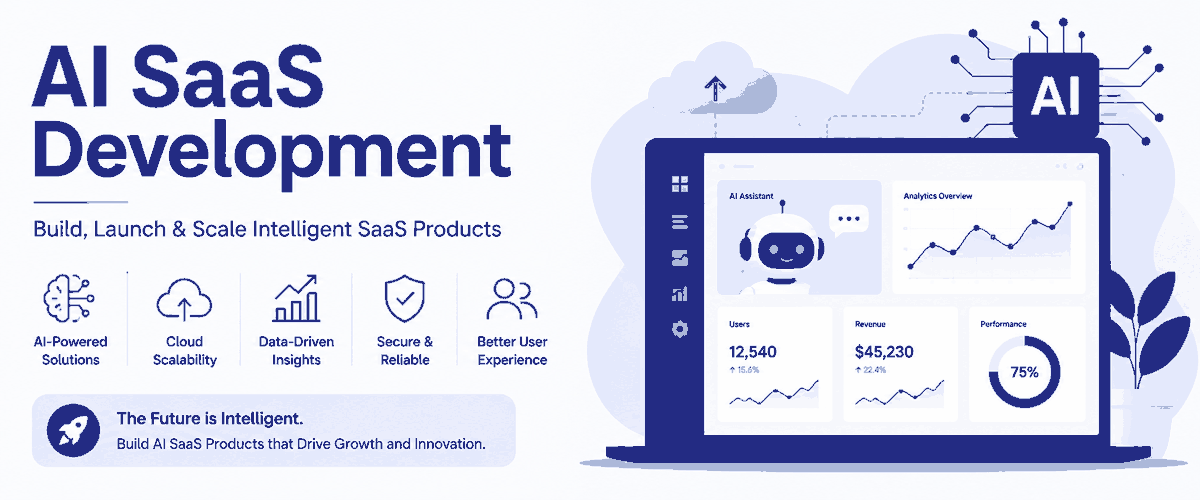

AI SaaS development means building subscription software where an AI model does core work for the user, such as drafting, answering, extracting, deciding or acting. It looks like ordinary SaaS from the outside, but the economics are different. Every AI request costs money, so a heavy user can cost many times what a light one does, and the product's quality has to be measured rather than assumed.
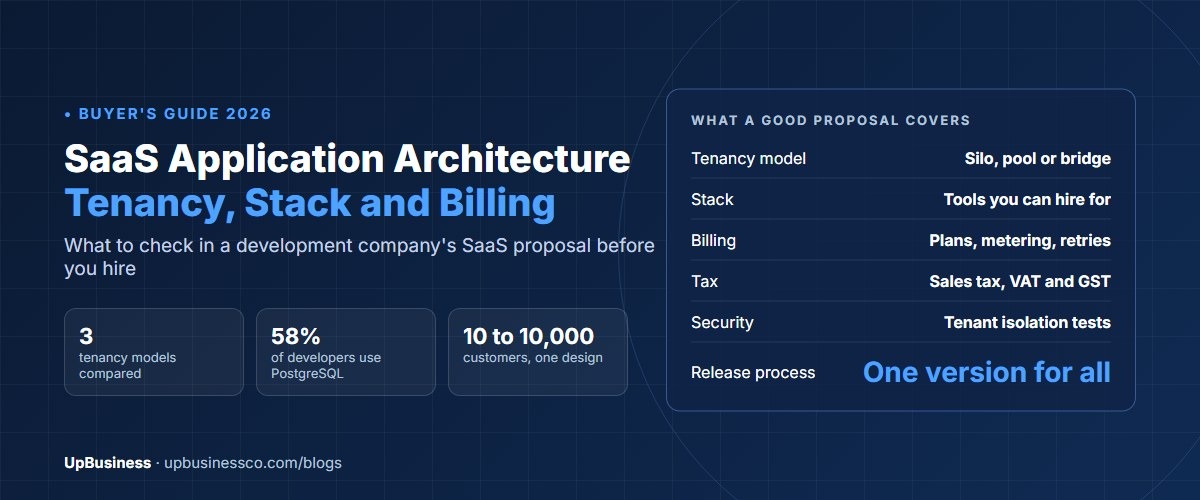
This guide sticks to what's specific to AI products, from cost per user and pricing to model choice and answer quality. It's written for founders and product owners hiring a development company to build one. The general SaaS foundation (tenancy, stack, billing and tax) is in our SaaS application architecture guide, and validation and product-market fit are in the SaaS product development guide.
Key takeaways
- At October 2026 list prices, 300 requests a month costs about $0.12 per user on Claude Haiku 5.5, $2.40 on Claude Sonnet 5.5 and $4.80 on Claude Opus 5.5[1].
- Sending 70% of requests to the small model and 30% to the mid-tier one cuts that $2.40 to about $0.80, a saving of two-thirds.
- Companies building AI products expect gross margins of about 52% on average in 2026, according to ICONIQ's survey of roughly 300 executives[2].
- Of the 15 partner companies on our AI development page, 13 list an AI service among their specialisations, but only 2 list SaaS.
What Makes AI SaaS Different From Traditional SaaS
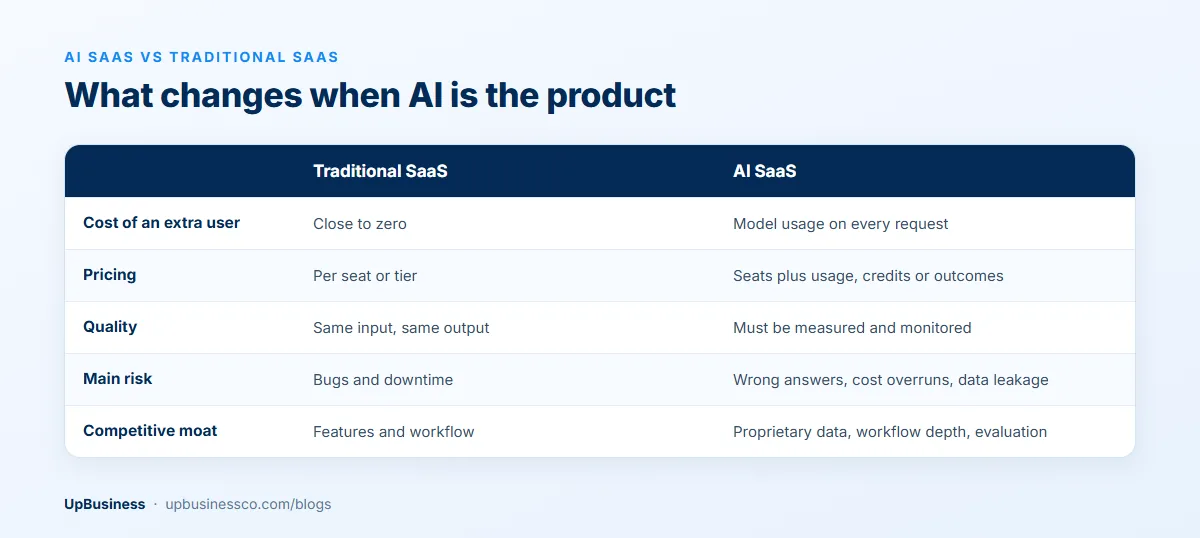
In classic SaaS, the cost of serving one more user is close to zero once the platform is running. In AI SaaS, each request sends tokens to a model and the provider bills for them. Cost of goods rises with every request. The output also changes from one run to the next, which means quality has to be tested like a product feature rather than checked once.
| Factor | Traditional SaaS | AI SaaS |
|---|---|---|
| Cost to serve an extra user | Close to zero | Model usage on every request |
| Pricing | Per seat or tier | Seats plus usage, credits or outcomes |
| Quality | Same input, same output | Varies by run; must be measured and monitored |
| Main risk | Bugs and downtime | Wrong answers, cost overruns, data leakage |
| Competitive moat | Features and workflow | Proprietary data, workflow depth and evaluation quality |
The upside is growth. In Kyle Poyar's 2025 benchmarks, AI-native companies grew faster than other B2B SaaS companies at every revenue stage, for example 110% against 40% a year between $1 million and $5 million in ARR[3]. The challenge is keeping that growth profitable.
Types of AI SaaS Products
| Type | What it does | Example |
|---|---|---|
| Vertical AI assistant | Answers and drafts for one industry or role | An assistant for legal, healthcare or accounting teams |
| Copilot inside a workflow | Adds AI to an existing job | Suggested replies inside a helpdesk |
| AI agent product | Completes multi-step tasks across tools | Scheduling, follow-ups, data entry |
| Document AI | Reads, extracts and checks documents at scale | Invoice, contract or identity document processing |
| Analytics and forecasting | Predicts and explains business numbers with Machine Learning | Demand, churn or risk forecasting |
| Content generation | Creates text, images or video from briefs | Marketing and product content tools |
The type matters for cost. A copilot that suggests a reply makes one short model call, while an agent that plans, calls tools and checks its own work can make ten or more calls for a single task. Estimate requests per task before you estimate cost per user.
Architecture of an AI SaaS Product
An AI SaaS product has seven layers. The first and last are ordinary SaaS work. The middle five are where AI products differ.
| Layer | What it handles |
|---|---|
| Application and UX | Screens, workflows, feedback buttons, human review steps |
| AI orchestration | Prompts, retrieval (RAG) from customer data, tools and agent steps |
| Model gateway | One internal interface to several model providers, with routing, fallbacks and cost limits |
| Data layer | Customer data, embeddings and vector search, separated per customer |
| Evaluation and monitoring | Test sets, quality scores, latency, errors and cost per request |
| Metering and billing | Counting usage per customer, plans, limits and invoices |
| Security and compliance | Tenant isolation, access control, audit logs, privacy controls |
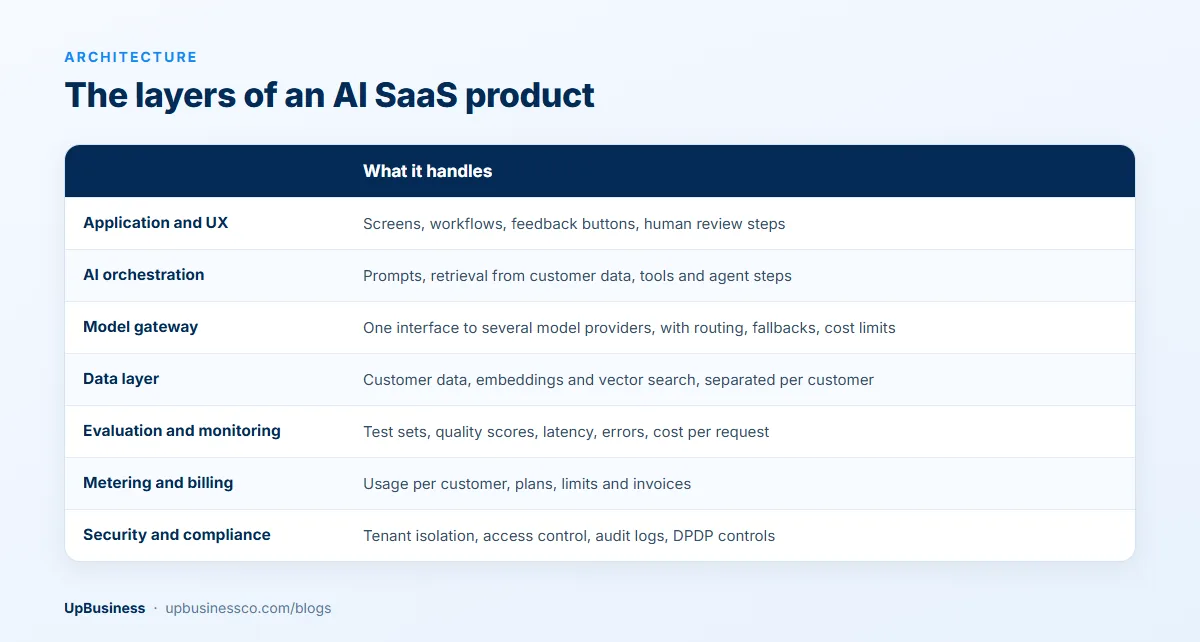
The model gateway is worth building in the first version. ICONIQ found that companies building AI products now use about 3.1 model providers on average, up from about 2.8 six months earlier[2]. Prices and quality change every few months, and a gateway lets you switch or mix models with a configuration change instead of rewriting every prompt call.
AI Cost per User: A Worked Example
Say an active user makes 300 AI requests a month, and each request sends about 2,000 tokens (the prompt plus retrieved context) and gets 400 back. That's 600,000 input tokens and 120,000 output tokens per user per month. Using published October 2026 list prices in US dollars:
| Model (example) | Price per million tokens, input / output | AI cost per active user per month |
|---|---|---|
| Claude Haiku 5.5[1] | $0.10 / $0.50 | $0.12 |
| Gemini 3.5 Flash-Lite[4] | $0.30 / $2.50 | $0.48 |
| Claude Sonnet 5.5 | $2 / $10 | $2.40 |
| Claude Opus 5.5 | $4 / $20 | $4.80 |
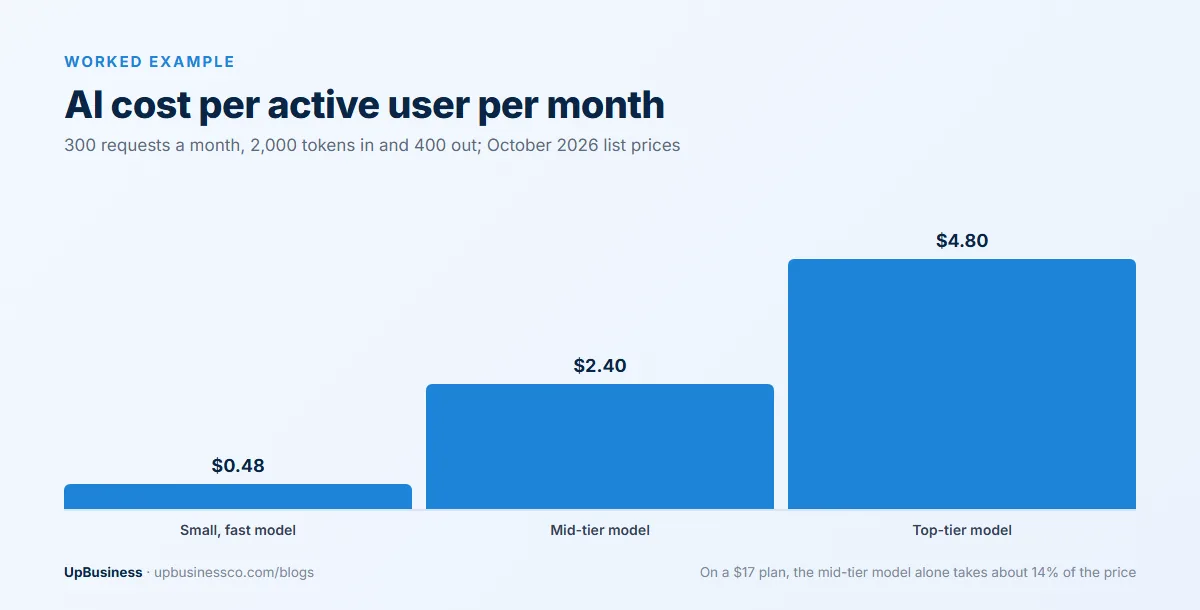
Now put that next to a price. If you charge $17 per user per month, the mid-tier model alone takes about 14% of it, before hosting, support and payment fees. Averages hide the real risk, though. A power user making 1,500 requests a month on the same model costs about $12. That's roughly 70% of the subscription. Usage limits or usage-based pricing need to be in place before that user signs up, not after the first bill arrives.
How to Protect AI SaaS Margins
Four techniques account for much of the saving, and each can be estimated from the same list prices.
| Technique | How it works | Effect on the $2.40 mid-tier example |
|---|---|---|
| Model routing | Send simple requests to a small model, hard ones to a larger model | 70% Haiku and 30% Sonnet: about $0.80 |
| Prompt caching | Reuse a fixed system prompt and context instead of paying full price each time | 1,500 of 2,000 input tokens read from cache at $0.10 per million: about $1.55[1] |
| Batch processing | Run non-urgent jobs, such as nightly summaries, through the batch API | Both providers list 50% off: $1.20[4] |
| Smaller context | Retrieve only the most relevant passages instead of whole documents | Halving input tokens: about $1.80 |
The caching figure leaves out the small charge for writing the cache and is a rough estimate. Routing usually saves the most, but only if the small model is good enough for the simple requests, which is something you prove with an evaluation set rather than assume.
On top of these, meter everything. Track cost per customer, per feature and per request, and set an alert when a tenant's daily spend jumps. ICONIQ's respondents expect average gross margins for AI products to reach about 52% in 2026[2], and the companies at the top of that range are usually the ones that know their cost per request.
AI SaaS Unit Economics: A Monthly Example
Scale the same numbers to a product with 1,000 paying users at $17 a month, or $17,000 in monthly revenue, billed by card on US rates. The payment line uses Stripe's published 2.9% plus 30 cents per charge and 0.7% for Stripe Billing, as worked through in our SaaS application architecture guide.
| Monthly line | Mid-tier model only | With 70/30 routing |
|---|---|---|
| Revenue | $17,000 | $17,000 |
| AI model usage | $2,400 (14%) | About $800 (5%) |
| Card and billing fees | About $910 (5%) | About $910 (5%) |
| Left for hosting, support and margin | About $13,690 | About $15,290 |
The table leaves out hosting, vector storage, monitoring and support time, which depend on your stack and team. Add your own figures before you fix a price. It also shows why routing is worth building early. On these assumptions it adds about $1,600 a month to gross profit at 1,000 users, and the gap grows with every new customer.
API, Fine-Tuning or Self-Hosting?
Start with a hosted model through an API. It's the fastest route to an MVP, and the price examples above show it can be cheap at the small-model end. Move along this table only when your evaluation set proves the next step beats what you have.
| Approach | When it makes sense | What it adds |
|---|---|---|
| Hosted model through an API | Almost every MVP and most products after launch | Prompts, retrieval and a model gateway |
| Fine-tuned hosted model | Thousands of good examples and a clear quality gap | Training data work and retesting with each base model update |
| Self-hosted open model | Strict data residency, very high volume or offline use | GPU hosting, scaling and model operations staff |
Self-hosting looks cheaper per token at high volume, but it moves the work of running GPUs, patching models and handling traffic spikes onto your team. For an early product, that's usually a poor trade against a small hosted model priced at a few cents per user.

Browse our curated list of Top AI Development Companies
AI SaaS Pricing Models
| Model | How it works | Best for |
|---|---|---|
| Seats with usage limits | Per-user price with a fair-use cap on AI requests | Productivity tools with steady use |
| Usage or credits | Customers buy credits, and AI actions draw them down | Spiky or very uneven usage |
| Per outcome | Charge per completed result, as Intercom does at $0.99 per outcome for its Fin AI agent[5] | Products where results are easy to count |
| Hybrid | Platform fee plus usage above an allowance | Many B2B AI products |
Per-outcome pricing ties price closely to value, but it needs a clear definition of an outcome that both sides accept. Intercom, for example, counts one when the customer confirms the issue is resolved, stops asking for help after the AI responds or a workflow completes. If you can't define the outcome that cleanly, a hybrid plan with a generous allowance is easier to sell and to forecast.
Whatever the model, show customers their usage inside the product. Surprise overage bills are a common reason AI tools get cancelled, and a usage meter on the account page costs very little to build.
How to Build an AI SaaS Product
- Validate the job to be done with 15 to 20 target customers, and collect real examples of their work, such as documents, emails or tickets.
- Build an evaluation set from those examples, with the answer you'd accept for each, before writing product code.
- Test two or three models against the evaluation set and record quality, speed and cost for each.
- Ship a narrow MVP that does one job well, with human review wherever mistakes are costly.
- Add metering, limits and billing before you open to paying customers.
- Prepare for business customers with single sign-on, audit logs, data isolation and a written data policy.
- Feed thumbs up or down, corrections and usage data back into the evaluation set for the next release.
Step 2 is easy to leave out of a proposal. Without it, nobody can say whether a prompt change or a new model made the product better or worse. Our guide on how to evaluate a RAG chatbot proposal lists the evaluation details to ask for.
Quality, Trust and Data
Ground answers in the customer's own data and show the sources where you can, because users trust an answer they can check. Keep each customer's documents, embeddings and logs separate, since one customer's data appearing in another's answer is one of the most damaging failures an AI SaaS product can have.
The OWASP Top 10 for LLM Applications lists prompt injection and sensitive information disclosure among the main risks[6]. In practical terms, the AI should only retrieve what the current user is allowed to see, should never hold admin credentials and should ask a person before taking actions such as sending emails or deleting records. Our SaaS security checklist covers the wider controls.
Two more checks belong in the contract. Get written confirmation from each model provider that customer data isn't used to train its models. And if you sell in the EU, plan for the AI Act's transparency rules, which from August 2026 require people to be told when they're interacting with an AI system and some AI-generated content to be marked as such[7].
Data quality is the other half of trust. Gartner predicts organisations will abandon 60% of AI projects unsupported by AI-ready data through 2026[8], so budget time for cleaning and structuring the data the product depends on.
What It Costs to Build an AI SaaS Product
The AI layer is rarely the biggest part of the build. Data handling, integrations and the core SaaS features usually take more effort than prompts and model calls. The table shows the main cost drivers.
| Cost driver | Lower cost | Higher cost |
|---|---|---|
| Scope | One core AI workflow | Several AI features and agents |
| Customer data | Files uploaded by users | Live integrations with customer systems |
| Customers | Small businesses, self-serve | Enterprises needing SSO, audit logs, custom contracts |
| Models | Existing models through an API | Fine-tuned or self-hosted models |
| Languages and channels | English text | Several languages, voice |
For budgets, see our MVP development cost guide, which includes what an AI MVP costs to run each month, and the custom SaaS development guide for full-platform costs and a five-year comparison.
Warning Signs in an AI SaaS Proposal
A few things in a proposal suggest the team hasn't built and run an AI product with paying customers before:
- A fixed monthly AI cost with no mention of requests per user, tokens per request or which model.
- No evaluation set, or quality described only as "high accuracy" with no way to measure it.
- The whole product tied to one model provider, with prompts called directly from feature code.
- Usage limits, metering and per-customer cost alerts missing from the MVP scope.
- Plans to fine-tune or self-host a model before there's any customer data to test against.
- No answer to whether the model provider can train on your customers' data.
None of these means the company can't do the work, but each one should get a clear written answer before you sign. A team that has run AI features in production will usually raise cost per user and evaluation on its own, often in the first call.
What UpBusiness Partner Data Shows
We reviewed the 15 partner companies on our AI development page in October 2026. The median average project size they report is $10,000, and 9 of the 15 report $10,000 or more. TrustScores range from 70.24 to 76.67.
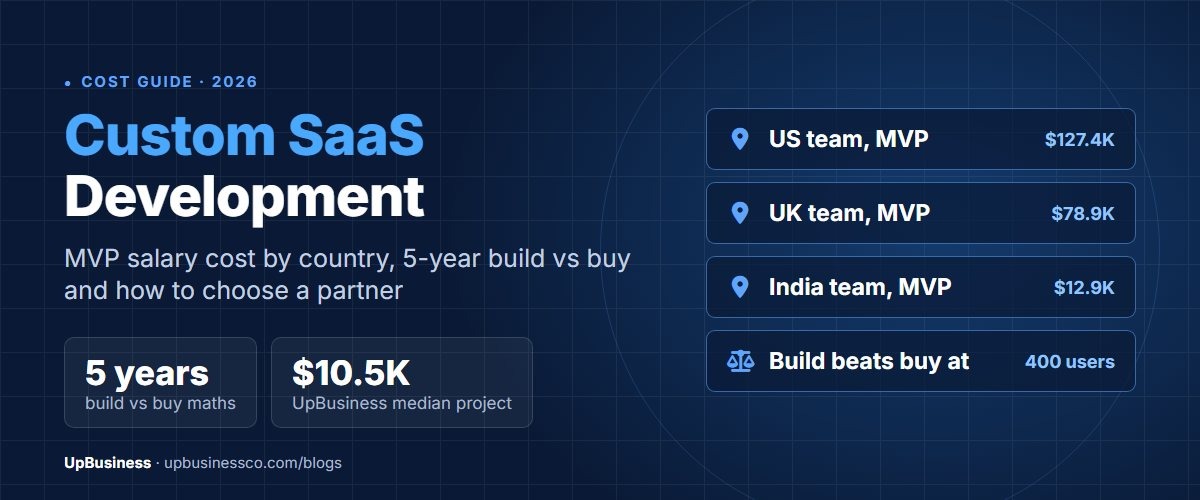
The skills split is the useful part. Thirteen of the 15 list an AI service, such as AI development, AI agents or voice AI, among their main specialisations. Only 2 list SaaS development. An AI SaaS product needs both, including multi-tenancy, metering and billing as well as prompts and models, so ask which part of the work each company has done before and whether it has shipped a multi-tenant product with paying customers. The SaaS development page lists companies from the other side of that skill set.
Choosing an AI SaaS Development Partner
- Ask for an AI product they built that has paying users, and for its usage, cost per request and quality numbers.
- Check how they meter AI usage and cap cost per customer.
- Ask to see an evaluation set from a past project and how they use it before each release.
- Ask how they stop one customer's data reaching another customer's answers.
- Confirm you'll own the code, prompts, evaluation sets and data pipelines.
- Agree who handles model upgrades and price changes after launch.
Our list of questions to ask an AI development company goes further on contracts and data rights.
The Bottom Line
AI SaaS can grow faster than classic SaaS, but only if the unit economics work. Work out the cost per user before you set prices, route simple requests to small models, build a model gateway and an evaluation set in the first version, and price in a way that covers your heaviest users.
When you're ready to build, compare verified AI development companies or post your project on UpBusiness to get matched with partner companies that fit your scope and budget.
Browse our curated list of Top AI Development Companies