

The AI development process is the path an AI system takes from idea to daily use in your business: discovery, data assessment, design, a proof of concept, the production build, and launch and improvement. This guide explains what each stage of AI development includes and the decision that should end it. It also covers how long each stage takes, who works on it, which engagement model fits each stage and what you should receive at every step. It's for buyers anywhere in the world who are about to hire a partner company for their first or second AI project.
Getting the project shape right matters more than it seems. Gartner's survey of organisations in the US, UK and Germany found only 48% of AI projects make it into production. Those that do take an average of 8 months to get from prototype to production[1].
Key takeaways
- An AI project has six stages, and each should end with a written go or no-go decision, not a slide deck.
- A typical first production release takes about 15 to 35 weeks, and data work is the stage most likely to overrun.
- Match the engagement model to the stage: fixed price for discovery and proof of concept, time and materials or a dedicated team for the build, and a retainer after launch.
- Agree handover and exit terms before signing. Gartner predicts 70% of enterprises will abandon agentic AI built by partner companies' embedded engineers by 2028[2].
What Does the AI Development Process Include?
A full AI development engagement usually covers six kinds of work: understanding the problem, preparing data, designing the solution, proving it works on a small scale, building the production version and running it after launch. Some partner companies do all six. Others focus on advice or on the build, so check which parts a proposal includes before comparing prices.
This guide is about how the project runs. If you still need to decide what kind of AI you need, start with our guide to the types of AI development services. If you're planning a custom build on your own data, our guide to custom AI development services covers data audits, build approaches, testing and model ownership in detail.
What Are the Stages of the AI Development Process?
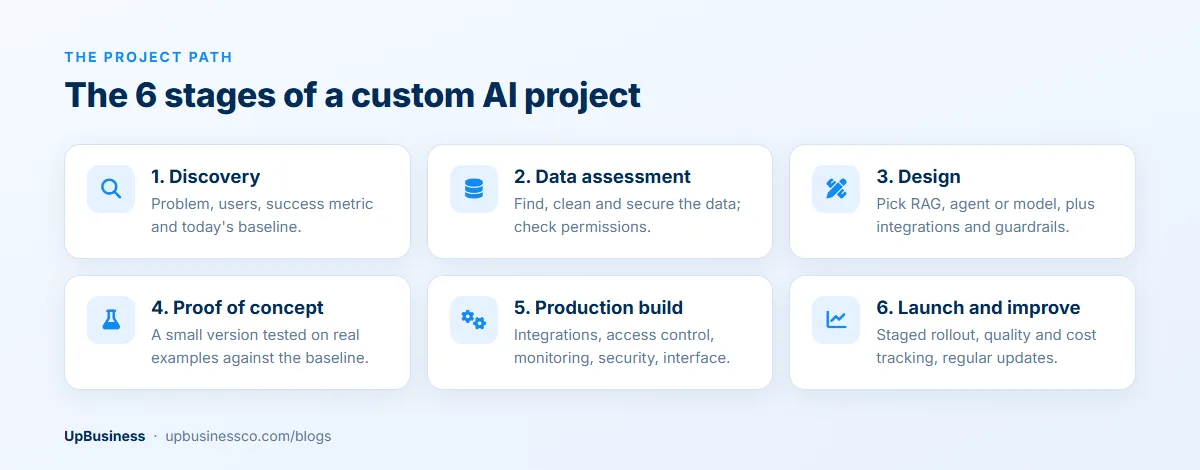
Every stage should produce something you can check and end with a decision. The table shows what happens, what you should receive and the question that decides whether to continue.
| Stage | What happens | What you receive | Go or no-go question |
|---|---|---|---|
| 1. Discovery | Workshops with the people who own the process, success measures agreed, risks listed | A one-page problem statement, baseline numbers and success measures | Is the problem worth solving, and can we measure the result? |
| 2. Data assessment | Data sources found, quality checked, access arranged, privacy reviewed | A written data report with gaps and the fixes needed | Is the data good enough, or what will it cost to fix? |
| 3. Design | Approach and model chosen, architecture drawn, integrations planned | An architecture document and a test plan | Does the design fit our systems, budget and rules? |
| 4. Proof of concept | A small working version tested on real data | A demo, test results against the agreed measures and a revised estimate | Did it pass the measures we set in discovery? |
| 5. Production build | Full build, integrations, security, user interface, monitoring | Working system, source code, documentation and test reports | Does it pass acceptance tests at production volume? |
| 6. Launch and improvement | Staged rollout, a support period after launch, monitoring, regular updates | Live system, monitoring dashboard, support reports | Is it delivering the result we measured at the start? |
The go or no-go gates are often missing from project plans. They let you stop after the proof of concept for a few thousand dollars instead of finding out at the end of a full build. Gartner predicted at least 30% of generative AI projects would be abandoned after proof of concept by the end of 2025, citing poor data quality, weak risk controls, rising costs and unclear business value[3]. A clear gate turns that outcome into a cheap, planned decision instead of a write-off.
How Long Does Each Stage of an AI Project Take?
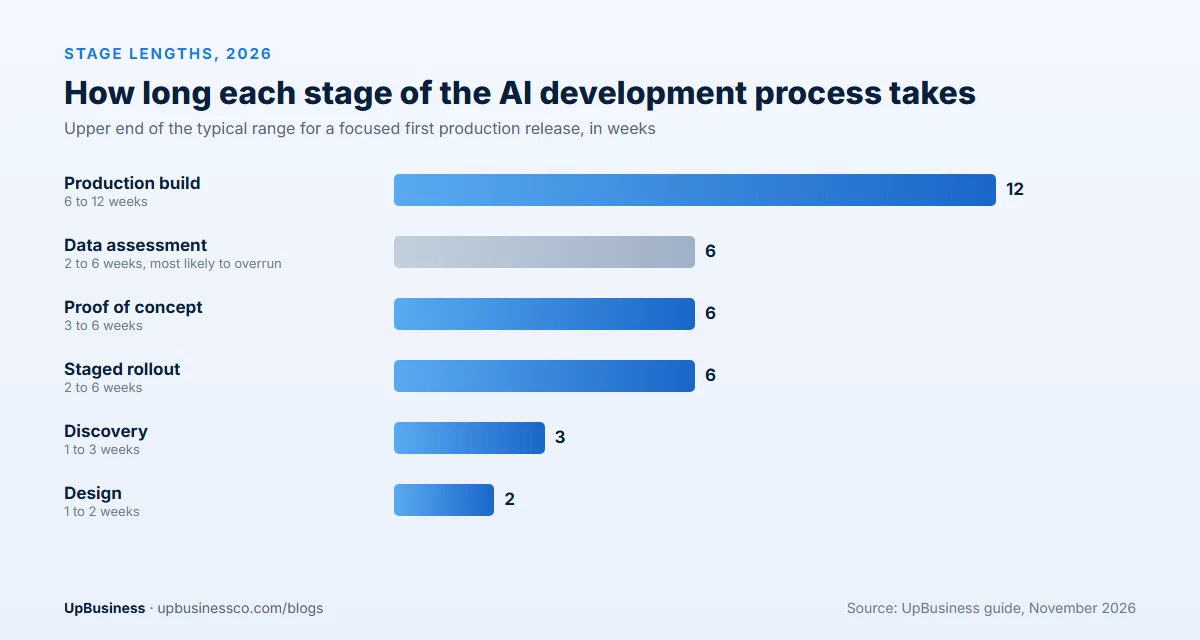
These ranges are for a first production release of a focused system, such as an assistant for one department or a forecasting model for one product line. They add up to the total in the last row.
| Stage | Typical duration | What makes it longer |
|---|---|---|
| Discovery | 1 to 3 weeks | Many departments involved, no agreed success measure |
| Data assessment | 2 to 6 weeks | Data spread across old systems, personal data reviews, missing history |
| Design | 1 to 2 weeks | Many integrations, strict security review |
| Proof of concept | 3 to 6 weeks | Several approaches to compare, slow feedback from users |
| Production build | 6 to 12 weeks | Complex permissions, several languages or channels, compliance testing |
| Staged rollout | 2 to 6 weeks | Large user groups, training, process changes |
| Total to first production release | 15 to 35 weeks | Regulated sectors usually add several weeks of documentation and testing |
Data assessment is the stage most likely to overrun. Gartner predicts organisations will abandon 60% of AI projects unsupported by AI-ready data through 2026, and 63% of organisations either lack or aren't sure they have the right data practices for AI[4]. If a partner company quotes a fixed timeline before seeing your data, treat the data stage as an estimate, not a promise.
Smaller jobs move faster. Connecting a ready-made AI tool to one system can take two to four weeks, while an AI agent that works across several systems often needs more time in design and testing than the table suggests. Our guide to AI agent development covers those projects.
AI Project Timeline Template: A Week-by-Week Example
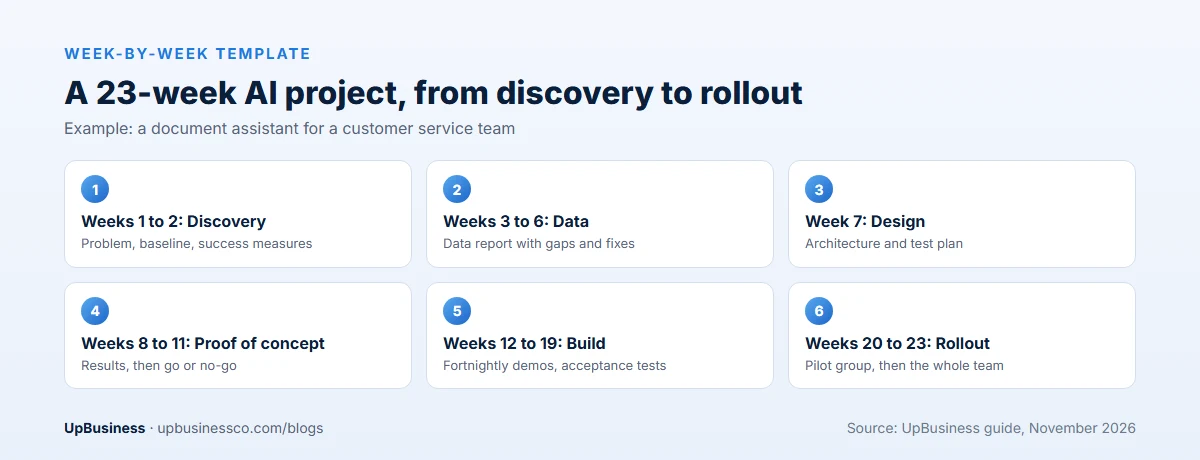
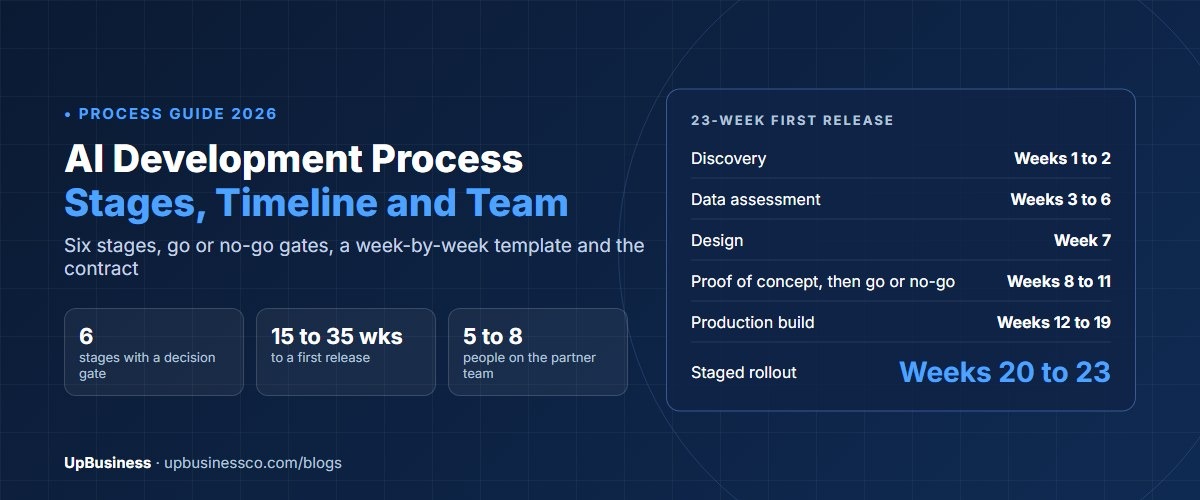
Here's how the stages fit together for a 23-week project, such as a document assistant for a customer service team. Use it as a template when you compare proposals: if a partner company's plan has no data stage or no gate after the proof of concept, ask why.
| Weeks | Stage | Milestone | What you do |
|---|---|---|---|
| 1 to 2 | Discovery | Problem statement and success measures signed off | Name the product owner, share baseline numbers |
| 3 to 6 | Data assessment | Data report with gaps and fixes | Approve data access, answer privacy questions |
| 7 | Design | Architecture and test plan agreed | Security review, confirm integrations |
| 8 to 11 | Proof of concept | Results against success measures; go or no-go | Staff write test cases and review answers |
| 12 to 19 | Production build | Fortnightly demos; acceptance tests passed | Review each demo, report issues within days |
| 20 to 23 | Staged rollout | Pilot group live, then the whole team | Train users, collect feedback |
| 24 onwards | Support and improvement | Monthly quality and cost reports | Monthly review against the baseline |
Treat the week numbers as a guide. The data assessment and proof of concept can each move by several weeks depending on what they find. That's the point of having them, because it's far cheaper to change the plan in week 6 or week 11 than in week 19.
Who Is on an AI Development Team, and What Does Each Role Do?
A focused AI project usually needs five to eight people from the partner company, though one person may cover two roles on a small team. You also need people of your own, and buyers often forget to plan for them.
| Role | Side | What they do |
|---|---|---|
| Project or delivery manager | Partner company | Plans the stages, reports progress and manages scope changes |
| Solution architect | Partner company | Chooses the approach, designs how the system connects to yours |
| AI or Machine Learning engineers | Partner company | Build prompts, retrieval, models and evaluation |
| Data engineer | Partner company | Moves, cleans and prepares data, builds data pipelines |
| Software engineers | Partner company | Build the user interface, APIs and integrations |
| QA and DevOps | Partner company | Test the system, set up hosting, monitoring and releases |
| Product owner | You | Makes decisions, signs off each gate, owns the success measures |
| Subject matter experts | You | Explain the process, write test cases and review results |
| IT and security contact | You | Grants access, reviews security and approves integrations |
Plan for your own subject matter experts to spend a few hours a week throughout the project, more during discovery and testing. When those hours aren't available, the project slows down regardless of how good the partner company is.
Which Engagement Model Fits Your AI Project?
An engagement model is how the work is contracted and paid for. Each one suits a different stage, and many successful projects use more than one.

Browse our curated list of Top AI Development Companies
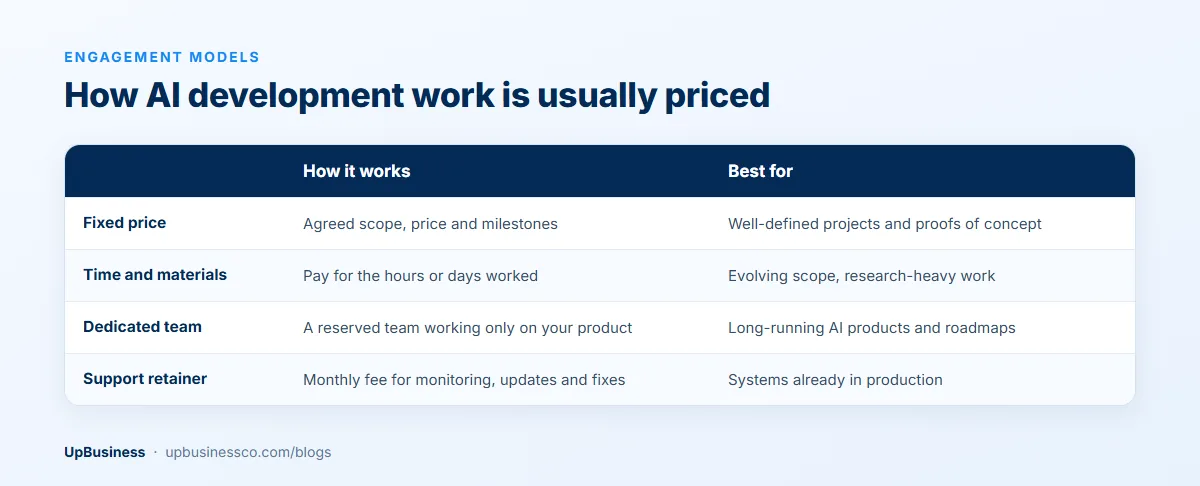
| Model | How it works | Best stage | Protect yourself with |
|---|---|---|---|
| Fixed price | An agreed fee for a defined scope | Discovery and proof of concept | A written list of deliverables and pass measures |
| Time and materials | Paid for hours or days worked | Production build, when scope will change | A monthly cap, weekly hours reports and sprint reviews |
| Dedicated team | A set team works on your project full time | Long builds and several projects in a row | Named people, a notice period and a handover plan |
| Support retainer | A monthly fee for monitoring, fixes and updates | After launch | Response times, included hours and what counts as extra |
A common pattern is to pay a fixed price for discovery and the proof of concept, then switch to time and materials with a monthly cap for the build, and finish with a retainer. That way you only commit to the expensive stage once the proof of concept has passed. Partner companies are usually open to this split when it's raised at the start. For hourly rates behind these models, see our AI developer rates guide, and for project budgets see our Machine Learning development cost guide.
What Do You Need to Provide as the Buyer?
Many delays in AI projects start on the buyer's side, not the partner company's. Have these ready before discovery begins:
- A named product owner who can make decisions within a day or two
- Access to the data, or a clear route to it, including who must approve that access
- Baseline numbers for the process today, such as volumes, handling time and error rates
- Time from the people who do the work today, to explain it and test the results
- Your security and privacy requirements in writing, including where data may be stored
- A budget range, so the partner company can propose a realistic scope
What Should an AI Development Contract Cover?
Standard software contracts miss several points that matter for AI. Before signing, check that the contract covers:
- Acceptance criteria: pass measures based on a test set, not "works as described".
- Ownership: code, prompts, data pipelines, test sets and any trained or fine-tuned models, listed one by one.
- Handover: source code in your repository, deployment scripts, documentation and a walk-through for your team.
- Support after launch: a defined period of fixes at no extra cost, then retainer terms.
- Running costs: an estimate of monthly model and hosting costs at your expected volume.
- Exit: what the partner company must hand over, and how fast, if either side ends the contract.
Our guide to custom AI development services explains how to write acceptance tests and how ownership splits between you, the partner company and the model provider. Gartner's 2026 warning about partner-built agentic AI comes with the same advice: set governance, IP ownership, knowledge transfer and an exit plan from the first day[2].
Why Do AI Projects Stall Between Pilot and Production?
The research points to a handful of causes, and each one maps to a stage that should catch it.
| Cause | Evidence | The stage that prevents it |
|---|---|---|
| Unclear purpose | RAND's interviews with 65 data scientists and engineers found misunderstanding the problem to be solved was the most common root cause of failure[5] | Discovery, with written success measures |
| Data not ready | Gartner: 60% of AI projects without AI-ready data will be abandoned through 2026[4] | Data assessment, before the build is quoted |
| No proof of value | BCG found 74% of companies had yet to show tangible value from AI, and only 26% had the capabilities to move beyond proofs of concept[6] | Proof of concept with pass measures |
| Pilot never scaled | McKinsey found only about a third of organisations have begun to scale AI across the business[7] | Production build planned from the start |
| Abandoned after launch | Gartner found 45% of high-maturity organisations keep AI projects running for three years or more, against 20% of low-maturity ones[8] | Launch and improvement, with a retainer and owner |
RAND also cites estimates that more than 80% of AI projects fail, about twice the rate of other IT projects[5]. Figures like that vary with how failure is defined, but the pattern is consistent: projects fail on purpose, data and ownership far more often than on the model.
What Happens After Launch?
Launch is the start of the most important stage, not the end of the project. Plan for three phases:
- Support period (first 4 to 8 weeks): the build team watches the system closely, fixes problems quickly and tunes it on real use.
- Handover: your team or a support retainer takes over, with documentation, monitoring access and a named contact.
- Ongoing improvement: monthly reviews of quality, cost and usage against the baseline from discovery, plus updates when the model provider changes or retires a model.
If you operate in the EU, also check when the AI Act's rules apply to your use case. Transparency duties have applied since 2 August 2026, and the rules for high-risk systems start on 2 December 2027, or 2 August 2028 for AI built into regulated products such as medical devices[9], and both affect testing and documentation work.
What UpBusiness Partner Data Shows
We looked at the 16 partner companies on our AI development page that list AI development among their own services, in November 2026. 15 of them are based in India, with TrustScores from 70 to 76 and a median of 72. 9 have 11 to 50 staff, 5 have 51 to 200 staff and 2 have 10 or fewer staff.
That team size matters for the roles above. A company of 11 to 50 people can staff a five to eight person project team, but it may be running several projects at once. Ask for the named people and how much of their time you'll get. Ask each company for its typical project size and for two projects at the stage you're buying. Some mostly deliver small proofs of concept and others mostly run full builds. The staged approach in this guide works best with a team that has done both.
How to Choose an AI Development Company
- Ask for two projects of your type that are running in production, and speak to those clients.
- Ask them to walk you through their stage plan for your project, with the gates and what each stage delivers.
- Check who will actually work on your project, and how much of their time you'll get.
- Ask what data they need to see before they can give a firm estimate.
- Compare how each proposal handles acceptance testing, ownership, handover and exit.
- Start with a fixed-price discovery or proof of concept before committing to the full build.
Our list of questions to ask an AI development company goes further. If you're weighing an outside partner against hiring, see agency vs freelancer vs in-house. If you need advice before a build, see our AI consulting services guide, and for programmes across several departments, our enterprise AI development guide.
The Bottom Line
A good AI development process looks less like a single big build and more like a series of small, checked steps. Agree success measures in discovery, check the data before the quote, pay a fixed price for the proof of concept, and only fund the full build once it passes. Put acceptance tests, ownership, handover and exit in the contract, and plan who will own the system after launch.
When you're ready, compare verified AI development companies, browse all artificial intelligence partner companies or post your project on UpBusiness to get matched.
Browse our curated list of Top AI Development Companies