


Browse our curated list of Software Development Companies
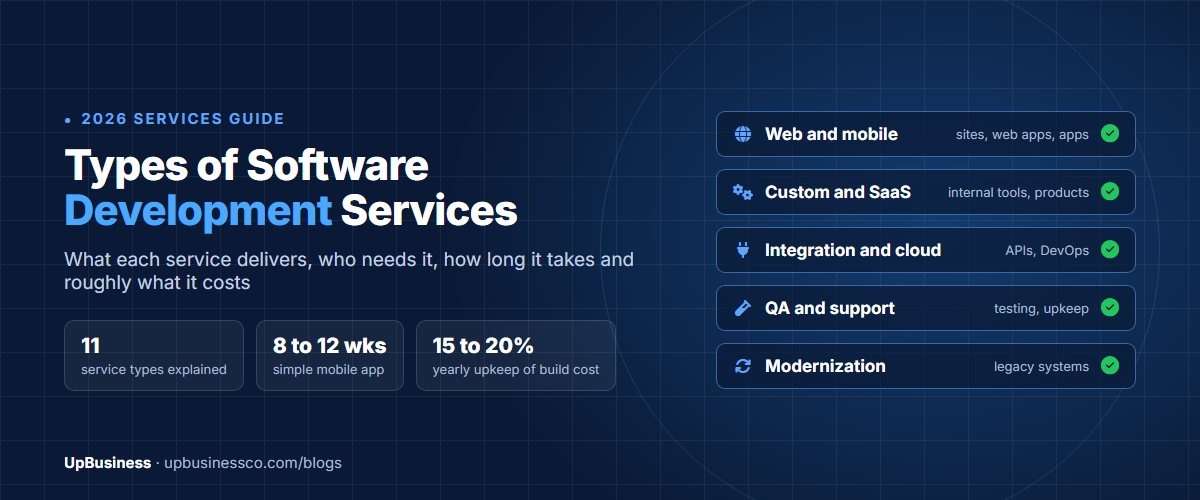
You know what's slowing your business down, but not which kind of software help fixes it. This guide explains the main types of software development services one by one. They cover far more than writing code. A software company can design a website, build a mobile app, link your CRM to your accounting tool, test a release or keep an old system running. For each, you'll see what it delivers, who needs it, how long a first version takes and roughly what it costs. It's for the founder, operations lead or IT manager who knows the problem but not the service, or the kind of partner company, it calls for.
Key takeaways
- There are 11 common types of software development services. A typical project buys several at once, such as design, build and testing.
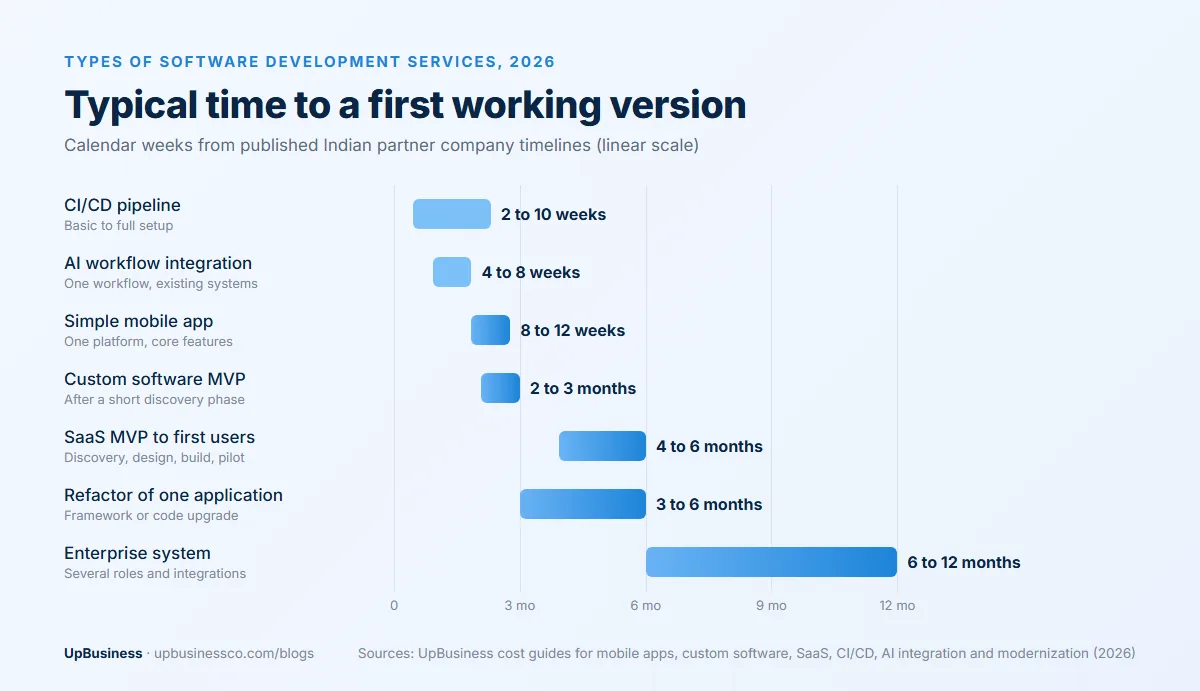
- First versions take from 2 to 10 weeks for a CI/CD pipeline to 6 to 12 months for an enterprise system. These timelines come from Indian partner companies.
- Upkeep is a service in its own right. Plan on 15 to 20% of the build cost every year for maintenance and support.
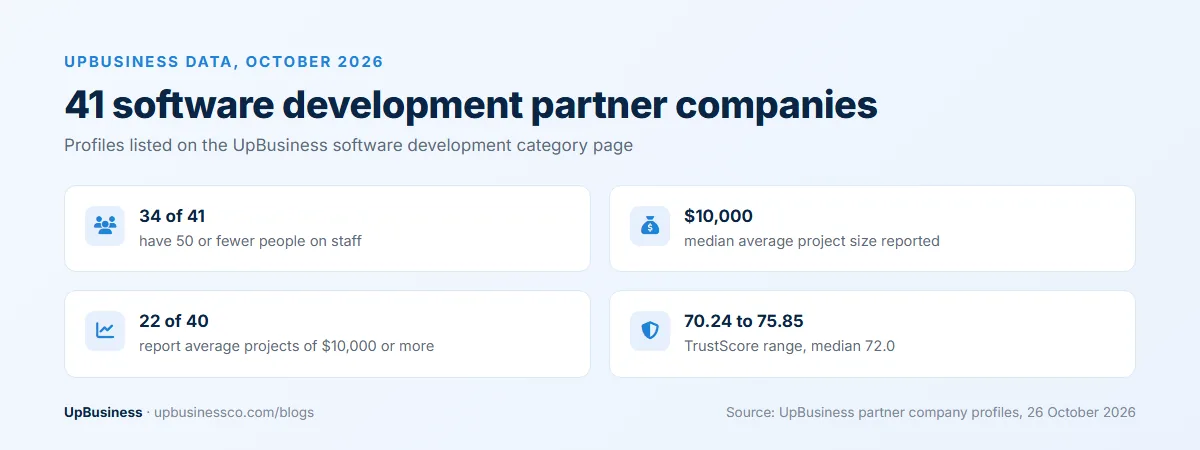
- Across the 41 software development partner companies on UpBusiness, the median average project is $10,000. And 34 of the 41 have 50 or fewer people.
What Are Software Development Services?
Software development services are paid work by an outside team to plan, design, build, test, launch and look after software for a business. The work can be a whole product, such as a mobile app, or one slice of it, such as testing or cloud setup. Depending on the contract, you pay for results, for time, or both.
Demand for this work is large and steady. The US Bureau of Labor Statistics puts the median pay of a software developer at $135,980 a year. It expects jobs for developers, testers and quality assurance analysts to grow 10% between 2025 and 2035[1]. Hiring that skill in-house for every need is costly. For a short project, buying part of the work from a partner company is often cheaper than a full-time hire. Mistakes are costly too. The Consortium for Information and Software Quality put the cost of poor software quality to the US economy at $2.41 trillion or more in 2022[2].
The Main Types of Software Development Services at a Glance
The table below lists the 11 types this guide covers. The timeline column shows a typical first working version, not a finished long-term product. For detailed prices, follow the cost guide linked in each section.
| Type of service | What you get | Typical first version |
|---|---|---|
| Web development | Websites, web apps, portals and online stores | 2 to 14 person-weeks |
| Mobile app development | iOS and Android apps | 8 to 12 weeks for a simple app |
| Custom and enterprise software | Internal tools, ERP, CRM and workflow systems | 2 to 3 months for an MVP |
| SaaS product development | Subscription software sold to many customers | 4 to 6 months to first users |
| API and system integration | Connections between the tools you already use | 4 to 8 weeks per workflow |
| Cloud and DevOps services | Hosting, deployment pipelines and monitoring | 2 to 10 weeks for a pipeline |
| UI/UX design | Research, wireframes, prototypes and design systems | 3 to 6 weeks of design |
| QA and software testing | Test plans, manual and automated testing | From a two-week test cycle |
| Maintenance and support | Fixes, updates, security patches and monitoring | Ongoing, monthly |
| Application modernization | Upgrading or replacing legacy systems | 3 to 6 months for one refactor |
| Data and AI development | Dashboards, data pipelines and AI features | 4 to 8 weeks for one AI workflow |
Types of Software Development Services Explained
Each section covers what the service delivers, who usually buys it, how long it takes and where the money goes. Read the ones that match your problem, and skip the rest.
1. Web development
Web development makes anything that runs in a browser: a marketing site, a customer portal, a booking system, a dashboard or an online store. A front-end developer builds what people see. A back-end developer builds the database, logins and business rules behind it.
Almost every business needs this at some point. A simple site of five to ten pages takes about 2 person-weeks of work. A custom site with logins or links to other tools takes around 14 person-weeks. In Indian developer salary terms, that's about $540 to $3,760. Quotes run higher, because a partner company adds design, project management and profit on top. Our website development cost guide breaks this down by country. The B2B ecommerce guide covers online stores linked to an ERP.
Ongoing care matters here too. Patchstack counted 11,334 new WordPress security flaws in 2025, 42% more than in 2024. Plugins caused 91% of them[3]. A website is a living system, not a one-off purchase.
2. Mobile app development
Mobile app development makes apps for iPhone and Android phones and tablets. Teams build either two native apps, or one app for both platforms using a tool such as Flutter or React Native. Building for both platforms at once usually cuts the first build by 25 to 40%.
The usual buyers are consumer brands, marketplaces, field-service companies and any business whose customers do things on the move. A simple app takes about 8 to 12 weeks. A fairly complex app for both stores takes 4 to 6 months, and an enterprise platform 7 to 12 months or longer. Fixed platform costs are small. Apple's developer program costs $99 a year[4], and a Google Play developer account a one-time $25[5]. Build budgets and hiring advice are in our mobile app development cost guide. The Flutter cost guide covers builds for both platforms.
3. Custom and enterprise software
Custom software is built for one organisation's way of working. Enterprise software is the larger version, used across teams, with more users, roles, approvals, reports and links to other systems. Typical examples are an order tool, a stock system, a field-staff app with a back office, or a custom ERP or CRM module.
The buyer is usually a business whose process doesn't fit a ready-made product without heavy workarounds. A basic MVP takes 2 to 3 months. A product with links to other tools and payments takes 4 to 6 months, and an enterprise system 6 to 12 months. Budgets in India start around $4,200 for a basic MVP and pass $78,900 for enterprise systems. Our custom software development cost guide has the full ranges. The ERP guide covers when a ready-made ERP is the better answer.
4. SaaS product development
SaaS product development builds software that you sell to many customers on a subscription. Compared with an internal tool, it needs more. It must serve many customer accounts safely from one system (multi-tenancy). It also needs billing, user management, onboarding, and usually single sign-on for larger clients.
The main buyers are founders, and established companies turning an internal tool into a product. A focused SaaS MVP usually reaches its first users in four to six months. A typical plan runs 2 to 4 weeks of discovery, 3 to 6 weeks of design and 10 to 16 weeks of build before a pilot. Our custom SaaS development guide covers build vs buy and cost. The MVP cost guide compares India and US budgets.
5. API and system integration
Integration services connect the systems you already pay for, so data moves between them without copy and paste. Common jobs are linking a website to a CRM, syncing orders with accounting software, connecting an ERP to an online store, or building an API so partners can order directly.
This is often the cheapest way to fix a slow process, because staff don't have to learn anything new. A single-workflow link usually takes four to eight weeks. The main risks are poor notes on the older system, and access requests that take weeks in larger companies. Our AI integration services guide covers links that add AI to existing tools.
6. Cloud and DevOps services
Cloud and DevOps services set up where your software runs and how changes reach users safely. That covers hosting on AWS, Azure or Google Cloud. It also covers CI/CD pipelines that test and release code automatically, monitoring, backups and cost control.
Any company that releases software more than a few times a year gains from this. A basic CI/CD pipeline takes two to four weeks. A full setup with automatic tests and security scans takes about six to ten weeks. Cloud bills need watching as well. Flexera's 2026 State of the Cloud report estimates that 29% of cloud spend is wasted[6]. Read our CI/CD implementation guide, DevOps consulting guide and cloud migration guide for scope and prices.
7. UI/UX design
UI/UX design decides how software looks and how easy it is to use. The work covers user research, user flows, wireframes, clickable prototypes and a design system that developers build from. Good design also covers accessibility, checked against WCAG 2.2, the W3C standard for accessible web content[7].
New products and redesigns need it. So does any app where people start a task and give up. A design phase for a new product usually runs three to six weeks before the main build, based on the timelines in our SaaS guide. Partner companies often price design inside the build. Ask to see it as its own line in the quote, so you know what you're paying for.
8. QA and software testing
Quality assurance and testing check that software does what it should, and keeps doing it after each change. The service includes test plans, manual testing, automatic repeat tests, speed and load testing, and security testing.
Testing is worth buying on its own when releases are frequent, when the product handles payments or personal data, or when bugs have reached customers. The US median pay for a quality assurance analyst or tester is $104,300 a year[1]. For a company with a few releases a year, a full-time hire is hard to justify. A common start is a two-week test scope with one manual test round. A set of automatic repeat tests takes about 8 person-weeks. It usually pays for itself within six to seven months if you release every two weeks. Our software testing cost guide has the full breakdown.
9. Maintenance and support
Maintenance and support keep live software working. The service covers bug fixes, system and framework updates, security fixes, monitoring, small changes and help when something breaks. It usually runs on a monthly fee or a block of hours.
Every live system needs it, even if nobody plans for it. Budget 15 to 20% of the original build cost every year. So a $30,000 app needs about $4,500 to $6,000 a year. Agree on the monthly price and response times before you sign the build contract. It's harder to agree on afterwards. Our website maintenance cost guide lists typical monthly fees.
10. Application modernization
Modernization upgrades or replaces older software that has become slow, risky or costly to change. The options are cleaning up the code, changing its structure, rebuilding it, or switching to a ready-made product. A good partner company picks based on the state of the code, not the age of the system.
Old systems quietly eat budgets. US federal agencies have often reported spending about 80% of their IT budgets on running and maintaining existing systems[8]. Cleaning up one app usually takes 3 to 6 months. A full enterprise rebuild can take 2 to 3 years. Our application modernization guide compares the four paths.
11. Data and AI development
Data services turn scattered business data into dashboards, reports and reliable data flows. AI development adds features on top of that data, such as chatbots, document processing or predictions. A first dashboard project is often around 200 hours of work. Our data analytics consulting guide covers rates and scope. For the different kinds of AI work, see our separate guide to the types of AI development services.
Specialised Software Development Services
A few services sit outside the main 11 but come up often in buyer briefs:
- Ecommerce development. Online stores, B2B ordering portals and marketplace builds, often on Shopify, WooCommerce or Adobe Commerce.
- Embedded and IoT software. Code that runs on devices, sensors and machines, usually with a companion app or dashboard.
- Game development. Mobile, web and console games, usually built on Unity or Unreal Engine.
- Blockchain development. Smart contracts, wallets and tokenised products. Check the business case carefully before funding one.
- Security engineering. Secure coding, code review and penetration testing. NIST's Secure Software Development Framework (SP 800-218) lists practices any development team can add to its process[9], and our cybersecurity consulting guide covers outside help.
Which Type of Software Development Service Do You Need?
Start from the business problem, not the technology. The table matches common problems with the service that usually solves them, and a sensible first step.
| Your problem | Service that usually fits | Sensible first step |
|---|---|---|
| Customers can't find or buy from you online | Web development | A scoped website or store with clear goals |
| Customers want to use your service on their phones | Mobile app development | A clickable prototype tested with real users |
| Staff run the business on spreadsheets and email | Custom software or integration | Map the process, then check ready-made tools first |
| You have a product idea to sell to many companies | SaaS product development | A paid discovery phase and a narrow MVP |
| Data is typed twice into different systems | API and system integration | Automate the workflow typed most often |
| Releases are slow, risky or done by hand | Cloud and DevOps services | One automated CI/CD pipeline |
| People sign up but don't finish tasks | UI/UX design | A usability review of the main user flows |
| Bugs keep reaching customers | QA and software testing | A test plan and automated regression tests |
| An old system is fragile and costly to change | Application modernization | A paid code and architecture assessment |
| Managers lack reliable numbers | Data and AI development | One dashboard on clean, agreed data |
Many projects need more than one service. A startup MVP usually combines design, web or mobile development, cloud setup and testing. An enterprise upgrade may combine modernization, links between systems and support. Buying them all from one partner company keeps responsibility in one place. Splitting them can save money, but you need a strong product owner on your side.
How Software Development Services Fit the Project Lifecycle
Whatever the type, a project moves through six stages. You can buy each stage on its own.
- Discovery. The team gathers needs, talks to users, fixes the scope and gives a first estimate. A paid discovery of a few weeks is the cheapest way to avoid building the wrong thing.
- Design. Architecture, user flows and prototypes are agreed before coding starts.
- Build. Development runs in short sprints, with a working demo every one or two weeks.
- Testing. Each release gets functional, performance and security checks.
- Launch. The team deploys, submits to app stores, migrates data and trains your staff.
- Support. Monitoring, fixes, updates and small improvements continue after go-live.
Many partner companies run the build in short rounds (Agile), reviewing priorities each round. Fixed-price contracts suit small, clear scopes. Paying for time suits products whose scope will change. Our custom software cost guide explains both pricing models. The software project brief template helps you describe the work before discovery starts.
Custom Software or Off-the-Shelf: Which Service Should You Buy?
Off-the-shelf software is a ready-made product, usually rented per user per month. Custom software is built for you and owned by you, if the contract says so. Buy ready-made when your process is standard, such as accounting, payroll or email marketing. Build when the process is what sets your business apart, when licence costs grow with headcount, or when no product fits without heavy workarounds.
A middle route is common. Keep the ready-made products, and pay for links and small custom add-ons around them. That's usually faster and cheaper than a full custom build. It also leaves upgrades to the product's maker rather than you.
Before You Ask for Quotes: A Buyer's Checklist
Once you know which type of service you need, a little preparation makes quotes easy to compare:
- Write a one-page brief. Describe the problem, the users, must-have features, deadlines and budget range. Our brief template gives you the structure.
- Decide who does the work. Pick a company, a freelancer or your own hires. Our agency vs freelancer vs in-house comparison works through the total cost of each.
- Compare like with like. Two quotes for the "same" project often cover different scopes. Use our guide to comparing software development proposals.
- Check the company. Confirm its registration, its people and its past work. Our verification guide and due diligence checklist cover the checks.
- Read the contract. Look at code ownership, payment milestones and exit terms. See our software development contract checklist.
For rates by country and full price benchmarks, use our software development cost benchmark rather than a single quote.
What Our Data Shows About Software Development Companies
We looked at the 41 software development partner companies listed on UpBusiness in October 2026. Most are small and mid-sized teams. 34 of the 41 have 50 or fewer people, and six have between 51 and 200. Of the 40 that report an average project size, the median is $10,000. 22 report $10,000 or more, with a range from $100 to $50,000. TrustScores run from 70.24 to 75.85, with a median of 72.0. Mobile apps, web development and custom software are the services they list most often.
You can compare their profiles, team sizes, project sizes and TrustScores side by side on our software development companies page, or browse the software company listings. If you'd rather have partner companies come to you, post your project with the service you need and your budget. We'll match you with suitable software development companies.