

Browse our curated list of Software Outsourcing Companies
Three software development proposals arrive in the same week. One says $6,800, one $8,400 and one $11,600. The temptation is to read the last page of each and pick the middle one. That’s usually a mistake, because the three numbers rarely describe the same project.
One quote may leave out testing, another may assume two rounds of changes instead of unlimited ones, and the cheapest may be priced for a junior team that you only discover after the contract is signed. This guide shows how to compare software development proposals line by line: what to line up first, how to score them fairly, and which red flags should end the conversation.
If you only have a minute
- Send every company the same written brief first. Proposals written against different briefs can’t be compared.
- Before looking at price, put scope, team, testing, change requests, support and code ownership side by side for each quote.
- Agree fixed weights before you open the proposals, then score each one against them. Otherwise price tends to decide everything.
- Check the total cost, not just the build: maintenance is commonly 15–20% of the build cost a year, and first-year budgets often run 25–30% above the quote[1].
Why Software Quotes Are So Hard to Compare
A software proposal is a guess about work that hasn’t been fully defined yet, so each company fills the gaps with its own assumptions. One prices a login screen as email and password, another includes OTP login and Google sign-in. One budgets two weeks of testing, another none. Neither is lying; they’re quoting different projects.
Hourly rates make this worse. Indian development teams typically bill around $15–35 an hour[1], but a quote at the bottom of that range often means a junior team or fewer hours, not a better deal. The only way to compare fairly is to rebuild each proposal into the same shape.
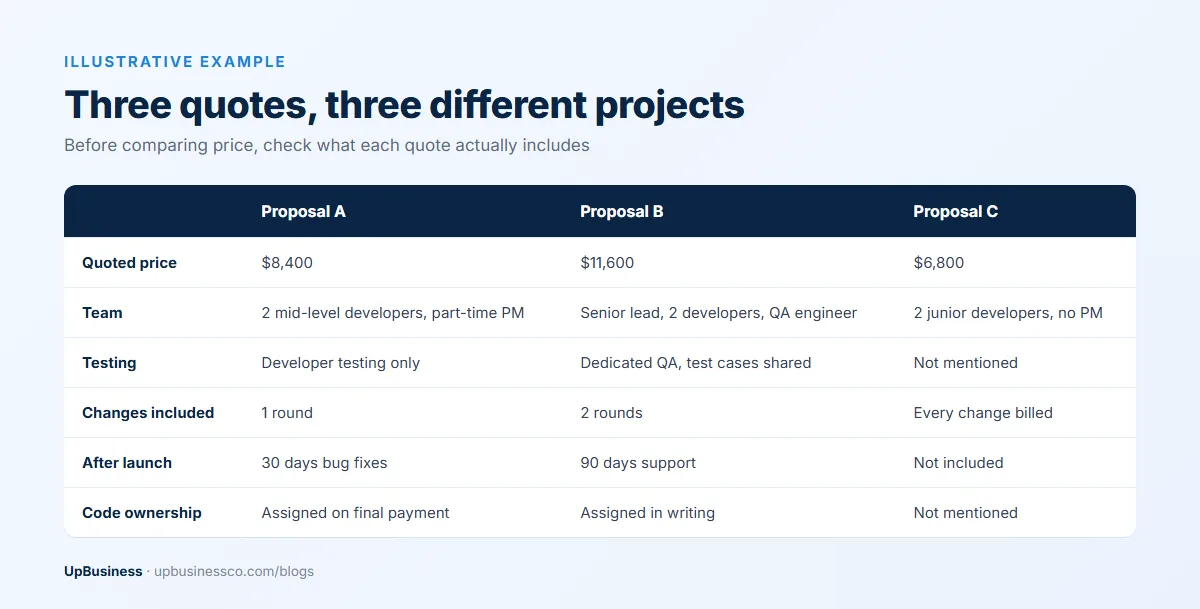
In the example above, Proposal C looks cheapest until you notice it includes no testing, no support after launch, charges for every change and says nothing about who owns the code. Add those back in and it may end up the most expensive of the three.
Step 1: Send the Same Brief to Everyone
Most comparison problems start before the proposals arrive. If you describe the project differently on three calls, you get three different scopes back. Write one brief and send it to every company, with:
- What the software should do, listed as user roles and the main screens or features each one needs.
- What has to work at launch and what can wait for a later phase.
- Systems it must connect to, such as payment gateways, your CRM, Tally or WhatsApp.
- Your rough budget range and target launch date.
- The questions you want answered in every proposal, in the same order.
If you’d rather not start from a blank page, our software project brief template has all 14 sections laid out, with an example for each and a pricing table that every company fills in the same way.
If you’re hiring a team in another city or country, this matters even more. Our guide to software development outsourcing to India covers how a clear brief cuts most of the back-and-forth.
Step 2: Line Up the Proposals Side by Side
Copy each proposal into one sheet with a column per company and a row for each of the items below. Where a proposal is silent, write “not mentioned” rather than assuming it’s included.
| Line to compare | What to look for | Ask if it’s missing |
|---|---|---|
| Scope | Features and screens listed one by one, matching your brief | Which features from our brief are not included? |
| Team | Names or profiles, roles and years of experience | Who will actually write the code, and are they full-time on our project? |
| Hours or effort | Estimated hours or person-weeks per phase | How did you arrive at this estimate? |
| Testing | Who tests, what kind of testing and how many hours | Is there a dedicated QA engineer, and will we see the test cases? |
| Project management | Included or billed separately, and how you get updates | How often will we see working software? |
| Change requests | How many rounds of changes are included and the rate after that | What counts as a change, and what does it cost? |
| Support after launch | Bug-fix period and the cost of ongoing maintenance | What happens if a critical bug appears in month two? |
| Ownership and exit | Written assignment of the code, handover if you end early | Will the code, servers and accounts be in our name? |
Ownership deserves special care with Indian partners. Under India’s Copyright Act, the author of a work is its first owner, and a transfer of copyright is valid only if it’s in writing and signed[2]. A proposal that says nothing about ownership isn’t neutral; by default the code stays with the company that wrote it.
Step 3: Score Them With Fixed Weights
Decide the weights before you open the proposals, otherwise the cheapest or the slickest one tends to win by default. For most business software, a split like this works well:
| Criterion | Weight | Proposal A | Proposal B | Proposal C |
|---|---|---|---|---|
| Scope fit (does it cover the brief?) | 30 | 22 | 26 | 16 |
| Team experience and seniority | 20 | 13 | 16 | 9 |
| Delivery plan and milestones | 15 | 10 | 12 | 8 |
| Testing and quality | 15 | 8 | 14 | 4 |
| Support and maintenance | 10 | 7 | 8 | 2 |
| Price (cheapest gets most) | 10 | 8 | 5 | 10 |
| Total | 100 | 68 | 81 | 49 |
This is an illustrative example, not real quotes. The point is the shape: price still counts, but it can’t outweigh a proposal that skips testing or support.
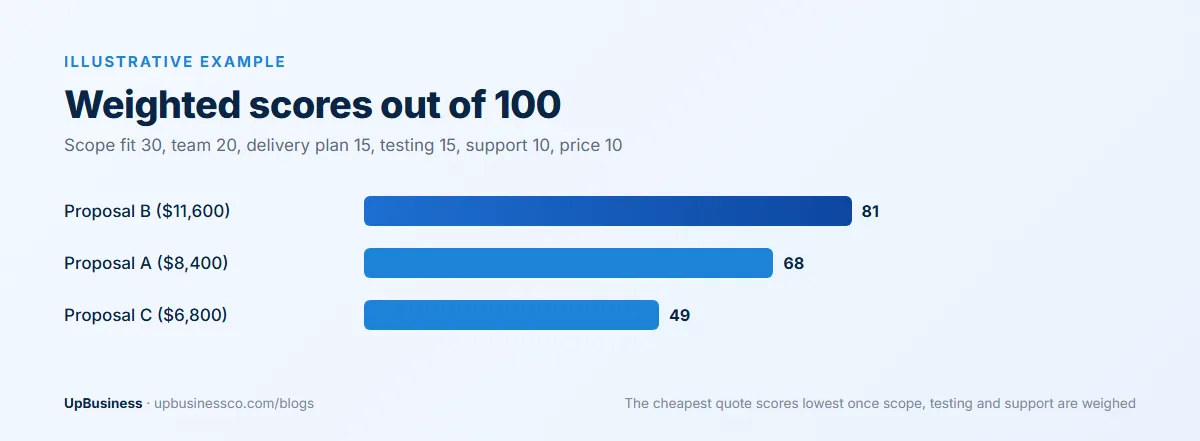
Adjust the weights to your situation. A startup racing to launch an MVP might raise delivery plan to 25. A business replacing a system that runs payroll should raise testing and support. Just fix them before the proposals arrive.
When Proposals Use Different Pricing Models
Comparing a fixed-price quote with a time-and-materials one is like comparing a hotel package with a room rate. To line them up, convert both into the same thing: an estimated total for the same scope.
- For a fixed-price quote, check what happens when scope changes. Ask for the change-request rate and assume at least a few changes over the project.
- For a time-and-materials quote, multiply the estimated hours by the rate, then ask how confident they are in the estimate and what usually pushes it over.
- For a dedicated-team quote, multiply the monthly cost by a realistic number of months, not the most optimistic one.
Once each proposal has an estimated total for the same features, the price row in your scoring sheet becomes meaningful. Our guide to custom software development in India explains when each pricing model suits a project.
Questions to Ask Before You Shortlist
Send the same follow-up questions to every company still in the running. Their answers are often more revealing than the proposal itself.
- Which parts of our brief were hardest to estimate, and what did you assume?
- Can we speak to a client whose project was similar in size and type?
- Who is the most senior person on our project, and how many hours a week will they spend on it?
- What happens if a developer leaves halfway through?
- How will we see progress: a demo every week or two, or status reports?
- What do you need from our side to stay on schedule?
Pay attention to how they answer as well as what they say. A team that admits uncertainty and explains its assumptions is usually easier to work with than one that has an instant, confident answer to everything.
Step 4: Compare Total Cost, Not the Headline Price
The quote is only the first bill. For a fair comparison, add up what each option costs over the first year:
- The build itself, plus any phases the proposal pushed to “later”.
- Change requests at the stated rate, assuming at least a few. Every project has them.
- Hosting, third-party services and licences.
- Maintenance, typically 15–20% of the build cost every year[1].
The same source suggests budgeting 25–30% above the initial quote for the first year[1]. If one proposal already includes support, testing and a change budget, its higher price may be the more honest number.
Six Red Flags That Should Stop the Deal
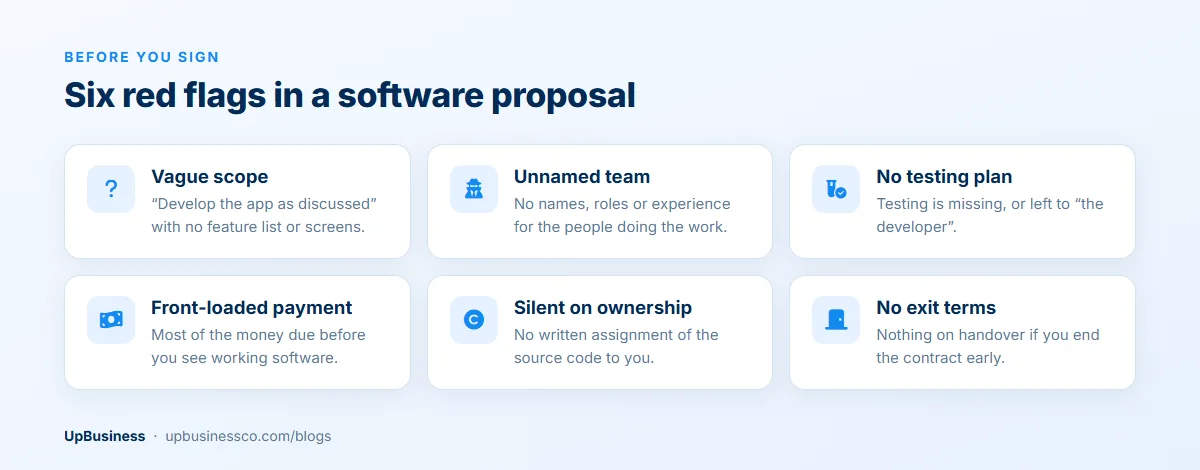
Most of these can be fixed with one email. Ask the company to add the missing pieces to the proposal in writing. A partner that refuses to name the team, put ownership in writing or commit to a testing plan is telling you how the project will go.
Payment terms deserve a second look. Paying for milestones you can test, such as a working login or a completed checkout, protects you far better than paying 50% upfront for work you can’t see yet.
Step 5: Clarify, Then Decide
Shortlist the top two scores and send each the same list of follow-up questions. Their answers often move the scores more than the original documents did. A short paid trial, such as one feature or a clickable prototype over two to three weeks, is the most reliable tie-breaker if the scores are close.
Once you’ve picked a partner, make sure the final contract repeats everything you compared: the feature list, team, testing, change process, support period and code ownership. If it isn’t in the contract, it isn’t in the price.
Want proposals that are easier to compare from the start? Post your project on UpBusiness and verified partner companies respond to the same brief. You can also browse software outsourcing companies, custom software development companies and specialist QA and testing teams if testing is a gap in your shortlist.