

Browse our curated list of ERP Development Companies
Indian businesses rarely go looking for an ERP; they usually get pushed into one. Stock in Tally doesn’t match what’s actually in the godown, the sales team keeps its own Excel sheet, the accountant spends the first week of every month chasing GST mismatches, and nobody can say what a single order really cost to make.
At that point there are three ways forward: subscribe to a ready-made ERP such as Zoho ERP, Odoo or TallyPrime, pay an ERP software development company to build one around your process, or mix the two. This guide compares what each costs in India in 2026, using published prices, and explains how to choose an ERP partner, including whether it matters which city they are in.
If you only have a minute
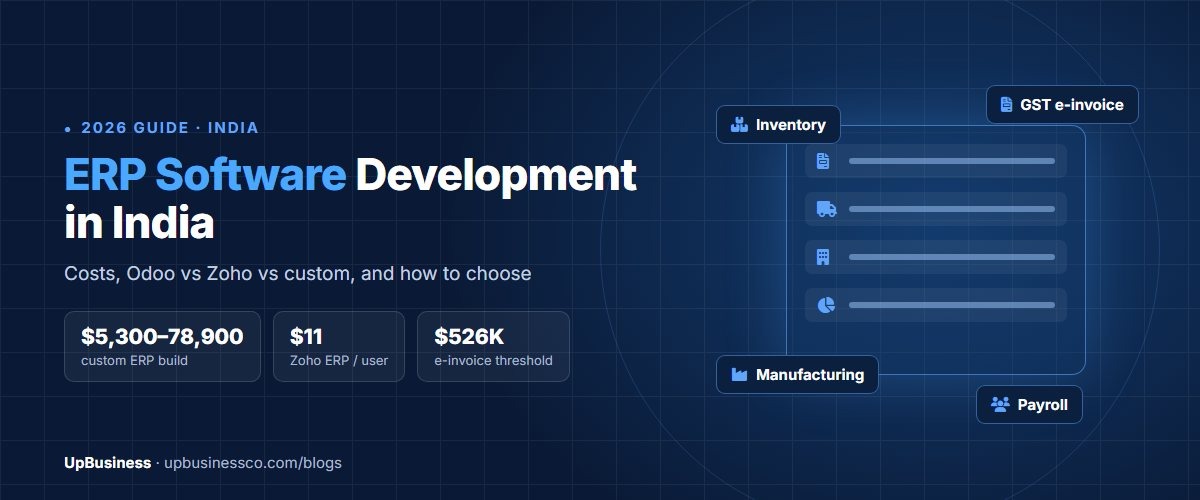
- Ready-made ERP is cheap to start. Zoho ERP costs $11 per user a month on its Standard plan (billed yearly, GST extra)[1], Odoo Standard starts at $6 per user a month including a first-year discount[2], and TallyPrime Gold is a one-time $710 for multiple users[3].
- A custom ERP usually costs $5,300–10,500 for 2–3 modules, $10,500–26,300 for 4–6 modules and 50–100 users, and $26,300–78,900 or more for a full enterprise build.
- Budget 15–20% of the build cost every year for upkeep on anything custom[4].
- If your turnover has crossed $526,000, your ERP must generate GST e-invoices[5], and at $1.1 million or more they must be reported within 30 days[6].
What an ERP Actually Does for an Indian Business
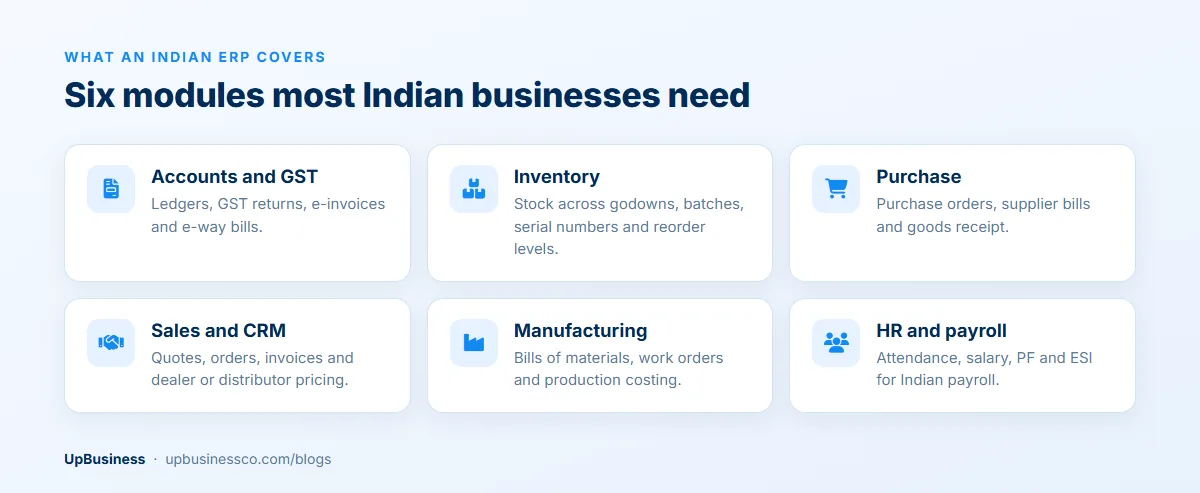
An ERP (enterprise resource planning system) puts accounts, stock, purchase, sales and often production and payroll into one database, so a sale updates stock, the ledger and GST at the same time instead of three people typing it into three places.
For Indian businesses, a few local details decide whether an ERP is usable at all: GST returns, e-invoices and e-way bills, stock spread across several godowns, batch and expiry tracking for pharma and FMCG, dealer and distributor price lists, and payroll with PF and ESI. A tool built for the US or Europe can do the core accounting well and still fall over on these.
You probably need an ERP rather than another spreadsheet when stock numbers in the books and on the shelf keep disagreeing, when month-end closing takes more than a few days, or when you can’t tell which product line or customer actually makes money. If only one of those is true, a good accounting tool plus an inventory system may be enough for now.
Ready-Made ERP vs Custom ERP vs Hybrid
For many small and mid-sized businesses, the sensible answer is to start with a ready-made ERP and only build what it can’t do. A fully custom ERP makes sense when your core process, the thing that makes you money, doesn’t fit any package without heavy workarounds.
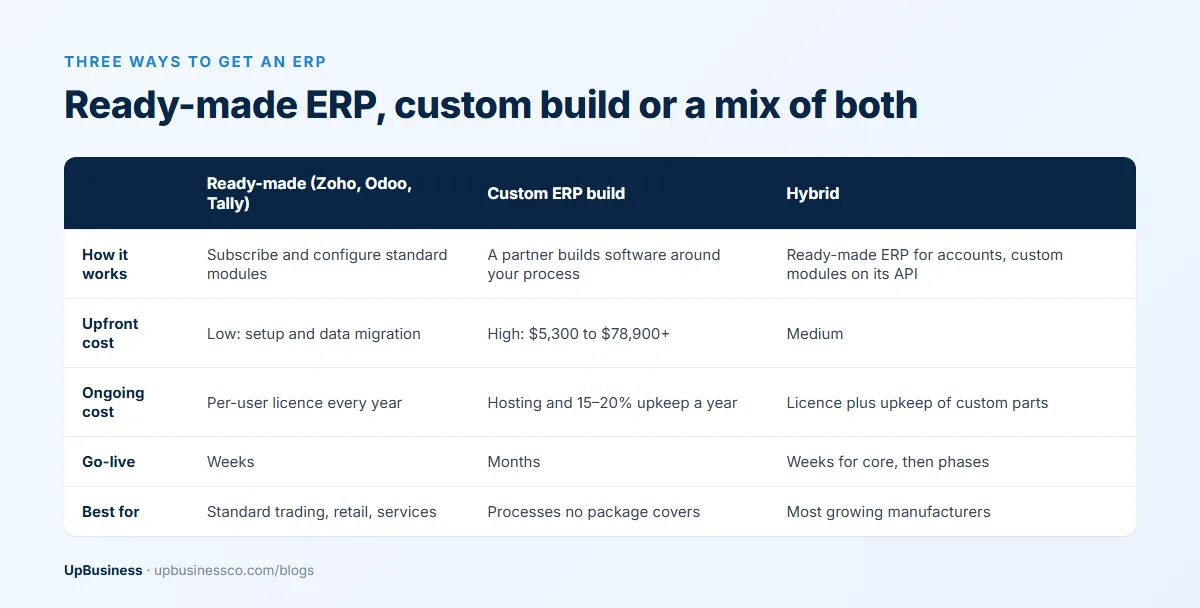
One Indian development firm puts the trade-off simply: buy when your finance, purchase and inventory processes are ordinary and you need to go live quickly, and build or extend only when a process on your critical path has no package equivalent[7]. The same firm points out that package cost grows with every user you add, while a custom build costs roughly the same after delivery whether 20 or 200 people use it.
The hybrid route is what many growing manufacturers end up with. They run Zoho ERP, Odoo or ERPNext for accounts, GST and standard inventory, and a partner company builds one or two custom modules (a shop-floor app, a dealer portal, a costing engine) that talk to it through its API. You get compliance and upgrades from the platform, and the custom part stays small.
Ready-Made ERP Prices in India (2026)
These are published list prices from each provider’s Indian pricing page, before GST and before any implementation work.
| ERP | Published price | Good to know |
|---|---|---|
| Zoho ERP Standard[1] | $11 per user a month, billed yearly ($15 monthly) | Minimum 5 users, up to 100,000 transactions a year; extra employees $3 a month |
| Zoho ERP Premium[1] | $26 per user a month, billed yearly ($32 monthly) | Up to 300,000 transactions a year |
| Odoo Standard[2] | From $6 per user a month | All apps on Odoo Online; includes a 20% discount for the first 12 months |
| Odoo Custom[2] | From $11 per user a month | Adds Odoo Studio, multi-company and external API; Odoo.sh hosting is extra |
| TallyPrime Silver[3] | $240 one-time, or $8 a month | Single user |
| TallyPrime Gold[3] | $710 one-time, or $24 a month | Multi-user |
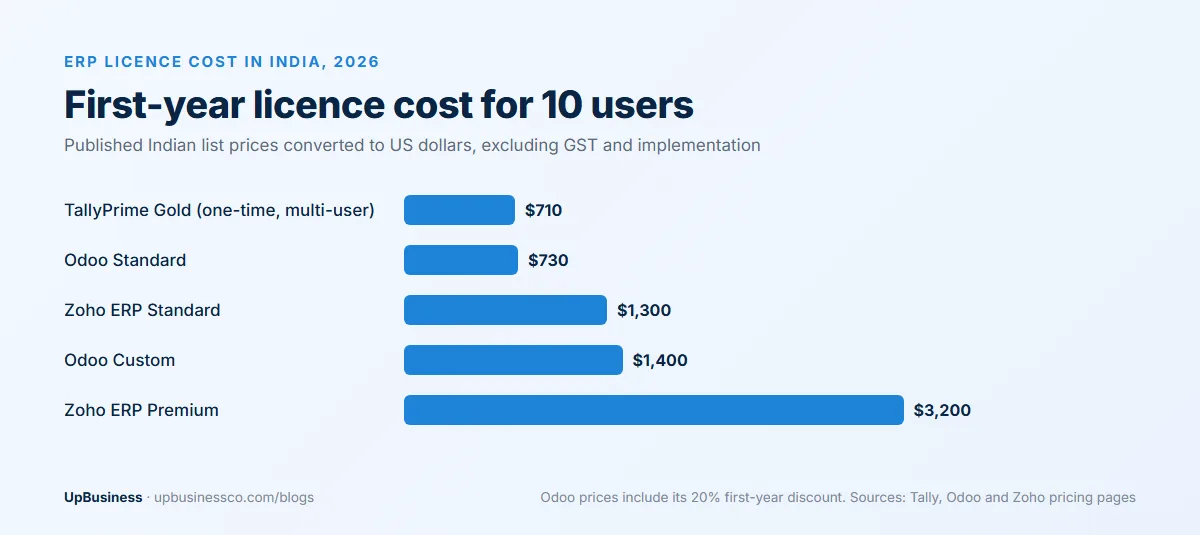
Zoho ERP is the newest of these. Zoho launched it in India in January 2026 for manufacturing, distribution, retail and non-profit businesses, and says it is GST and e-invoicing compliant[8]. Tally is usually the cheapest to buy, but it is accounting-first: once you need production planning, multi-location workflows or approvals, companies often add custom modules or move to a fuller ERP.
The licence is rarely the biggest cost. Setting up the chart of accounts, moving years of old data, connecting your e-commerce or CRM and training staff is where the partner company’s fee goes, and that work is the same whichever platform you pick.
What a Custom ERP Costs in India
Published price ranges from Indian development firms cluster around the numbers below. Treat them as a starting point for budgeting, not a quote.
| Type of build | Typical cost | Usually suits |
|---|---|---|
| Open-source ERP (Odoo Community, ERPNext) set up and customised | $3,200–21,100 | Businesses that want to own the code without building from zero |
| Basic custom ERP: 2–3 modules, 10–15 users | $5,300–10,500 | A single plant or trading business with one main process |
| Mid-range custom ERP: 4–6 modules, 50–100 users | $10,500–26,300 | Growing manufacturers and distributors |
| Enterprise ERP: full suite with integrations, 100+ users | $26,300–78,900 or more | Multi-plant or multi-state operations |
All four ranges come from one Indian firm’s 2025 cost guide.
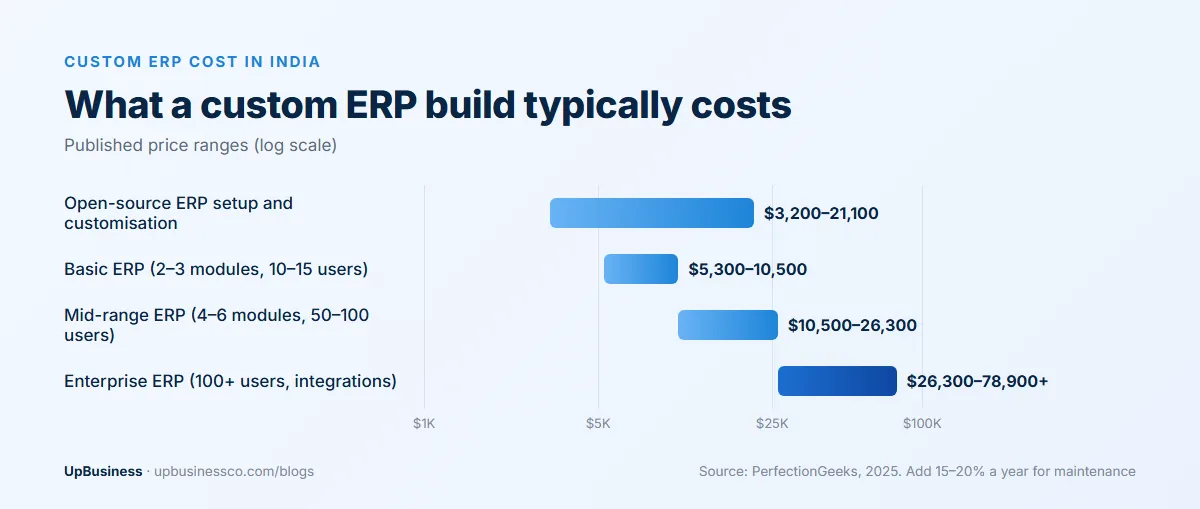
Three things move a custom quote more than the module count. The first is data migration: the real cost is often moving and cleaning old data, not writing new code[7], so ask how many years of Tally or Excel history will be brought across and who cleans it. The second is integrations with your bank, e-commerce stores, transporters and the GST portal. The third is upkeep, which you should budget at 15–20% of the build cost every year[4]. On a $21,100 ERP, that’s $3,200–4,200 a year.
If you decide to build, our guide to custom software development companies in India covers contracts, code ownership and how to compare quotes in more detail.
GST E-Invoicing: Check This Before You Choose
E-invoicing has been mandatory since 1 August 2023 for businesses whose aggregate turnover has crossed $526,000 in any year since 2017-18[5]. From 1 April 2025, businesses with an annual aggregate turnover of $1.1 million or more can’t report an e-invoice to the invoice registration portal more than 30 days after its date, and the portal blocks late entries automatically[6].
In practice, your ERP should generate the IRN and QR code directly instead of making someone upload invoices by hand. Ask every ERP partner company to show you this working, along with e-way bill generation, before you sign. With a custom ERP, this integration is usually the first thing to slip, so put it in the scope with a date.
Odoo vs Zoho ERP vs Custom: Which One Fits?
- Choose Zoho ERP if you already use Zoho Books, CRM or Inventory, have a small number of people who need full access, and want Indian compliance handled by the platform. Specialists in Zoho ERP implementation can set it up.
- Choose Odoo if you want more flexibility, plan to customise heavily or may want to self-host later. Its Custom plan adds Studio and API access[2], and Odoo ERP partner companies handle the localisation and custom modules.
- Stay on TallyPrime, perhaps with a few add-ons, if accounting and GST are the main need and operations are simple.
- Build a custom ERP when your production, pricing or service process is unusual enough that every package needs workarounds, and you have the budget for yearly upkeep.
Hiring an ERP Development Company by City
People often search for an ERP software company in Bangalore, Pune, Mumbai, Hyderabad, Delhi NCR, Chennai or Ahmedabad, and it’s a fair instinct. ERP projects are more on-site than most software work. Someone has to sit with your store-keeper, walk the shop floor and train staff who have used Tally for fifteen years.
That said, the city matters less than it used to. A cloud ERP like Zoho ERP or Odoo can be configured remotely, and many teams split the work: discovery and training visits on-site, development and support remotely. If the best-fit partner is in another city, ask what a site visit costs and write the number of visits into the contract.
Where local presence does help is industry experience. Pune and Chennai have large automotive and engineering manufacturing bases, Ahmedabad and Surat are strong in textiles and chemicals, and Mumbai and Delhi NCR have many trading and distribution businesses. A partner company that has already set up ERP for businesses like yours, wherever it is based, will usually save you more time than one that is simply close by.
How to Choose an ERP Partner Company
Start by writing down your five most painful processes in plain language, with rough volumes (orders a day, number of godowns, users). Send the same note to three or four companies so the quotes can be compared. Then ask each one:
- Which ERP would you recommend for us, and why that one over the others?
- Can you show a live demo of GST e-invoicing and e-way bills, and an ERP you’ve set up for a business in our industry?
- How many years of data will you migrate, and who cleans it?
- What does the licence cost at our user count after the first year, and what does your support retainer include?
- For custom work: will the source code, server and database accounts be in our company’s name?
- How many site visits are included, and who trains our staff?
Be careful with a quote that skips data migration or training entirely, or a plan to switch every department over on the same day. A phased go-live, starting with accounts and inventory, is much easier to recover from if something goes wrong.
On UpBusiness, you can compare verified partner companies under ERP solutions, Odoo ERP and Zoho ERP implementation, and teams that handle data migration if moving off Tally is the hard part. If you’d rather have companies come to you, post your project and get matched with verified teams.