

AI chatbots in customer service answer routine questions on your website, app or messaging channels in seconds and pass harder cases to a person. Done well, they solve a large share of chats without an agent: Klarna's assistant handled two-thirds of its service chats in its first month[1]. Done badly, they drive customers away. In a Gartner survey, 64% of customers said they'd prefer companies didn't use AI for customer service[2].
This guide covers the real benefits of AI chatbots in customer service, the challenges that sink many projects, what named companies have achieved and where the technology is heading next. It's written for support leaders and business owners deciding whether, and how, to use one.
Key takeaways
- Service teams say AI handles about 30% of their cases today and expect 50% by 2027, in a Salesforce survey of 6,500 service professionals.
- The biggest benefits are round-the-clock answers, faster resolution and help for new agents: one study of 5,179 support agents found 14% more issues solved per hour with an AI assistant, and 34% more for the newest agents.
- The biggest challenge is trust. Customers' top fear is not being able to reach a person, so an easy handoff matters more than any feature.
- You're responsible for what your bot says. A Canadian tribunal made Air Canada pay for wrong advice from its chatbot.
- From 2 August 2026, the EU AI Act requires that people are told when they're talking to an AI system.
What AI Chatbots in Customer Service Actually Do
The word "chatbot" covers three very different products. Knowing which one you're looking at is the first step to realistic expectations.
| Type | How it works | Good for | Limits |
|---|---|---|---|
| Rule-based bot | Fixed menus and decision trees ("Press 1 for order status") | Very narrow, predictable flows | Breaks as soon as a customer phrases something differently |
| AI chatbot | A large language model answers from your help centre, policies and FAQs | Answering questions in natural language, in many languages | Can only answer, not act; gives wrong answers if your content is out of date |
| AI agent | An AI chatbot connected to your systems (orders, CRM, payments) so it can take actions | Refunds, order changes, bookings, account updates | Needs integrations, permissions and careful testing |
Most new projects in 2026 sit in the second or third row. The benefits and challenges below apply to both, but the risks grow once a bot can take actions on a customer's account.
Benefits of AI Chatbots in Customer Service
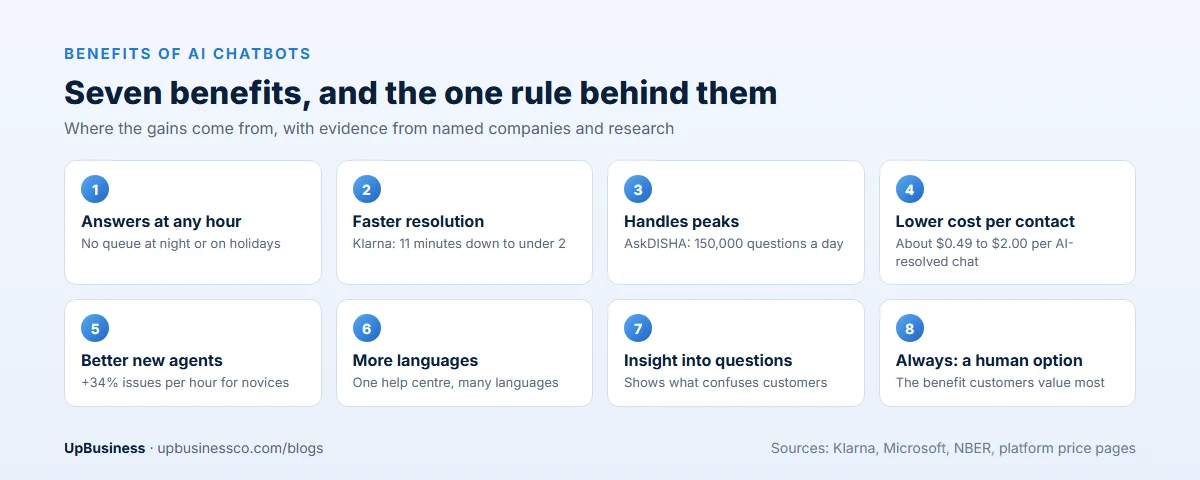
1. Answers at any hour
A chatbot doesn't keep office hours. Customers who write at midnight or on a public holiday get an answer straight away instead of waiting for the next shift. For businesses that sell across time zones, this is often the first and clearest gain.
2. Faster resolution
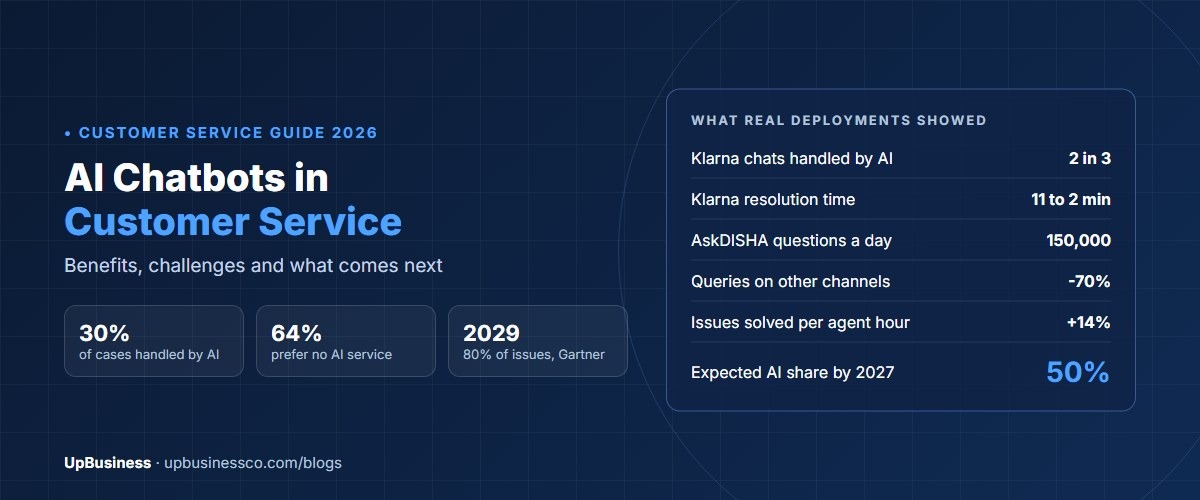
Speed is where the numbers are strongest. In its first month, Klarna's AI assistant cut the average time to resolve a chat from 11 minutes to under 2 minutes, and repeat enquiries fell by 25%[1]. Most of that gain comes from questions with a clear, documented answer, such as order status, refunds and delivery times.
3. Handling peaks without hiring
A sale, a product launch or a service outage can multiply chat volume overnight. A chatbot absorbs the repeated questions, so agents aren't buried. Indian Railways' AskDISHA assistant handles about 150,000 passenger questions a day, and queries on other channels such as phone, email and social media fell by 70% after it launched[3].
4. Lower cost per contact
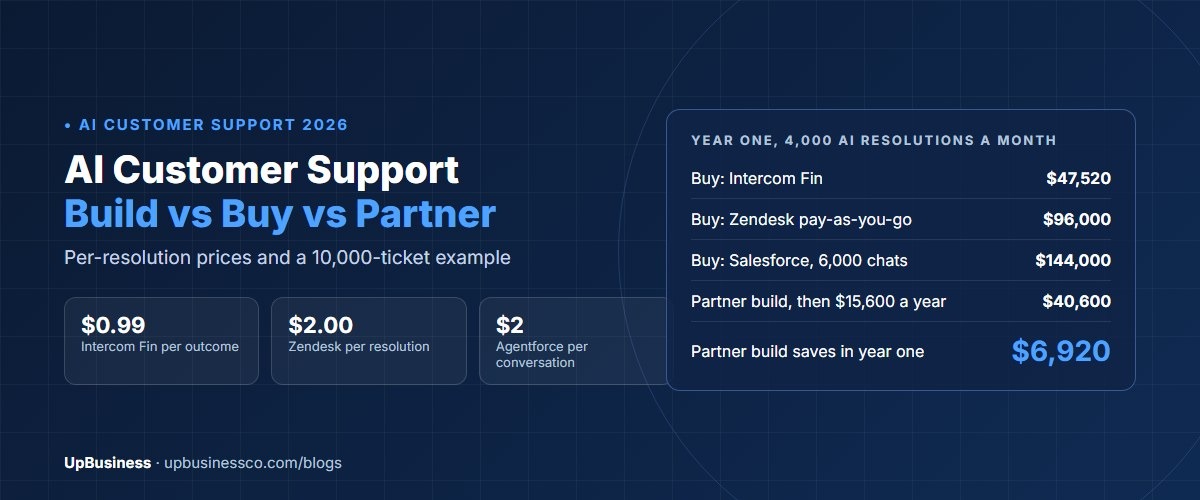
Most helpdesk platforms now charge for each chat the AI resolves. List prices run from about $0.49 per AI session on Freshdesk[4] to $0.99 per resolution on Intercom Fin[5] and $2.00 per automated resolution on Zendesk's pay-as-you-go plan[6], on top of agent seats. Each of those is a fraction of what a person's time on the same chat usually costs, as long as the bot really solves the problem.
5. Better results from new agents
AI doesn't only face customers. It can suggest replies and pull up the right help article for agents. A study of 5,179 customer support agents at a software company found that an AI assistant raised issues resolved per hour by 14% on average and by 34% for novice and low-skilled agents, with little effect on the most experienced[7]. New hires got up to speed faster.
6. Support in more languages
Modern AI chatbots can answer in many languages from the same help content. That opens up markets where hiring native-speaking agents would be slow or expensive. Test each language with real customer phrasing before launch, since quality varies.
7. A clear view of what customers ask
Every chat becomes data. Patterns in bot conversations show which policies confuse people, which product pages miss key details and which problems keep coming back. Fixing those sources often cuts contacts more than the bot does.
Advantages and Disadvantages of AI in Customer Service
| Advantages | Disadvantages |
|---|---|
| Instant answers, day and night | Customers may struggle to reach a person |
| Handles volume peaks without extra staff | Gives wrong answers when help content is out of date |
| Lower cost per resolved chat | Per-resolution fees add up at high volume |
| Helps new agents work faster | Needs ongoing tuning, testing and review |
| Answers in many languages | Quality varies by language and topic |
| Shows patterns in customer questions | Collects personal data that law protects |
Challenges of AI Chatbots in Customer Service (and How to Handle Them)
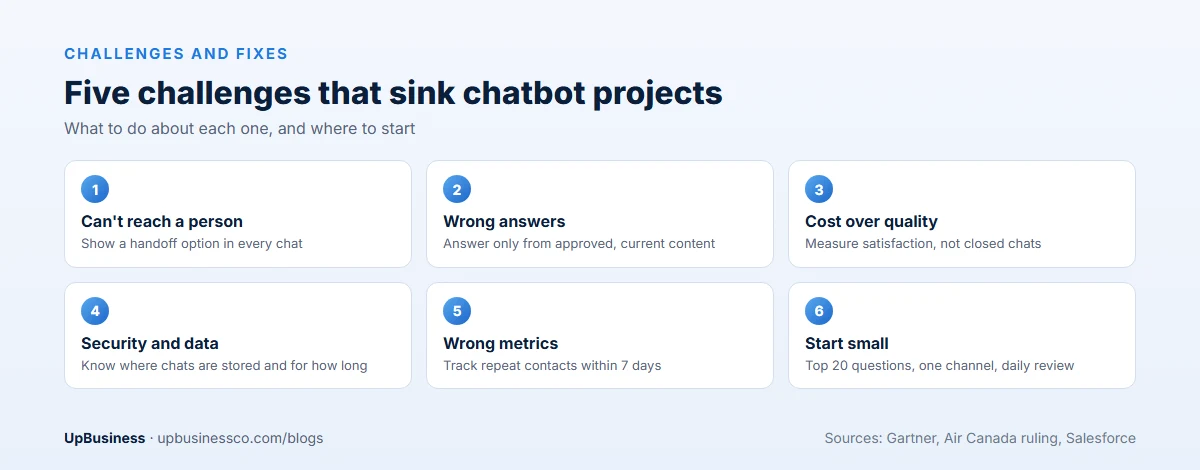
Customers who can't reach a human
In Gartner's survey of 5,728 customers, 64% said they'd prefer companies didn't use AI for customer service, and 53% would consider switching to a competitor if they found out a company was going to use it. Their top worry was that reaching a person would get harder[2]. The fix is simple: show a "talk to a person" option in every chat, pass the full conversation to the agent and never trap customers in a loop.
Wrong answers you're liable for
In Moffatt v. Air Canada (February 2024), the airline's website chatbot told a grieving customer he could claim a bereavement discount after booking. That wasn't the policy. Air Canada argued the chatbot was responsible for its own words. The tribunal rejected this and ordered the airline to pay[8]. Treat every chatbot answer as an official company statement, base it only on approved content and keep that content current.
Chasing cost instead of quality
Klarna, the best-known example of AI customer service, later changed course. In 2025 its CEO said the focus on cost had led to lower quality, and the company began hiring people for support again, keeping AI for routine work[9]. It isn't alone. Gartner predicts that by 2027, half of the organisations that planned to cut their customer service workforce significantly because of AI will drop those plans[10].
Security and data concerns
Chatbots handle names, order details and sometimes payment questions. In Salesforce's research, 51% of service leaders said security concerns had delayed or limited their AI plans[11]. Ask where chat data is stored, how long it's kept, who can see it and how the bot is stopped from revealing one customer's details to another.
Measuring the wrong numbers
A bot can "close" a chat that didn't solve anything. If you only count closed chats, you'll miss angry customers who give up and call instead. Track repeat contacts within 7 days and customer satisfaction for bot chats alongside the share of chats the AI resolves.
What Real Deployments Have Achieved
Chatbot marketing is full of big numbers. The figures below come from named companies and research firms.
| Company or study | Result | Source |
|---|---|---|
| Klarna (fintech, 2024) | 2.3 million conversations in the first month, two-thirds of all service chats; resolution time down from 11 minutes to under 2; repeat enquiries down 25% | Klarna |
| Indian Railways AskDISHA | About 150,000 passenger questions a day in English and Hindi; queries on other channels down 70% | Microsoft |
| Support agents with an AI assistant | 14% more issues resolved per hour, 34% more for novice agents | NBER |
| Service teams worldwide | About 30% of cases handled by AI today, 50% expected by 2027 | Salesforce |
Two patterns stand out. The wins come from common, repeated questions, and every successful deployment still gives customers a way to reach a person.

Browse our curated list of Top AI Chatbot Companies
Examples of AI Chatbots in Customer Service by Industry
The best uses look similar across industries: high-volume questions with a clear answer in your own systems. The handoff points differ, and they matter as much as the bot itself.
| Industry | What the chatbot handles well | When to hand off to a person |
|---|---|---|
| Online retail | Order status, delivery dates, returns, sizing questions | Damaged goods, repeated failed deliveries, angry customers |
| Banking and fintech | Balances, card blocking, statement requests, payment status | Disputes, fraud reports, hardship requests |
| Travel | Booking changes, baggage rules, check-in, flight or train status | Cancellations with refunds outside policy, bereavement or medical cases |
| Software and SaaS | How-to questions, password resets, plan and billing details | Bugs, data loss, contract or pricing negotiations |
| Telecom and utilities | Plan changes, outage updates, bill explanations | Complaints, disconnections, vulnerable customers |
| Healthcare | Appointment booking, opening hours, preparation instructions | Anything about symptoms, diagnosis or medication |
Notice what sits in the last column: money disputes, emotional situations and anything regulated. Those are the cases where a wrong answer costs the most, and where customers most want a person.
Do Chatbots Improve Customer Experience?
They can, but only for the right questions. Customers like fast, accurate answers to simple questions at any hour, and that's where chatbots shine. They dislike bots that guess, repeat themselves or block the way to a person, and that's where most complaints come from.
A good test is to ask what happens when the bot doesn't know. If the answer is a quick handoff with the chat history passed on, customer experience usually improves. If the bot keeps trying, it usually gets worse. Klarna's change of course shows that even strong early numbers need checking against satisfaction over time.
Rules to Know Before You Launch
Disclosure rules are tightening. Under Article 50 of the EU AI Act, providers must design AI systems that interact with people so that users are told they're dealing with an AI, unless it's obvious; this applies from 2 August 2026[12]. In California, it's unlawful to use a bot to mislead someone about its artificial identity to encourage a sale, unless the bot discloses that it's a bot[13].
Privacy law applies to chat data too: the GDPR in the EU and UK, state privacy laws in the US and India's Digital Personal Data Protection Act, whose main duties apply from around May 2027[14]. In practice: tell users what the bot collects and why, collect only what the chat needs, never ask for full card or ID numbers in chat and have a way to delete a customer's data on request. This is a summary, not legal advice.
The Future of AI Chatbots in Customer Service
Four changes are already under way.
From answers to actions. Chatbots are becoming AI agents that can issue refunds, change bookings and update accounts. Gartner predicts that by 2029, agentic AI will resolve 80% of common customer service issues without human help, cutting operating costs by 30%[15]. That's a forecast, not today's reality, but it shows where platforms are investing.
A bigger share, not all of it. Service teams expect AI to handle about half of their cases by 2027[11]. Yet Gartner predicts that no Fortune 500 company will have fully eliminated human customer service by 2028[16]. The likely shape is smaller human teams handling the hard, emotional and high-value cases.
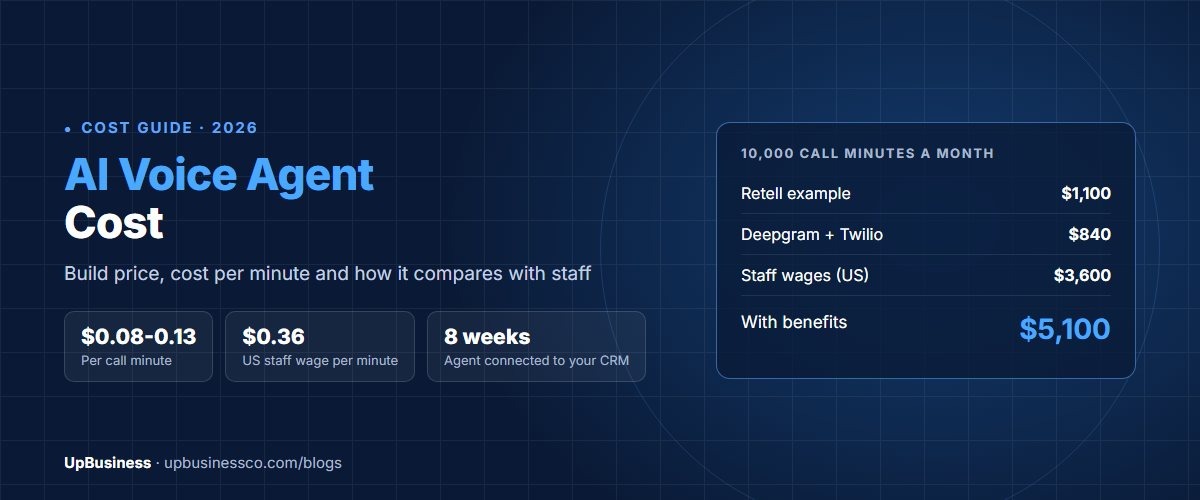
Voice and more languages. The same models now power phone agents, so voice is the next channel to change. Our guide to AI voice agent cost covers what that costs per minute.
Help before customers ask. Bots connected to order and booking systems can message customers first: a delivery delay, a failed payment or a cancelled train, with options to fix it in the same chat. Each message like that can stop a contact before it starts, which is usually cheaper and better received than any reply.
When an AI Chatbot Pays Off (and When It Doesn't)
A chatbot pays off when three things are true: you get a steady volume of chats, most of them repeat the same questions and the answers are written down somewhere the bot can read. It rarely pays off for a small team getting a few dozen complex enquiries a week.
Here's a rough worked example. A team gets 10,000 chats a month, and the AI resolves half of them. At $0.99 per resolution, the AI costs about $4,950 a month, plus agent seats. The US Bureau of Labor Statistics put the median wage of customer service representatives at $20.59 an hour in May 2024[17]. If an agent handles about six chats an hour, those 5,000 chats would take about 833 agent hours, or about $17,150 in wages alone, before benefits, management and tools.
The numbers change fast with your assumptions. At $2.00 per resolution, the AI costs $10,000 a month. If customers whose chats the bot "resolved" come back by phone, the saving shrinks or disappears. Run the sum with your own chat volumes, handling times and wages, and check repeat contacts during the pilot before you count any saving.
What an AI Chatbot for Customer Service Costs
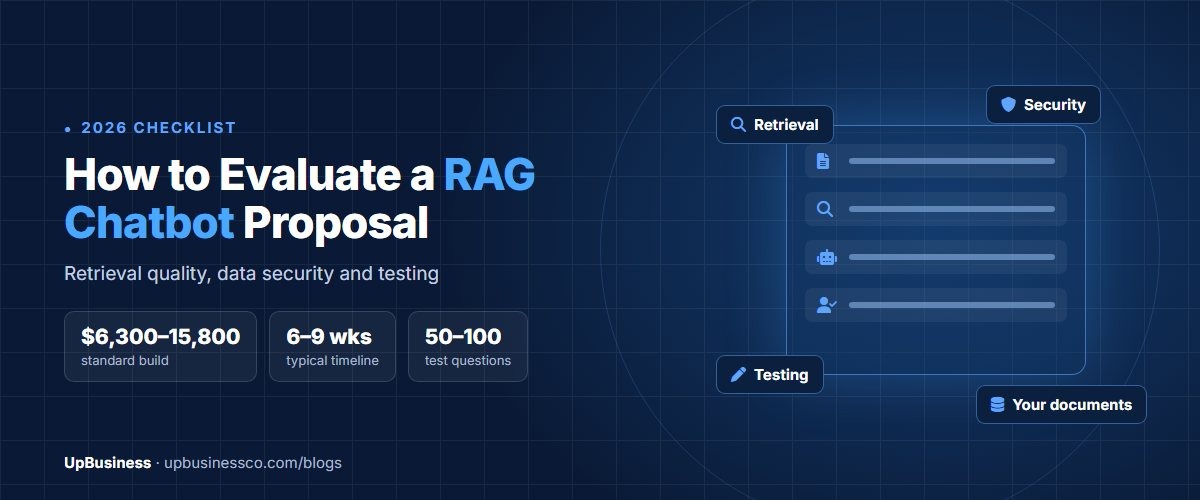
There are three routes. A helpdesk's built-in AI charges seats plus a fee per AI-resolved chat, roughly $0.49 to $2.00 at list prices. A specialist platform quotes by volume and channel. A custom build costs a one-time project fee plus model and hosting costs. We cover each in depth elsewhere: our AI chatbot development cost guide breaks down build budgets, our build vs buy guide for AI customer support compares platforms with custom work, and our WhatsApp chatbot cost guide covers messaging fees. For bots that answer from your own documents, see RAG chatbot cost.
How to Launch an AI Chatbot: A 6-Step Plan
- Pick the top 20 questions. Pull the last 3 months of tickets and chats. The 20 most common questions usually make up a large share of volume.
- Fix your help content first. The bot is only as accurate as the content it reads. Update policies, prices and FAQs, and remove anything that contradicts itself.
- Design the handoff. Decide when the bot must pass to a person: an angry customer, a payment issue, a repeated question or a direct request. Pass the full chat, so customers never repeat themselves.
- Pilot on one channel. Launch on your website or one messaging app for one product line, with agents reviewing a sample of conversations daily.
- Measure the right numbers. Track the share of chats the AI resolves, satisfaction for bot chats, handoff rate, repeat contacts within 7 days and first response time.
- Grow step by step. Add actions such as refunds and order changes, and new channels, only once accuracy and satisfaction hold steady.
Getting Help With an AI Chatbot
If you need help with setup, system links or a custom build, shortlist partners on proof. Ask for a live chatbot they built in your industry and its resolution rate, check they've connected bots to systems like yours, ask where chat data will be stored and get monitoring and retraining terms in writing. Our questions to ask an AI development company help with the shortlist.
You can compare AI chatbot development companies, customer support chatbot specialists, AI customer support agent builders and multilingual chatbot developers on UpBusiness, or post your project to get matched with suitable partner companies.
Browse our curated list of Top AI Chatbot Companies