

Browse our curated list of AI Development Companies
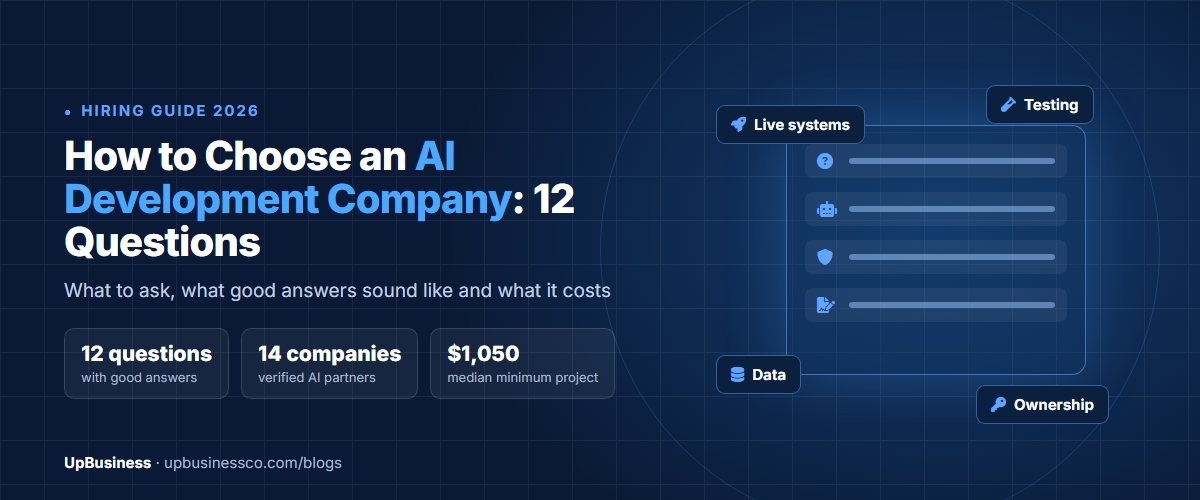
To choose an AI development company in India, ask it to show you a live system it built, explain how it will measure accuracy before launch, and tell you what happens when the AI gets an answer wrong. Then ask what it will cost to run each month, where your data goes, and who owns the result. A company that answers those six clearly is worth a second meeting, and the 12 questions below give you the full set.
This guide is for the person hiring, usually a founder, product head or operations lead who needs an AI feature or product built and doesn't want to judge companies on demos alone. It also includes data from the 14 verified AI development companies on UpBusiness in October 2026, so you know what minimum project sizes and team sizes look like before you start the conversation.
Key takeaways
- The most revealing questions cover live systems, accuracy testing before launch, error handling, monthly running costs, data handling and ownership.
- Our data on 14 verified AI development companies in India shows a median minimum project of $1,050, with most teams of 11 to 50 people.
- Prompt injection and sensitive information disclosure top the OWASP list of risks for AI applications, so security testing belongs in every proposal.
- India has no separate AI law; projects are governed mainly by the IT Act and the DPDP Act, which requires a contract with any data processor.
Know What You're Buying Before You Ask
"AI development" covers very different projects, and the right questions depend on which one you need. Most work that Indian AI companies take on falls into a few groups.
| Type of project | Typical examples | What usually decides success |
|---|---|---|
| Chatbots and assistants on your own documents | Support bots, internal knowledge assistants, sales assistants | The quality of your documents and how answers are checked |
| AI agents and workflow automation | Agents that read emails, update a CRM or process invoices | How well errors and edge cases are handled |
| Predictive Machine Learning | Demand forecasting, churn prediction, credit scoring | Enough clean historical data |
| Computer vision | Defect detection, document reading, people counting | Training images that match real conditions |
| AI features inside an existing product | Search, summaries, recommendations | Cost per use and speed inside the product |
If you're not sure whether to build at all, our comparison of custom AI and off-the-shelf AI tools is a good place to start. Plenty of businesses find that a well-configured existing tool covers most of what they need at a fraction of the cost, and a good AI company will tell you so.
12 Questions to Ask an AI Development Company
Send these in writing to every company on your shortlist so you can compare the answers side by side. Here they are at a glance, with what a strong answer and a weak one look like.
| # | Question | A strong answer | A red flag |
|---|---|---|---|
| 1 | Can we see a live system you built? | A working system, plus the client's contact | Only slides or a prototype |
| 2 | How will you measure accuracy before launch? | A test set of real questions, with a target score | "Very accurate, trust us" |
| 3 | What happens when the AI is wrong? | Fallbacks, human handoff and logging | No plan for errors |
| 4 | What data do you need, and who prepares it? | A specific list and an honest effort estimate | "Just send us everything" |
| 5 | Where does our data go? | Named services, regions and a data clause | Vague talk of "the cloud" |
| 6 | Which models will you use, and why? | A reason tied to your use case, and a way to switch | One provider for everything, no reason |
| 7 | What will it cost to run each month? | A per-use estimate at your expected volume | Only the build price |
| 8 | How do you handle prompt injection and data leaks? | Specific controls and tests | Unaware of the risk |
| 9 | Who on your team has shipped AI to production? | Named people and the systems they built | Only general developers |
| 10 | Who owns the code, prompts and models? | You, by written assignment | The company keeps the core |
| 11 | How will you monitor it after launch? | Logs, quality checks and a support plan | Launch and leave |
| 12 | What would you not use AI for here? | A clear, honest limit | AI for everything |
1. Can you show us a live AI system you built, and can we talk to its owner?
Demos are easy to make look good, because the person running them picks the questions. A live system that real users rely on is much harder to fake. Ask for one that's similar to your project, try it yourself if you can, and ask for the client's contact.
When you speak to that client, ask how accurate the system is today compared with launch, how much it costs them to run, and whether the company still supports it. If every example the company has is a proof of concept, that's not necessarily a deal-breaker for a small first project, but you should know you're paying for its learning curve.
2. How will you measure accuracy before launch?
This is the question that separates serious AI teams from the rest. A good company will build a test set before it builds much else: a list of real questions or inputs from your business, with the answers you'd accept, usually a few hundred at most. Every version of the system gets scored against that set, so improvements and regressions are visible.
The proposal should state a target score, explain how questions with no agreed answer will be handled, and commit to sharing the results with you. "Our model is very accurate" without a number or a method should end the conversation. If you're buying a chatbot built on your documents, our guide to evaluating a RAG chatbot proposal goes deeper into this.
3. What happens when the AI gets something wrong?
Every AI system gets things wrong sometimes, so what you're really asking is what it does next. Good answers include confidence thresholds that send uncertain cases to a person, clear wording to users when the system doesn't know, logging of every wrong answer so it can be fixed, and limits on what the AI can do without a human approving it.
For anything that takes actions, such as an agent that updates records or sends emails, ask exactly which actions need approval. An agent that can issue refunds on its own is a very different risk from one that drafts a refund for a person to approve.
4. What data do you need from us, and who prepares it?
Data preparation is usually the slowest part of an AI project and the one most often left out of the quote. Ask the company to list exactly what it needs (which documents, how many records, what format and how far back), and then ask who does the cleaning. If it's your team, get an estimate of the hours involved, because pulling five years of support tickets out of an old system and removing customer names can take weeks. A company that says it can start with whatever you have, without asking to see a sample, hasn't done many of these.
5. Where will our data go, and is it used to train anything?
Your data will probably pass through at least one outside AI service, so ask for the list: which model provider, which hosting service, which regions, and whether any of them keep or train on what they receive, and get those answers in writing.
There's a legal side to this as well. If the system handles personal data of your customers or staff, the company is a data processor under the Digital Personal Data Protection Act, and a business can engage a data processor only under a valid contract[1]. The DPDP Rules, notified on 14 November 2025, are being phased in over 18 months, and the highest penalty under the Act is up to $26.3 million for failing to keep reasonable security safeguards[2].
6. Which models will you use, and why?
There's no single right answer, but there should be a reason. A company might choose a large hosted model for quality, a smaller one for cost and speed, or an open model running on your own servers for privacy. Ask why its choice fits your use case rather than just its habits, and how hard it would be to switch models later. Model prices and quality change quickly, and a system built so that the model can be swapped with modest effort protects you from being stuck with one provider's pricing.
7. What will it cost to run each month, not just to build?
AI systems have running costs that normal software doesn't: model usage charged per request, vector database hosting, monitoring, and the time someone spends reviewing errors. For a busy customer-facing assistant, they can add up to a large share of the build cost every year.
Request an estimate at your real volume, such as cost per 1,000 conversations or per 1,000 documents processed, along with the figure if usage triples. A good company will also tell you how it plans to keep the cost down, for example by caching common answers or using a cheaper model for simple requests.
8. How do you protect against prompt injection and data leaks?
AI applications bring security risks that ordinary web apps don't have. The OWASP Top 10 for Large Language Model applications lists prompt injection first, followed by sensitive information disclosure, and also covers excessive agency and system prompt leakage[3].
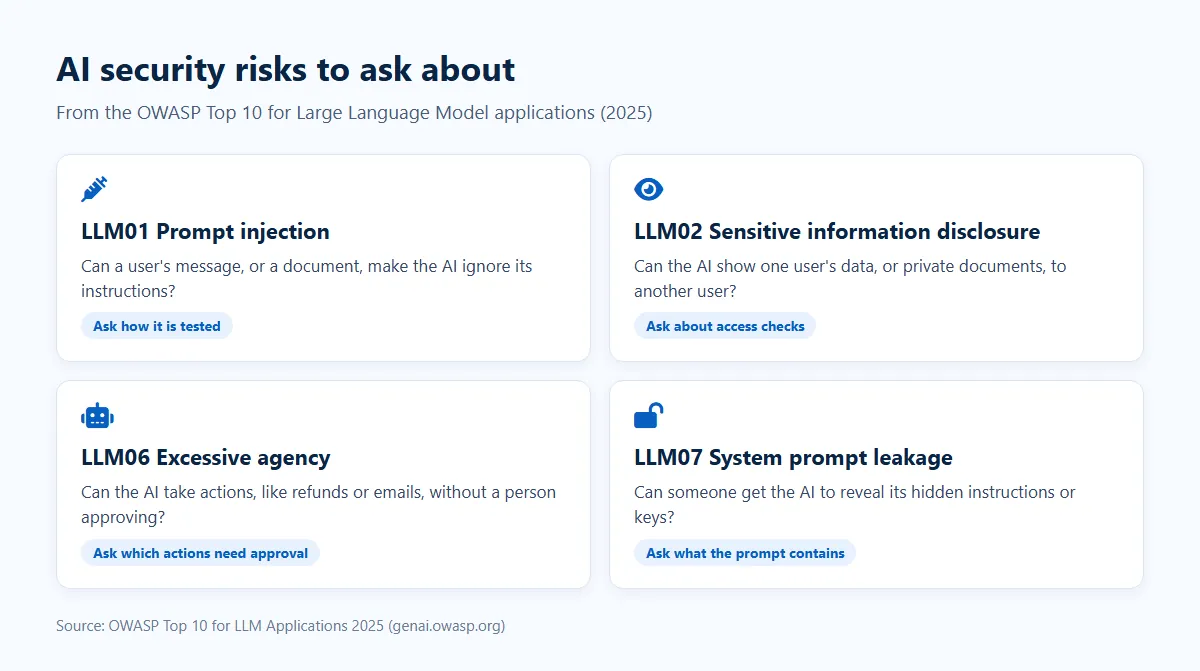
A credible company will explain which of these apply to your project and how it tests for each one. For a chatbot that reads your documents, a sensible answer covers checking what each user is allowed to see before any document reaches the model, and testing whether the bot can be talked into revealing other users' data or its own instructions. A company that's never heard of prompt injection hasn't shipped many AI systems to real users.
9. Who on your team has shipped AI to production?
Many software companies have added "AI" to their services in the last two years, and some have the experience to back it up while others are learning on client projects. Ask for the names of the people who'd work on yours and the AI systems each of them has put into production (as opposed to built in a notebook), and look them up. Someone who has run an AI system for real users can talk about what broke after launch, what the bills looked like, and what they'd do differently, and that conversation is more revealing than any portfolio page.
10. Who owns the code, prompts, fine-tuned models and data?
In India, the author of a work is its first owner unless it's made by an employee under a contract of service, and an assignment of copyright must be in writing[4]. So an outside company owns what it builds for you until a written assignment says otherwise, and that includes the prompts, evaluation sets and any model it fine-tunes on your data.
Make sure the contract assigns all of it to you on payment, and that the company can't reuse a model trained on your data for another client. Some companies build on their own frameworks and license them to you instead of assigning them, which can be fine, but you need to know the terms and what happens if you part ways. Our software development contract checklist has suggested wording for these clauses.
11. How will you monitor the system after launch?
AI systems drift over time, as your documents change, your users ask new kinds of questions and model providers update their models. Ask what the company will watch after launch: answer quality, error rates, cost per request, and response times. Ask how often it will re-run the test set from question 2.
Get a support plan in writing with a monthly price and response times. CERT-In's directions already require service providers and body corporates to keep logs of their ICT systems for a rolling 180 days within India[5], so ask how the AI system's logs fit into that, and who can see conversation logs that may contain personal data.
12. What would you not use AI for in our project?
This is the honesty test, and it's the question we'd ask first. A good AI company will happily tell you which parts of your idea don't need AI, where a simple rule or search would work better, and where AI isn't reliable enough yet. If the answer is that AI can handle everything, treat it as a sales pitch rather than advice. Good partners will often suggest a smaller AI scope in the first meeting, which lowers both your cost and your risk.
Red Flags in AI Development Proposals
Most weak AI proposals show the same gaps. Watch for a fixed price given before the company has seen a sample of your data, an accuracy figure with no test set behind it, and no mention of running costs at all.
Be careful too with proposals that promise to "train a custom model" when your use case could be handled by an existing model with your documents, because training is slower and more expensive, and with any company that wants to host the system on its own accounts with no plan to hand it over. None of these alone proves a company is bad, but two or three together usually mean you're looking at a team that's new to AI.
What AI Development Companies in India Look Like
As of October 2026, UpBusiness lists 14 verified AI development companies. All of them hold a TrustScore between 70.2 and 76.7, with a median of 72.2.
Most are mid-sized, with eight having 11 to 50 people, four having 51 to 200 and two having 1 to 10. They're spread well beyond the usual IT hubs: Surat has four and Noida three, with one each in Bengaluru, Jaipur, Indore, Kota, Amritsar, Birbhum and Fatehgarh Sahib.
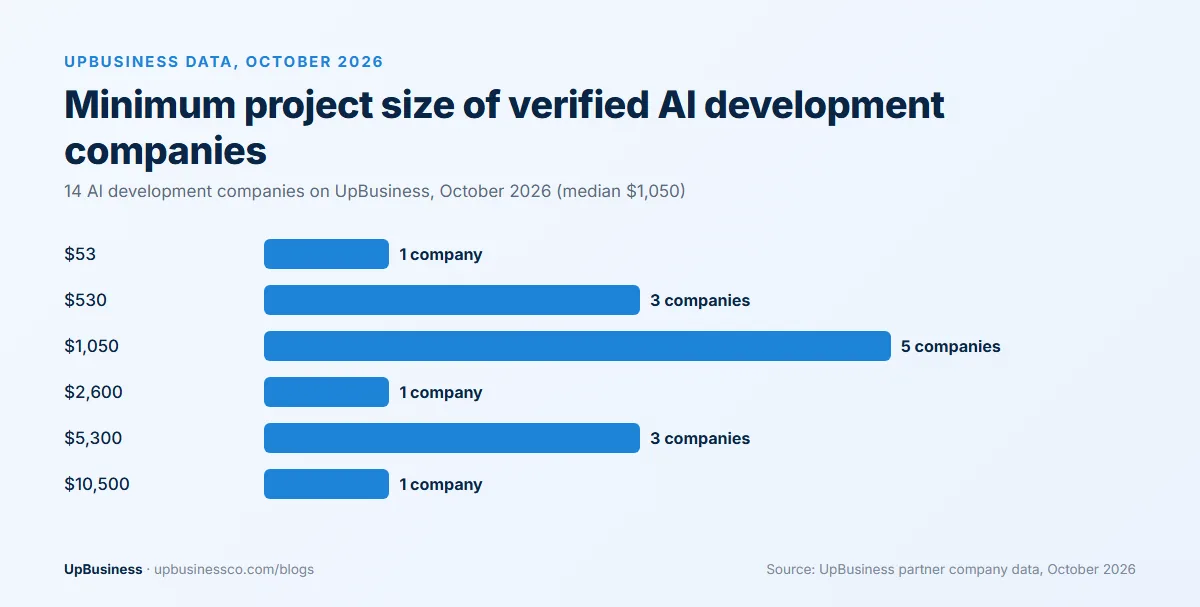
Minimum project sizes tell you who to approach. The median is $1,050, and five of the 14 companies start there. Three will take projects from $530 and one from $53, while three need at least $5,300, one $2,600 and one $10,500. If your budget is $3,200, four of the 14 won't consider it, so check the minimum before you spend time on a call. For hourly and monthly rates, see our guide to AI developer rates in India.
Even Developers Don't Fully Trust AI Output
It's worth knowing how the people who build software feel about AI's reliability, because it explains why questions 2 and 3 matter so much. In Stack Overflow's 2025 Developer Survey, 84% of respondents said they use or plan to use AI tools in their work, yet more developers distrust the accuracy of AI tools (46%) than trust it (33%)[6].
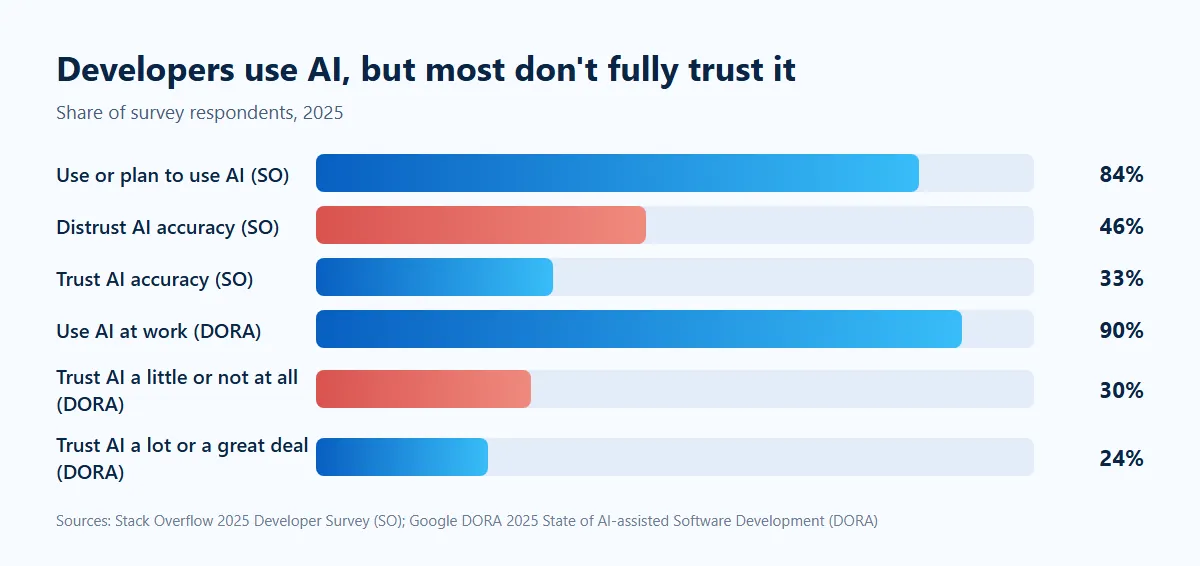
Google's 2025 DORA research found the same gap. AI use among software professionals reached 90%, but only 24% reported a great deal or a lot of trust in it, while 30% trusted it a little or not at all[7]. The same report describes AI as a "mirror and a multiplier": teams that work well get faster with it, while struggling teams see their weak spots exposed. That's a good way to think about any AI company you hire, since its habits around testing and review will be multiplied in your project.
Rules That Apply to AI Projects in India
India doesn't have a separate AI law. MeitY released the India AI Governance Guidelines on 5 November 2025 as a principle-based framework, with seven guiding principles, recommendations across six governance pillars, and an action plan[8]. In practice, AI projects are governed by existing laws, mainly the Information Technology Act and the DPDP Act.
For a buyer, that means three practical things: treat the AI company as a data processor and sign a contract that covers personal data, make sure security incidents are handled under CERT-In's reporting rules, and keep a record of how the system was tested before launch. If you sell into Europe or the US, ask the company whether your use case falls under any rules there too.
How to Use These Questions
Shortlist three to five companies whose minimum project size and past work fit your project. Send all 12 questions in writing on the same day, along with a short brief, and give them a week to reply. Then hold a call with the two or three best answers, with the people who'd actually build your system on the call, not only the sales lead.
Before you sign, run the basic checks on the company itself. Our guide on how to verify a software development company covers the free MCA, GST and EPFO checks, and our due diligence checklist helps you score the finalists.
Every AI company on UpBusiness has already passed document, GST and portfolio checks, and you can compare them by TrustScore, team size and minimum project. Browse verified AI development companies, read our list of the best AI development companies in India, or post your requirement and we'll send you three matched companies for free.