

Browse our curated list of AI Development Companies
AI developer rates in India are lower than in the US or UK, but the range is wide enough to cause real mistakes when you hire. A junior engineer who has followed a few tutorials and a senior engineer who has run a language model in production can both describe themselves as “AI developers”, and their rates can differ by three times or more.
This guide sets out what AI developers in India charge in 2026, why the rates vary so much, which skills are worth paying extra for, and a simple interview rubric for telling real experience from a good CV. It also shows how to turn an hourly rate into a realistic project budget.
If you only have a minute
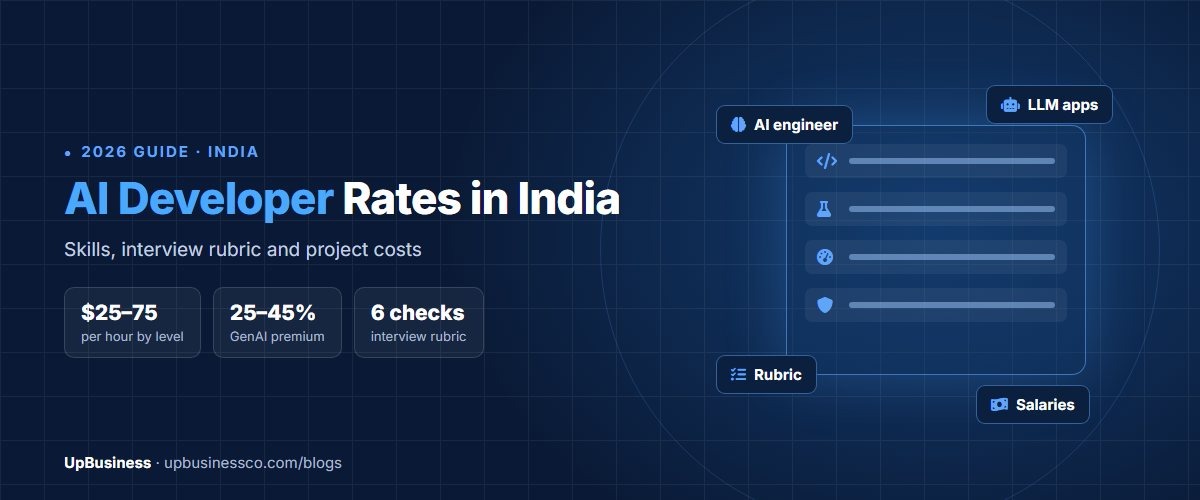
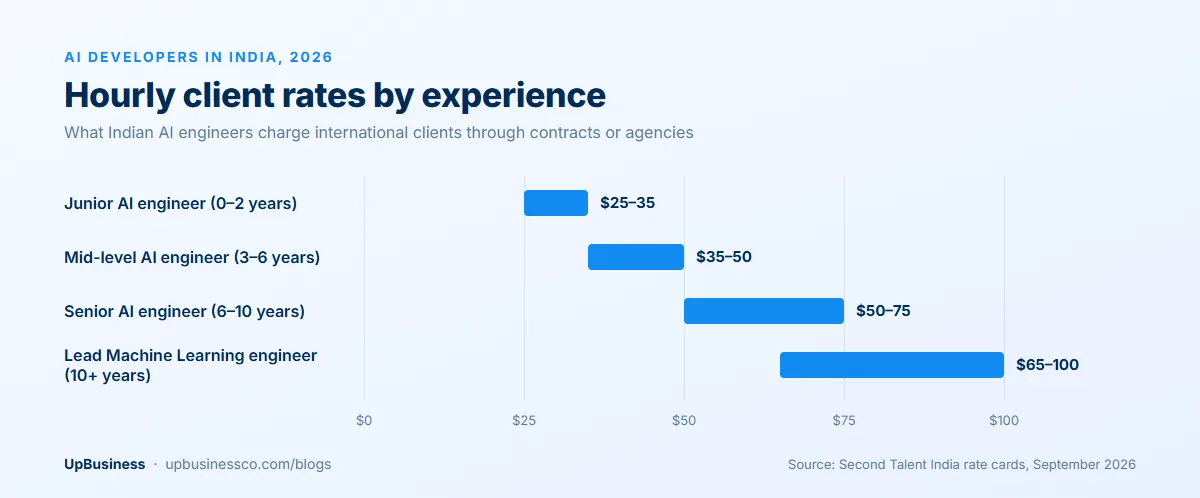
- Published 2026 rate cards put AI engineers in India at about $25–35 an hour for juniors, $35–50 for mid-level and $50–75 for senior engineers on client work[1].
- Generative AI work typically carries a 25–45% premium over traditional Machine Learning roles[2], and the employer type moves pay more than years of experience.
- Screen on shipped work, not tool lists. Ask how a candidate would measure output quality, what broke in a past project and what 1,000 requests would cost to run[3].
- Before giving anyone access to your data, sign an IP assignment and a data processing agreement, not just an NDA[3].
AI Developer Rates in India (2026)
These figures are what Indian AI and Machine Learning engineers charge international clients through contracts or agencies. They come from staffing and development companies, so read them as market ranges rather than quotes.
| Level | Experience | AI engineer (client rate) | Machine Learning engineer (client rate) |
|---|---|---|---|
| Junior | 0–2 years | $25–35 an hour | $22–32 an hour |
| Mid-level | 3–6 years | $35–50 an hour | $32–45 an hour |
| Senior | 6–10 years | $50–75 an hour | $45–70 an hour |
| Lead or principal | 10+ years | Not listed | $65–100 an hour |
Sources: Second Talent rate cards for AI engineers[1] and Machine Learning engineers[2] in India, September 2026.
Other published figures sit in a similar band but a little lower. One 2026 guide puts mid-level Indian AI engineers at $20–35 an hour and seniors at $35–48, with top specialists at $70–80 and full-time engagements at $3,500–6,500 a month[4]. An Indian agency that supplies AI developers lists its own rate as $15–25 an hour[3]. The gap usually comes down to who carries the overheads: an agency rate often includes some project management and replacement cover, while a contractor rate doesn’t.
Why Rates Vary So Much
Years of experience explain less than you’d think. One rate card notes that the type of employer moves pay more than experience does: a fresher at an IT services company might start around $3,700–5,300 a year, while one at a product company starts at $12,600 or more[2]. Engineers from product companies know this and price their contract work accordingly.
Specialisation is the second driver. Generative AI work carries a 25–45% premium over traditional Machine Learning, and engineers who have actually served models in production under cost and latency limits are harder to find than those who can fine-tune one[2]. Location matters a little too: the same source puts Bengaluru 15–20% above the national average and Hyderabad 10–15% below Bengaluru[2].
Finally, freelance rates run higher than contract rates for the same person, roughly 25% higher according to one rate card[1], because the freelancer carries the gaps between projects.
Salaries, if You’re Hiring In-House
If you’re weighing a contractor against a full-time hire in India, compare against salaries rather than hourly rates. The same 2026 rate card lists annual pay for AI engineers at $6,300–14,700 for juniors, $15,800–31,600 for mid-level and $31,600–73,700 for seniors[1].
A full-time hire is cheaper per hour once you have steady work for a year or more, but you carry recruitment time, notice periods and the risk of a bad hire. For a first project or a fixed piece of work, a contractor or a dedicated developer through a partner company is usually the safer start.
Which AI Skills You Actually Need
“AI developer” covers very different jobs. Paying for the wrong one is a common way to overspend, for example hiring a model-training specialist to build what is really a chatbot on top of an existing model.
| What you’re building | Who you need | What to look for |
|---|---|---|
| A chatbot or assistant on top of GPT, Claude or Gemini | AI application or LLM engineer | Has built retrieval, prompts, evaluation and cost controls into a live product |
| Predictions from your own data (demand, churn, fraud) | Machine Learning engineer | Feature engineering, model validation, monitoring for drift |
| Getting models into production reliably | MLOps engineer | Deployment pipelines, model serving, GPU and inference cost management |
| Clean, connected data for any of the above | Data engineer | Pipelines, data quality checks, warehouse design |
Most business projects in 2026 need the first row, sometimes with help from the last. If a candidate or company steers a simple assistant towards training a custom model, ask why an existing model with your data won’t do the job.
An Interview Rubric for AI Developers
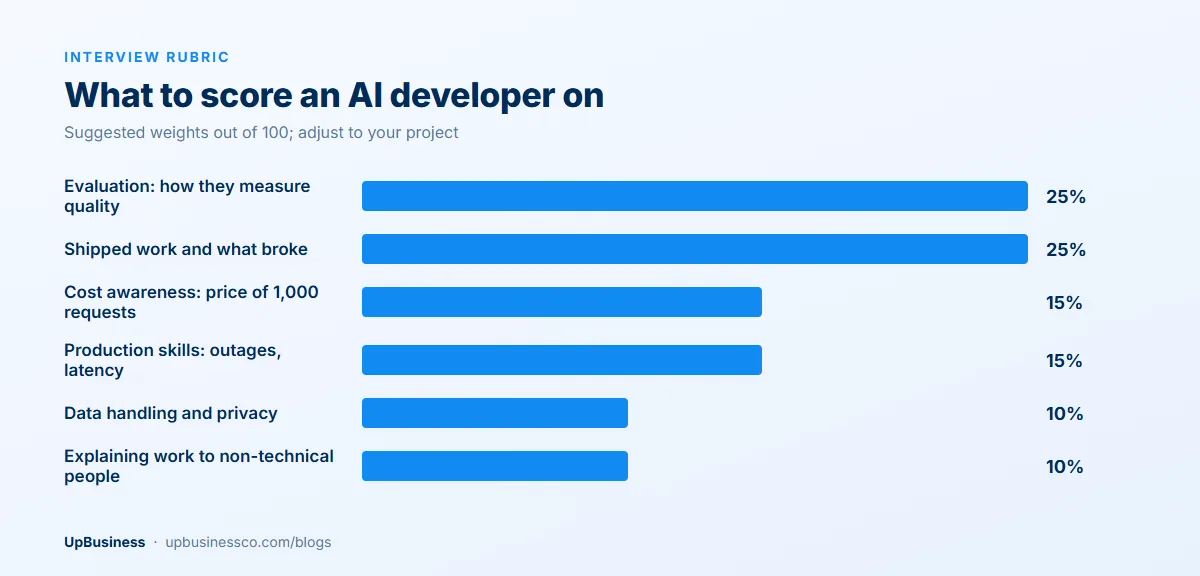
CVs in this field are full of tool names, and a list of frameworks tells you very little. Score candidates on what they’ve built and how they think about quality and cost instead.
| What to test | How to ask | What a strong answer sounds like | Weight |
|---|---|---|---|
| Evaluation | Give 20 real examples of your use case and ask how they’d measure good output | Talks about test sets and pass criteria before naming a model | 25% |
| Shipped work | Ask for a project that’s live with real users, and what broke | Specific failure, how they found it and what they changed | 25% |
| Cost awareness | Ask what 1,000 requests a day would cost to run | Gives a rough number and knows what drives it | 15% |
| Production skills | Ask how they’d handle slow responses or a model provider outage | Mentions caching, fallbacks, timeouts and monitoring | 15% |
| Data handling | Ask how they’d protect customer data sent to a model | Covers access control, masking and where data is processed | 10% |
| Communication | Ask them to explain their last project to a non-technical manager | Clear, plain explanation without hiding behind jargon | 10% |
The first three questions come from an Indian AI firm’s hiring advice, which recommends screening on shipped work rather than lists of tools[3]. Adjust the weights to your project, but keep evaluation and shipped work near the top. Developers who can’t say how they’d measure quality usually can’t tell you when their system is getting worse.
For the final decision, a paid trial of one to two weeks on your own problem tells you more than any interview[3]. Judge the working result, how often they asked sensible questions and how clearly they explained what they couldn’t finish.
From Hourly Rate to Project Budget
An hourly rate only becomes useful once you multiply it by a realistic amount of time. As a rough worked example, one developer at $25–50 an hour working full-time (about 160 hours a month) for two months costs about $8,000–16,000 before any model or hosting costs. An Indian AI firm reports that a customer support agent it built took eight weeks and a set of six back-office agents took twelve[3], which gives a sense of real timelines.
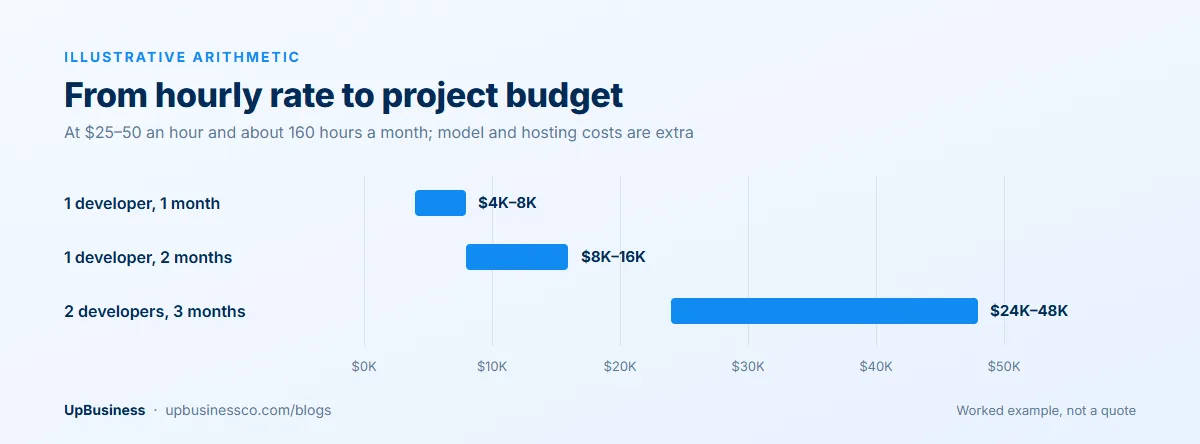
Add three things to that figure. First, the model and hosting bill, which keeps running after launch and grows with usage. Second, your own team’s time for testing and feedback. Third, a buffer for evaluation and fixes after the first users arrive, because AI features rarely behave the same with real users as they did in testing. Our guide to AI development services covers typical project costs and ROI in more detail.
Risks to Cover Before You Hire
- One developer with no backup. If they leave or fall ill, the project stops. Ask a partner company how cover works.
- Accounts in the developer’s name. Model provider keys, cloud accounts and code repositories should belong to your company from day one[3].
- Unwatched model costs. Set spending limits and alerts with your model provider before launch, not after the first large invoice.
- An NDA alone. Sign an IP assignment and a data processing agreement before anyone sees your data[3]. Under India’s Copyright Act, an assignment of copyright is valid only if it’s in writing[5].
- No owner on your side. Without someone who can answer questions quickly, an AI project drifts into a good demo of the wrong thing.
UpBusiness Data: AI Development Project Sizes
The 13 approved AI development companies on UpBusiness report a median average project size of $10,500, and five of them put their typical project at $26,300 or more. Entry points are much lower: eight of the thirteen accept projects starting under $2,600, which is enough for a small pilot. More than half are teams of 11 to 50 people.
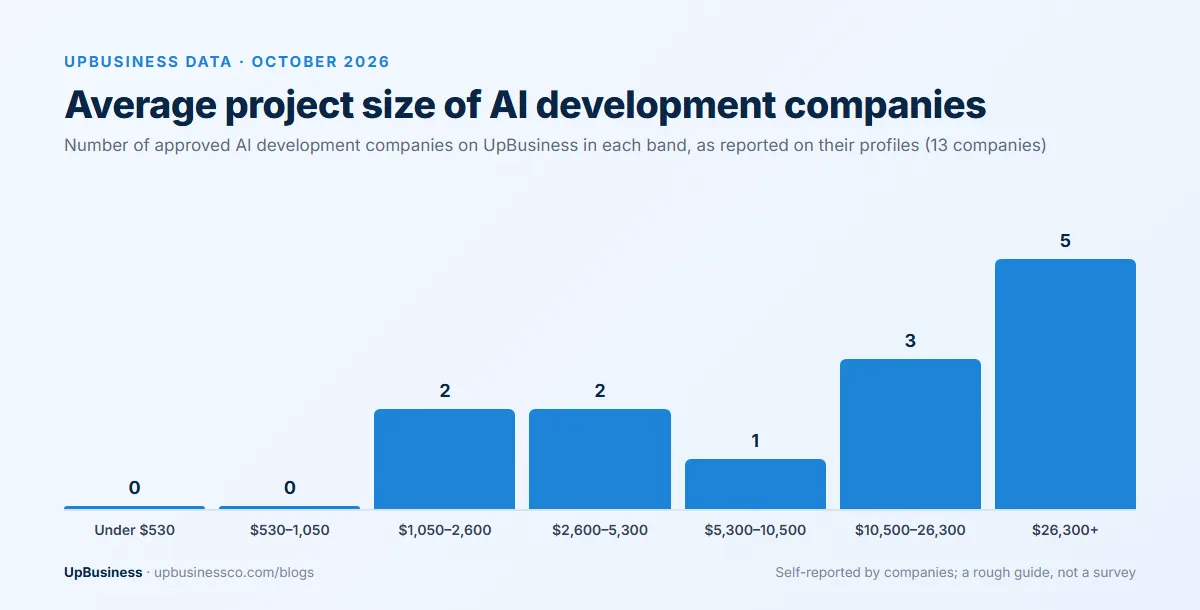
These figures are self-reported on company profiles and describe whole projects, not hourly rates, so they’re most useful for checking whether a company works at your budget.
Hiring AI Developers Through UpBusiness
On UpBusiness you can compare verified AI development companies, Machine Learning companies and AI consulting firms by TrustScore, project size and profile. If you need a chatbot or assistant specifically, start with AI chatbot development companies. You can also post your project with your use case and budget and let verified partner companies respond.