

Browse our curated list of Software Outsourcing Companies
When you look to hire dedicated developers in India, you’re usually offered one of two deals. Either they build a defined project for an agreed price, or they give you developers who work only on your product, every month, for as long as you keep paying. Both are sold as the safer choice, and both can go badly if they don’t match how your product actually needs to be built.
This guide compares dedicated developers and project-based teams in plain terms: how each model works, what each costs in 2026, how much of your own time each one takes, and the contract terms that protect you. By the end you should know which one fits your situation, and when to switch from one to the other.
If you only have a minute
- A project-based team delivers an agreed scope for a fixed or estimated price. It suits a clearly defined build with a finish line.
- A dedicated team is a group of developers working only on your product for a monthly fee, with you setting priorities. It suits ongoing products where the backlog keeps changing.
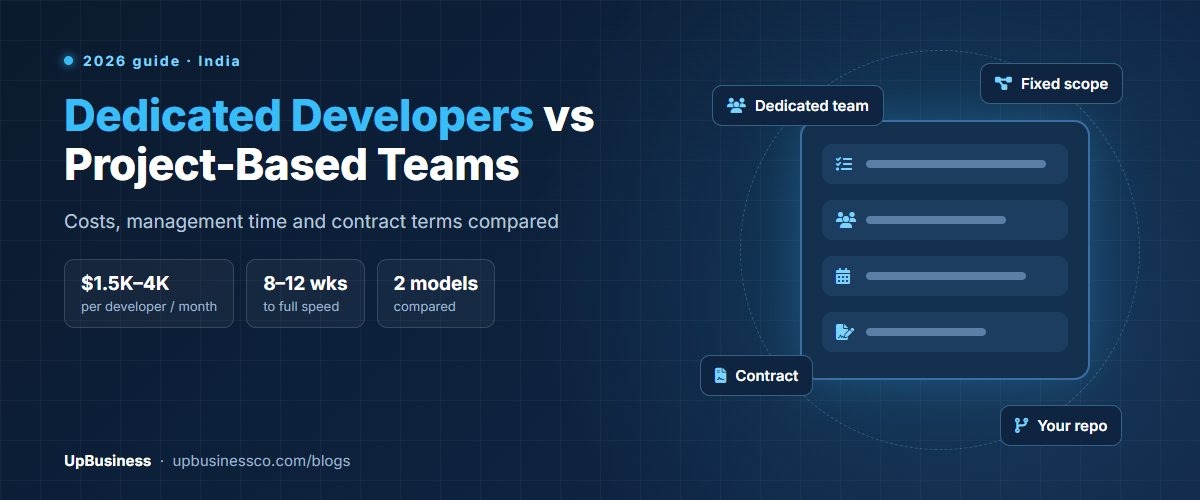
- Dedicated developers in India typically cost $1,500–4,000 a month each[1], and a four-person team with a lead, two developers and QA around $8,000–15,000 a month[2].
- A dedicated team needs a product owner on your side and takes time to settle in: one guide suggests 8–12 weeks to reach full speed with structured onboarding[3].
The Two Models in Plain Terms
The real difference is who decides what gets built each week. In a project-based engagement, the company commits to a scope and manages its own people to deliver it. In a dedicated team, the company provides the people and you decide what they work on.
| Project-based team | Dedicated developers | |
|---|---|---|
| What you buy | A defined outcome: an app, a module, a website | People’s time: a set number of developers each month |
| Pricing | Fixed price, or time and materials against an estimate | Monthly fee per developer or for the whole team |
| Who manages day to day | The partner company’s project manager | You or your product owner, often with a team lead from the partner |
| Changing scope | Through change requests, often at extra cost | Reprioritise the backlog at the next planning session |
| Main risk | Scope gaps and change-request costs | Paying for a team that isn’t well directed |
| Best for | Clear, one-off builds with a finish line | Ongoing products with a changing backlog |
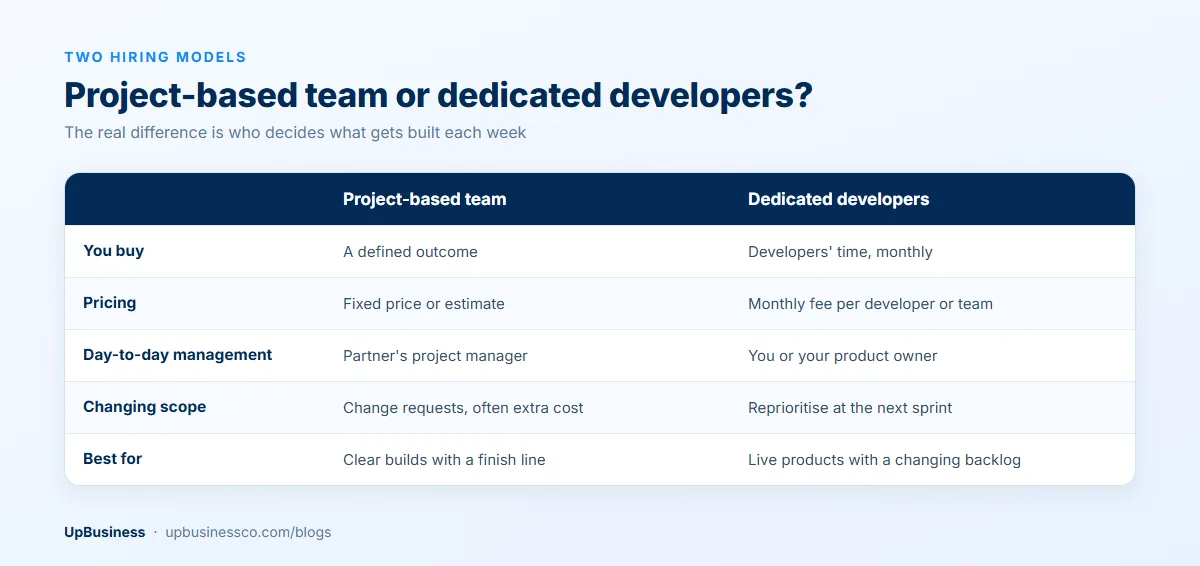
Neither model is cheaper by default. A fixed-price project can end up costing more than planned once change requests pile up, and a dedicated team can burn money quietly if nobody on your side is giving it clear priorities.
What It Costs to Hire Dedicated Developers in India (2026)
Project-based pricing depends entirely on scope, and there’s no useful per-month figure for it. Our guide to custom software development costs in India breaks down typical project prices by type of software.
Dedicated teams are easier to price, because you’re paying for people. These are published 2026 figures from Indian development companies, so treat them as ranges to check against real quotes:
| Role or team | Typical monthly cost | Source |
|---|---|---|
| Dedicated developer, typical range | $1,500–4,000 | Indian development company[1] |
| Junior developer | $1,500–4,000 | 2026 hiring guide[2] |
| Mid-level developer | $2,500–5,500 | 2026 hiring guide[2] |
| Senior, AI or DevOps engineer | $5,000–8,000 | 2026 hiring guide[2] |
| 4-person team: lead, 2 developers, QA | $8,000–15,000 | 2026 hiring guide[2] |
| 5-person blended team, all-in | $18,000–26,000 | Indian development company[3] |
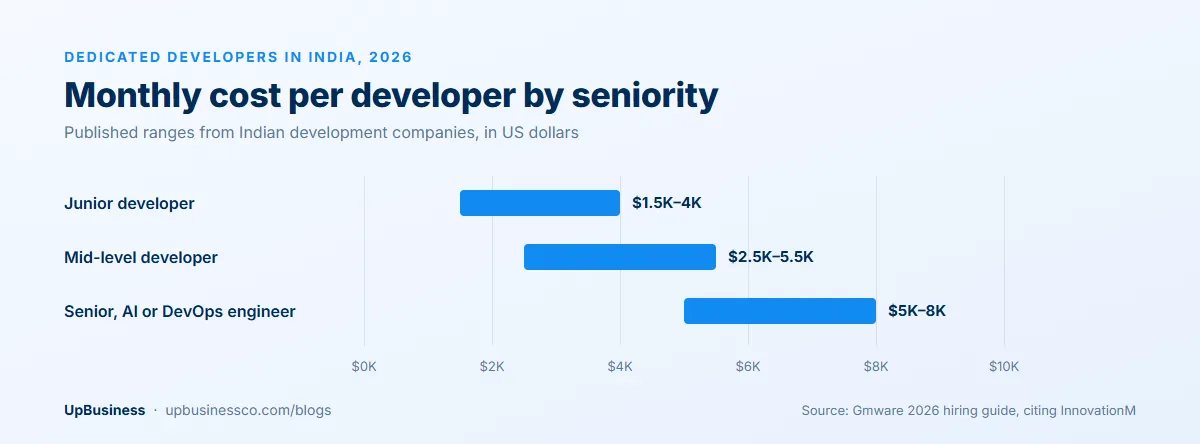
Most Indian companies quote dedicated teams in US dollars, even to Indian clients, so check the currency and whether GST is extra before comparing. The ranges overlap a lot because they include different things. One company notes that the margin above the developer’s own cost is commonly 20–35%, and that tools and licences add another $200–500 per developer per month[3]. Ask every company whether its monthly figure includes project management, QA, tools and a replacement if someone leaves.
When a Project-Based Team Is the Better Choice
Choose a project-based team when you can describe what “done” looks like. A company website, a booking app with a fixed feature list, an integration between your ERP and a courier service, or a first version of a product you’ve already designed screen by screen all fit well.
It also suits businesses without anyone technical in-house. The partner company runs the project, plans the work and reports progress, so you mainly review demos and approve milestones. Fixed prices give you budget certainty, as long as the scope is written down properly. Our guide to comparing software development proposals shows how to check that it is.
Where it struggles is change. If you expect to learn from users and adjust the product every few weeks, each change becomes a negotiation, and the project slowly turns into a string of change requests.
When Dedicated Developers Make More Sense
A dedicated team works best once you have a product that’s live, a backlog that keeps growing and someone on your side who can decide what matters each sprint. SaaS products after launch, internal platforms that several departments depend on, and companies adding features every month are the classic cases.
The trade-off is management. The team will build what you ask for, in the order you ask for it, so unclear priorities turn directly into wasted months. If nobody in your company can spend real time each week writing requirements, answering questions and reviewing work, a dedicated team is likely to disappoint you.
Give it time to settle in, too. One Indian company estimates 8–12 weeks before a dedicated team reaches full speed with structured onboarding, and 3–6 months without it[3]. Another advises against dedicated engagements shorter than about eight weeks, because ramp-up costs can cancel out the savings[2].
The Common Path: Start With a Project, Then Switch
Many products are best built with both models, one after the other. A fixed-price discovery phase pins down scope, a fixed-price first version gets the product live, and only once there’s a real backlog does it make sense to move to a dedicated team or time and materials. Our guide to custom software development in India describes this sequence in more detail.
If you plan to switch, say so at the start. Ask the company whether the developers who built the first version can continue as the dedicated team, because keeping the same people avoids paying for a second round of ramp-up.
Contract Terms That Protect You
For a dedicated team, the contract matters more than the rate. These are the clauses worth asking for:
- Named developers with their experience listed, and your right to interview them before they join.
- A replacement commitment if someone leaves or isn’t working out, with a time limit and a handover period at the company’s cost.
- How much notice either side must give to add people, reduce the team or end the contract.
- Knowledge transfer on exit. One 2026 guide estimates it at 20–30% of project cost when switching companies[2], so agree documentation and handover obligations upfront.
- Code repositories, cloud accounts and tools in your company’s name from the first day.
For both models, put ownership in writing. Under India’s Copyright Act, the author of a work is its first owner, and an assignment of copyright is valid only if it’s in writing and signed[4]. Whether you’re buying a project or a team, the contract should assign all code and designs created for you to your company.
How to Decide
Four questions settle it for most businesses.
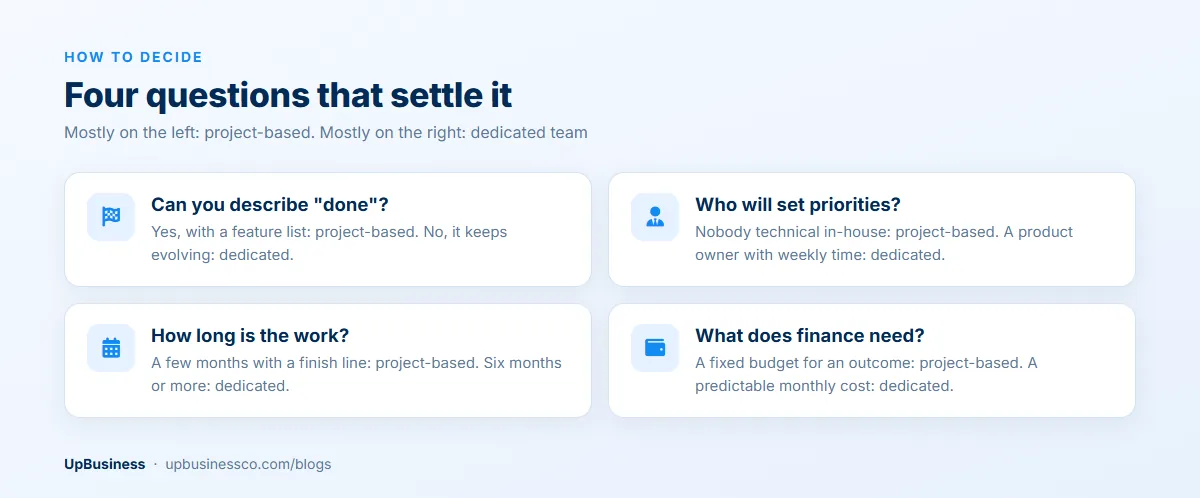
If most of your answers point to a dedicated team but you don’t have a product owner yet, start with a project-based build and hire or appoint that person while it runs. If your answers are mixed, a small dedicated team of two or three people on a three-month trial is a sensible middle ground.
Our guide to software development outsourcing to India covers the wider risks of working with an Indian team, from unclear scope to data protection.
UpBusiness Data: Outsourcing Company Project Sizes
The 7 approved software outsourcing companies on UpBusiness range from small teams to firms with up to 500 people, and four of the seven have between 11 and 200 employees. Five of the seven report an average project of $10,500 or more, while their minimum project sizes start at a median of about $2,600.
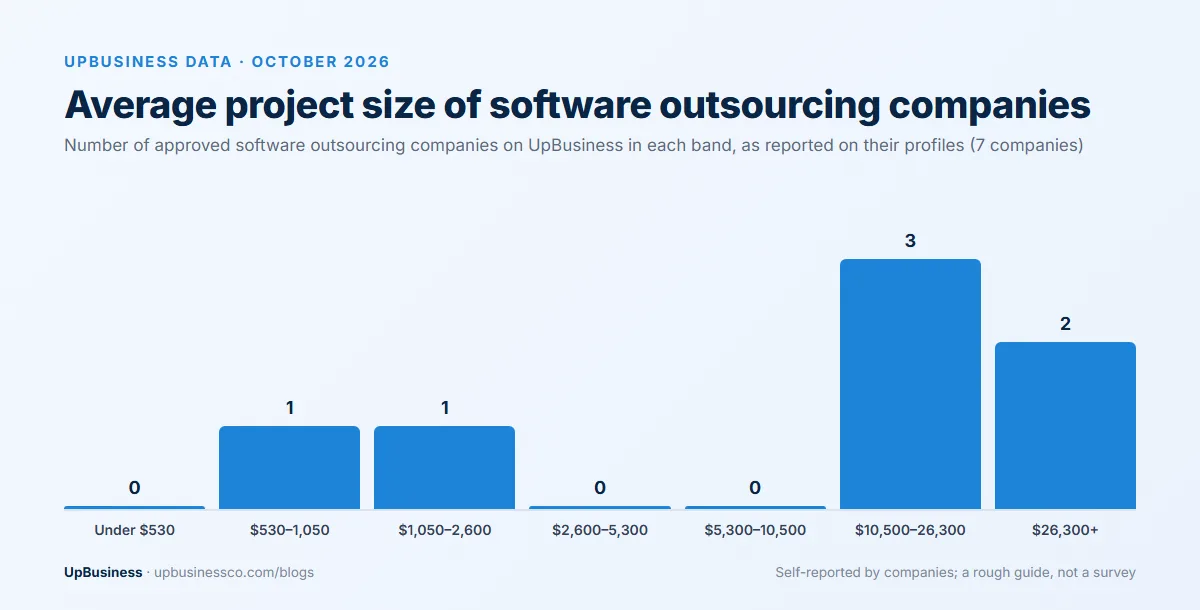
These figures are self-reported on company profiles, so use them to judge which companies fit your budget rather than as a quote.
Finding the Right Team on UpBusiness
On UpBusiness you can compare verified software outsourcing companies and custom software development companies by TrustScore, project size and profile, and add QA and testing teams if testing is a gap. Post your project with your brief, and say whether you want a fixed-scope build or a dedicated team, so the proposals you get back are comparable.