

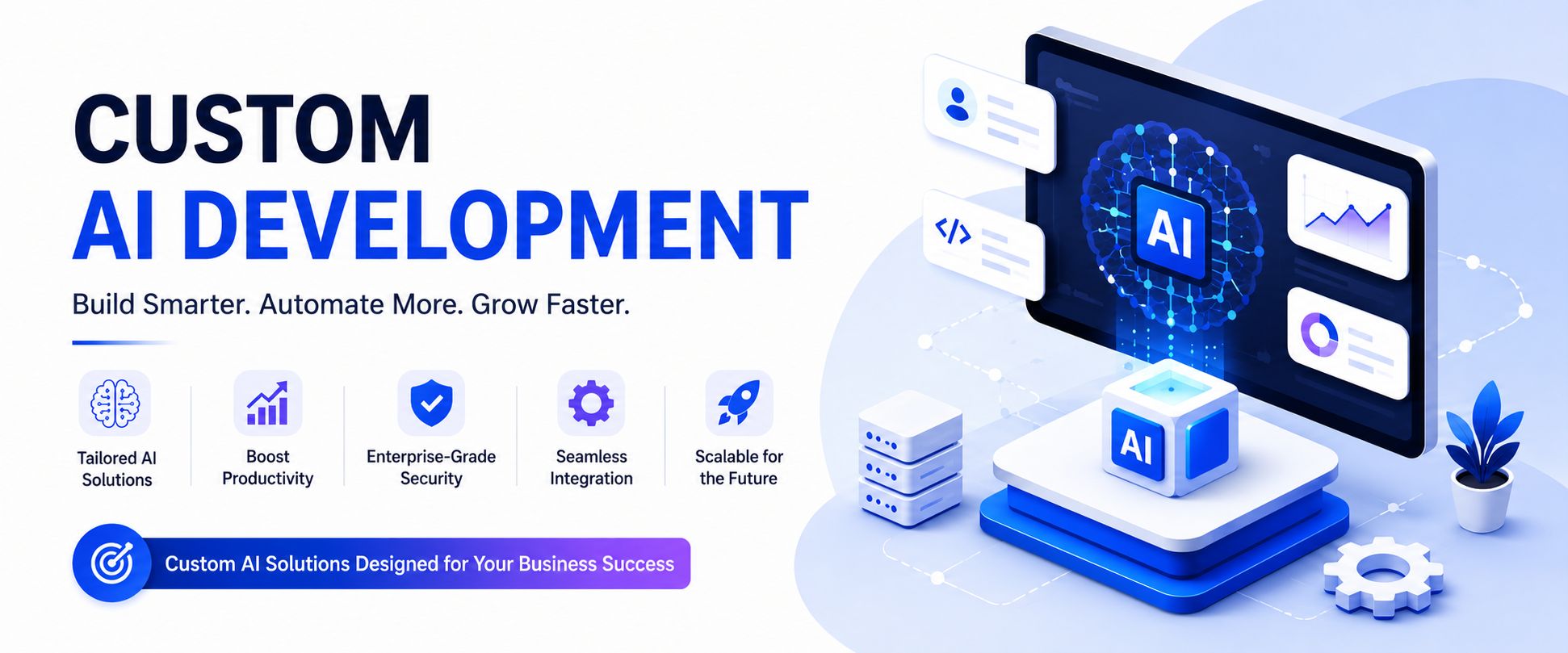
Custom AI Development Services
Artificial intelligence is no longer something businesses experiment with on the side. Companies are using AI to automate repetitive work, improve customer experiences, analyze data, support employees, and make faster business decisions.
But there is a problem with relying entirely on ready-made AI tools: they are built for broad use cases, not necessarily for the way your business operates.
A company may need an AI assistant connected to its internal knowledge base. Another may need a recommendation engine, predictive analytics platform, AI chatbot, or an intelligent workflow that connects several existing systems.
Custom AI development involves designing and building AI-powered software around a company's specific goals, data, workflows, and technology environment. Instead of changing your processes to fit a generic tool, you build a solution that fits the business.
This guide explains what custom AI development is, the services businesses can use, its benefits, development process, costs, challenges, and how to choose the right AI development company.
What is Custom AI Development?
Custom AI development is the process of designing, developing, integrating, and deploying an artificial intelligence solution for a specific business requirement.
Unlike off-the-shelf AI software, a custom solution can be designed around your:
-
Business processes
-
Customer requirements
-
Internal data
-
Existing software
-
Security requirements
-
Industry regulations
-
Growth plans
For example, an eCommerce company might develop an AI recommendation engine based on its customer and product data. A financial company could build an AI system for document processing and fraud detection. A SaaS company might integrate an AI assistant directly into its product.
The goal is not simply to "add AI." The goal is to solve a real business problem using AI.
What Services Are Included in Custom AI Development?
Custom AI development can cover everything from an initial strategy and proof of concept to development, integration, deployment, and ongoing optimization.
AI Strategy and Consulting
Before development starts, businesses need to understand where AI can actually create value.
AI consulting can help identify suitable use cases, evaluate existing technology, assess data readiness, define project requirements, and create an AI implementation roadmap.
A good strategy prevents businesses from investing in AI simply because it is trending.
Custom AI Assistant Development
AI assistants can help employees and customers access information, complete tasks, generate content, summarize documents, and interact with internal systems.
For example, an organization could build an internal assistant that searches company documents and answers employee questions using approved business information.
AI Chatbot Development
Custom AI chatbots can handle customer questions, lead qualification, appointment scheduling, product recommendations, support requests, and other conversations.
The major difference from a basic chatbot is that a custom solution can connect with business data, workflows, CRM systems, knowledge bases, and other applications.
Generative AI Development
Generative AI applications can create or transform content such as text, documents, images, code, summaries, and reports.
Businesses can use custom generative AI solutions for:
-
Content generation
-
Document analysis
-
Internal knowledge assistants
-
Research automation
-
Code assistance
-
Customer support
-
Report generation
AI Agent Development
AI agents go beyond answering questions. They can be designed to plan tasks, use tools, access information, and execute multiple steps within a defined workflow.
For example, an AI sales agent could research a prospect, collect relevant information, update a CRM, and prepare a follow-up message.
Machine Learning Model Development
Custom machine learning models can identify patterns in business data and support predictions or automated decisions.
Common applications include:
-
Demand forecasting
-
Fraud detection
-
Predictive maintenance
-
Customer churn prediction
-
Recommendation systems
-
Risk assessment
-
Sales forecasting
Enterprise AI Development
Large organizations often need AI solutions that work across departments and existing enterprise systems.
Enterprise AI development may involve integrations with CRM, ERP, cloud platforms, databases, internal applications, and business intelligence systems.
Security, scalability, governance, and data access become particularly important at this level.
Why Are Businesses Investing in Custom AI Solutions?
The biggest reason is simple: businesses have different problems.
A generic AI product may work well for one organization but provide limited value for another.
Custom AI gives businesses the flexibility to design technology around the problem they actually want to solve.
Common reasons businesses invest in custom AI include:
-
Automating repetitive processes
-
Reducing manual work
-
Improving customer support
-
Making better use of internal data
-
Improving decision-making
-
Increasing employee productivity
-
Personalizing customer experiences
-
Building new AI-powered products
-
Creating competitive differentiation
The strongest AI projects usually start with a business problem rather than a technology trend.
Also Read, Generative AI Development Services Guide 2026
What Are the Benefits of Custom AI Development?
Built Around Your Business
Custom AI solutions are designed around your workflows, users, data, and objectives. This makes them more relevant than generic software that offers the same functionality to every business.
Better Integration
A custom AI application can be connected to your existing systems, including CRM platforms, ERP software, databases, websites, mobile applications, and internal tools.
More Control Over Data
Businesses can define how data is collected, accessed, processed, stored, and used. This is particularly important for organizations handling confidential or regulated information.
Greater Flexibility
Your requirements may change as the business grows. A custom AI solution can be expanded with additional features, integrations, models, or workflows instead of forcing the company to replace the entire system.
Improved Operational Efficiency
AI can take over repetitive tasks and help employees spend more time on work that requires judgment, creativity, and human interaction.
Long-Term Business Value
Custom AI usually requires more planning and investment than purchasing a ready-made tool. However, when the solution addresses a valuable business problem, the long-term benefits can extend beyond simple automation.
Custom AI vs. Off-the-Shelf AI: Which Is Better?
Neither option is automatically better. The right choice depends on the business problem.
| Factor | Custom AI | Off-the-Shelf AI |
|---|---|---|
| Customization | High | Limited |
| Integration | Designed for your systems | Depends on available integrations |
| Data control | Greater control | Usually platform dependent |
| Flexibility | Highly adaptable | Limited by provider |
| Initial investment | Higher | Usually lower |
| Deployment | More planning required | Faster |
| Best for | Unique or complex requirements | Common use cases |
If your requirement is straightforward, an existing AI tool may be enough.
If AI needs to work with proprietary data, complex workflows, or business-specific systems, custom development may make more sense.
Also Read, Types of AI Development Services: 2026 Guide
How Does the Custom AI Development Process Work?
A successful AI project needs more than model development. The process usually involves several stages.
1. Define the Business Problem
Start by identifying what you want AI to improve.
Is the goal to reduce support workload? Improve forecasting? Automate document processing? Build an AI-powered product?
The clearer the problem, the easier it becomes to measure success.
2. Assess Data and Technology
The development team evaluates available data, existing applications, APIs, infrastructure, security requirements, and technical limitations.
Data quality is especially important because poor or incomplete data can affect AI performance.
3. Create the AI Strategy
The team selects an appropriate approach, technology stack, model strategy, integrations, and deployment architecture.
For some projects, using an existing AI model may be sufficient. Others may require fine-tuning, retrieval-augmented generation, machine learning models, or more specialized development.
4. Build a Proof of Concept or MVP
Instead of immediately building the entire system, businesses can start with a smaller version.
Browse our curated list of Top Companies on UpBusiness
A proof of concept or MVP helps validate whether the proposed solution works before making a larger investment.
5. Develop and Integrate
Once the approach is validated, the development team builds the production solution and connects it with relevant business systems.
6. Test and Optimize
AI applications need to be tested for accuracy, reliability, security, performance, and usability.
The team can then improve the system based on test results and user feedback.
7. Deploy and Monitor
Launching the AI solution is not the final step.
Performance should be monitored after deployment, with regular improvements to models, workflows, integrations, and security controls.
How Much Does Custom AI Development Cost?
There is no single price for custom AI development.
The total cost depends on factors such as:
-
Project complexity
-
Number of AI features
-
Data volume and quality
-
Model requirements
-
Integrations
-
Security requirements
-
Infrastructure
-
User interface
-
Development team
-
Maintenance requirements
A simple AI proof of concept can require significantly less investment than a production-ready enterprise AI platform.
Instead of choosing a provider solely based on the lowest quote, businesses should compare the expected business outcome, technical approach, scalability, security, and ongoing costs.
What Challenges Should Businesses Consider?
Data Quality
AI systems depend heavily on reliable data. Inconsistent, incomplete, or outdated information can affect the quality of AI outputs.
Integration
Connecting AI with legacy applications, databases, CRMs, ERPs, or other business systems can require significant technical work.
Security and Privacy
Businesses need appropriate access controls, data protection, security testing, and governance—especially when sensitive information is involved.
AI Accuracy
AI systems can produce incorrect or unreliable outputs. Testing, monitoring, human oversight, and appropriate safeguards are important for business-critical applications.
Ongoing Maintenance
AI systems need to evolve as data, business requirements, models, and customer expectations change.
Employee Adoption
Even a technically strong AI system can fail if employees do not understand how or when to use it. Training and change management should be part of the implementation plan.
How to Choose the Right Custom AI Development Company
Choosing an AI development partner is an important part of the project.
Don't evaluate companies only by the technologies they list on their website. Look for evidence that they can turn an AI idea into a reliable business solution.
Check Their AI Expertise
Look for experience in areas relevant to your project, such as:
-
Machine learning
-
Generative AI
-
Large language models
-
AI agents
-
Natural language processing
-
Computer vision
-
Predictive analytics
-
AI integrations
Review Relevant Case Studies
Ask whether the company has worked on projects similar to yours.
A provider that has solved a problem similar to yours may understand the technical and business challenges more quickly.
Evaluate Their Development Process
Ask how they handle discovery, prototyping, development, testing, deployment, and post-launch support.
A clear process is often a better indicator of project maturity than a long list of technologies.
Ask About Security
Understand how your data will be stored, accessed, processed, and protected.
For sensitive projects, discuss compliance, access controls, infrastructure, and deployment options before development begins.
Look at Verified Reviews
Reviews can provide useful insight into communication, delivery, technical expertise, and client experience.
However, don't rely on ratings alone. Look at the context behind the reviews and whether they relate to projects similar to yours.
Questions to Ask an AI Development Company Before Hiring
Before signing a contract, ask:
-
Have you built a similar AI solution before?
-
What AI approach would you recommend for our use case?
-
What data will the system require?
-
How will you protect our business data?
-
Will the solution integrate with our existing systems?
-
How will AI accuracy and performance be measured?
-
What will the MVP or proof of concept include?
-
What ongoing costs should we expect after launch?
-
Who owns the source code and intellectual property?
-
What support will you provide after deployment?
These questions can help separate companies that understand your business problem from those simply selling AI development.
What Are the Key AI Trends for Businesses in 2026?
AI development is moving from simple chat interfaces toward systems that can work with business data and perform meaningful tasks.
AI Agents and Agentic Workflows
Businesses are increasingly exploring AI systems that can complete multi-step tasks rather than simply generate responses.
Enterprise Generative AI
Companies are moving beyond public AI tools and building secure generative AI applications connected to internal knowledge and workflows.
Multimodal AI
AI systems can increasingly work across text, images, audio, video, and structured data, opening up new business applications.
AI-Powered Automation
AI is being combined with business automation to handle processes such as customer support, document processing, research, sales operations, and internal workflows.
Industry-Specific AI
Businesses are also looking at AI solutions designed for specific industries rather than relying exclusively on general-purpose applications.
Why Use UpBusiness to Find an AI Development Company?
Finding an AI development partner can be difficult when every company claims to offer the latest technology.
UpBusiness takes a different approach.
Businesses can discover and compare service providers through a trust-focused B2B marketplace designed to make provider selection easier.
Every company is verified, every review is verified, and only trusted companies qualify to be listed. This helps businesses focus on quality over quantity when searching for a development partner.
With UpBusiness, businesses can explore providers across:
-
Artificial Intelligence
-
Software Development
-
Web Development
-
Mobile App Development
-
SaaS Development
-
Digital Marketing
-
SEO
-
Data Analytics
-
Cloud Services
-
Cybersecurity
Instead of spending hours searching through hundreds of agencies, businesses can shortlist providers based on their requirements and compare potential partners with greater confidence.
Custom AI development: Conclusion
Custom AI development is no longer limited to companies building advanced research systems. Businesses of different sizes are using custom AI solutions to automate processes, improve customer experiences, make better use of data, and build new digital products.
Browse our curated list of Top Companies on UpBusiness