


Browse our curated list of LLM Fine-Tuning Companies
LLM fine-tuning cost in 2026 comes in two parts, and they are very different in size. The training run is cheap. Teaching an 8B open model on 12 million training tokens costs about $4 to $8 on a managed platform. The same job on Gemini 2.5 Flash costs about $60.
The project around that run is where the money goes. You need clean examples, a way to test the results, a few rounds of training and a way to run the model inside your product. With an offshore partner company, a typical business project costs $10,000 to $50,000. At US rates, the same work costs $40,000 to $150,000.
Fine-tuning means taking a model that already exists and training it a little more on your own examples. It learns your format, your tone or one specific task. This guide prices every part of that for a buyer: platform fees, GPU rental, people, hosting, and the cases where you should skip fine-tuning altogether.
Key takeaways
- Training compute is usually under 5% of the budget. Most of the hours go to preparing data and testing results.
- OpenAI is closing its fine-tuning service. New organizations lost access on 7 May 2026, and existing customers can't start new jobs after 6 January 2027.
- Training prices run from $0.34 per million tokens for small open models on Together AI to $25 per million for Gemini 2.5 Pro on Vertex AI.
- Hosting sets the yearly cost. A tuned model on a reserved GPU can cost $2,000 to $17,000 a month, while pay-per-token options bill only for what you use.
- The UpBusiness listing shows 7 partner companies with broader AI work. None names LLM fine-tuning on its profile yet, so ask any company for 2 or 3 past fine-tuning projects.
How Much Does LLM Fine-Tuning Cost in 2026?
A full fine-tuning project costs $10,000 to $50,000 for one clear use case built by an offshore partner company. The same work at US contract rates costs $40,000 to $150,000. Training compute is only $50 to $1,000 of that, even after several attempts.
The ranges below are our estimates. We built them from the platform prices and hourly rates you'll find later in this guide.
| Project type | Typical scope | Compute (all runs) | Offshore partner | US rates |
|---|---|---|---|---|
| Format or tone tuning | 500 to 2,000 examples, small open model or Gemini Flash, one task | $20 to $200 | $8,000 to $20,000 | $30,000 to $60,000 |
| Domain task model | 2,000 to 10,000 examples, sorting or pulling data from text, with a scored test set | $100 to $600 | $15,000 to $40,000 | $50,000 to $120,000 |
| Large model or preference tuning | 70B class model, SFT plus DPO, several rounds of data work | $300 to $3,000 | $35,000 to $80,000 | $100,000 to $250,000 |
Where you land in each range depends mostly on your data. Say you already have 5,000 clean, labelled support tickets. You'll sit near the bottom. If experts must write and check every example by hand, most of the budget is gone before training even starts.
Not sure fine-tuning is the right method? Our guide to custom AI development services compares prompting, retrieval, fine-tuning and training a model from scratch. This guide assumes fine-tuning is on the table and you need a budget.
What Drives LLM Fine-Tuning Cost?
Six things move the price. Here they are, biggest first.
- Data readiness. Examples you already have are cheap to prepare. Examples that people must write or fix are the most expensive part of the project.
- Model size. Bigger models cost more to train. Size is counted in parameters, the numbers a model learns during training. On Fireworks AI, LoRA training costs $0.50 per million tokens for models up to 16B parameters and $3.00 from 16.1B to 80B[1].
- Method. LoRA trains a small add-on instead of the whole model, and it is the usual choice. Full training costs twice as much per token on Fireworks AI. Preference tuning (DPO), which teaches the model which of two answers is better, costs more again.
- Dataset size and epochs. Platforms charge per training token. That is the size of your dataset multiplied by the number of epochs, which is how many times the model reads it.
- Number of attempts. Few projects get it right first time. Plan for three to five training runs while you fix the data.
- Hosting. Running the tuned model after launch often costs more in a year than everything above put together.
Fine-Tuning Prices by Platform: OpenAI, Gemini, Bedrock, Together and Fireworks
Managed platforms are the cheapest way to run the training. You send your data, they run the job, and you pay only for the tokens processed. You never pay for a GPU sitting idle. A token is a small piece of text, roughly three quarters of a word.
Here are the published training prices in October 2026.
| Platform | Model | Training price | After training |
|---|---|---|---|
| Together AI[2] | Llama 3.1 8B, Qwen3.5 9B (LoRA SFT) | $0.34 per 1M tokens, $4 minimum per job | Serverless or dedicated endpoint |
| Together AI | Llama 3.3 70B (LoRA SFT) | $2.03 per 1M tokens | Serverless or dedicated endpoint |
| Fireworks AI[1] | Models up to 16B (LoRA SFT) | $0.50 per 1M tokens | Same price as the base model |
| Fireworks AI | Models 16.1B to 80B (LoRA SFT) | $3.00 per 1M tokens | Same price as the base model |
| Google Vertex AI[3] | Gemini 2.5 Flash (SFT) | $5 per 1M tokens | Base model price in the global region |
| Google Vertex AI | Gemini 2.5 Pro (SFT) | $25 per 1M tokens | Base model price in the global region |
| Google Vertex AI | Llama 3.3 70B (SFT) | $6.72 per 1M tokens | Your own endpoint |
| Amazon Bedrock[4] | Claude 3 Haiku and Llama models | Per 1M tokens, varies by model | Provisioned Throughput required |
| OpenAI[5] | o4-mini (reinforcement fine-tuning) | $100 per training hour | $4 input and $16 output per 1M tokens |
SFT in the table stands for supervised fine-tuning: you show the model example questions with the answers you want. Now a real example. Take a dataset of 4 million tokens and train on it 3 times. That is 12 million training tokens, or about 5,000 support conversations of 800 tokens each.
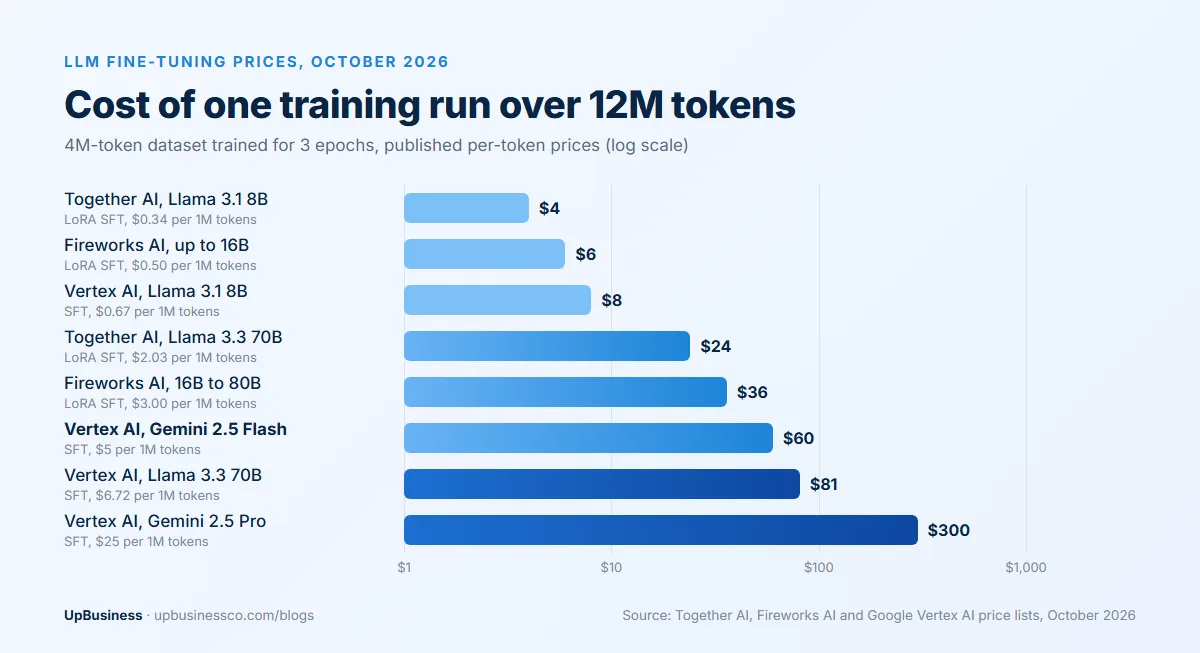
That job costs about $4 on Together AI and $6 on Fireworks AI. On Gemini 2.5 Flash it costs $60, and on Gemini 2.5 Pro it costs $300. Even the top price is less than one day of an engineer's time. So don't pick a platform on training price. Pick it on how well the model does your task, where your data is allowed to go and where you want to run the result.
Is OpenAI still offering fine-tuning?
Only for existing customers, and only until 6 January 2027. OpenAI is shutting the service down in steps. New organizations lost access on 7 May 2026. Organizations that hadn't used a tuned model in the previous 60 days lost access on 2 July 2026. Everyone else can't start new jobs after 6 January 2027[6].
Models you have already tuned keep running until their base model is retired. The only model left on the price list is o4-mini, at $100 per training hour[5]. If a proposal plans a new GPT fine-tune, ask the partner company what happens after January 2027.
Can you fine-tune Claude?
Not through Anthropic's own API. You can do it on Amazon Bedrock, where fine-tuning for Claude 3 Haiku is available in the US West (Oregon) region[7]. There is a catch. The tuned model only runs on Provisioned Throughput, which means you rent reserved capacity by the hour on top of the training job.
Renting GPUs: What Self-Hosted Fine-Tuning Costs
You can also rent GPUs, the chips that train and run models, and use free open-source training tools yourself. Then you pay by the hour instead of by the token. This makes sense if you train often, want full control of the model or can't send your data to an outside service.
On RunPod in October 2026, an H100 PCIe costs $2.89 an hour. An H100 SXM costs $3.99, an H200 costs $5.29 and a B200 costs $7.99[8].
How long does training take? Spheron's examples put a 70B model trained with QLoRA on 25,000 examples at about 10 hours on one H100 PCIe. A 70B LoRA run takes 8 to 14 hours on two H100 SXM cards[9]. At RunPod's prices, that is about $29 for the QLoRA run and $64 to $112 for the LoRA run. Training every part of a 70B model needs a cluster of GPUs and costs thousands of dollars per run.
The hidden cost is people. Someone has to set up the tools, check the results and fix failed runs, and that person costs more per hour than the GPU. If you only train once or twice a year, a managed platform usually works out cheaper.
LoRA vs Full Fine-Tuning: How Method Changes the Bill
LoRA leaves the original model alone and trains a small add-on next to it. It needs less GPU memory, finishes faster and costs less. QLoRA goes one step further. It packs the model into a smaller format first, so even a 70B model can train on a single 80 GB GPU. Full fine-tuning changes every part of the model and needs far more memory and many more GPUs.
| Method | Fireworks AI, models up to 16B | Fireworks AI, 16.1B to 80B | When to use it |
|---|---|---|---|
| LoRA SFT | $0.50 per 1M tokens | $3.00 per 1M tokens | Most business tasks: format, tone, sorting, pulling data from text |
| LoRA DPO | $1.00 per 1M tokens | $6.00 per 1M tokens | Teaching the model which answers you prefer |
| Full SFT | $1.00 per 1M tokens | $6.00 per 1M tokens | Big changes in behaviour, after LoRA has been tried |
| Full DPO | $2.00 per 1M tokens | $12.00 per 1M tokens | Rare in business projects |
Together AI shows the same pattern. LoRA training on Llama 3.1 8B costs $0.34 per million tokens, and LoRA DPO costs $0.84[2]. For most business projects, LoRA is enough. If a partner company proposes full fine-tuning, ask to see the LoRA result it is trying to beat.
The Labour Cost: Data, Evaluation and Engineering
People cost far more than GPUs. The GSA CALC database of US federal contract rates shows what the roles cost. Data scientists have a median ceiling rate of $169 an hour (1,516 rates from 481 contractors). Machine Learning engineers sit at $170 (62 rates) and AI engineers at $175 (83 rates)[10]. These are maximum rates for government buyers, and commercial quotes are often lower.
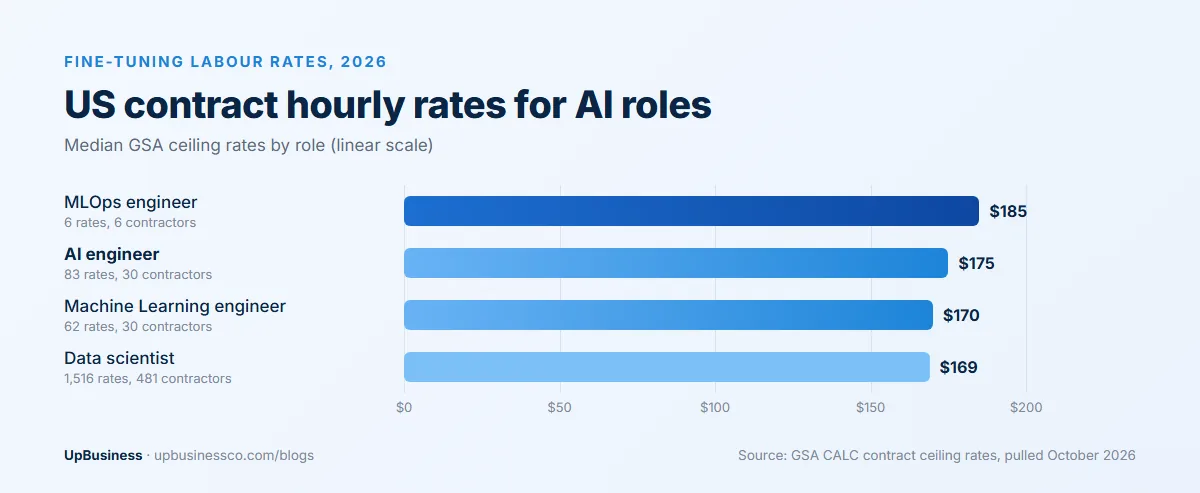
Offshore rates are much lower. Senior AI engineers in India bill about $50 to $75 an hour on client work, as our AI developer rates guide explains. That gap is most of the difference between the offshore and US columns in the first table.
The hours go to four places.
- Collecting and cleaning data. Pulling examples from tickets, documents or chat logs, removing personal data and fixing wrong labels. In our estimates, this takes 35% to 45% of the hours.
- Evaluation. Building a test set the model never sees in training, plus rules for scoring its answers. This is how you prove the tuned model beats the original. Skip it and you can't tell whether the money worked.
- Experiments. Train, read the mistakes, fix the data and train again.
- Deployment. Running the model, connecting it to your product and watching how it behaves. Our guide to AI integration services covers this step.
How much data do you need to fine-tune an LLM?
Less than most buyers think. OpenAI's documentation sets a minimum of 10 examples and reports clear gains from 50 to 100[11]. Google suggests starting Gemini tuning with 100 examples and growing to thousands if needed[12]. Quality beats quantity. Five hundred carefully checked examples often do better than ten thousand scraped ones, and they cost far less to prepare.
What Does a Fine-Tuned Model Cost to Run?
You pay for training once. You pay for hosting every month, and it is the line most cost guides leave out.
| Hosting option | How it is billed | Monthly cost if always on |
|---|---|---|
| Gemini on Vertex AI, global region[3] | Per token, same as the base model | Usage only |
| Fireworks AI serverless[1] | Per token, same as the base model | Usage only |
| One H100 PCIe on RunPod, open model | $2.89 per hour | About $2,110 |
| Amazon Bedrock custom model[4] | $23.50 per model unit hour, no commitment, plus $1.95 storage | About $17,150 per model unit |
The Bedrock figure uses the no-commitment price AWS lists for custom Llama models. One- and six-month commitments cost less per hour. Either way, a model that must be ready all day on reserved capacity can cost more in one month than the whole training project. If your traffic is low or uneven, start with an option that bills per token.
Plan for retraining too. When your products, policies or tone change, the training data goes out of date. Most teams retrain every three to six months, and each round repeats part of the data and testing work.
A Worked Example: Fine-Tuning a Support Assistant
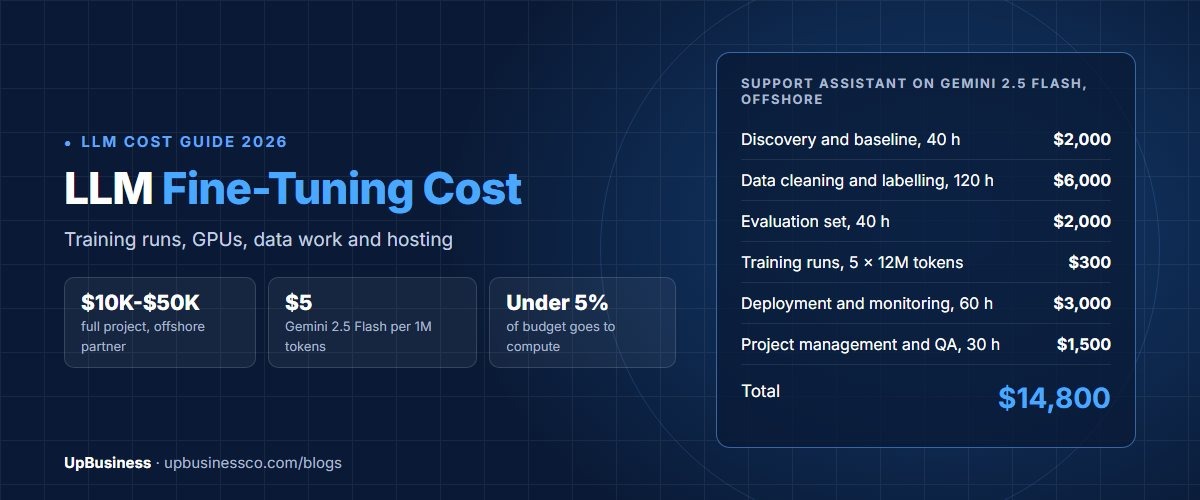
Here is a realistic first project. A company tunes Gemini 2.5 Flash on 3,000 past support replies, so its assistant answers in the company's own tone and format. It runs on Vertex AI in the global region, where each answer costs the same as the base model. The hours are our estimate for a partner company doing the whole job.
| Line | Hours or units | Offshore partner ($50/h) | US rates ($170/h) |
|---|---|---|---|
| Discovery and a baseline test with prompting | 40 hours | $2,000 | $6,800 |
| Data extraction, cleaning and labelling | 120 hours | $6,000 | $20,400 |
| Test set and scoring | 40 hours | $2,000 | $6,800 |
| Training runs on Gemini 2.5 Flash | 5 runs of 12M tokens | $300 | $300 |
| Deployment, integration and monitoring | 60 hours | $3,000 | $10,200 |
| Project management and QA | 30 hours | $1,500 | $5,100 |
| Total | 290 hours | $14,800 | $49,600 |
Compute is $300 of the total. That is about 2% of the offshore budget and under 1% at US rates. After launch, the company pays Gemini 2.5 Flash prices for each reply, plus a retraining round of perhaps 60 to 80 hours twice a year. If the same assistant needed its own 70B model on reserved GPUs, hosting alone could pass $25,000 a year.
LLM Fine-Tuning vs RAG vs Prompting: Which Costs Less?
Prompting is the cheapest way to start. RAG costs more to build but keeps answers up to date. Fine-tuning costs the most up front, but it can lower the cost of each request when volume is high. Each one solves a different problem, and many projects use two of them together.
A quick guide to the terms. Prompting means writing better instructions for a model you don't change. RAG (retrieval-augmented generation) means the model looks up your documents before it answers.
| Approach | Upfront cost | Best for | Weak spot |
|---|---|---|---|
| Prompting | Low: days of work | Most tasks with a strong base model | Long prompts raise the cost of each request |
| RAG (cost guide) | Medium: build plus a vector database | Answers from your documents that change often | Doesn't reliably change style or format |
| Fine-tuning | Highest: data and testing work | Fixed format, tone, sorting, shorter prompts | Knowledge goes out of date; retraining needed |
OpenAI explained its reasons when it announced the shutdown. Newer models follow instructions and formats so well that prompting is now cheaper and faster for many old fine-tuning jobs[13]. Fine-tuning still pays off in two cases. The first is when you send millions of requests a month and a small tuned model can replace a large model with a long prompt. The second is when you need a fixed output format that prompting can't hold. Test prompting first, and fine-tune only to beat a result you have measured.
Which LLM Fine-Tuning Partner Companies Are on UpBusiness?
The LLM fine-tuning companies listing on UpBusiness showed 7 partner companies in October 2026. All of them do broader AI work. None of them names LLM fine-tuning as a service on its profile yet.
That does not mean they can't do the job. It means you should check first. Before you hire any company, ask for 2 or 3 past projects where it fine-tuned a model. Ask which base model it used, how much data it prepared and which score improved. Ask what the hosting cost after launch. A team that has done this work will answer with real numbers. Compare those answers with the cost ranges in this guide.
How to Lower LLM Fine-Tuning Cost
- Prove you need it. Spend a week testing prompts against a written test set. If prompting hits your target, you have saved the whole project.
- Start small. Tune an 8B model or Gemini Flash before a 70B model. Move up only if the test shows the small model falls short.
- Use LoRA. It is the default for a reason, and it costs a fraction of full training.
- Pay for better data, not more data. A few hundred checked examples beat thousands of messy ones and cost less to prepare.
- Host per token. Pay per request until your traffic is high and steady enough for a dedicated GPU.
- Own your data. Make sure the contract says you keep the dataset and the test set. They are the expensive part, and you'll need them every time you retrain.
How to Get an Accurate Fine-Tuning Quote
Ask every partner company to price the same scope, line by line: discovery, data preparation, testing, training runs, deployment and monthly hosting. Then ask three more questions. What result do you expect from prompting alone? Which score will you report? What does one retraining round cost? A proposal that prices only the training run is missing most of the bill.
Our guide to generative AI development services lists more questions for choosing a partner, and the AI chatbot development cost guide prices the assistant built around the model.
When you're ready, post your project on UpBusiness with your use case, data volume and hosting needs. We'll match you with verified LLM fine-tuning partner companies that fit your budget.