


Generative AI development services plan, build and run apps on top of large language models. Common examples are assistants that answer from your documents, agents that do tasks inside your systems, and tools that draft content, code or reports. Most companies now use AI. McKinsey's 2025 State of AI survey found 88% of organisations now use AI in at least one part of the business.
The harder questions are what it costs and whether it pays back. Only about a third of firms use AI across the whole company. MIT research also found that most generative AI pilots never show a clear effect on profit.
This guide is for the person who signs off the budget. That is usually a founder, a CTO or an operations head hiring an outside team. It covers what you can build and what each type of project costs in US dollars. It also compares rates in India and the US and explains what advice-only work looks like. Finally, it shows how to pick a partner company that has built working systems before.
Key takeaways
- Model fees are rarely the big cost. At current list prices, an assistant that answers 100,000 questions a month costs about $215 to $2,200 in model use, depending on the model.
- The build is where the money goes. Agency estimates put a RAG knowledge assistant at $25,000 to $60,000 and an enterprise platform at $160,000 or more.
- India changes the maths. Mid-level AI engineers in India bill overseas clients $35 to $50 an hour. The median US software developer's salary alone works out to about $65 an hour, before benefits and other costs.
- Our generative AI listing on UpBusiness shows 8 companies (October 2026). Only one of them, Rain Infotech, names generative AI as a service on its profile. Its average project size is $1,000.
What Generative AI Development Services Include
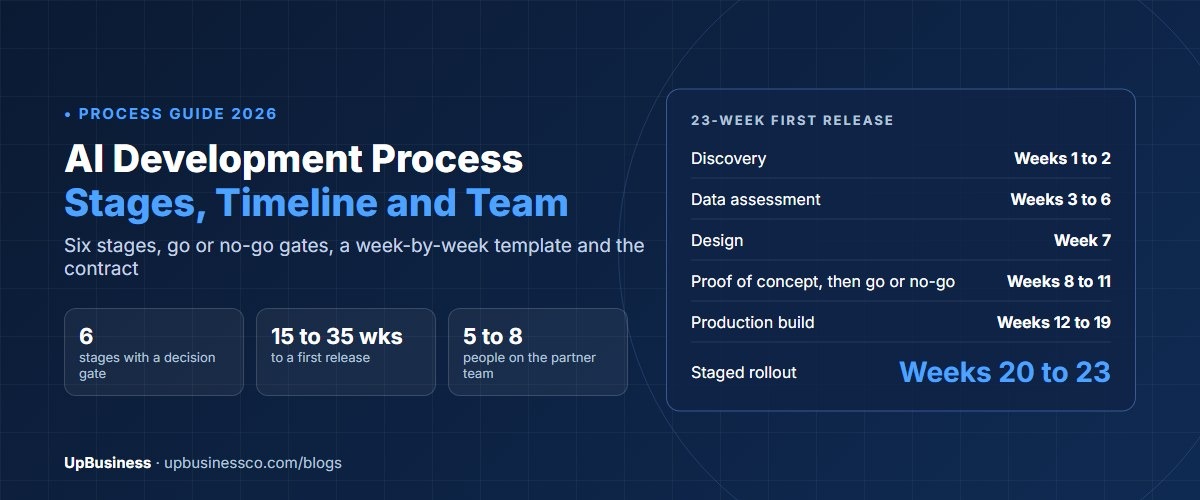
Most projects fall into one of six types. Knowing which one you need keeps scope, cost and timelines real. For how any of them runs from discovery to launch, see our guide to the AI development process.
| Service | What you get | Typical use |
|---|---|---|
| Generative AI consulting | Use-case selection, ROI case, data readiness check, roadmap | Deciding where to start and what to avoid |
| LLM integration | A language model connected to an existing app, CRM or helpdesk through an API | Summaries, drafting, classification inside tools your team already uses |
| RAG assistants (retrieval-augmented generation) | An assistant that answers from your own documents, policies and data, with citations | Internal knowledge search, customer support, sales enablement |
| AI agents | Assistants that take actions: update records, raise tickets, process refunds | Multi-step workflows in operations, finance and support |
| Fine-tuning | A model adapted to your tone, format or domain using your examples | Consistent outputs at high volume, specialised terminology |
| Document and content automation | Pipelines that read, extract and generate documents at scale | Invoices, contracts, reports, product descriptions |
For most businesses, a RAG assistant or a model linked into an existing tool is the right first project. A RAG assistant looks up your own documents before it answers. It uses data you already have and needs no model training. It usually shows value within weeks. If you're still deciding whether to build at all, our guide on custom AI vs off-the-shelf AI covers when a ready-made tool is the cheaper answer.
Generative AI Development Companies on UpBusiness
Our generative AI companies listing shows 8 partner companies. Only one of them names generative AI as a service on its profile. The others list broader AI work, such as AI solutions or custom AI. So ask any company on the listing to show you its generative AI projects before you hire. The one company below passed our manual checks of registration papers, founder identity and three client projects. It holds a TrustScore of 70 or more out of 100.
| Partner company | Main focus | Average project size | Team | TrustScore |
|---|---|---|---|---|
| Rain Infotech | Generative AI solutions and AI development | $1,000 | 11-50 | 70.67 |
Average project size is the average Rain Infotech reports across its client work. It is not a minimum price. Rain Infotech is based in Surat, and generative AI makes up 20% of the services on its profile. At an average of $1,000, it fits a small test project. For an assistant or agent inside your CRM, ERP or document store, ask every company for a demo of a generative AI system it runs today. If you'd rather not shortlist yourself, post your requirement and we'll match you with three.
How Much Does Generative AI Development Cost?
1. Model usage (pay per use)
Model providers charge per million tokens. A token is about three-quarters of an English word. Take an assistant that handles 100,000 questions a month. Each question sends about 3,000 tokens of question plus looked-up text, and gets back a 500-token answer. That's 300 million input tokens and 50 million output tokens a month. The figures below use October 2026 list prices.
| Model tier (example) | List price per million tokens (input / output) | Approx. monthly model cost |
|---|---|---|
| Small, fast model (Google Gemini Flash-Lite) | $0.30 / $2.50 | $215 |
| Mid-tier model (Anthropic Claude Sonnet) | $2 / $10 | $1,100 |
| Top-tier model (Anthropic Claude Opus) | $4 / $20 | $2,200 |
OpenAI, Google and Anthropic all sell several model sizes and change prices often. Google's own page already lists higher rates for some models from December 2026. Check the pricing pages before you budget. Two habits cut the bill sharply. Send simple questions to a small model. And send only the most useful passages with each question, not whole documents.
2. The build by project type (one-time)
The build is usually the largest single cost. It covers planning, getting data ready, designing prompts and search, linking to your systems, testing with real examples, safety limits and launch. Estimates from two development agencies give a useful range by project type.
| Project type | Build cost | Typical timeline |
|---|---|---|
| RAG internal search assistant, one data source | $25,000 to $60,000 | 6 to 10 weeks |
| Customer-facing assistant with CRM or catalogue integration | $60,000 to $120,000 | 10 to 14 weeks |
| Document processing with human review | $100,000 to $160,000 | 14 to 20 weeks |
| Content generation tool | $40,000 to $120,000 | Not published |
| AI copilot inside an existing product | $50,000 to $150,000+ | Not published |
| Agentic workflow automation | $80,000 to $200,000+ | Not published |
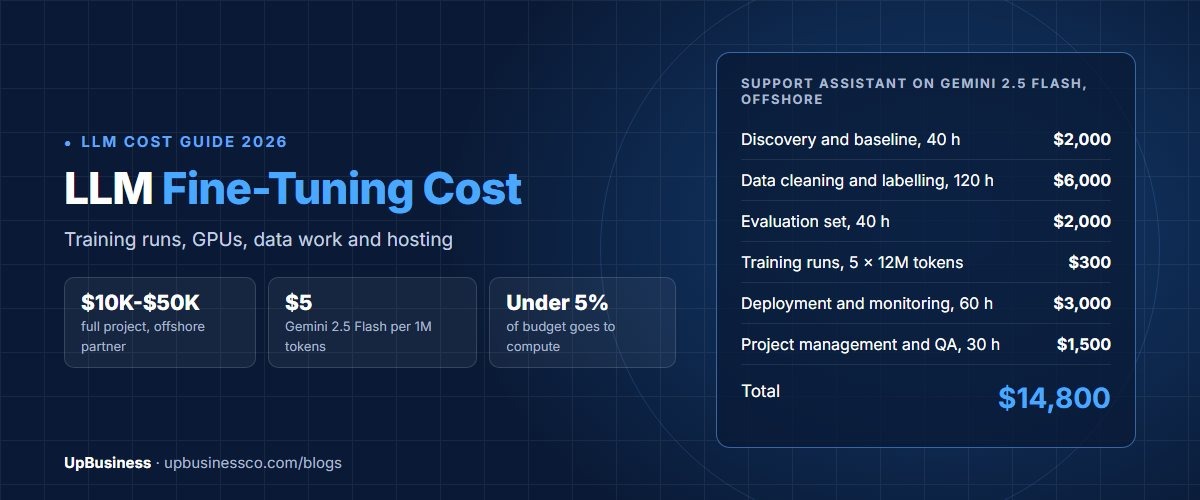
| Fine-tuning, added on top of prompting and RAG | +$30,000 to $80,000 | Adds about 3 months |
Treat these as a starting point, not a price list. Both sources are agencies quoting their own work. Their ranges overlap and sometimes disagree; one puts RAG apps as high as $180,000. They do agree on where the money goes: getting data ready, deep links to your systems, and testing. It does not go on the model itself. One estimate puts data work alone at 15% to 30% of a project.
Within any project type, these things move a quote the most:
| Cost driver | Lower cost | Higher cost |
|---|---|---|
| Data readiness | Clean, current documents in one place | Scattered files, scanned PDFs, conflicting versions |
| Integrations | Read-only access to one system | Read and write access to ERP, CRM and payment systems |
| Languages | English only | Hindi, regional languages, voice |
| Risk level | Internal drafts reviewed by staff | Customer-facing answers, financial or medical decisions |
| Approach | Existing model through an API, with RAG | Fine-tuning or hosting your own model |
3. Team rates: India vs the US
Engineering time makes up much of the build cost. Where the team sits changes that number a lot. 2026 rate cards show what Indian AI engineers charge overseas clients. Juniors bill $25 to $35 an hour, mid-level engineers $35 to $50 and seniors $50 to $75. Engineers who build live agent systems charge $65 to $110.
In the US, the Bureau of Labor Statistics reports a median software developer salary of $135,980 (May 2025). Over a 2,080-hour working year, that's about $65 an hour in pay alone. Benefits, office space, hiring and the margin an agency adds all come on top.
Here is what this means for a budget. Say a RAG knowledge assistant needs three mid-level engineers for eight weeks at 40 hours a week. That's 960 hours. At $35 to $50 an hour, it comes to $33,600 to $48,000. The same hours from a US team at a modest $100 an hour would cost $96,000. Real Indian quotes vary much more than that, because team mix and scope differ. Still, the gap is the main reason global buyers send generative AI work to India.
There are trade-offs to plan for. Working hours overlap little with the US. Senior generative AI engineers in India are hard to find. One rate card notes that only a small group earns the top rates. You'll also need clear written specs and weekly demos to manage a remote team well. For more on rates by level, see our guide to AI developer rates in India.
4. Running costs (monthly)
A generative AI system isn't finished at launch. Its answers drift as your documents change. Someone has to watch quality, update content and re-test after model upgrades. Budget for these lines every month.
| Running cost | Typical range | Notes |
|---|---|---|
| Model usage | $215 to $2,200 a month at 100,000 queries | Depends on model tier and context size (see above) |
| Vector database | From $0 (free tier) to $50 or $500 monthly minimums | Pinecone's Standard plan has a $50 monthly minimum and Enterprise a $500 minimum |
| Monitoring and evaluation | $200 to $800 a month | Logging, answer-quality checks, alerting |
| Maintenance and updates | 15% to 30% of the build cost a year | Content updates, prompt changes, re-testing after model upgrades |
For a mid-sized internal assistant, that usually adds up to $500 to $2,000 a month, plus the yearly upkeep budget. Ask every partner company to state its support fee apart from the build price. Otherwise you can't compare the quotes fairly.
5. What the generative AI partner company on UpBusiness charges
Agency estimates tell you what one company thinks a project should cost. Our own listing data is thin here. Our generative AI listing shows 8 companies (October 2026), but only Rain Infotech names generative AI as a service on its profile. The others list broader AI work. Rain Infotech is based in Surat, has 11 to 50 people and holds a TrustScore of 70.67. Its average project size is $1,000. That is an average across its client work, not a minimum.

Browse our curated list of Top Generative AI Companies
One company is not a market sample, so treat this as a single data point. For a live RAG assistant, plan around the agency ranges above. Then compare quotes from several teams on the same scope.
Generative AI Consulting and Development Services: When to Start With Consulting
Not every buyer is ready for a build. You may not yet know which task to automate, whether your data is good enough, or how you'd measure success. If so, a short advice project is the cheaper first step. A good one usually gives you four things. First, a ranked list of uses with an estimated return for each. Second, a review of the documents and systems involved. Third, a suggested build approach: API, RAG, fine-tuning or running your own model. Fourth, a scoped, priced plan for the first project.
Ask for a fixed fee and a fixed timeline, usually a few weeks. Make sure you own the results too. Then you're free to take the plan to a different partner company. A simple rule helps here.
A focused planning project should cost a small part of the build, nowhere near a full build budget. Be careful with advice that ends in a slide deck with no data review and no priced next step. That's work you'll end up paying for twice.
Use Cases That Pay Off First
Start where volume is high, the rules are clear and success is easy to measure. Customer support is the classic example. An assistant answers routine questions from your help content and passes the harder cases to people. Our guide to AI chatbots in customer service covers the costs and tools.
Internal knowledge assistants are another quick win. Staff can search policies, SOPs and past projects in plain language instead of digging through shared drives. Document processing works well too. The system pulls fields out of invoices, purchase orders, KYC papers and contracts. Then it checks them against your rules before anyone signs off.
Sales teams use generative AI to draft proposals, RFP answers and follow-up emails from their own product details. Developers use coding assistants to finish code, write tests and draft docs. Reporting gets faster when raw data and meeting notes become first-draft summaries. Someone reviews them before they go out.
Be careful with agents that act fully on their own. Gartner predicts that over 40% of agentic AI projects will be cancelled by the end of 2027. The reasons are rising costs, unclear value or weak risk controls. Start with an assistant that suggests. Let it act on its own only once its accuracy is proven on real cases.
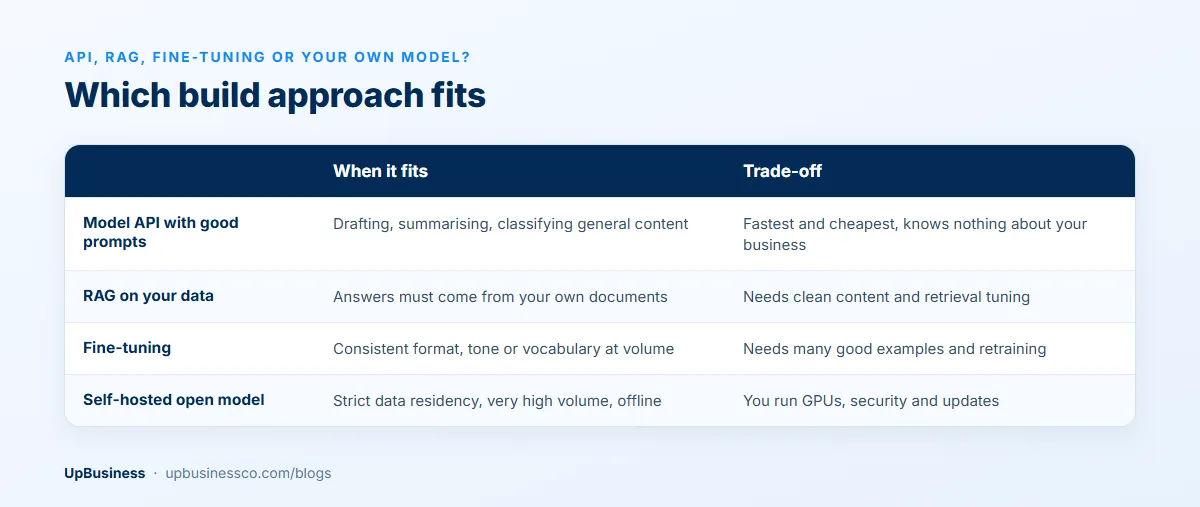
Build Approach: API, RAG, Fine-Tuning or Your Own Model?
| Approach | When it fits | Trade-off |
|---|---|---|
| Model API with good prompts | Drafting, summarising, classifying general content | Fastest and cheapest, but knows nothing about your business |
| RAG on your data | Answers must come from your documents, policies or catalogue | Needs clean source content and retrieval tuning |
| Fine-tuning | You need a consistent format, tone or domain vocabulary at high volume | Needs hundreds to thousands of good examples; retraining when things change |
| Self-hosted open model | Strict data residency, very high volume, or offline use | You run the GPUs, security and updates yourself |
Most businesses should start with an API plus RAG. Add fine-tuning only when you measure a gap that better search can't close. If you need GPU power in India, the government's IndiaAI Mission is building shared AI computing for Indian startups and researchers. It was approved in March 2024 with a budget of $1.1 billion.
Why Generative AI Projects Fail (and How to Avoid It)
Gartner expected at least 30% of generative AI projects to be dropped after the test stage by late 2025. It named bad data, weak risk controls, rising costs and unclear value. Bad source data comes first on that list, and it is the easiest to underrate. If your documents are out of date or contradict each other, the assistant will repeat the mistakes. Fix the content before you build anything on it.
The second cause is having no measure of success. "Use AI" isn't a goal. Agree on one number before you start, such as hours saved per week, share of questions solved, or documents handled per day. Measure it before launch as well as after.
Weak risk controls come next. That means no review step for high-stakes answers and no limits on what the system can do. Add human approval wherever mistakes are costly. Then there are pilots that never meet real work. A demo that isn't linked to the tools people use every day won't get used, however good it looks in a meeting.
Costs can also run away. Usually whole documents go out with every question, or the largest model handles everything. Measure the cost per task from the first week. And handle personal data with care. India's DPDP Act covers personal data in prompts, documents and chat logs, and buyers in Europe face GDPR on the same data. Collect only what you need. Confirm in writing where your provider stores it.
How to Choose a Generative AI Development Company
Ask every partner company on your shortlist the same questions.
- Show me a live system. Ask for a generative AI product they built that is in use today, not a demo, and the result it delivers.
- How will you measure accuracy? Good teams build a test set of real questions and track answer quality before and after launch. Our guide on evaluating a RAG chatbot proposal lists what that test set should contain.
- How do you prevent wrong answers? Look for answers based on your data, with sources, confidence limits and human review for high-risk cases.
- Which models will you use, and why? They should compare at least two providers on cost and quality for your use, and avoid tying you to one.
- Where will our data go? Get clear answers on where it is stored, how long it is kept, who can access it and how they meet DPDP or GDPR.
- What happens after launch? Monitoring, content updates, re-testing and support terms belong in the contract, priced apart from the build.
Partner evaluation checklist
- At least one generative AI system in live use, with measured results.
- Experience with RAG, AI agents and system links like yours.
- A testing process you can see.
- Support for Indian languages, if your users need it.
- Clear data handling, security and DPDP practices.
- Fixed scope, milestones and support after launch, in writing.
UpBusiness doesn't have published client reviews for these companies yet. So ask each one for a reference client you can speak to. For larger programmes that touch ERP, CRM and many teams, our guide to enterprise AI development covers governance and a 90-day rollout plan. You can compare verified generative AI development companies on UpBusiness by TrustScore, team size and average project size. You can also browse the wider list of AI development companies, or post your project to get matched with suitable partner companies.
The Bottom Line
Generative AI is now a standard business tool. Model fees have dropped so far that usage rarely holds a project back. The money goes into the build and the upkeep. Those vary so much between teams that the same assistant can cost $25,000 from one and three times that from another.
Projects that work tend to have one clear use, clean data and a measure of success agreed up front. They're also run by a partner company that has built working systems before. Start with one measured project, compare quotes on the same scope, and grow what proves itself.
Browse our curated list of Top Generative AI Companies
Comments 1
This is a valuable comparison of different approaches to building software solutions for businesses. Generative ai development can help organizations create smarter applications and streamline complex workflows. Thanks for sharing these useful insights into modern software innovation.