
UpBusiness
Back to Blog

Custom AI vs Off-the-Shelf AI: Complete Business Decision Guide for 2026

20 Jun 2026
Custom AI vs Off-the-Shelf AI: Complete Business Decision Guide for 2026

Custom AI vs Off-the-Shelf AI: Which Is the Right Choice for Your Business in 2026?

Many businesses want to adopt artificial intelligence, but one major question slows down decision-making:

Should you build a custom AI solution or buy an existing AI product?

The answer affects implementation speed, scalability, long-term costs, competitive advantage, and business outcomes.

Some organizations invest heavily in custom AI development only to discover they lacked the data, resources, or internal expertise needed to maintain it. Others purchase off-the-shelf AI software and later realize it cannot support their unique workflows or business goals.

As AI adoption accelerates across industries, decision-makers must evaluate whether a tailored AI system or a ready-made AI solution delivers the best return on investment.

This guide explains the differences between Custom AI and Off-the-Shelf AI, compares costs and benefits, identifies common risks, and provides a practical framework for selecting the right solution.

Quick Answer - 

Custom AI is best for organizations with unique business requirements, proprietary data, complex workflows, or long-term competitive differentiation goals.

Off-the-Shelf AI is best for businesses that need faster deployment, lower upfront investment, standardized functionality, and reduced implementation complexity.

In most cases:

Business Need Recommended Option
Fast deployment Off-the-Shelf AI
Lower initial investment Off-the-Shelf AI
Unique workflows Custom AI
Competitive differentiation Custom AI
Enterprise-scale integration Custom AI
Proof of concept projects Off-the-Shelf AI
Long-term AI strategy Custom AI

Table of Contents

  1. What Is Custom AI?

  2. What Is Off-the-Shelf AI?

  3. Custom AI vs Off-the-Shelf AI: Key Differences

  4. Benefits of Custom AI

  5. Benefits of Off-the-Shelf AI

  6. Common Challenges and Risks

  7. Cost Considerations

  8. Real-World Business Use Cases

  9. UpBusiness Vendor Evaluation Framework™

  10. How to Choose the Right AI Solution

  11. Why Businesses Choose UpBusiness

  12. FAQs

  13. Conclusion


What Is Custom AI?

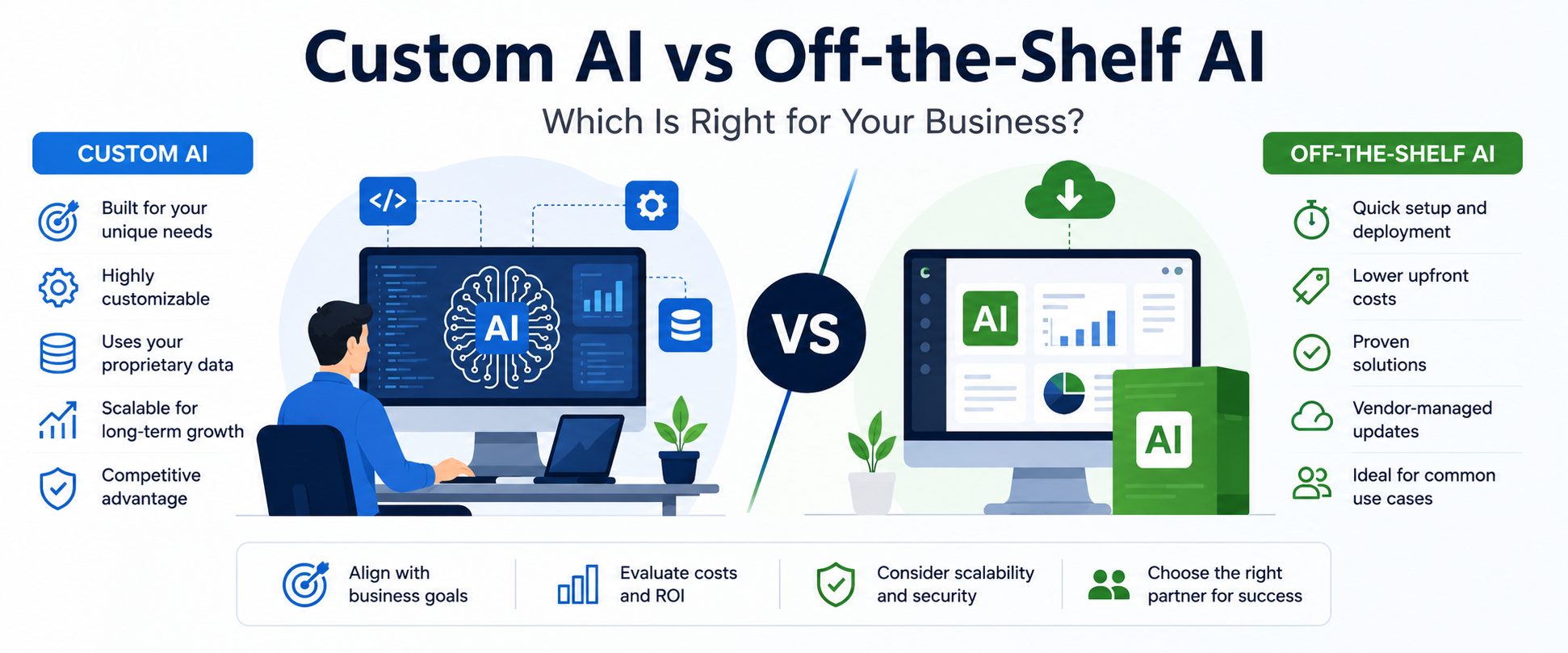
Custom AI refers to artificial intelligence systems designed specifically for a company's requirements, workflows, data sources, and business objectives.

Unlike generic AI software, custom AI solutions are built to solve unique organizational challenges.

Key Characteristics of Custom AI

  • Tailored to specific business processes

  • Built around proprietary datasets

  • Supports unique workflows

  • Flexible integration capabilities

  • Scalable according to business growth

  • Provides competitive differentiation

Examples of Custom AI Applications

Customer Support Automation

An enterprise develops a custom AI assistant trained on internal documentation, policies, and customer history.

Predictive Analytics

A retailer builds machine learning models using historical sales and inventory data.

AI-Powered Operations

A logistics company develops AI systems for route optimization and demand forecasting.

Businesses seeking specialized AI capabilities often work with providers listed in the Artificial Intelligence category:
https://www.upbusinessco.com/artificial-intelligence/


What Is Off-the-Shelf AI?

Off-the-Shelf AI refers to prebuilt AI software products that organizations can purchase, subscribe to, or deploy with minimal customization.

These solutions are designed to serve broad business needs across multiple industries.

Key Characteristics of Off-the-Shelf AI

  • Ready for deployment

  • Subscription-based pricing

  • Standardized features

  • Faster implementation

  • Lower technical complexity

  • Vendor-managed updates

Examples of Off-the-Shelf AI Solutions

  • AI Chatbots - Ready-made conversational AI platforms that help businesses automate customer support, lead generation, and user interactions.
  • AI Writing Tools - Content creation and productivity solutions designed to assist with writing, editing, summarization, and content optimization.
  • AI Analytics Platforms - Prebuilt business intelligence and analytics tools that provide reporting, forecasting, and data-driven insights.
  • Workflow Automation Tools - AI-powered automation platforms designed to streamline common business processes, repetitive tasks, and operational workflows.
 

Many businesses begin their AI journey with ready-made AI SaaS solutions before investing in custom development.


Custom AI vs Off-the-Shelf AI: Key Differences

Comparison Table

Factor Custom AI Off-the-Shelf AI
Development Approach Built from scratch Prebuilt product
Deployment Speed Slower Faster
Initial Investment Higher Lower
Customization Extensive Limited
Maintenance Business responsibility Vendor responsibility
Competitive Advantage High Moderate
Integration Flexibility High Limited to platform capabilities
Scalability Highly customizable Depends on vendor
Ownership Full control Vendor-controlled
Long-Term Strategic Value High Moderate

When Custom AI Wins

Custom AI becomes valuable when businesses:

  • Have proprietary data

  • Need specialized functionality

  • Require deep integrations

  • Want long-term differentiation

  • Operate in highly specialized industries

When Off-the-Shelf AI Wins

Off-the-Shelf AI is ideal when businesses:

  • Need rapid deployment

  • Have limited AI budgets

  • Require common functionality

  • Lack internal AI expertise

  • Want to validate AI opportunities quickly


Benefits of Custom AI

Competitive Advantage

Competitive Advantage - Custom AI systems are built around your unique business needs rather than generic industry requirements, creating capabilities that competitors cannot easily replicate.

Better Workflow Alignment - Custom AI integrates seamlessly with existing business processes, reducing disruption and improving operational efficiency.

Greater Flexibility - Organizations can continuously refine AI models, workflows, and outputs as business requirements evolve over time.

Enhanced Data Utilization - Custom AI can leverage proprietary business data and internal knowledge sources that public AI platforms cannot access.

Long-Term Scalability - Custom AI solutions can grow alongside the business through additional features, integrations, and advanced capabilities as needs change.


Benefits of Off-the-Shelf AI

  • Faster Time to Value - Businesses can start using AI tools quickly without lengthy development and deployment cycles.
  • Lower Upfront Costs - Subscription-based pricing models reduce the initial investment required for AI adoption.
  • Reduced Technical Complexity - Implementation, maintenance, updates, and infrastructure management are typically handled by the vendor.
  • Proven Functionality - Commercial AI solutions often include features that have been tested and validated across multiple industries and use cases.
  • Continuous Updates - Vendors regularly enhance security, performance, functionality, and compliance through ongoing product updates.
 

Common Challenges of Custom AI Solutions

  • Higher Initial Investment - Custom AI development requires specialized expertise, strategic planning, and implementation resources, leading to higher upfront costs.
  • Longer Development Timelines - Building, testing, and deploying a custom AI solution can take several months before delivering measurable business value.
  • Ongoing Maintenance - Organizations are responsible for maintaining AI models, infrastructure, integrations, security, and governance processes over time.
  • Data Readiness Issues - The success of custom AI solutions depends heavily on the availability, quality, accuracy, and accessibility of business data.
 

Common Challenges of Off-the-Shelf AI Solutions

  • Limited Customization - Generic AI solutions may not fully align with unique business processes, workflows, or industry-specific requirements.
  • Vendor Dependency - Organizations rely on vendor roadmaps, pricing structures, support quality, and feature availability for future enhancements.
  • Integration Constraints - Some off-the-shelf AI platforms may have limitations when integrating with existing systems, applications, and data sources.
  • Reduced Differentiation - Since competitors can access the same AI tools and capabilities, it may be difficult to establish a unique competitive advantage.
 

Cost Considerations

AI investment decisions should evaluate both short-term implementation costs and long-term business value.

AI Cost Comparison

Solution Type Estimated Cost Category Best For
Off-the-Shelf AI SaaS Low to Medium Startups and SMBs
Enterprise AI Platform Medium to High Growing organizations
Custom AI Development High Enterprises with specialized needs
Custom Generative AI Solutions High Advanced AI initiatives
Enterprise AI Transformation Programs Very High Large-scale AI adoption

Important: Actual costs vary significantly depending on project scope, infrastructure, integrations, compliance requirements, and implementation complexity.


Real-World Business Use Cases

  • Startups - Startups often adopt off-the-shelf AI solutions to validate business ideas quickly, automate routine tasks, and minimize initial investment costs.
  • Small and Mid-Sized Businesses (SMBs) - SMBs frequently combine AI SaaS platforms with selective customization to balance affordability, flexibility, and business-specific requirements.
  • Enterprises - Large organizations typically invest in custom AI solutions to achieve greater scalability, seamless system integration, enhanced security, and long-term competitive differentiation.
  • Regulated Industries - Organizations in healthcare, finance, legal, and cybersecurity sectors often require custom AI solutions to meet strict compliance, security, governance, and data privacy requirements.
 

Strategic Internal Resources

To learn more about related services, explore:

Artificial Intelligence Solutions

https://www.upbusinessco.com/artificial-intelligence/

Mobile App Development Services

https://www.upbusinessco.com/mobile-app-development/

Marketing Services

https://www.upbusinessco.com/marketing/

UpBusiness Blog

https://www.upbusinessco.com/blogs/


UpBusiness Vendor Evaluation Framework™

Choosing the right AI partner is often more important than choosing the technology itself.

The UpBusiness Vendor Evaluation Framework helps businesses compare AI providers objectively before investing.

Vendor Evaluation Scorecard

Criteria Weight Key Questions
Business Understanding 20% Do they understand your industry and goals?
Technical Expertise 20% Can they build or implement the required AI solution?
AI Experience 15% Have they delivered similar projects before?
Scalability 10% Can the solution grow with your business?
Integration Capability 10% Can they connect with existing systems?
Security & Compliance 10% Do they follow security best practices?
Support & Maintenance 10% What happens after deployment?
Pricing Transparency 5% Are costs clearly defined?

How to Use the Framework

  • Score Multiple Providers - Evaluate at least three AI vendors or development partners using the same criteria to ensure an objective comparison.
  • Compare Long-Term Value - Focus on business outcomes, scalability, support, and return on investment rather than selecting solely based on upfront pricing.
  • Validate References - Review verified customer feedback, case studies, and implementation experiences to assess the provider's track record and reliability.
  • Assess Future Readiness - Ensure the provider has the expertise, technology roadmap, and support capabilities needed to scale future AI initiatives and evolving business requirements.
 

Businesses can simplify vendor discovery through UpBusiness, where verified providers and verified reviews help reduce selection risk.


How to Choose the Right AI Solution

Choose Custom AI If:

  • Your workflows are unique.

  • You have proprietary data.

  • Competitive differentiation is important.

  • AI is part of your long-term strategy.

  • Deep integrations are required.

  • You need complete control over the solution.

Choose Off-the-Shelf AI If:

  • Speed is the top priority.

  • Budget is limited.

  • Requirements are standardized.

  • Internal AI expertise is limited.

  • You want to test AI before making larger investments.

Consider a Hybrid Approach

Many organizations combine both approaches.

Examples include:

  • Using AI SaaS tools for productivity.

  • Building custom AI for core business processes.

  • Deploying commercial AI platforms with custom integrations.

This approach balances speed, flexibility, and cost efficiency.


Best Practices for AI Adoption

Start with Business Goals

Avoid adopting AI simply because competitors are doing it.

Identify measurable business outcomes first.

Prioritize High-Impact Use Cases

Focus on processes where AI can improve:

  • Productivity

  • Decision making

  • Customer experience

  • Cost efficiency

  • Automation

Evaluate Data Readiness

Successful AI implementation depends on quality data.

Review:

  • Data availability

  • Data quality

  • Data governance

  • Data accessibility

Plan for Change Management

Employees need training, communication, and support throughout implementation.

Measure ROI Continuously

Track performance against defined objectives and business outcomes.


Future of Custom AI and Off-the-Shelf AI (2026 and Beyond)

  • Growth of Generative AI - Businesses will increasingly deploy custom generative AI solutions trained on proprietary knowledge bases, internal documentation, and business-specific data.
  • AI-Powered Personalization - Organizations will leverage AI to deliver highly personalized experiences across marketing, sales, customer service, and product recommendations.
  • Enterprise AI Platforms Will Expand - Commercial AI platforms will provide greater customization, integration, and industry-specific capabilities while maintaining rapid deployment advantages.
  • AI Agents and Autonomous Workflows - AI systems will evolve from task assistance to managing complete workflows, automating decision-making and reducing manual intervention.
  • Industry-Specific AI Solutions - Healthcare, finance, manufacturing, legal, and retail sectors will continue adopting specialized AI applications designed to address unique operational, compliance, and business challenges.
 

Increased Focus on AI Governance

Organizations will prioritize:

  • Transparency

  • Security

  • Compliance

  • Responsible AI practices

Hybrid AI Strategies Will Become Standard

Many businesses will combine custom AI development with commercial AI platforms to maximize flexibility and ROI.


Why Businesses Choose UpBusiness

Selecting the right AI provider can be challenging.

Businesses must evaluate expertise, trustworthiness, service quality, implementation capability, and long-term support.

UpBusiness helps simplify that process.

  • Verified Service Providers - Every company listed on UpBusiness undergoes a verification process to help businesses connect with credible and trusted service providers.
  • Verified Reviews - Businesses can evaluate potential partners through verified customer reviews and authentic client feedback.
  • Trust-First Marketplace - UpBusiness is built around transparency, credibility, and trust, helping organizations make informed vendor selection decisions.
  • Easier Vendor Comparison - Compare providers across AI, technology development, marketing, consulting, design, and other business service categories from a single platform.
  • Reduced Vendor Selection Risk - Businesses gain greater confidence by assessing verified providers, reviews, and capabilities instead of relying solely on vendor marketing claims.
 

Access to Specialized Expertise

Find providers across:

  • Artificial Intelligence

  • Software Development

  • SaaS Development

  • Web Development

  • Mobile App Development

  • Digital Marketing

  • Data Analytics

  • Consulting

Explore Trusted Service Providers

Explore trusted providers and find the right partner for your next project:

https://www.upbusinessco.com/


Conclusion

The decision between Custom AI and Off-the-Shelf AI is ultimately a business strategy decision, not just a technology decision.

Choose Custom AI when your organization requires unique functionality, proprietary intelligence, deep integrations, and long-term competitive advantage.

Choose Off-the-Shelf AI when speed, simplicity, lower upfront investment, and rapid implementation are the primary objectives.

For many businesses, a hybrid strategy offers the best path forward by combining the flexibility of custom development with the efficiency of commercial AI platforms.

Before making a decision:

  • Define business goals.

  • Assess data readiness.

  • Evaluate long-term scalability.

  • Compare implementation requirements.

  • Select the right technology partner.

The success of any AI initiative depends not only on the technology but also on choosing trusted providers capable of delivering measurable business outcomes.

UpBusiness helps organizations reduce vendor selection risk by making trust visible through verified companies, verified reviews, and transparent provider comparisons.
Next Steps

  1. Define your AI use case.

  2. Determine whether custom or prebuilt AI aligns with your goals.

  3. Compare qualified providers.

  4. Evaluate implementation requirements.

  5. Select a trusted AI development partner.

Explore trusted AI providers and business service experts: https://www.upbusinessco.com/

Related Blogs

AI Development Services Guide 2026

https://upbusinessco.com/blogs/ai-development-services-guide-2026/

Generative AI Development Services Guide

https://upbusinessco.com/blogs/generative-ai-development-services/

Find the right partner for your business

Browse our curated list of Top Companies on UpBusiness

Explore Companies
Deepak P
Written by
Deepak P
Editorial Team

Deepak Kumar is an experienced Digital Marketing Strategist and SEO Consultant with expertise in search engine optimization, AI-driven marketing, content strategy, and digital growth. He regularly researches emerging technologies, includin… See full profile

Frequently Asked Questions

Custom AI is built specifically for a business's unique requirements, workflows, and data, while Off-the-Shelf AI is a pre-built solution designed for broad use cases and faster deployment.
Off-the-Shelf AI generally has lower upfront costs due to subscription-based pricing. Custom AI requires a larger initial investment but may provide higher long-term value and ROI for complex business needs.
Businesses should consider Custom AI when they require unique functionality, deep system integration, proprietary data utilization, advanced security controls, or a competitive advantage that standard solutions cannot provide.
Off-the-Shelf AI is ideal for startups, small businesses, and organizations seeking quick implementation, lower costs, and proven AI capabilities without extensive development efforts.
Yes. Many organizations adopt a hybrid approach by using commercial AI platforms for common tasks while developing custom AI solutions for strategic or business-specific requirements.
Leave a comment
Deepak P

Deepak P

Editorial Team

Deepak Kumar is an experienced Digital Marketing Strategist and SEO Consultant with expertise in search engine optimization, AI-driven marketing, content strategy, and digital growth. He regularly researches emerging technologies, including artificial intelligence, automation, and business transformation, helping organizations leverage digital solutions to improve efficiency and ROI.