


Browse our curated list of Marketing Attribution Consulting Agencies
Marketing attribution models are rules for deciding which marketing touchpoints get credit for a sale or lead. The main marketing attribution models are last click, first click, linear, time decay, position-based and data-driven. In 2026, Google Analytics 4 and Google Ads offer only data-driven and last click, so most businesses use data-driven attribution in Google's tools and check it with two other methods: marketing mix modelling and incrementality tests. No single model is "true", and the right choice depends on your sales cycle, your data and the decisions you need to make.
This guide explains each model in plain language with a worked example, what changed in 2026, how to pick a model, a 12-point setup checklist, what an agency should deliver and what attribution work costs.
Key takeaways
- Attribution is about budget decisions. Pick the model that helps you decide where the next dollar goes, not the one that flatters a channel.
- GA4 and Google Ads removed first click, linear, time decay and position-based models in 2023. Data-driven is now the default.
- Click-based attribution misses what people see but don't click, and what happens offline. Marketing mix modelling and lift tests fill those gaps.
- Most attribution problems are tracking problems: missing consent setup, broken UTM tags, or leads that never reach the CRM.
- A tracking and attribution setup by a partner company often costs $1,500 to $8,000. Marketing mix modelling projects often cost $10,000 to $50,000.
What Are Marketing Attribution Models?
A buyer rarely converts after one ad. They might see a LinkedIn post, search on Google a week later, read a review, open an email and then book a demo. Each of those is a touchpoint. An attribution model is the rule that splits the credit for that demo across them.
The rule matters because budgets follow credit. If your model gives all credit to the last click, branded search and email look brilliant and the LinkedIn post that started it all looks useless. Cut LinkedIn, and next quarter fewer people search for you at all.
The Main Marketing Attribution Models Explained
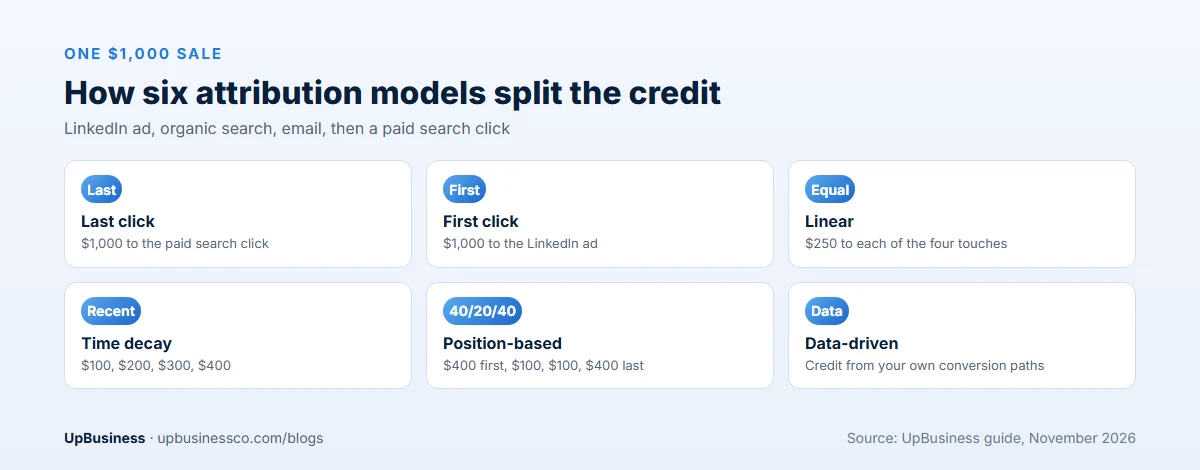
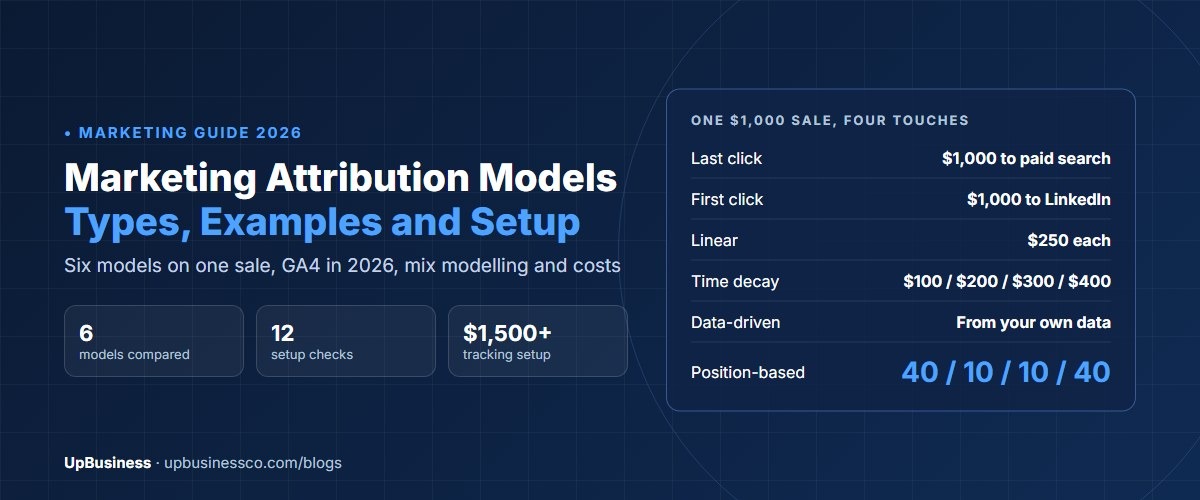
Take one path to a $1,000 sale: a LinkedIn ad, then an organic Google search, then a newsletter email, then a paid branded search that converts. Here is how each model splits the $1,000:
| Model | Rule | LinkedIn ad | Organic search | Paid search | |
|---|---|---|---|---|---|
| Last click | All credit to the final touch | $0 | $0 | $0 | $1,000 |
| First click | All credit to the first touch | $1,000 | $0 | $0 | $0 |
| Linear | Equal credit to every touch | $250 | $250 | $250 | $250 |
| Time decay | More credit to touches near the sale | $100 | $200 | $300 | $400 |
| Position-based | 40% first, 40% last, 20% shared in the middle | $400 | $100 | $100 | $400 |
| Data-driven | Credit based on how each touch changes the odds of converting | Varies | Varies | Varies | Varies |
Time decay figures are rounded to show the idea. Real tools use a half-life, often seven days.
- Last click is simple and good for judging what closes sales. It undervalues everything that creates demand.
- First click shows what brings new people in. It ignores what persuades them.
- Linear is fair but blunt. It treats a passing glance the same as a demo request.
- Time decay suits short sales cycles, where recent touches matter most.
- Position-based, also called U-shaped, values both discovery and closing. A W-shaped version also credits the moment a visitor becomes a lead, which suits B2B.
- Data-driven uses your own conversion data and Machine Learning to compare paths that convert with paths that don't. It needs enough conversions to work well.
Worked Example: How the Model Changes Your Budget
A software company spends $20,000 a month across four channels and wins 40 customers. Here is the credit each channel gets under two models:
| Channel | Monthly spend | Customers, last click | Cost per customer | Customers, position-based | Cost per customer |
|---|---|---|---|---|---|
| LinkedIn ads | $8,000 | 4 | $2,000 | 12 | $667 |
| Google search ads | $6,000 | 18 | $333 | 13 | $462 |
| Content and SEO | $4,000 | 6 | $667 | 10 | $400 |
| $2,000 | 12 | $167 | 5 | $400 |
Under last click, LinkedIn looks five times worse than search, and the obvious move is to cut it. Under position-based, LinkedIn's cost per customer is close to the others, because it starts many of the journeys that search and email later close. Neither model is proven right by this table. That is why the next step is a lift test: pause LinkedIn in part of the market for a month and see what happens to branded search and demos.
Single-Touch vs Multi-Touch Attribution
Single-touch models, first click and last click, give all credit to one touchpoint. They're easy to explain and easy to set up, which is why many small businesses still use them in practice.
Multi-touch models, linear, time decay, position-based and data-driven, share credit across touches. They give a fuller picture but depend on tracking the same person across visits and devices. Privacy rules and browser limits make that harder each year, so multi-touch numbers are estimates, not facts.
What Changed in Attribution for 2026
- Fewer models in Google's tools. In 2023, Google removed first click, linear, time decay and position-based models from GA4 and Google Ads. GA4 now offers data-driven and last click options[1], and data-driven is the default in Google Ads[2]. To use the older rules, you need another tool or your own data warehouse.
- Consent decides what you can measure. In the EEA and UK, Google requires Consent Mode for ads measurement and personalisation[3]. Without consent, some conversions are only modelled, not observed.
- Less cross-site tracking. Safari and Firefox block third-party cookies by default, and Apple's App Tracking Transparency limits mobile app tracking. Google kept third-party cookies in Chrome, but tracking that relies on them already misses a large share of users.
- Server-side tracking grew. Meta's Conversions API, Google's enhanced conversions and server-side tagging send conversion data from your server, which survives ad blockers and browser limits better.
- Marketing mix modelling became affordable. Google's open-source Meridian[4] and Meta's open-source Robyn[5] let mid-sized companies run models that used to need a big consultancy.
Our digital marketing trends for 2026 covers the wider changes, including AI search.
Attribution, Marketing Mix Modelling and Incrementality
These three methods answer different questions, and good teams use more than one.
| Method | Question it answers | Data it needs | Weak spot |
|---|---|---|---|
| Multi-touch attribution | Which tracked touches led to this conversion? | Clicks and visits per user | Misses views, offline and untracked users |
| Marketing mix modelling | How much did each channel add, in total? | Two or more years of weekly spend and sales | Slow, and less detail for small channels |
| Incrementality or lift test | Would these sales have happened without this ad? | A test and a control group | Tests one thing at a time |
A practical approach: use data-driven attribution for weekly campaign decisions, a lift test once a quarter on your biggest channel, and marketing mix modelling once or twice a year if you spend across several channels.
How to Choose a Marketing Attribution Model
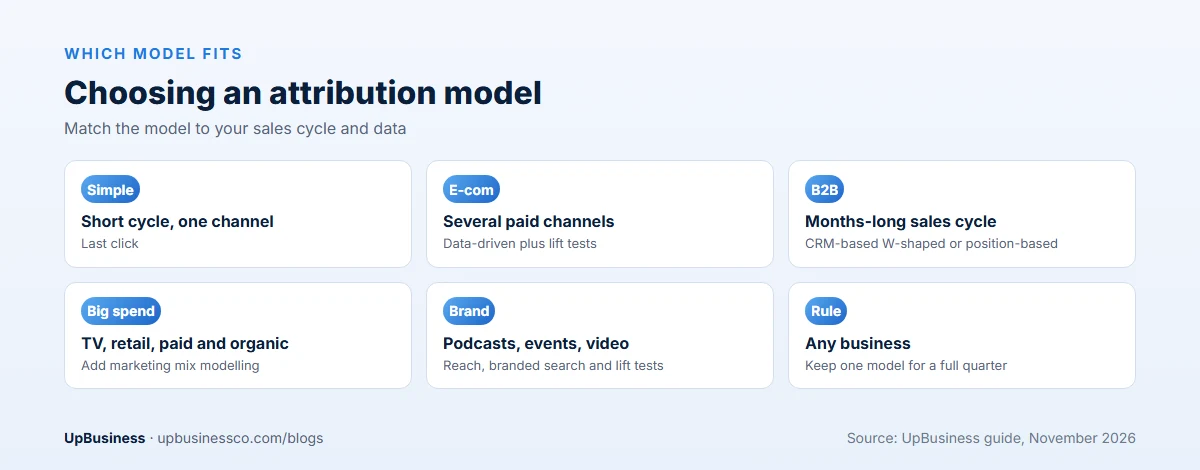
- Short cycle, one channel, few conversions. Use last click and keep it simple. Data-driven needs volume.
- E-commerce with several paid channels. Use data-driven in GA4 and your ad platforms, and run lift tests on Meta or Google to check them.
- B2B with a sales cycle of months. Use a CRM-based W-shaped or position-based model, so lead creation and opportunity creation get credit. Import offline conversions from the CRM into Google Ads and Meta.
- Large spend across TV, retail, paid and organic. Add marketing mix modelling.
- Brand-building channels. Judge podcasts, events and social video on reach, branded search growth and lift tests, not on clicks.
Whichever model you pick, keep it the same for at least a quarter. Changing models every month makes trends impossible to read.
Attribution for E-commerce
E-commerce attribution is easier than B2B because the sale happens online, often within days. The main risks are different:
- Double counting. Meta, Google and affiliates all claim the same order. Use GA4 or your store's analytics as the single source for revenue by channel.
- Discount code leakage. Influencer and affiliate codes spread to coupon sites, so code-based attribution over-credits them.
- Repeat buyers. A loyal customer's fifth order through a branded search ad shouldn't count as new demand. Split new and returning customers in reports.
- Returns. Report on net revenue after returns, not gross orders, or the channels that drive returns look best.
Attribution for B2B Companies
B2B attribution is harder because the path is long and involves several people. A typical deal includes ads, content downloads, webinars, sales calls and emails across three to six months. Most of that sits in the CRM, not in GA4.
Three steps make it work:
- Capture the source on every lead. Hidden form fields store the UTM source, campaign and first page in the CRM.
- Track the stages. Record when a lead becomes qualified, when an opportunity opens and when a deal is won, with dates.
- Send results back to ad platforms. Offline conversion imports tell Google Ads and LinkedIn which clicks became real pipeline, so their bidding learns from sales, not form fills.
CRMs such as HubSpot, Salesforce and Zoho all support this. If you're setting up Zoho, our Zoho implementation cost guide covers the CRM side, and our guide to B2B lead generation agencies covers lead quality.
Lookback Windows: How Far Back Credit Goes
A lookback window is how many days before a conversion a touchpoint can still earn credit. In GA4 the defaults are 30 days for first visits and app installs and 90 days for other conversions, and you can shorten them. Ad platforms use their own windows, often 7 or 28 days after a click and 1 day after a view.
Match the window to your sales cycle. A shop where people buy within a week can use short windows. A B2B company with a 90-day cycle needs the longest window available, plus CRM data, because many first touches happen before any window starts. Write the windows into your measurement plan so reports stay comparable.
Marketing Attribution Setup Checklist
- Write down the decisions attribution must support, such as monthly budget splits.
- Define conversions: purchases, qualified leads and demos, not just page views.
- Set a UTM naming rule and use it on every campaign link.
- Install GA4 and a tag manager, and test every conversion event.
- Set up a consent banner and Consent Mode where required.
- Add server-side tracking: Meta Conversions API and Google enhanced conversions.
- Capture UTM data in hidden form fields and store it in the CRM.
- Import offline conversions from the CRM into ad platforms.
- Choose one attribution model for reporting and write down why.
- Set lookback windows that match your sales cycle.
- Build one dashboard that shows spend, conversions and revenue by channel.
- Plan a lift test on your largest channel within six months.
Steps 2 to 8 are tracking. They decide whether any model can work at all, so spend most of the first month on them before anyone argues about which model to use.
What a Good Attribution Dashboard Shows
A dashboard should help a manager decide where next month's budget goes in five minutes. Keep it to one page with these parts:
- Spend, conversions and revenue by channel, under your chosen model, for this month and the last three.
- Cost per customer or cost per qualified lead, not just cost per click or per form fill.
- New and returning customers shown separately, so loyal buyers don't inflate a channel.
- Pipeline and revenue from the CRM for B2B, matched to the source captured on each lead.
- Branded search volume as a signal of demand created by channels that don't get clicks.
- Notes on changes, such as a new campaign, a tracking fix or a price change, so nobody misreads a jump.
Looker Studio, which is free, is enough for most mid-sized companies. Bigger teams often move the data into a warehouse such as BigQuery and report from there.
Common Attribution Mistakes
- Trusting each ad platform's own numbers. Google, Meta and LinkedIn each claim the same sale. Add them up and you often get more conversions than you had.
- Broken UTM tags. "Facebook", "facebook" and "fb" become three channels.
- Counting form fills as wins. Spam and unqualified leads make the wrong channels look good.
- Ignoring branded search. People who search your name were usually sent by something else.
- Changing the model to fix a bad month. The model isn't the problem. The campaign is.
What a Marketing Attribution Agency Should Deliver
- A tracking audit with a list of what's broken and what it costs you.
- A measurement plan: conversions, events, UTM rules and the reporting model.
- GA4, tag manager, consent and server-side tracking set up and tested.
- CRM fields and offline conversion imports working end to end.
- A dashboard your team understands, with a short guide.
- A test plan for at least one lift test.
- Admin access to every account in your company's name.
If the agency also runs your ads, ask how it avoids marking its own homework. A separate report owner, or a lift test the agency doesn't control, keeps it honest. Our list of digital marketing agency red flags covers the warning signs.
What Marketing Attribution Costs
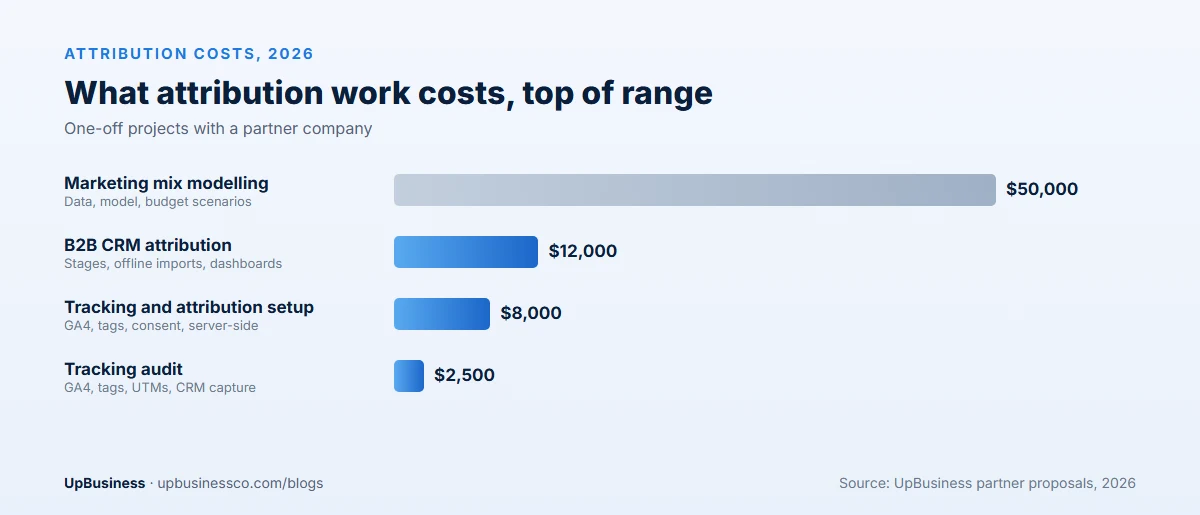
| Work | Typical scope | Typical cost with a partner company |
|---|---|---|
| Tracking audit | Review GA4, tags, consent, UTMs and CRM capture | $500 to $2,500 |
| Tracking and attribution setup | GA4, tag manager, consent, server-side tracking, CRM fields | $1,500 to $8,000 |
| B2B CRM attribution | Stage tracking, offline conversion imports, dashboards | $3,000 to $12,000 |
| Marketing mix modelling | Data collection, model build, budget scenarios | $10,000 to $50,000 |
| Monthly measurement retainer | Upkeep, reports, tests and fixes | $500 to $4,000 a month |
These ranges come from the proposals we see on UpBusiness. Partners in India usually sit at the lower end and agencies in the US, UK and Australia at the upper end. Attribution tools are a separate cost, from free for GA4 to several thousand dollars a month for enterprise platforms.
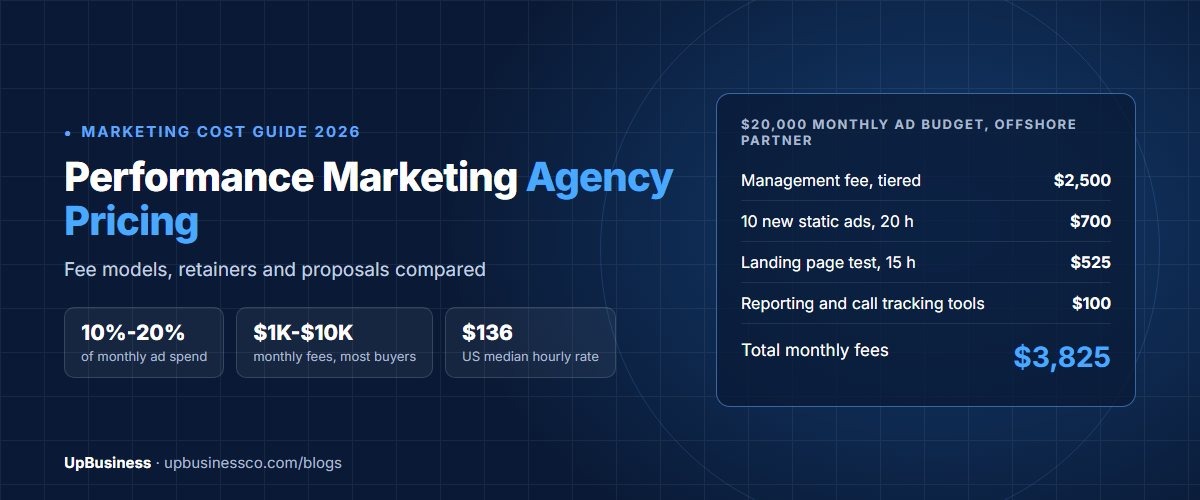
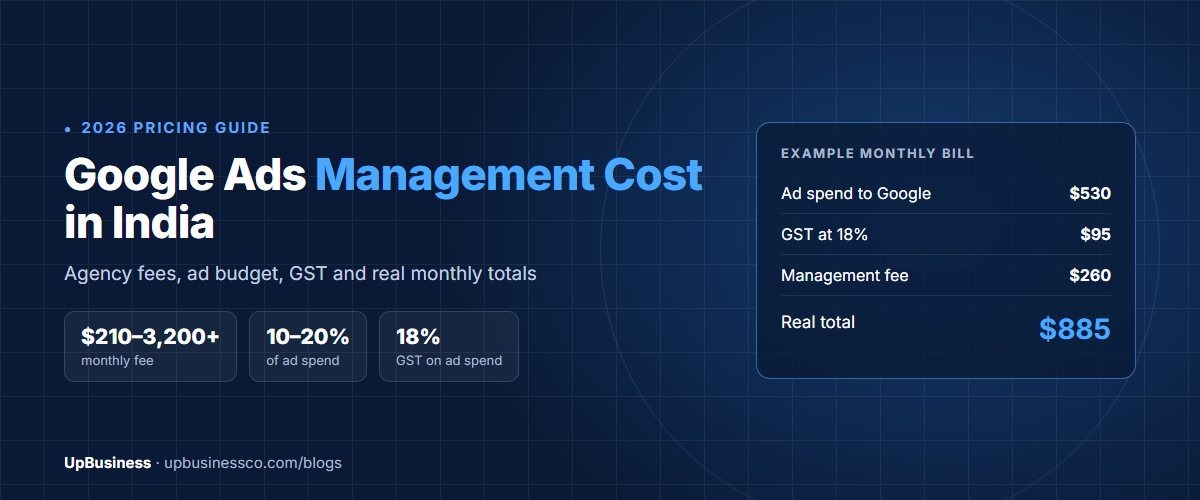
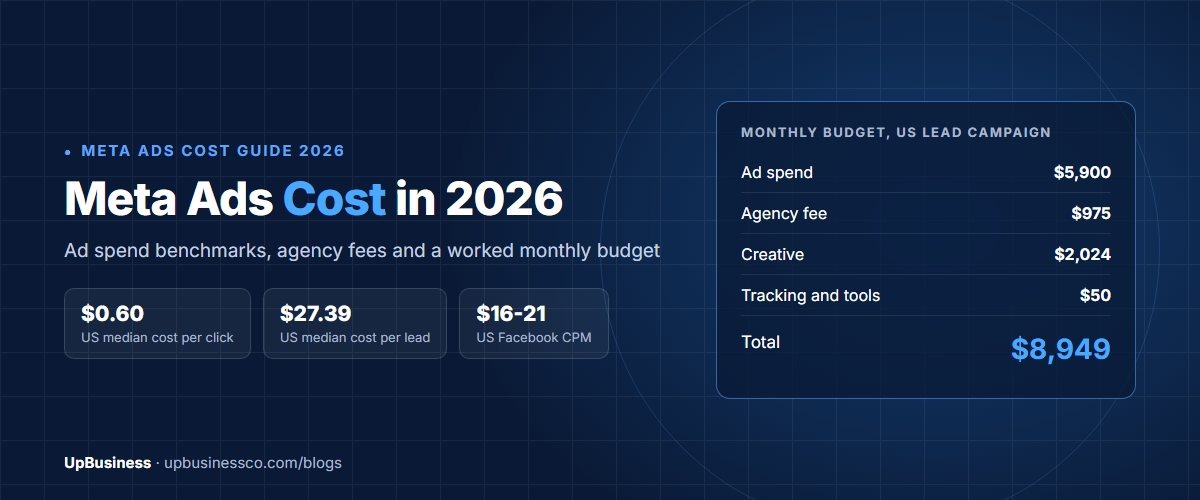
Attribution is usually part of a wider performance marketing contract. Our guides to performance marketing agency pricing, Google Ads management cost and Meta ads cost show how fees are structured, and our guide to marketing automation services covers email and CRM workflows.
Questions to Ask an Attribution Partner
- Which attribution model would you use for us, and why?
- How will you check the model with a lift test or mix model?
- How do you handle users who don't give consent?
- Which conversions will be sent back to ad platforms, and how?
- Who owns the accounts, tags and dashboards when we part ways?
- Can we speak to a client whose budget decisions changed after your work?
Finding Attribution Partners on UpBusiness
UpBusiness lists verified partner companies, mostly based in India. Every company has passed five checks reviewed by our team: company details, registration and tax papers, the founder's identity, expertise and three client projects with evidence. Only companies with a TrustScore of 70 or more are listed.
Our marketing attribution consulting page and digital marketing page list marketing partner companies. Not every one names attribution as a core service yet, so ask each for an attribution or tracking setup they delivered and the dashboard that came out of it.
- Post your requirement with your channels, tools and budget.
- Get three partner companies matched to your budget, service and industry.
- Compare them side by side, start with a tracking audit and choose the partner with the clearest plan. Buyers pay nothing, and there's no commission on the project.