


Browse our curated list of Digital Marketing Companies
Many digital marketing agency red flags show up before you sign anything. They're in the sales call, the proposal and the contract, and they're easy to miss when the pitch deck looks good. Spotting them early matters more when budgets are tight. Gartner's 2026 survey of 401 marketing leaders found budgets flat at 7.8% of company revenue, with 56% saying they didn't have the budget to deliver their strategy[1].
This guide is for the founder, marketing head or business owner choosing an agency. It lists 15 warning signs of a bad digital marketing agency, grouped by the stage where you'll meet them, and gives a way to check each one. Where a rule exists, such as Google's requirements for agencies that run Google Ads or the US Federal Trade Commission's ban on fake reviews and followers, we cite it directly. We've also included data from the 18 verified digital marketing companies on UpBusiness.
Key takeaways
- No one can guarantee a #1 ranking on Google, in Google's own words. Treat any guaranteed ranking, follower count or lead number as a red flag.
- Agencies that charge a management fee for Google Ads must tell new customers about it in writing before the first purchase and show it on every invoice.
- The FTC's 2024 rule bans buying or selling fake reviews and fake followers or views for commercial use, so an agency that offers them puts your business at legal risk.
- One of the costliest red flags is ownership. If the agency owns your ad accounts, analytics or website, leaving it can cost you years of data.
What Are the Red Flags When Hiring a Digital Marketing Agency?
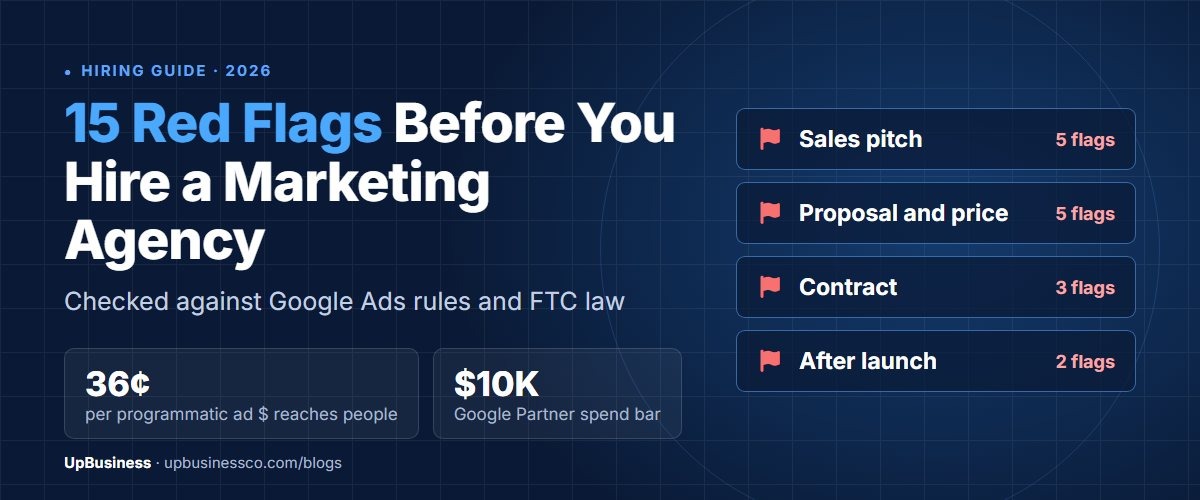
The main red flags when hiring a digital marketing agency are guaranteed results, a management fee hidden inside the ad budget, accounts created in the agency's name, vague deliverables, offers of followers or reviews, long contracts paid in advance and reports that leave out cost and enquiries. Here are all 15, in the order you're likely to meet them, with a quick way to check each one.
| Stage | Red flag | How to check |
|---|---|---|
| Sales pitch | Guaranteed rankings, leads or followers | Ask what happens, in writing, if the number isn't reached |
| Sales pitch | Unsolicited outreach or a "special relationship" with Google | Check how they found you and what the claim rests on |
| Sales pitch | A partner badge you can't verify | Look the agency up in Google's Partner directory |
| Sales pitch | Few questions about your business | Count the questions about margins, customers and sales cycle |
| Sales pitch | Case studies without numbers or references | Ask for one client you can call |
| Proposal | Management fee mixed into ad spend | Ask for the fee and the media budget as separate lines |
| Proposal | No visibility into where media money goes | Ask which platforms, networks and fees sit between your money and the ad |
| Proposal | A price far below the market | Compare the hours it buys with the work promised |
| Proposal | Vague deliverables | Ask for monthly quantities in writing |
| Proposal | Offers of followers, reviews or likes | Walk away |
| Contract | The agency owns your accounts | Check who is the owner of each ad, analytics and website account |
| Contract | Long lock-in, paid in advance, no exit | Ask for a 30 to 60 day notice period and a handover list |
| Contract | No named team | Ask who will do the work each week |
| After launch | Reports without cost, clicks and enquiries | Ask for direct login access to every platform |
| After launch | Content at volume with no review | Ask who edits and fact-checks each piece |
Red Flags in the Sales Pitch
1. Guaranteed rankings, leads or followers
This is one of the best-known warning signs, and Google is blunt about it. Its guide to hiring an SEO says no one can guarantee a #1 ranking on Google, and if someone promises first place in search results, you should find someone else[2]. The same logic applies to paid ads and social media.
An agency can commit to work, spend and testing. It can't control an auction, an algorithm or your sales team, so a promised number of leads by a date is either a guess or a sign of shortcuts.
Organic results also take longer than many pitches suggest. When Ahrefs tracked 2 million English pages created in October 2023, 6.11% reached Google's top 10 for at least one keyword within a year. In a separate sample, 72.9% of pages ranking in the top 10 were more than three years old[3]. An agency promising page-one SEO results within weeks is ignoring that pattern.
2. Cold outreach and claims of a "special relationship"
Google also warns about SEO firms and agencies that email you out of the blue, and about any that claim a "special relationship" with Google[2]. Cold email isn't wrong in itself, as plenty of good agencies prospect. Be careful when the message opens with an alarming audit of your site, a ranking you supposedly lost or a deal that expires this week. Pressure is usually a sign that the agency needs the sale more than it understands your business.
3. A partner badge you can't verify
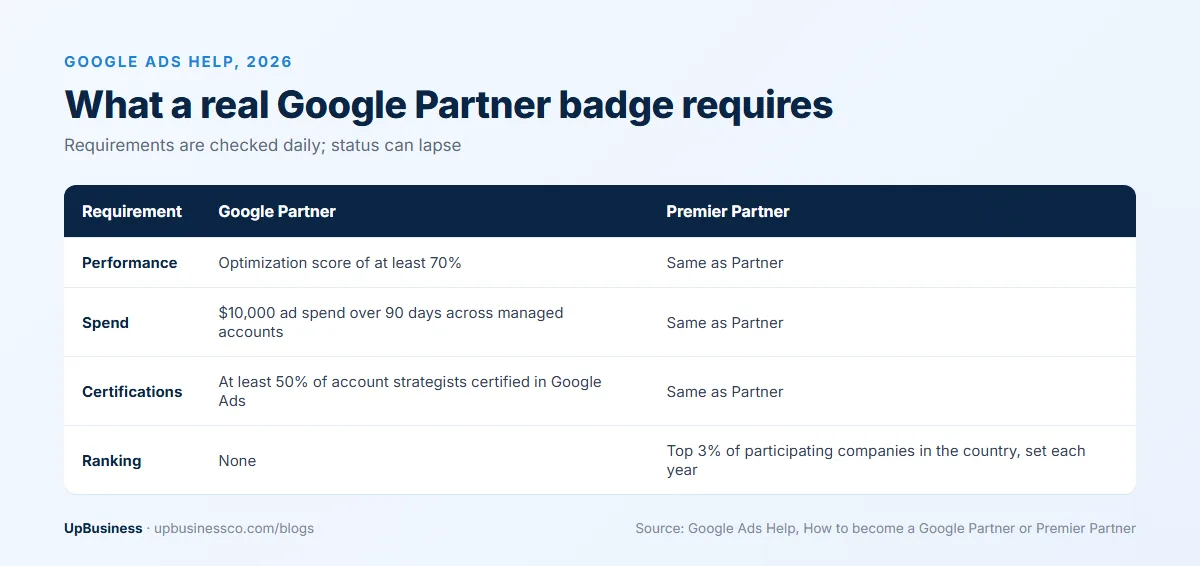
"Google Partner" means something specific. To hold the status, an agency's manager account needs an optimization score of at least 70% and at least $10,000 of ad spend over 90 days across the accounts it manages. At least half of its account strategists must also be certified in Google Ads.
Premier Partners must also rank in the top 3% of participating companies in their country, reviewed each year[4]. Google checks the requirements daily, and status can lapse when an agency falls below them. Look the agency up in Google's Partner directory rather than relying on a logo in a slide deck.
4. Few questions about your business
A good agency asks about your margins, your best customers, your sales cycle and what a lead is worth to you before it proposes channels. If the first call is mostly a presentation and the proposal arrives within hours, the plan was probably written before they spoke to you. Proposals that recommend the same mix for every client (a little SEO, some social posts, a small ads budget) are a common sign of this.
5. Case studies without numbers or references
Logos and adjectives aren't evidence. Ask for case studies from businesses like yours, with the starting point, the budget, what changed and over what period. Then ask to speak to one current client. An agency with good results will usually find someone willing to take a 15-minute call.
Red Flags in the Proposal and the Price
6. The management fee is hidden inside the ad budget
If a proposal quotes one monthly figure for "ads", you can't tell how much reaches Google or Meta and how much the agency keeps. For Google Ads, this is also a policy issue. Google requires third parties to be honest and transparent about their costs and expected results[5]. If an agency charges a management fee separate from the cost of Google Ads, it must tell new customers in writing before each first purchase and show the fee on every invoice.
Where a monthly report is required, it must show costs, clicks and impressions at account level, with costs reported exclusive of the agency's own fees[6].
7. No visibility into where the media money goes
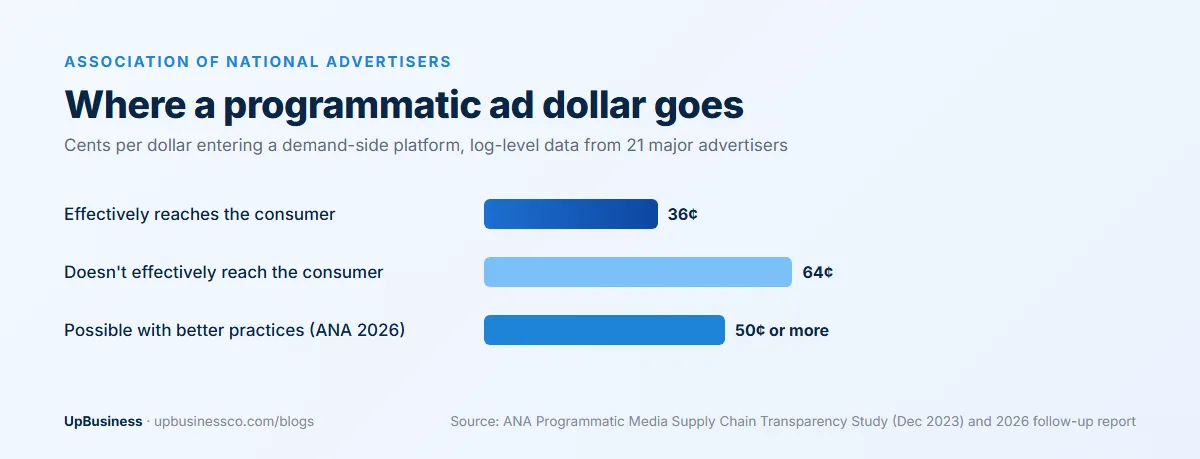
This matters especially for programmatic display and video, where several technology companies take a cut between your budget and the ad. The Association of National Advertisers studied the log-level data of 21 major advertisers and found that only 36 cents of every dollar entering a demand-side platform effectively reached the consumer.
Its 2026 follow-up report says better practices could raise that to 50 cents or more[7]. Those were large advertisers with their own procurement teams, so a smaller buyer has even more reason to ask which platforms, networks and fees sit between its money and the ad.
8. A price far below the market
Cheap isn't automatically bad, but every retainer buys a certain number of hours. Divide the monthly fee by a realistic hourly rate and compare the result with the work promised. If $500 a month is meant to cover SEO, two ad platforms, 20 social posts and a monthly report, something will be skipped, usually strategy, testing or senior attention. Our guide to digital marketing cost gives typical ranges by service.
9. Vague deliverables
"Social media management" or "SEO optimisation" with no quantities can't be checked later. A clear proposal says how many campaigns, ad variations, articles, posts or landing pages you get each month, who approves them and what the report includes. If an agency refuses to put numbers in writing, it's hard to hold anyone to anything.
10. Offers of followers, reviews or likes
Some agencies still sell "growth packages" that include followers, page likes or review campaigns. In the US, the Federal Trade Commission's final rule, announced on 14 August 2024, bans writing, buying or selling fake reviews, including reviews from people who don't exist. It also bans buying or selling fake indicators of social media influence, such as followers or views from bots or hijacked accounts, when they're used for a commercial purpose.
The FTC can seek civil penalties against knowing violators[8]. Even outside the US, bought followers damage engagement data and make it harder to judge what's working. This one is a reason to walk away.
Red Flags in the Contract
11. The agency owns your accounts
This is often the costliest red flag when you leave. If your Google Ads account, Meta ad account, analytics property, Google Business Profile, domain or website hosting sits in the agency's name, switching agencies can mean losing years of campaign history, audiences and conversion data. The fix is simple.
Create every account in your company's name, then give the agency access through a manager or partner connection that you can remove. Google also requires agencies to let customers see their cost and performance data, either through reports or by letting them sign in to their own accounts[6].
12. Long lock-in, paid in advance, with no exit
A minimum term of three to six months is common and often fair, because SEO and content take time to show results. Be careful with 12-month contracts paid fully in advance, automatic renewals and contracts with no notice period. Ask for a 30 to 60 day notice period after the first term and a written handover list covering logins, creative files, keyword research and campaign settings.
13. No named team
A senior person often runs the sales process and then hands the account to someone you've never met. That's normal in a growing agency, but you should know who that person is before you sign. Ask who will manage the account day to day, how many other clients they handle and who reviews their work. An answer of "our team" with no names usually means the quality will vary.
Red Flags After You Start
14. Reports without cost, clicks and enquiries
A report full of impressions, reach and follower growth, with nothing on cost per lead, enquiries or sales, tells you how busy the agency was rather than what the money achieved. Ask for login access to every ad and analytics platform from day one and check the numbers yourself now and then. For Google Ads you're entitled to see costs, clicks and impressions, as described above. A monthly call where someone explains what changed, what failed and what they'll test next is worth more than a long PDF.
15. Content at volume with no review
AI tools have made it cheap to produce dozens of blog posts or social captions a month. Google doesn't ban AI-assisted content, but its spam policies treat scaled content abuse (generating many pages mainly to manipulate rankings) as spam, however the content is made[9]. A proposal built around "30 articles a month" with no mention of research, editing or fact-checking is a risk to your site. Our SEO trends 2026 guide covers what Google's guidance means for content work.
Extra Checks When the Agency Is in Another Country
Plenty of businesses hire marketing agencies abroad, often to stretch the same budget further. That can work well, and the red flags above apply in the same way. A few extra checks help when the agency sits in a different country from you.
Pay ad platforms directly. Put your own company card or invoicing account on Google Ads, Meta and LinkedIn. The agency then invoices only its fee. This removes any question of currency mark-ups or resold media, and it keeps the billing history with you.
Agree on working hours before you sign. Ask for at least two or three overlapping hours a day and a named contact who can join calls in your time zone. Campaign problems, such as a disapproved ad or a broken tracking tag, are cheaper to fix the same day.
The contract should say which country's law applies, which currency each invoice uses and how disputes are handled. Ask whether the agency follows the privacy rules of the markets you sell in. If you collect leads from EU or UK customers, for example, ask how the agency stores and deletes that data. A short call with your own lawyer is usually cheaper than untangling a dispute later.
A Worked Example: Two Proposals for the Same Budget
Here's a rough illustration of why line items matter. Two agencies quote $3,000 a month for Google Ads.
| Agency A | Agency B | |
|---|---|---|
| How the price is shown | $3,000 a month "all-inclusive" | $2,200 media budget plus an $800 management fee |
| Who owns the ad account | Created by the agency | Created in your name, agency added as manager |
| What you can see | A monthly PDF summary | Direct login, plus a monthly report |
| What you can work out | Nothing about how much reached Google | Exact media spend, fee and cost per lead |
Agency A might be cheaper in practice, or much more expensive. You can't tell, and that's the problem. Agency B's fee works out at about 27% of the total, a figure you can set against other quotes. Its account set-up also means you keep your data if you leave. Our guide to Google Ads management costs explains how management fees are usually structured.
Which Digital Marketing Agency Red Flags Are Deal-Breakers
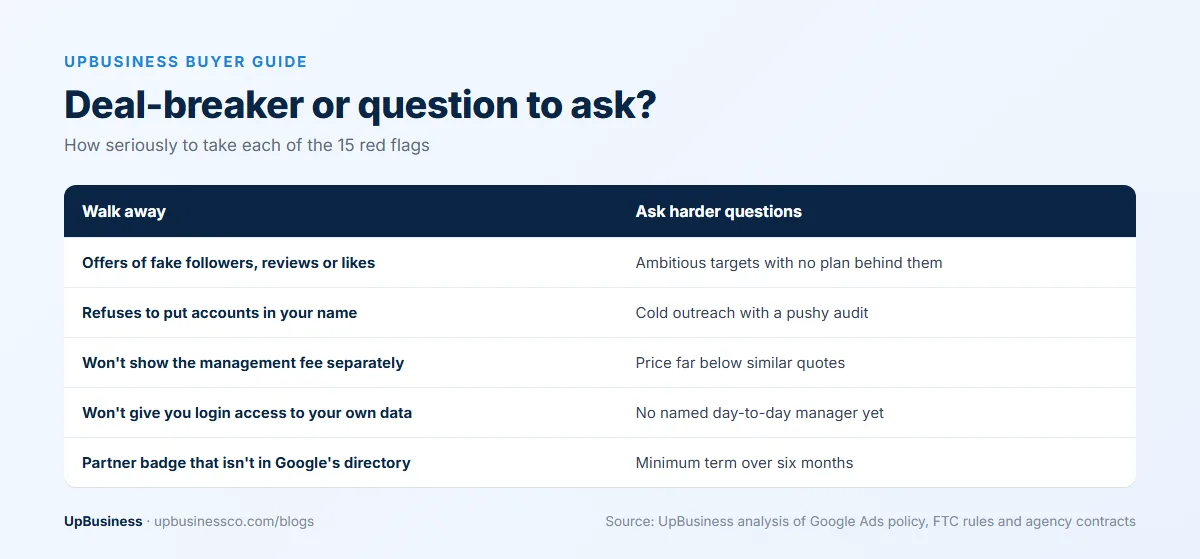
Not every warning sign means you should walk away. Some are reasons to ask harder questions, and a good agency will answer them without fuss. A simple rule of thumb: one yellow flag is worth a question, two or more together is a pattern. When several deal-breakers appear at once (guarantees, agency-owned accounts, no fee breakdown, bought followers), you may be looking at something closer to a scam than a weak agency.
If you're choosing between agencies, put the same questions to each one and compare the answers side by side. Our overview of digital marketing services explains what each service includes, and our guide to SEO agency pricing covers SEO retainers and SEO-specific warning signs in more detail.
What a Good Digital Marketing Agency Does Instead
Red flags are easier to spot when you know what good looks like. These are the habits worth looking for in a proposal and the first months of work.
| Area | What a good agency does |
|---|---|
| First call | Asks about your margins, customers, sales cycle and what a lead is worth before suggesting channels |
| Proposal | Lists monthly deliverables, the team, the fee and the media budget as separate lines |
| Accounts | Sets up every ad, analytics and website account in your company's name |
| Targets | Gives ranges and assumptions rather than guarantees, and says what would change them |
| Reporting | Shows cost, enquiries and sales next to reach, and explains what it will test next |
| Contract | Offers a fair minimum term, a notice period and a written handover list |
What to Do if Your Current Agency Shows These Red Flags
If you're already working with an agency and some of these signs look familiar, protect your data before you raise the issue. Start by listing every account the agency touches, from Google Ads, Meta and LinkedIn to analytics, Search Console, your Google Business Profile, the domain, hosting and the website's admin login.
Check who the owner is on each one, and ask for ownership or admin access to be moved to your company now, while the relationship is still working. Some platforms don't let an account move between business accounts, so you may need to set up new ones and accept some lost history.
Next, export campaign reports, audiences, keyword research, creative files and past invoices while you still have access. Then read the notice clause in your contract and give the agency a clear written brief, for example a 30-day plan with the numbers you expect to see. Should the answers not improve, you'll be ready to move without losing your accounts or your data.
Questions to Ask Before You Sign
- Who will work on our account each week, and how many other clients do they handle?
- Can you show the management fee and the media budget as separate lines on every invoice?
- Will every ad, analytics and website account be created in our company's name?
- Which numbers will the monthly report show, and can we log in to check them ourselves?
- What will you do in the first 30, 60 and 90 days, and what should we expect to see by each point?
- What's the notice period, and what will you hand over if we part ways?
- Can we speak to one current client in a similar business?
UpBusiness Data: Digital Marketing Companies (October 2026)
Our analysis of the 18 verified digital marketing companies on UpBusiness gives a picture of who you're likely to be talking to. Half are small teams of 1 to 10 people, eight have 11 to 50 staff and one has 51 to 200. Four are based in Pune and two each in Bengaluru and Noida. The other ten are in ten different cities, including Mumbai, Ahmedabad, Jaipur and Indore.
Many are young businesses. Eight of the 18 were founded in 2023 or later, while the oldest dates from 2004. A recent founding date isn't a red flag in itself, but it makes case studies and references more important. Their average project sizes, as they report them, run from $250 to $50,000, with a median of $2,500. TrustScores range from 70.0 to 75.3.
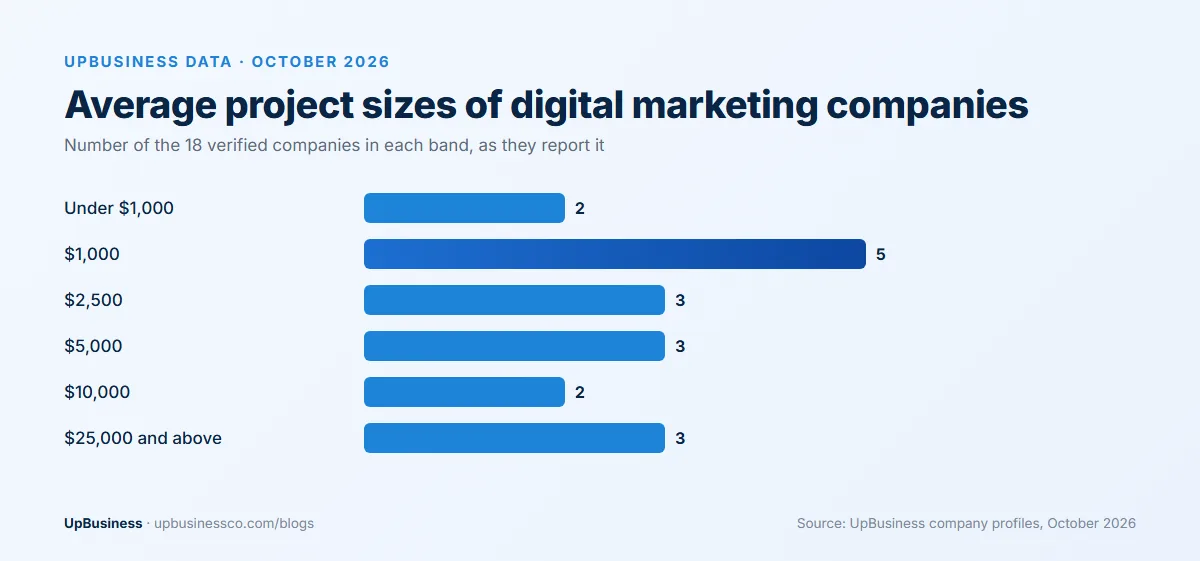
These are self-reported figures from a small group, so treat them as a sense-check on quotes rather than a market average. If a proposal is far outside this range for similar work, ask the agency to explain why.
Find a Digital Marketing Partner Company on UpBusiness
You can browse verified digital marketing companies on UpBusiness and compare team size, location, project sizes and TrustScore before you contact anyone. If search is your main channel, start with our SEO companies. Or post your project once and let matching partner companies come to you, so you can compare proposals side by side with the questions above.