


Browse our curated list of Digital Marketing Companies
Most lists of digital marketing trends 2026 are written for marketers who run the campaigns. They talk about AI content, short-form video and social search, with a handful of predictions. This guide is for the people who pay for that work: founders, marketing heads and business owners who hire agencies and set the budget. For each trend it shows the data behind it and what it changes in your plan, your agency's scope or the questions you should ask.
The figures come from the largest studies published this year. Global figures come from WPP Media's ad forecast and Gartner's 2026 CMO Spend Survey. US figures come from the IAB and PwC count of internet ad revenue and from The CMO Survey 2026, run by Duke, Deloitte and the American Marketing Association. We also use Forrester, Pew Research Center and Google's own announcements, and we say where a study covers only the US.
Key takeaways
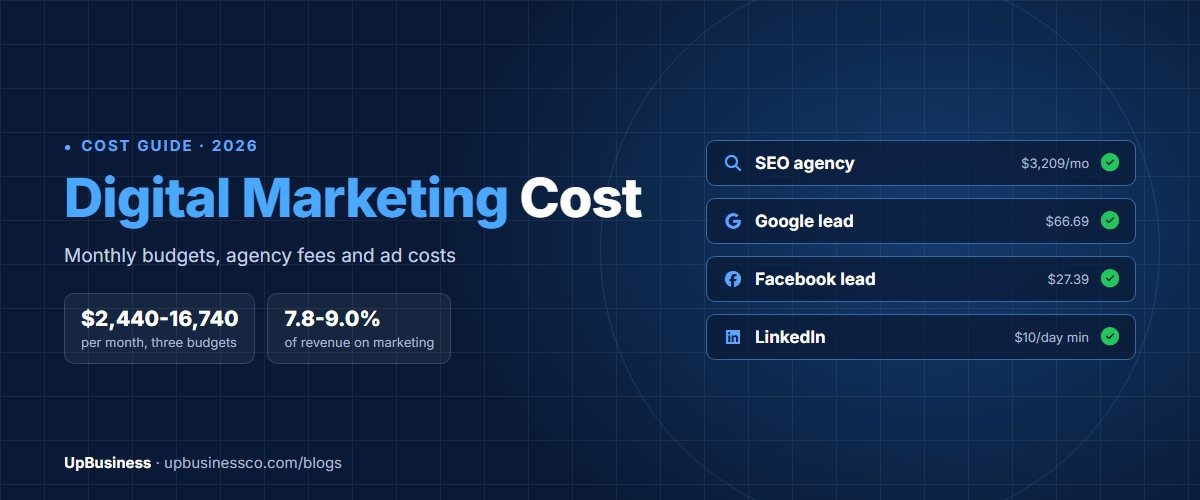
- Marketing budgets are flat at 7.8% to 9.0% of revenue, but digital keeps taking a larger share. In The CMO Survey 2026, digital spending grew 8.2% while total marketing spending grew 1.7%.
- Global ad revenue is forecast to grow 8.9% to about $1.3 trillion in 2026, according to WPP Media, and Alphabet, Meta and Amazon take 57.6% of it outside China.
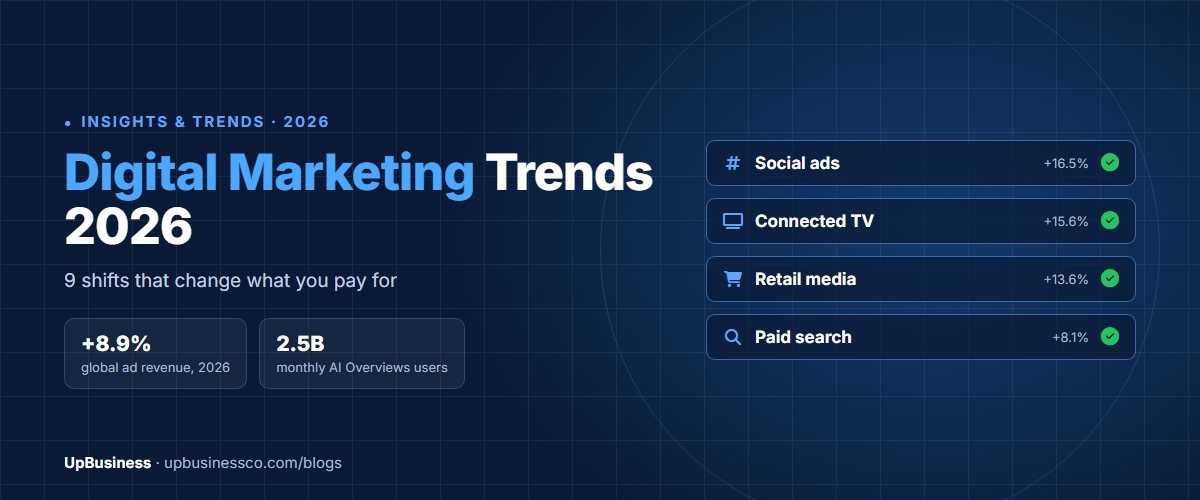
- Social, connected TV and retail media are the fastest-growing US channels in 2026, at 16.5%, 15.6% and 13.6% growth in IAB's forecast, while paid search grows 8.1%.
- B2B buyers contact suppliers 61% of the way through their buying process, and the winner was on the first shortlist 95% of the time, according to 6sense's study of about 4,000 buyers.
Digital Marketing Trends 2026 at a Glance
The nine trends below are the ones with the strongest evidence behind them and the biggest effect on what a business spends. The table gives the headline number for each; the sections that follow explain what it means for your budget and your agency.
| Trend | Headline data | What it changes for buyers |
|---|---|---|
| 1. Flat budgets, growing digital share | Digital spend +8.2% vs total marketing +1.7% (US) | Money moves between channels, not into marketing overall |
| 2. AI answers in search | Google AI Overviews: over 2.5 billion monthly users | SEO scopes now include visibility in AI answers |
| 3. Social and video take more budget | US social ad revenue +32.6% in 2025, to $117.7 billion | Video production becomes a regular budget line |
| 4. Retail media and connected TV | Global commerce ad revenue passed TV in 2025 | New ad channels for brands that sell through retailers |
| 5. Creators as paid media | US creator advertising $37 billion in 2025, $44 billion in 2026 | Creator fees and usage rights need contracts |
| 6. B2B buyers decide before they call | First contact at 61% of the buying process | Content and reviews must win the shortlist early |
| 7. Measurement is being rebuilt | 86% are changing how they measure media | Ask for reporting beyond clicks and rankings |
| 8. Agencies change how they charge | Forrester expects agency jobs to fall 15% in 2026 | More project and outcome-based fees |
| 9. Retention is underfunded | Acquisition budgets 26.0% larger than retention | Shift some budget to existing customers |
1. Budgets Stay Flat While Digital Takes a Larger Share
Marketing budgets are not growing much as a share of revenue. Gartner's 2026 CMO Spend Survey of 401 marketing leaders in North America, the UK and Europe found budgets at 7.8% of company revenue, up from 7.7% in 2025. More than half, 56%, said they lack the budget to deliver their 2026 strategy [1]. The CMO Survey 2026, which covers 308 US companies of all sizes, puts the figure at 9.0% of revenue, the lowest share since 2021 [2].
Inside those budgets, digital keeps growing. The same CMO Survey found total marketing spending rose just 1.7% over the previous 12 months while digital marketing spending rose 8.2%. Marketers expect digital to grow another 10.4% over the next 12 months, while traditional advertising falls 1.5% [2].
The global ad market tells the same story. WPP Media's midyear 2026 forecast expects worldwide advertising revenue to grow 8.9% to about $1.3 trillion this year, excluding US political ads, with Alphabet, Meta and Amazon taking 57.6% of it outside China [3]. Dentsu's mid-year forecast is more cautious at 5.0% growth [4].
Digital Marketing Trends by Region
Growth is uneven around the world. WPP Media expects US advertising revenue to grow 11.9% in 2026, faster than the 8.9% global rate, and puts search, including AI search, at 21.8% of all ad revenue [5]. It also expects social media ad growth to slow to single digits from 2027 as the channel matures. The IAB channel figures later in this guide cover the US only, so expect smaller numbers if you sell mainly in Europe, the Middle East or Asia, where Dentsu's forecast of 5.0% global growth is the more cautious guide [4].
For a buyer outside the US, the direction of each trend still applies, because the same platforms dominate almost everywhere. The size of each shift differs by market, and click prices are set in local auctions.
What it means for you: expect your marketing budget to stay roughly the same size and plan to move money between channels rather than add to it. Our digital marketing cost guide shows how to build a budget from cost per lead and check it against these revenue benchmarks.
2. AI Answers Are Changing How Search Traffic Works
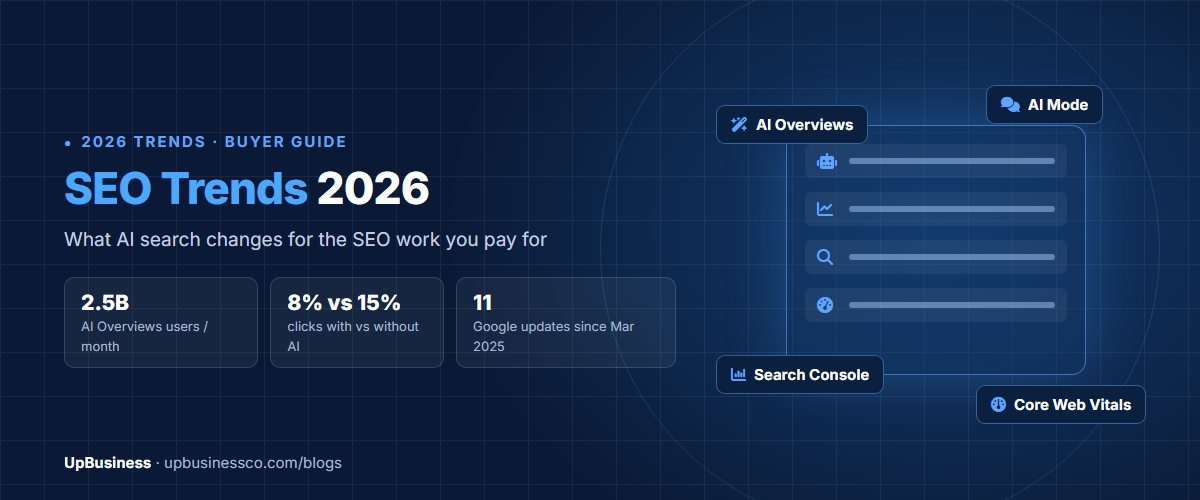
Google said in May 2026 that AI Overviews have more than 2.5 billion monthly users and that AI Mode has passed 1 billion [6]. When an AI summary appears, people click fewer links. Pew Research Center tracked 68,879 searches by 900 US adults. Users clicked a regular result on 8% of visits with an AI summary, against 15% without one, and clicked a link inside the summary on just 1% [7].
Marketers are already reacting. The CMO Survey 2026 found 41.5% of companies use generative engine optimisation, which means getting content into AI-generated answers [2]. In IAB's 2026 outlook, 76% of brand and agency leaders named optimising content for AI answers as their top area of increased focus [8]. WPP Media estimates advertising in generative search at $5.1 billion in 2026 [3]. Budgets are following: Gartner found marketing leaders put 15.3% of their 2026 budgets into AI, but only 30% say their organisation is ready to use AI at scale [1].
For your SEO brief: search is still a major channel, but traffic per ranking is falling for questions that AI can answer. Ask your SEO partner how they report visibility in AI answers and which pages they expect to lose clicks. Our SEO trends 2026 guide covers this in detail, and our guide to AI in digital marketing covers the tools.
3. Social Media and Video Take a Bigger Share of Spend
Social media is now the largest single category of US internet advertising. The IAB and PwC count for 2025 put social ad revenue at $117.7 billion, up 32.6%. Search came second at $114.2 billion after growing 11% [9]. Digital video, including connected TV, reached $78 billion, up 25.4%.
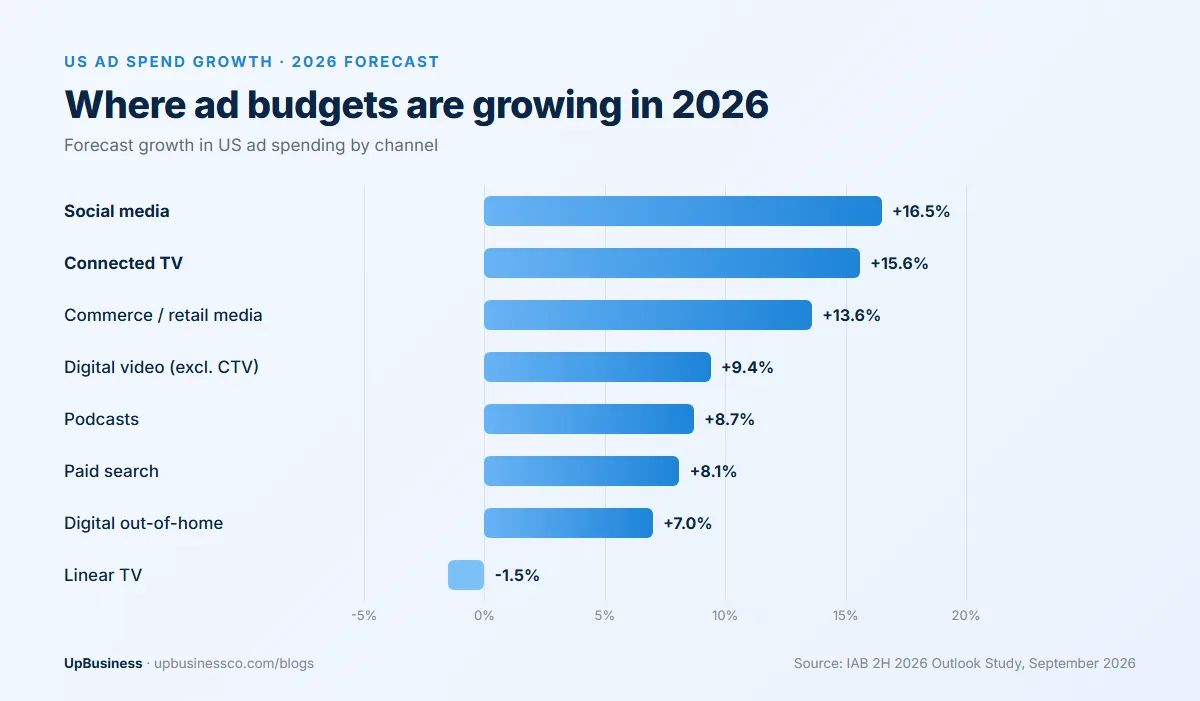
For 2026, IAB's September outlook expects US ad spending to grow 12.3%, led by social at 16.5% and connected TV at 15.6%, while paid search grows 8.1% and linear TV falls 1.5% [8]. Marketers' own plans point the same way: social media takes 14.3% of marketing budgets today in The CMO Survey 2026, rising to an expected 17.1% next year [2]. The survey's authors note that these one-year projections have tended to run ahead of actual spending, so treat the forecast as a direction rather than a promise.
For your content budget: video production stops being an occasional project and becomes a monthly line item. When you brief a social media marketing partner, agree how many videos a month are included, who appears in them, and who owns the raw footage.
4. Retail Media and Connected TV Become Mainstream Channels
Retail media means ads sold by retailers and marketplaces on their own sites and apps, such as Amazon or Walmart. WPP Media found that commerce advertising reached $178.2 billion worldwide in 2025, passing TV ad revenue for the first time [10]. In the US, commerce media grew 18% to $63.4 billion in 2025 [9], and IAB expects another 13.6% growth in 2026 [8]. In The CMO Survey, 23.6% of companies say they are using more retail media [2].
For your media plan: if you sell through retailers or marketplaces, test part of your ad budget there. These ads reach people who are already shopping. If you sell services or sell only from your own site, these channels matter less, and you can skip them without missing much.
5. Creators Become a Paid Media Line
Paying creators to make and share content has become a budget category of its own. IAB estimates US creator advertising at $37 billion in 2025, rising to $44 billion in 2026 [9]. In Influencer Marketing Hub's 2026 benchmark survey of more than 600 respondents, 87.49% expect their influencer budgets to rise [11].
For your contracts: creator work needs the same paperwork as any other media buy. Agree usage rights, how long you can run the content as ads, disclosure of paid posts, and how results are tracked before any content is made. An influencer marketing partner should handle creator selection and contracts as part of the scope.
6. B2B Marketing Trends 2026: Buyers Decide Before They Talk to You
B2B buyers now do most of their research alone. 6sense's 2025 study covered about 4,000 buyers in North America, Europe and Asia-Pacific. Buyers first contacted a supplier 61% of the way through their buying process, and the eventual winner was on the first shortlist 95% of the time [12]. They compared about five suppliers, the process took about 10 months, and 94% used large language models such as ChatGPT while buying.
Gartner's survey of 632 B2B buyers found 61% prefer a buying experience without a sales rep, 73% avoid suppliers who send irrelevant outreach, and 69% noticed differences between what a supplier's website said and what its sales team said [13].
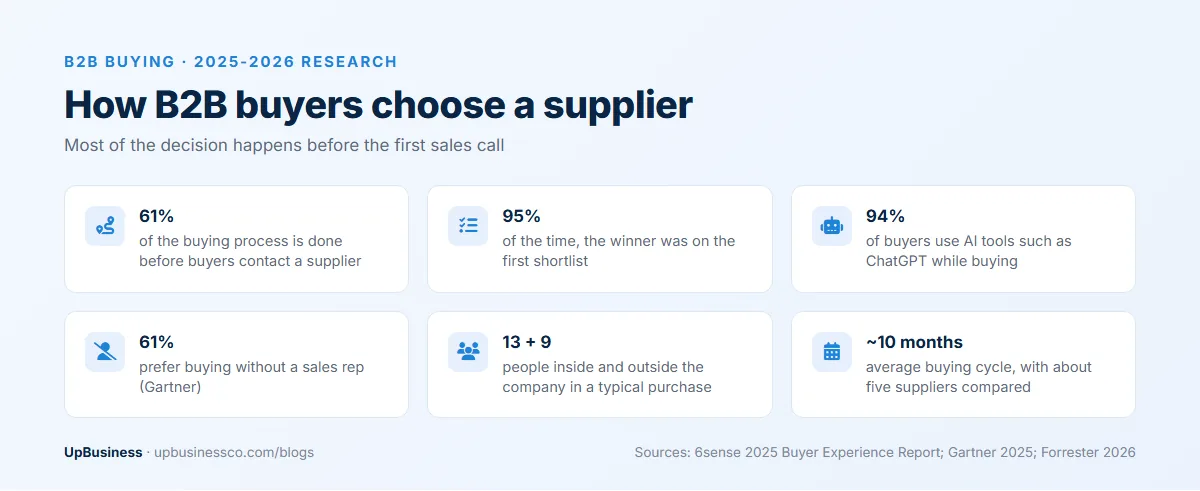
Buying groups are also large. Forrester's 2026 State of Business Buying study found a typical purchase involves 13 people inside the company plus 9 outside influencers, with procurement involved in the decision in 53% of buying cycles [14].
For B2B sellers: if you sell to businesses, most of your marketing has to work before anyone fills in a form. That favours content that answers buyers' questions, reviews and case studies, pricing information, and a presence in the places buyers research, including AI answers. Our guide to B2B SaaS marketing strategy turns this into a plan.
7. Measurement Is Being Rebuilt
As clicks fall and AI tools answer more questions, the old reports built on traffic and last-click conversions show less of what marketing does. IAB's 2026 outlook found 86% of brand and agency leaders are changing, or expect to change, how they measure media within 12 months because of AI. Already 48% measure brand visibility inside AI tools [8].
One change many trend lists still get wrong: third-party cookies are not disappearing from Chrome. Google decided in 2025 to keep its current cookie approach and, in October 2025, retired most of its Privacy Sandbox technologies [15]. First-party data, collected with consent through your website, CRM and email list, still matters, because privacy rules and browser limits continue to restrict what can be tracked.
For your reports: ask any agency what it will measure beyond clicks, impressions and rankings. Good answers include cost per qualified lead, sales from marketing, repeat purchase rates and brand searches over time.
8. Agencies Are Changing How They Charge
The agency model is under pressure from AI and from clients. Forrester predicted that agency jobs would fall 15% in 2026, after an average cut of 8% in 2025. It also found that low-margin project work has largely replaced long retainers, and it advises marketing leaders to renegotiate around outcome, performance or fixed fees [16].
Companies are not doing less with agencies, though. The CMO Survey 2026 found 33.6% of digital marketing work is done by outside agencies and partners, up from 31.6% in 2022, and expected to reach 34.3% in two years [2]. The same survey found AI already supports 24.2% of marketing activities, up from 13.1% in 2024 [2].
For your next negotiation: you have more room than before. Ask agencies to price work by deliverable or outcome, to explain where they use AI and how that changes the hours they bill, and to keep ad accounts and data in your company's name. Our list of digital marketing agency red flags covers the warning signs to check before you sign.
9. Retention Is Underfunded
Most budgets still chase new customers. The CMO Survey 2026 found acquisition budgets are 26.0% larger than retention budgets, up from 19.6% a year earlier. Yet customer retention is now the strongest-growing performance measure in the survey, up 12.8%, against 7.4% for customer acquisition [2]. When profits fall short, 53.1% of companies respond by cutting costs, and marketing is the expense cut 45.4% of the time [2].
For your budget split: email, customer content and loyalty programmes for existing customers usually cost less per sale than finding new ones. If your plan is almost all acquisition, test moving part of it to retention and compare the cost per sale.
What These Trends Mean for Your 2026 Marketing Budget
Put together, the data points to a few practical moves for most businesses:
- Keep the total steady and move money between channels. Benchmarks sit at 7.8% to 9.0% of revenue. Growth is coming from social, video, retail media and connected TV, not from bigger budgets.
- Budget for video every month. Short videos feed social, YouTube, ads and sales content at once.
- Change the SEO brief. Ask for visibility in AI answers and for pages that win high-intent searches. Traffic alone is a weak target now.
- Give retention its own line. Track cost per sale for existing customers separately from new ones.
- Fix measurement before adding channels. Agree what counts as a qualified lead and how sales are tracked back to marketing.
Questions to Ask Your Digital Marketing Agency in 2026
Use these questions when you review a current agency or compare new ones:
- How do you report our visibility in AI answers such as Google AI Overviews and ChatGPT?
- Which of our pages or campaigns do you expect to lose clicks to AI answers, and what is your plan for them?
- How many videos a month are included, and who owns the footage?
- Where do you use AI in our work, and how does that change the hours you bill?
- Can you price this work by deliverable or outcome instead of a fixed monthly retainer?
- What will you measure besides clicks, impressions and rankings?
- Are our ad accounts, analytics and CRM in our company's name?
- What would you do with 10% of our budget moved from acquisition to retention?
What UpBusiness Partner Data Shows
On UpBusiness, 18 verified companies list digital marketing among their services. Nine offer search engine optimization, five performance marketing and three social media marketing. The average project sizes they report run from $250 to $50,000, with a median of $2,500, and their TrustScores sit between 70 and 75. All 18 are based in India and work with clients worldwide. These are self-reported figures from a small group, so use them as a reference point when you compare quotes.
Find a Digital Marketing Partner on UpBusiness
You can compare verified digital marketing companies on UpBusiness by TrustScore, team size, location and project size. You can also go straight to specialists in SEO, social media, content marketing and influencer marketing. Or post your project once, using the questions above as part of your brief, and compare the replies side by side.
The Bottom Line
The digital marketing trends 2026 data points one way. Budgets are flat, but the money inside them is moving toward social, video, retail media and creators, and away from linear TV and from search traffic that AI now answers directly. B2B buyers make up their minds before they talk to anyone, and agencies are being pushed toward project and outcome pricing. If you buy marketing, this is the year to move budget to where the growth is and to measure more than clicks. Use the change in agency pricing to ask for clearer scopes and fairer fees.