

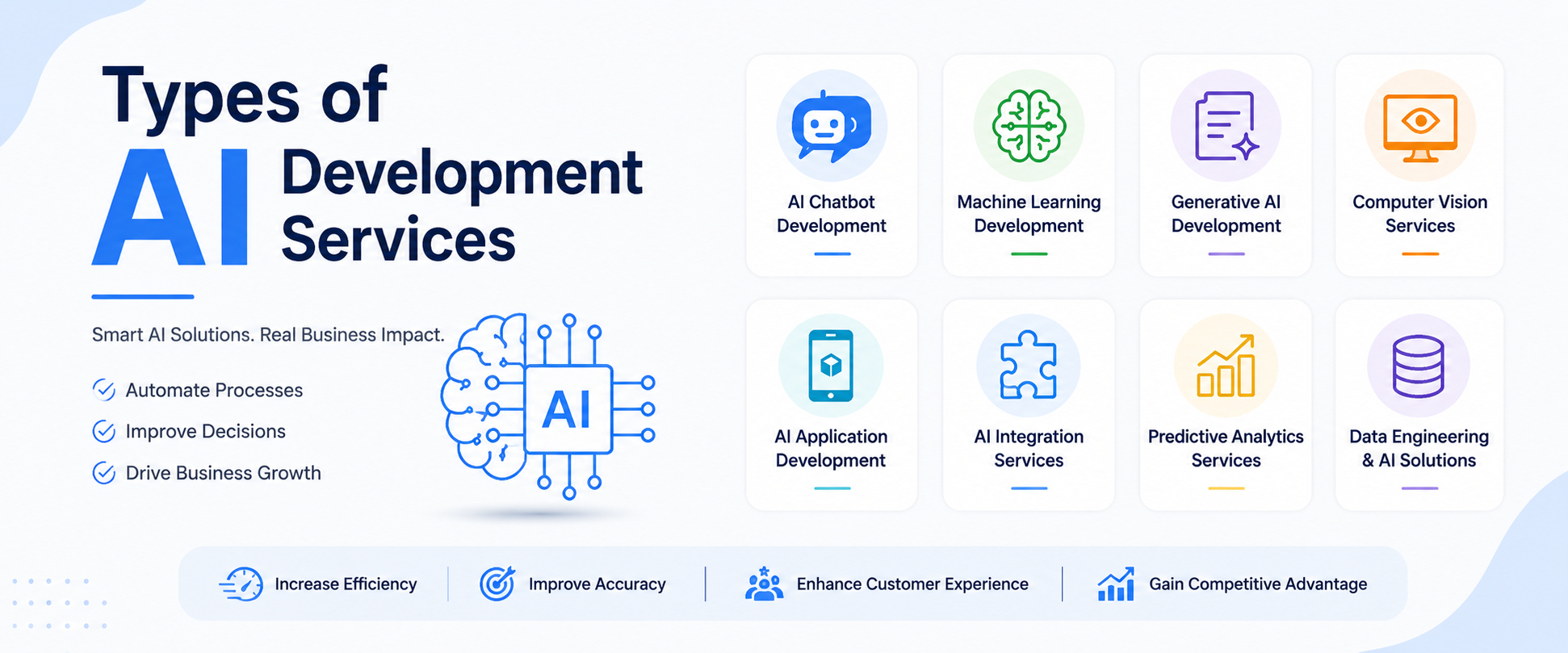
Types of AI Development Services
AI stopped being a future investment a while ago. It's now closer to table stakes — the question most businesses are actually asking isn't whether to adopt it, it's which AI development company or AI consulting company can actually deliver something that works.
That's harder than it sounds. The market is crowded with vendors promising machine learning, generative AI, agentic AI, predictive analytics, and enterprise AI transformation — often using those terms almost interchangeably, even though they describe genuinely different services with different price tags and different skill requirements behind them. Getting that distinction wrong is exactly how businesses end up overpaying for the wrong thing.
This guide breaks down what AI development services actually are, the real categories of AI solutions available today, how implementation works end to end, what each type realistically costs in 2026, and how to choose a partner who's actually equipped to deliver.
What Falls Under AI Development Services?
AI development services are the professional solutions that help organizations design, build, deploy, and optimize artificial intelligence systems — spanning machine learning, deep learning, natural language processing, computer vision, generative AI, and increasingly, autonomous AI agents. The goal across all of them is the same: help a business solve a problem faster, cut operational cost, or surface something in its data that a person would never catch manually.
A distinction worth getting right early
AI consulting companies advise on strategy — where AI fits, what the roadmap should look like, which use case to prioritize. AI development companies actually build the thing — the models, the integrations, the deployed system. Some providers do both; plenty specialize in one or the other, and confusing the two is a common reason businesses hire the wrong partner for the stage they're actually at.
Example: An ecommerce company drowning in daily customer inquiries doesn't necessarily need a strategy deck — it needs a working chatbot, automated ticket routing, and sentiment analysis wired into its existing support stack. That's a development engagement, not a consulting one.
From Idea to Deployment: How an AI Project Actually Runs
Business discovery
Before any technology gets chosen, the real work is understanding the actual objective, existing workflows, and what "success" looks like in measurable terms. Skipping this is the single most common reason technically sound AI projects fail to deliver business value.
Data assessment
AI is only as good as the data behind it. This stage checks data quality, volume, source reliability, and compliance requirements — and it's worth taking seriously, because poor data is the most common root cause of an AI system that technically works but produces unreliable output.
Solution design
The architecture gets mapped here — which models, what infrastructure, which APIs, what security framework — decisions that are expensive to unwind later if rushed.
Model development
Engineers prepare data, engineer features, train models, and validate performance. For projects using pre-trained foundation models (GPT-class, Claude, Gemini, open-source LLMs) rather than training from scratch, this stage moves considerably faster and cheaper — a distinction that materially affects both timeline and cost.
Integration
The AI system gets connected into CRM platforms, ERPs, websites, or internal tools. This is where AI integration services for enterprises matter most, since a model that performs well in isolation is only useful once it's actually reachable inside the workflows people use daily.
Deployment
The system goes live, with performance monitored closely in the early period when unexpected edge cases tend to surface.
Ongoing optimization
AI systems aren't "done" at launch — retraining, monitoring, and feedback loops keep performance from degrading as real-world data drifts from what the model was originally trained on.
The Seven Categories, and Who Actually Needs Each One
Custom AI software development
Tailored systems built for a specific business's workflow — a logistics company's proprietary route optimization engine is the classic example. Best suited to enterprises and high-growth startups with requirements generic tools can't cover, at the cost of a longer build and higher upfront investment than an off-the-shelf option.
Machine learning development and consulting
Focused on predictive and analytical systems — demand forecasting, risk scoring, customer segmentation. This is where most businesses managing large datasets see the clearest ROI, because the value is in the prediction accuracy, not a flashy interface.
Generative AI development services
Systems that generate text, images, code, or audio — AI copilots, content assistants, and increasingly autonomous support agents. Marketing teams, SaaS providers, and content platforms are the heaviest adopters right now, largely because the productivity gain is immediate and easy to measure.
Agentic AI / AI agent development
A newer, increasingly distinct category from generic generative AI — autonomous agents capable of executing multi-step workflows with minimal human intervention, rather than just responding to a single prompt. This has grown enough to become its own listed service category on major B2B directories in 2026, which reflects genuine market demand, not just marketing language: businesses want systems that can actually complete a task chain, not just draft a response.
AI application development
Building intelligent, customer-facing web or mobile products — think a fitness app offering genuinely personalized coaching rather than a static workout plan. The differentiator here is usually the depth of personalization the AI layer enables.
AI integration services
Connecting AI capability into systems a business already runs — CRM, ERP, internal tools — without ripping out the existing stack. This tends to be faster and less disruptive than a ground-up build, which is why it's often the right starting point for enterprises with established infrastructure.
Browse our curated list of Top Companies on UpBusiness
Enterprise AI implementation
Large-scale, organization-wide AI transformation — the kind global financial institutions or multi-division enterprises undertake. This category demands the most rigorous governance and change management, since the blast radius of a mistake is proportionally larger.
Which Industries Are Actually Spending on This
| Industry | Use Case | Business Impact |
|---|---|---|
| Healthcare | Medical imaging analysis, patient monitoring | Faster diagnosis, better outcomes |
| Retail & ecommerce | Recommendations, demand forecasting | Higher conversion and retention |
| Banking & finance | Fraud detection, risk assessment | Losses caught before they compound |
| Manufacturing | Predictive maintenance, quality control | Less downtime, less waste |
| Logistics | Route optimization, inventory management | Faster delivery, lower cost per shipment |
| Education | Personalized learning platforms | Better engagement and outcomes |
| Real estate | Property valuation, lead qualification | Sharper decision-making |
The Competitors Who Already Automated This
Most businesses evaluate AI purely on implementation cost. The bigger number is usually the one nobody's tracking: the cost of falling behind competitors who already automated the same workflow. Without AI-driven insight, businesses tend to miss high-intent leads and emerging trends they'd otherwise have caught early. Manual processes that AI could handle keep requiring more headcount as volume grows, which is a cost that compounds quarter over quarter rather than showing up as one line item. And customer expectations for instant, personalized service keep rising — falling short of that consistently erodes trust in a way that's hard to win back with a single good interaction later.
Picture two online retailers: one runs AI-powered recommendations and automated support, the other operates entirely manually. A year in, the first is converting more, spending less on support per customer, and retaining better — not because of one dramatic feature, but because of what compounds when a system handles the repetitive work reliably every single day.
Also Read, AI SaaS Development Guide for Businesses (2026)
The Real Price Tags, By Project Type
This is the question every decision-maker asks, and it's worth being direct: current market data shows real range here, largely driven by whether a project is using a pre-trained foundation model versus training something from scratch, and how deep the integration work goes.
| Service Type | Typical Cost (Global, USD) | What Drives the Range |
|---|---|---|
| AI consulting / strategy roadmap | $5,000 – $50,000 | Scope of the roadmap and depth of current-state assessment |
| Basic / rule-based chatbot | $10,000 – $50,000 | Simple FAQ logic vs. multi-workflow decision trees |
| LLM-powered AI assistant | $30,000 – $220,000+ | Integration depth (CRM/ticketing handoff), guardrails, and human-escalation logic |
| Machine learning / predictive analytics | $40,000 – $350,000 | Data readiness, model complexity, and whether training is from scratch |
| Generative AI application | $60,000 – $300,000+ | Content type, fine-tuning needs, and infrastructure for scale |
| Computer vision system | $100,000 – $500,000+ | Custom training data requirements and real-time inference needs |
| Enterprise AI platform | $200,000 – $1,000,000+ | Governance, multi-model orchestration, and organization-wide rollout scope |
For India-specific budgeting, most sources currently place these roughly in the ₹8 lakh–₹80 lakh band for mid-complexity machine learning or generative AI projects, and ₹50 lakh to several crore for genuine enterprise-scale platforms — though given how much this space is still shifting, any of these numbers deserve a fresh quote against your specific scope rather than being treated as fixed.
The cost trap almost nobody mentions upfront data preparation alone commonly consumes 20–40% of total project cost, and it's rarely priced clearly in an initial quote. A vendor quoting a suspiciously low number for a "custom AI solution" is often not accounting for how much of the budget clean, structured data preparation is actually going to eat.
One Business, One Year: What the Investment Returned
A mid-sized ecommerce business invests roughly ₹20 lakhs (about $24,000) in an AI recommendation system. A year later, a genuinely achievable outcome looks something like an 18% lift in average order value, a low-double-digit improvement in retention, and a meaningful bump in conversion rate — enough that the investment pays for itself well within the first year. That's a realistic outcome for a well-scoped project with clean data going in, not a guarantee independent of execution quality.
Consultant or Builder? Getting This Distinction Right
| Factor | AI Consulting Company | AI Development Company |
|---|---|---|
| Strategy | Core offering | Sometimes limited |
| Technical build | Rarely, if at all | Core offering |
| Deployment | Advisory only | Full execution |
| Long-term support | Varies | Usually included |
Go with a consulting company when you need strategic guidance or are still building the roadmap. Go with a development company when the work has moved past strategy into actually needing something built, deployed, and supported. A meaningful number of businesses end up needing both — starting with a consulting engagement to define the right use case, then handing execution to a development partner (or one that offers both under the same roof).
Build It Custom, or Buy Something Off the Shelf?
Custom development costs more upfront and takes longer to reach market, but it delivers real customization, stronger scalability, and a genuine competitive edge for businesses with complex or industry-specific workflows. Off-the-shelf AI tools are faster to deploy and cheaper initially, which makes sense for smaller budgets or standard processes that don't need anything unique — but they cap out quickly once requirements get more specific than what the tool was built for.
Vetting an AI Partner Before You Sign Anything
Look for relevant project experience in your specific industry, not just general AI credentials — building a fraud-detection model for finance and a recommendation engine for retail draw on genuinely different expertise. Review the portfolio for measurable outcomes rather than technical jargon; a case study that says "reduced churn by 14%" tells you far more than one that lists frameworks used. Confirm technical depth across machine learning, NLP, computer vision, cloud platforms, and data engineering — a team strong in one area but thin elsewhere will hit a wall on anything moderately complex. Ask about their actual process end to end, from discovery through deployment and monitoring, and be wary of anyone who can't walk you through it concretely. Check that the solution is built to scale rather than optimized purely for a quick launch. And don't treat deployment as the finish line — AI models need ongoing monitoring and retraining, so confirm what long-term support actually looks like before signing.
What's Actually New in AI Development Right Now
Generative AI expansion beyond content
Generative AI is moving into software development, knowledge management, and business process automation — not just drafting copy anymore.
Rise of autonomous AI agents
Agentic AI is becoming capable of handling multi-step workflows with minimal human oversight, which is why it's emerging as its own distinct category rather than a subset of generative AI.
Hyper-personalization at scale
Businesses are using AI to deliver individualized experiences to large audiences without the manual segmentation work that used to require.
Multimodal AI
Systems that process text, images, audio, and video simultaneously are unlocking use cases that single-mode AI couldn't handle.
Responsible AI governance
Transparency and compliance are shifting from nice-to-have to enterprise purchasing criteria, particularly in regulated industries.
Ready to Transform Your Business With AI?
At UpBusiness, we connect businesses with verified AI development and AI consulting partners across machine learning, generative AI, agentic AI, and enterprise implementation. Contact UpBusiness to discuss your requirements and find the right AI development company for your specific use case.
Types of AI Development Services: Conclusion
Artificial intelligence has moved from emerging technology to standard business infrastructure — but the businesses getting real value from it aren't the ones spending the most. They're the ones who understood which category of AI development service actually matched their problem, budgeted for the real cost including data preparation, and picked a partner equipped for the specific type of build — consulting, custom development, generative AI, or agentic automation — rather than a generalist promising to do all of it at once.
Browse our curated list of Top Companies on UpBusiness