

Browse our curated list of AI Chatbot Development Companies
A RAG chatbot cost in 2026 runs from about $10,000 for a proof of concept to $80,000 for a production system, and past $200,000 for an enterprise platform. After launch you also pay a monthly bill for the language model, the vector database, hosting and the people who check answers. This guide is for the founder, support head or IT lead who is about to hire a company to build one. It breaks down where the money goes and prices the monthly bill with real model and database rates checked on 22 October 2026. It also compares vector database pricing and shows what the 12 AI chatbot partner companies on UpBusiness charge. The last part shows how to read a proposal so you pay for a bot that works, not one that only demos well.
RAG stands for retrieval-augmented generation. The bot first searches your own documents for the passages that answer a question, then asks a language model to write the reply using only what it found. That's why it can answer from your policies, manuals and product data instead of guessing.
Key takeaways
- Published 2026 cost guides put a proof of concept at $10,000 to $25,000 and a production RAG chatbot at $30,000 to $80,000; enterprise systems with access control and audit logs reach $80,000 to $200,000 or more.
- The model is the small part of the bill. At 10,000 questions a month, model usage costs between $5 and $100 a month on current Anthropic and Google prices, depending on the model.
- Managed vector databases start at $20 to $50 a month for small projects (Pinecone Builder and Standard, Weaviate Flex at $45), so data preparation and testing drive the budget far more than infrastructure does.
- The 12 AI chatbot partner companies on UpBusiness report a median average project size of $17,500, and four of them average under $5,000, so a paid pilot is within reach of small teams.
How Much Does a RAG Chatbot Cost?
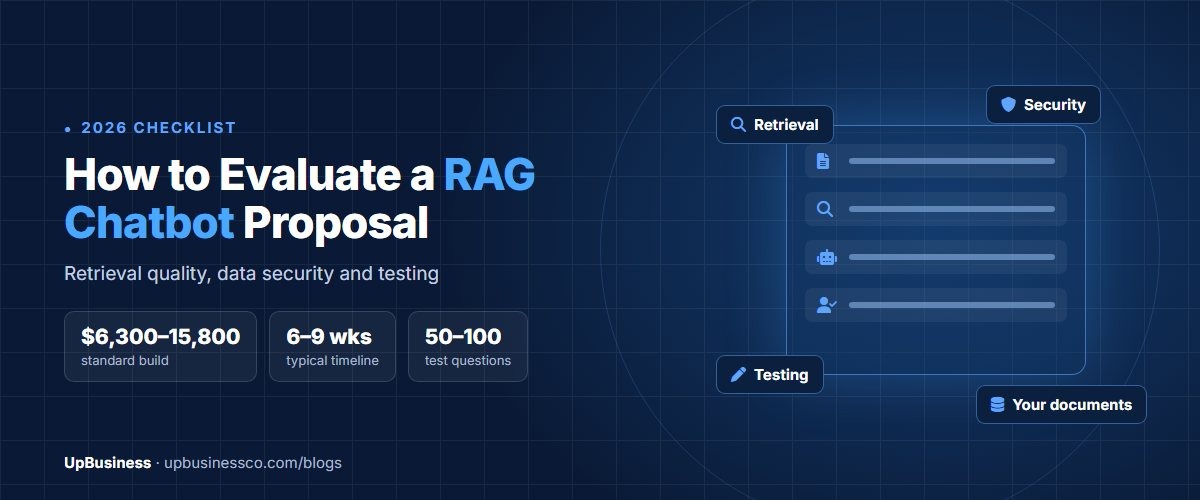
Expect $10,000 to $25,000 for a proof of concept on one data source, $30,000 to $80,000 for a production chatbot with several sources, citations and monitoring, and $80,000 to $200,000 or more for an enterprise system[1]. Running costs add anything from under $100 to several thousand dollars a month.
The ranges below come from published 2026 guides by companies that build these systems, so treat them as a starting point rather than a quote. They line up closely with each other, which makes them a fair benchmark for checking a proposal.
| Project type | Typical build cost | What's included | Typical timeline |
|---|---|---|---|
| SaaS chatbot platform, configured | $0 to $500 a month, plus a few days of setup | Upload documents to a ready-made tool; limited control over retrieval and data location | Days |
| Proof of concept | $10,000 to $25,000 | One data source, basic document splitting, simple chat window, accuracy tested on sample questions | 3 to 4 weeks |
| Production RAG chatbot | $30,000 to $80,000 | 2 to 5 data sources, hybrid search, reranking, citations, evaluation pipeline, monitoring | 8 to 12 weeks |
| Enterprise RAG platform | $80,000 to $200,000+ | Many sources, role-based access, audit logs, compliance controls, links to internal tools | 4 to 6 months |
The build ranges and timelines come from Abark's 2026 RAG pricing guide[1]. The SaaS row comes from Dreambit's 2026 chatbot guide, which also puts a mid-complexity custom build with CRM links and analytics at $75,000 to $120,000[2].
RAG Chatbot Cost Breakdown: What You're Paying For
Two proposals can both say "RAG chatbot using GPT" and describe very different systems. One loads your PDFs into a vector database with default settings. Another cleans the documents, splits them with care, adds filters by product or region, tests retrieval against your real questions and passes uncertain answers to a person. The second can cost three times as much, and it's the one that still works after a few thousand real questions.
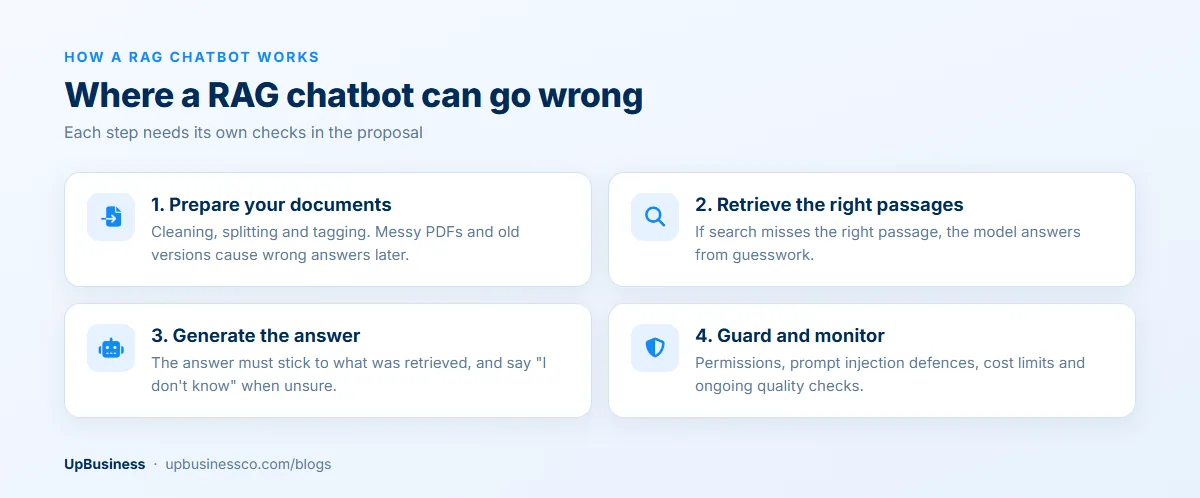
| Part of the build | What the work covers | What makes it expensive |
|---|---|---|
| Data preparation | Collecting, cleaning and splitting documents so each passage can be found on its own | Scanned PDFs, tables, old versions, several languages |
| Embeddings and indexing | Turning text into vectors and loading them into a vector database | Rarely expensive; a few dollars even for large libraries |
| Retrieval | Search method, filters, reranking and how many passages reach the model | Many similar documents, strict accuracy targets |
| Answer generation | Prompts, citations, "I don't know" behaviour and hand-off to a person | Regulated answers, several languages, long conversations |
| Security and access | Who can see which documents, logging, rate limits | Staff with different permission levels, customer personal data |
| Integrations and channels | Website widget, WhatsApp, CRM, helpdesk, single sign-on | Each extra system or channel |
| Evaluation and monitoring | A test set of real questions, scoring, dashboards, weekly reviews | High-stakes answers that need human review |
Abark calls data preparation the most underestimated cost in RAG projects. Clean text files are quick to process. Scanned documents, spreadsheets and material in several languages need OCR, layout parsing and manual checks, which can double that phase[1]. Ask every company how many hours it has allowed for your documents specifically, after it has seen a sample.
Monthly Running Costs: The RAG Chatbot Pricing After Launch
Every answer is a call to a language model, priced per million tokens (a token is roughly three-quarters of a word). A typical RAG answer sends the question, a few retrieved passages and some conversation history, around 3,000 input tokens, and gets back about 400 output tokens. Here's what that costs at current list prices.
| Model (list price per million tokens) | 10,000 questions a month | 100,000 questions a month |
|---|---|---|
| Claude Haiku 5.5 ($0.10 in, $0.50 out)[3] | $5 | $50 |
| Gemini 3.5 Flash-Lite ($0.30 in, $2.50 out)[4] | $19 | $190 |
| Gemini 3.8 Flash ($0.75 in, $3.75 out until 31 Dec 2026)[4] | $37.50 | $375 |
| Claude Sonnet 5.5 ($2 in, $10 out)[3] | $100 | $1,000 |
Google has announced that Gemini 3.8 Flash doubles to $1.50 in and $7.50 out from 1 January 2027, so a bill priced today may not hold next year. Ask the company to show the formula behind its estimate, not just the total, and to say which model it would switch to if prices rise.
Embedding your documents is a small one-off cost. Google's gemini-embedding-2 charges $0.20 per million text tokens[4], so 5,000 documents of about 2,000 tokens each cost around $2 to embed. You pay again only when documents change.
The rest of the monthly bill is hosting, the vector database, monitoring tools and people. Smaller deployments can run on a few hundred dollars a month; one European guide puts a mid-size business at €180 to €450 a month in total[5]. High-volume production systems commonly run $1,000 to $15,000 a month once human review time is included[2]. Check that the proposal includes it.
Ways to keep the monthly bill down
A few design choices cut model costs sharply, and a good partner company will raise them without being asked.
- Prompt caching. The fixed part of every request (instructions and common context) can be cached. Anthropic charges $0.10 per million tokens to read cached input on Claude Sonnet 5.5 instead of $2, and $0.01 instead of $0.10 on Haiku 5.5[3].
- Sending fewer, better passages. Good retrieval and reranking mean the model reads three relevant passages instead of ten loosely related ones, which lowers cost and usually improves the answer.
- Routing by difficulty. Simple questions such as opening hours or order status can go to a cheaper model, with only harder ones sent to a stronger model.
- Batch work. Jobs that don't need an instant reply, like summarising last week's conversations, can use batch processing, which Anthropic prices at half the normal rate.
Vector Database Pricing Comparison
The vector database stores your embedded documents and returns the closest passages for each question. For most business chatbots it's a modest line, but the entry prices differ and some plans carry monthly minimums. List prices checked on 22 October 2026:
| Vector database | Free option | Entry paid plan | Production or enterprise |
|---|---|---|---|
| Pinecone[6] | Starter plan | Builder: $20 a month flat | Standard: $50 a month minimum, then usage (storage $0.33 per GB a month); Enterprise: $500 a month minimum |
| Weaviate Cloud[7] | Free tier | Flex: from $45 a month, pay as you go | Premium: from $400 a month |
| Qdrant Cloud[8] | Free forever: 1 GB RAM, 4 GB disk | Standard: usage-based | Premium and hybrid cloud: on request |
| Supabase (Postgres with pgvector)[9] | Free plan | Pro: $25 a month, including $10 of compute | Larger compute add-ons and Enterprise |
If you already run PostgreSQL, the pgvector extension lets you keep vectors next to your other data at little extra cost, though someone has to tune and maintain it. A managed service costs more but takes that work off your team. For a chatbot answering from a few thousand documents, the difference is usually tens of dollars a month, so pick the option your partner company knows well and can support.
What Pushes a RAG Chatbot Budget Up
The spread between a $15,000 chatbot and a $120,000 one is rarely the model. It comes from the state of your content, the number of systems involved and how much can go wrong if an answer is wrong.
- Messy content. Two companies with the same requirements can see very different quotes if one has current, consistent documentation and the other has years of contradictory PDFs.
- More sources and integrations. Each connection to a CRM, ERP or ticketing system needs its own parsing and testing, and some guides say it can double the development effort[5].
- Several languages. A bilingual chatbot costs roughly 30% to 50% more than a single-language one in one 2026 estimate, because retrieval has to work across languages[5].
- Private deployment. Keeping all data and models inside your own cloud can add 50% to 100% compared with using cloud APIs[5].
- Permissions. If staff in different roles use the bot, retrieval must respect what each person is allowed to see, which means more design and testing.
- Regulated answers. Health, finance and legal bots need stricter testing, logging and human review.
RAG vs fine-tuning cost
For a chatbot that answers from your documents, RAG is usually the cheaper and more practical choice. You can update the knowledge by changing documents rather than retraining a model, and each answer can cite its source. Fine-tuning suits changing a model's style or teaching it a narrow task, and it often sits alongside RAG rather than replacing it. Our guide to custom AI development services compares prompting, RAG, fine-tuning and training in more depth.
SaaS platform or custom build
A configured SaaS chatbot can go live in days for a few hundred dollars a month, and it's a sensible first step if your content is simple and public. A custom build makes sense when you need the bot inside your own systems, strict control over where data is processed, permissions by role, or answers drawn from databases rather than documents. Many teams start on a platform, learn which questions customers ask, then commission a custom build with a much clearer brief.
What AI Chatbot Partner Companies on UpBusiness Charge
We looked at the 12 verified partner companies listed on our AI chatbot development page on 22 October 2026. Each reports an average project size on its profile, and each holds a TrustScore between 70.24 and 74.24 out of 100.
| Average project size | Partner companies |
|---|---|
| Under $5,000 | 4 |
| $10,000 | 2 |
| $25,000 | 5 |
| $50,000 | 1 |
The median is $17,500, which sits inside the proof-of-concept and lower production bands in the table above. Half the companies average $25,000 or more, so a production RAG chatbot is normal work for them. The four smaller firms are worth a look for a paid pilot or a first version on a single data source. Because these figures cover all of each company's AI work, ask for a quote against your own brief rather than relying on the average.
Seven of the same companies also build AI customer support agents, and you'll find others under AI integration if the chatbot has to connect to existing systems.
How to Evaluate a RAG Chatbot Proposal Before You Pay
Price only means something next to what's included. Put every proposal into the same sheet, and where one is silent on an item, ask for a written answer before you score anything.
| Item | What a good proposal says | Question to ask |
|---|---|---|
| Data sources | Which documents and systems, and how often content is refreshed | What happens when we update a policy document? |
| Data preparation | How documents are cleaned, split and tagged | How will you handle scanned PDFs, tables and old versions? |
| Retrieval | Search method, filters, reranking, passages sent to the model | How will the bot pick the right passage among similar documents? |
| Model and hosting | Which model, where it runs, where data is processed | Can we switch models later without a rebuild? |
| Evaluation plan | A test set of real questions, named metrics and target scores | What score must the bot reach before launch? |
| Running costs | Monthly estimate at your volume, with the formula | What will 50,000 conversations a month cost? |
| Ownership | Code, indexes and model accounts held in your name | Who owns the API keys and the vector index? |
Test retrieval on your own questions
Retrieval is where many RAG chatbots fail. If the search step misses the right passage, the model either answers from general knowledge or makes something up, and it does both fluently. Ask each company to measure context recall, which checks how much of the relevant information was actually retrieved[10], and faithfulness, which checks whether the answer is backed by what was retrieved[11].
The practical test is simple. Prepare 50 to 100 real questions your customers or staff ask, each with the correct answer and the document it comes from. Give the same set to every shortlisted company and ask for scores during a short paid pilot. A company that will only show hand-picked examples is telling you how confident it is in its system.
Check security before sharing data
A RAG chatbot connects a language model to your internal documents, which opens new ways for data to leak. OWASP's 2025 Top 10 for language model applications ranks prompt injection first and sensitive information disclosure second, and also lists vector and embedding weaknesses and unbounded consumption[12]. That last one is a cost risk as well: ask what stops one user, or a script, from sending thousands of requests and running up your model bill. Get a data processing agreement signed before any real customer data changes hands.
Score proposals with agreed weights
Agree the weights before you open the proposals, so the cheapest or flashiest one doesn't win by default. For most business chatbots, a split like this works.
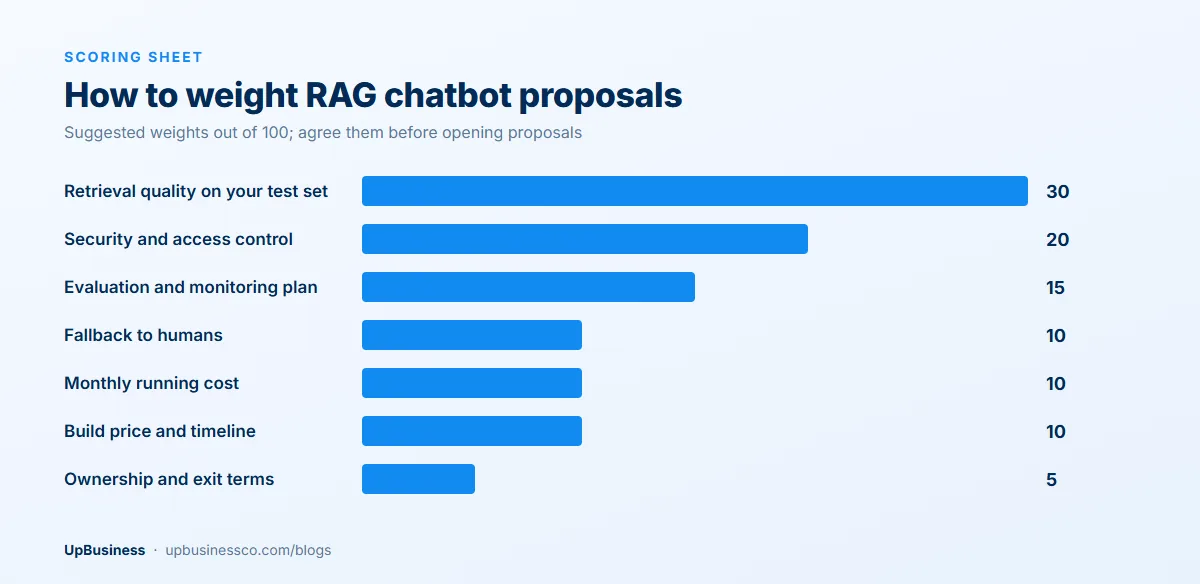
Watch for these warning signs while you score:
- An accuracy claim like "95% accurate" with no test set or method behind it.
- A build price with no estimate of monthly model and hosting costs.
- No plan for documents that change, so answers slowly go out of date.
- Every user can retrieve every document.
- No "I don't know" behaviour and no route to a person.
- API keys, indexes or code held in the company's accounts rather than yours.
Our guide to comparing software development proposals covers the commercial side of the comparison, and AI chatbots in customer service explains where live chatbots tend to struggle. If you're pricing a WhatsApp bot or a voice agent instead, see our WhatsApp chatbot cost guide and AI voice agent cost guide. For wider generative AI projects, read our generative AI development services guide.
When you're ready, post your project with your document volume, channels and a sample of real questions, and verified partner companies can quote against the same brief. Or compare verified AI chatbot development companies by TrustScore and project size.