

Browse our curated list of Software Development Companies
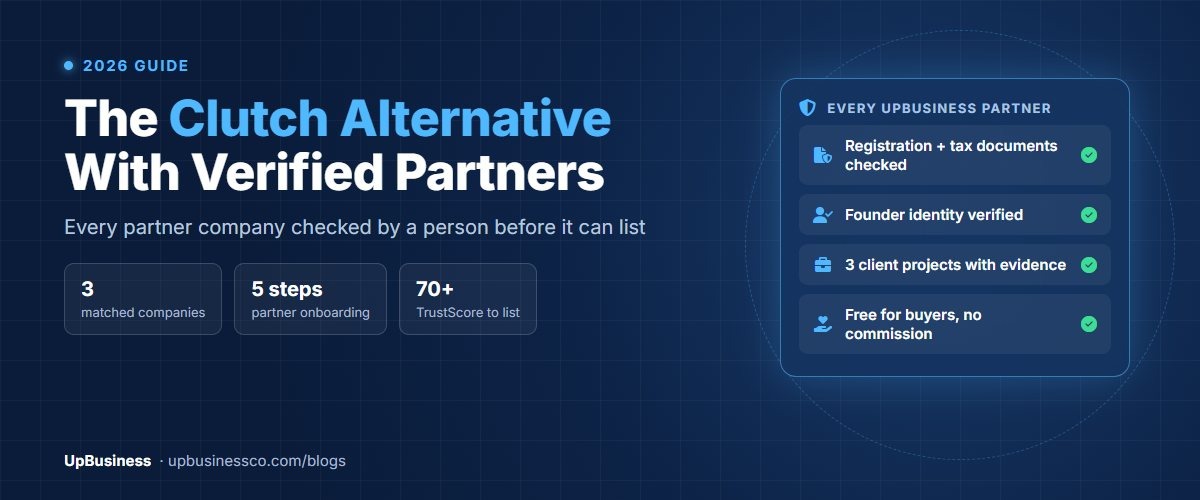
UpBusiness is a Clutch alternative for businesses that want to hire a service company they can trust, without spending weeks sorting through profiles. You describe your project once and get three partner companies matched to it, and every one of them has been through a five-step onboarding where our team checks its registration documents, its founder's identity and three real client projects before it's allowed to list. It's free for buyers, there's no commission on the deal, and it works for buyers and partner companies anywhere in the world.
If you only have a minute
- Every partner company completes a five-step onboarding and needs a TrustScore of 70 or more out of 100 to be listed.
- Each company submits three client projects with evidence, and we can email those clients to confirm the work.
- You post one requirement and get three matched companies, free and with no commission.
- You can also browse categories, shortlist companies, compare them side by side and share the list with your team.
Why Buyers Choose UpBusiness Over Clutch
Clutch is an open directory: any service provider can create a free profile, and companies can buy sponsorships and featured listings that move them to the top of directory pages[1]. That leaves you to work out which companies are real, active and right for your project.
UpBusiness works the other way round. We check the company first, so by the time you see a profile, someone has already looked at its registration documents, confirmed who runs it and seen proof of its client work. You start from a list of companies you can trust and spend your time choosing between them instead of filtering them.
UpBusiness vs Clutch at a Glance
| UpBusiness | Clutch | |
|---|---|---|
| How you find companies | Describe your project once and get 3 matched partner companies, or browse categories ranked by TrustScore | Search and filter a directory, then contact companies one by one |
| Who can list | Registered businesses that complete a five-step onboarding and reach a TrustScore of 70+ | Any service provider can create a free profile |
| What gets checked | Registration and tax documents, founder identity, three client projects with evidence, achievements and online presence | Reviewer identity and work history |
| Client projects | Three per company, with evidence, and clients can be emailed to confirm | Shown through client reviews |
| Comparing companies | Shortlist, compare side by side, add your own notes and share the list with your team | Browse profiles and reviews |
| Cost for buyers | Free, no commission | Free |
What Every Company Goes Through Before It Can List
A company can't simply sign up and appear on UpBusiness. It has to complete a five-step onboarding, and our team reviews each step by hand before the profile goes live.
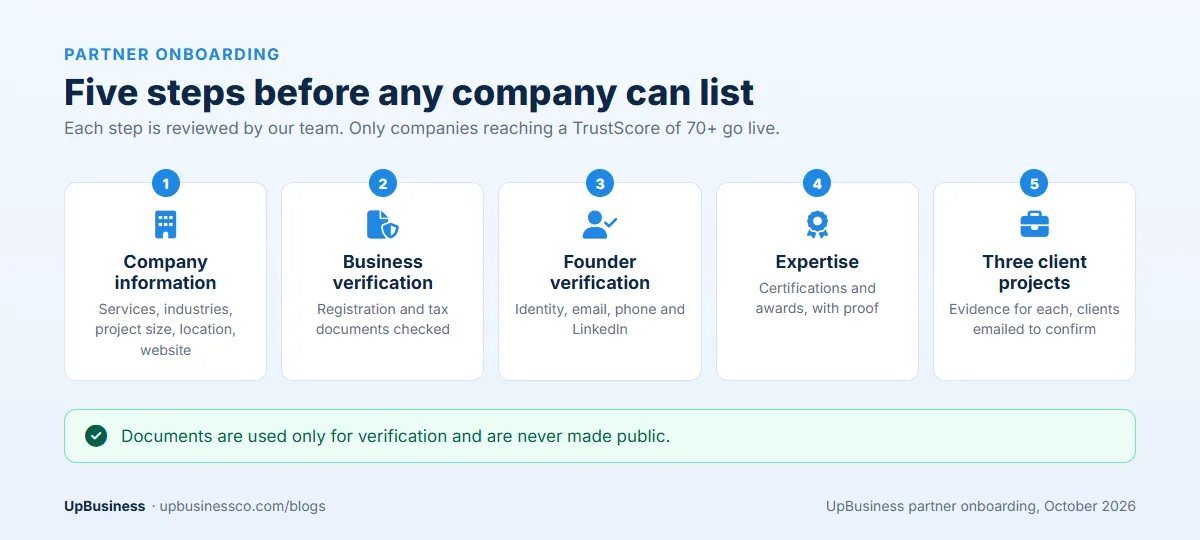
1. Company information
The basics a buyer needs to judge fit: the company name and founding year, its minimum project size and hourly rate, where it's based, its website and social profiles, office photos or a video, the services it offers, the industries it serves and the size of clients it usually works with. This is what lets us match a company to the right briefs instead of every brief.
2. Business verification
The company uploads its incorporation or registration certificate and, where it has one, its tax registration certificate. Our team checks them against the company details, and the founding date on those documents (not the "since" year on a website) decides how many years in business the company gets credit for.
3. Founder verification
We confirm who runs the company. The founder verifies their identity, and their email address, phone number and LinkedIn profile are checked, so you know there's a real, accountable person behind the profile.
4. Expertise and achievements
Companies can add certifications, awards and notable work, each backed by a link or a supporting document. Claims without proof don't earn points.
5. Three client projects
This is the part most directories skip. Every company submits three client projects, and for each one it gives the client's name, the project title, the services delivered, the project size, the start and end dates and a description, along with evidence of the work and proof of the engagement. The company can also give us the client's email address, and we write to that client to confirm the two companies really worked together. A project the client confirms earns extra trust points.
Client details are sensitive, so the company chooses whether each client is shown on its public profile. The documents themselves are used only for verification and are never made public, which is why companies are willing to share real projects with us instead of a handful of logos.
How the TrustScore Works
Everything from onboarding feeds into a TrustScore out of 100. A company needs 70 or more to be listed at all, and the score also decides where it appears on category pages.
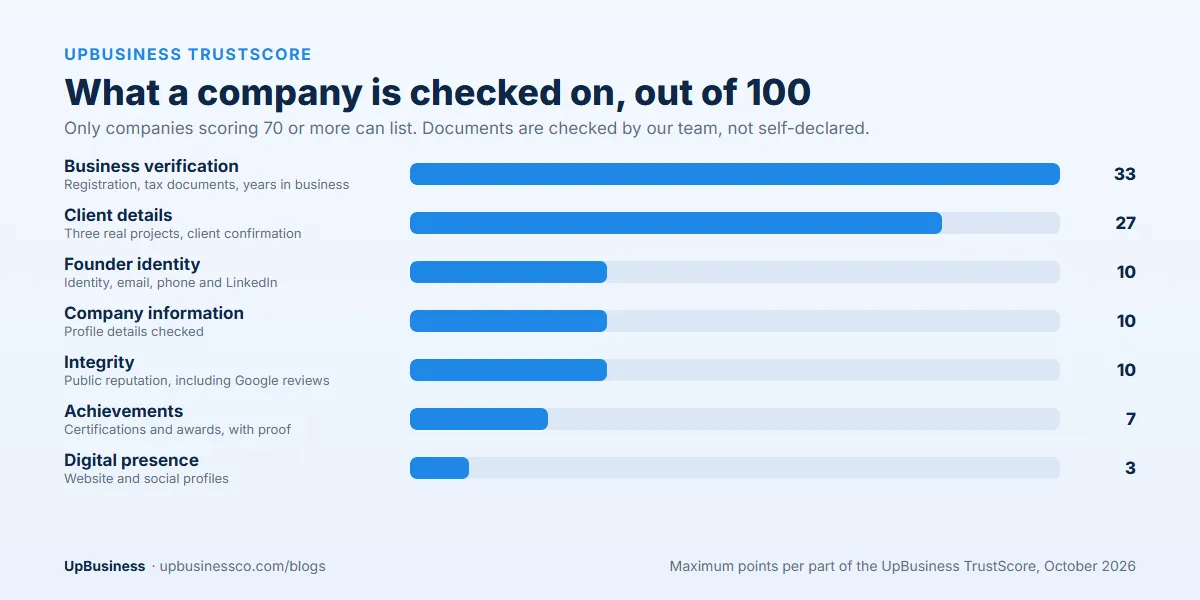
Business verification carries the most weight, up to 33 points, followed by client details at up to 27 points. Founder identity, company information and public reputation (including Google reviews) are worth up to 10 points each, achievements up to 7 and online presence up to 3. Freelancers without a registered business can't list, and neither can product companies, SaaS tools or other marketplaces, because UpBusiness is only for companies that sell services to other businesses.
Partner companies can choose optional paid plans, which appear first in the default "Recommended" order on category pages, but every paid profile still has to complete the same onboarding and reach the same TrustScore of 70. Paying can move a company up the page. It can't get an unchecked company onto it.
How It Works for Buyers
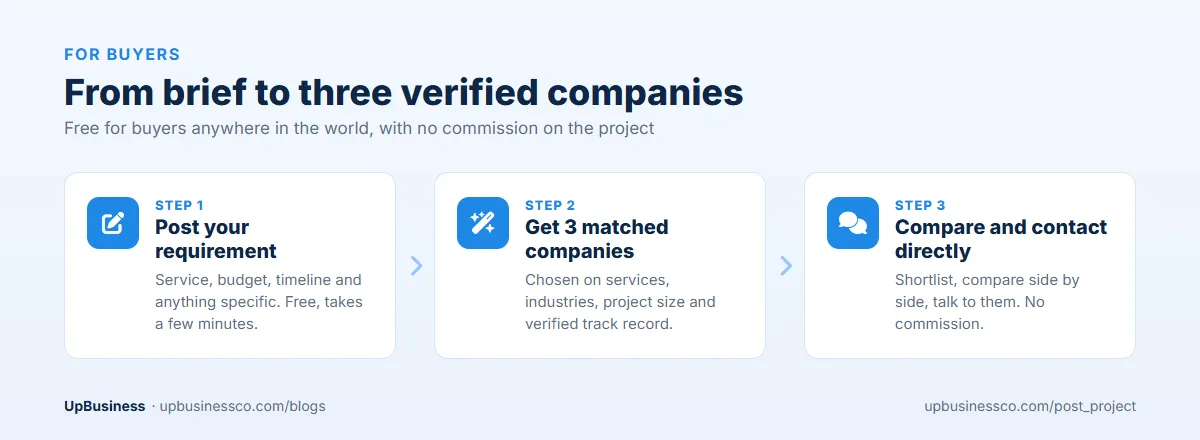
- Post your requirement once: the service you need, a rough budget, your timeline and anything specific (a tech stack, an industry, a time zone you need them to overlap with). It takes a few minutes and it's free.
- UpBusiness recommends the three partner companies best suited to that brief, based on their services, industries, project size and verified track record.
- You look at their full profiles (services, verified client projects, team and documents) and contact the ones you like directly. There's no middleman on the conversation and no commission on the deal.
If you'd like to write a stronger brief before you post, our software project brief template walks through what to include. When proposals come back, our guide on how to compare software development proposals shows how to line them up fairly.
Post your requirement free and get 3 verified partner companies
Compare and Shortlist Companies Side by Side
Three matched companies is the starting point, not the limit. You can browse any category yourself, where companies are ordered by TrustScore, and shortlist the ones you like. Your shortlist lets you compare them side by side on the things that decide a good hire:
- TrustScore and the verification behind it
- Reviews and ratings
- Industry experience
- Commercial fit for your budget
- Portfolio quality and case studies
- How responsive the company is
You can add your own ratings and notes to each company, save the shortlist to come back to later, and share a link to it with your co-founder or team so everyone is looking at the same list. Every company on it has already passed the same onboarding, so you're comparing like with like rather than sorting real firms from empty profiles.
What You Can Hire on UpBusiness
UpBusiness covers more than 5,000 specific services across 10 categories, so most B2B projects have a home here. The largest areas are:
- AI and data: AI application development, AI integration, chatbots, automation and AI consulting
- Software development: custom software, web and mobile apps, APIs, cloud, DevOps and ERP
- Digital marketing: SEO, paid ads, social media, e-commerce marketing and analytics
- Consulting: strategy, operations, legal, HR and finance consulting
- Design and creative: branding, UI/UX, 3D and video
- Content: writing, content strategy and production
If you're not sure which category your project falls under, post it anyway. The matching looks at what you need done, not the label you give it.