
A few years ago, AI in Digital marketing meant a chatbot on your website and maybe some auto-generated ad copy. That's not what it means anymore. Today it touches research, targeting, content, reporting, and increasingly, the search engines themselves — Google's AI Overviews and tools like ChatGPT Search and Perplexity are changing how people find businesses in the first place.
For founders, that shift changes the question. It's no longer "should we use AI in digital marketing." It's "which parts of our marketing stack are we going to fall behind on if we don't." Teams that are slow to adopt tend to feel it in three places first: content takes longer to ship, customer acquisition costs creep up because targeting isn't as sharp, and competitors start showing up in AI-generated answers where you don't.
This guide walks through where AI is actually making a difference in digital marketing right now, which tools are worth a founder's attention, how to roll AI into your marketing operation without breaking what already works, and what's changing about search itself — because that last part affects every business, not just the ones chasing AI trends.
What is AI in Digital Marketing?
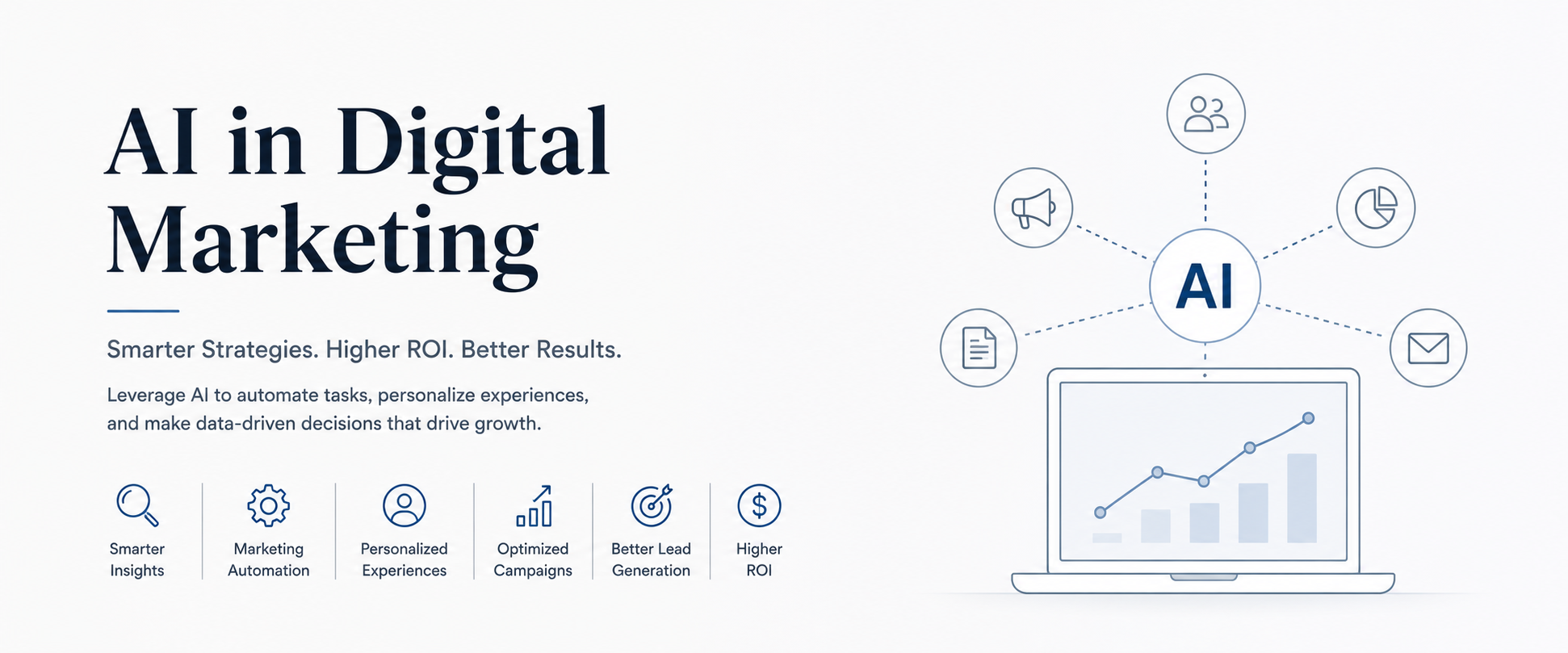
AI in digital marketing means using machine learning, automation, and generative tools to handle the parts of marketing that used to depend entirely on manual work and guesswork — research, targeting, content drafting, bid management, and performance analysis. Instead of a team manually building audience segments or A/B testing headlines one at a time, AI systems process behavioral and campaign data continuously and adjust in something close to real time.
The important distinction: AI isn't a separate marketing channel sitting alongside SEO, ads, and email. By 2026 it's woven into the platforms most businesses already use — Google Ads sets bids and generates creative variants with it, HubSpot scores leads with it, Salesforce predicts churn with it. For most companies, the question isn't whether to "add AI" to their stack. It's how deliberately they use the AI that's already sitting inside the tools they've got.
Where AI is Actually Changing Digital Marketing
Search and SEO
The biggest shift isn't a new tool — it's that search results themselves look different now. Google AI Overviews pull answers directly into the results page, and a growing share of people are starting their research in ChatGPT or Perplexity instead of a search bar. That means ranking #1 the old way matters less than it used to, and being the source an AI model cites matters more.
On the practical side, AI has made the unglamorous parts of SEO faster: finding content gaps, spotting keyword opportunities competitors have missed, and running technical audits that used to take a specialist days now take hours. That doesn't replace strategy — someone still has to decide what's worth writing about — but it frees up time to actually do the strategic work instead of the spreadsheet work.
Content Creation
Content is usually the first place founders try AI, and for good reason — it's the bottleneck almost every marketing team complains about. AI is genuinely useful for first drafts, outlines, and getting past the blank page on blog posts, social captions, and email copy.
Where it falls apart is when teams publish that first draft as-is. Generic AI output reads generic, and both readers and search engines have gotten better at noticing. The teams getting real value — HubSpot's content workflow is a good public example — use AI to speed up the first 70% of the work and keep a human tightening the last 30%: the specific examples, the brand voice, the claims that need a real source behind them.
Advertising
Ad platforms have quietly become AI systems. Google Ads, Meta, and LinkedIn all use machine learning to handle bidding, placement, and audience targeting behind the scenes — you're not really choosing whether to use AI in advertising anymore, you're using it whether you opt in or not.
What's still a human decision: the creative, the offer, and the budget guardrails. AI optimizes toward whatever goal and data you give it, so bad inputs still produce bad campaigns — just faster.
Analytics and Insights
This is where AI's advantage is least visible and most valuable. Predicting churn, forecasting revenue, spotting which audience segment is quietly disengaging — these are pattern-recognition problems across large datasets, exactly what AI is built for and exactly what's tedious to do by hand. Salesforce has pushed hard into this space for a reason: the founders who catch a churn signal two weeks early make very different decisions than the ones who find out from a cancellation.
Personalization
Amazon's product recommendations, Netflix's homepage, Spotify's playlists — these aren't just nice UX touches, they're revenue drivers, and they all run on the same underlying idea: use behavioral data to show each customer something more relevant than what you'd show everyone else. Shopify has made this kind of personalization accessible to much smaller stores, which is the real story — this used to be an enterprise-only capability, and it isn't anymore.

Browse our curated list of Top Companies on UpBusiness
Customer Support
AI-driven support has moved past "annoying chatbot that can't answer anything." Done well, it handles the repetitive first-line questions — order status, pricing, scheduling — and routes anything complicated to a human fast. Airbnb and Shopify both lean on this to keep response times down without scaling support headcount linearly with growth. Done poorly, it just frustrates customers with a bot that loops. The difference is almost always in how much the bot is allowed to hand off, and how quickly.
Building an AI Marketing Workflow: A Practical Framework
Founders who get burned by AI adoption usually made the same mistake: they bought a tool before they knew what problem it was solving. A simpler sequence works better.
- Audit what's actually slow. Look at where your team spends the most hours relative to the output — reporting is a common offender.
- Pick one or two processes to automate first, not five. Content production, reporting, and lead qualification are usually the highest-leverage starting points.
- Choose tools that fit the problem, not the ones with the most marketing buzz. A tool that's great for SEO research is a poor fit for ad optimization, and vice versa.
- Get the team actually trained on it. The single biggest waste of an AI tool budget is a license nobody on the team knows how to use well.
- Track it against real numbers — CAC, conversion rate, lead quality, hours saved — not "does it feel faster."
- Only scale what's proven. Roll out to more of the business once you have evidence, not enthusiasm.
Where the ROI Actually Shows Up
If you're trying to justify AI spend to a co-founder or a board, these are the numbers that tend to move:
- Customer acquisition cost — sharper targeting means less wasted ad spend on people who were never going to convert.
- Conversion rate — personalized experiences consistently outperform generic ones, because relevance is most of what conversion comes down to.
- Lead quality — AI-based lead scoring catches high-intent prospects that a manual process would rank too low or miss entirely.
- Output per person — the honest version of "productivity" is that a smaller team can now produce what used to need a bigger one.
- Retention — churn prediction gives you a chance to intervene before a customer has already decided to leave, which is the only point at which intervention actually works.
Questions Worth Asking Before You Spend on AI Tools
Before signing up for another subscription, it's worth sitting with a few honest questions:
- Which marketing task is eating the most hours relative to its impact?
- Where do prospects actually drop off — and do you have the data to see that clearly?
- Does your team have the skill (or time to learn) to run the tool well, not just log into it?
- What does success look like in a number, not a feeling?
- Have you thought through data governance, or is that a problem for later?
Founders who start from a specific, named problem get far more out of AI than founders who start from "we should probably be using AI for something."
AI Search Optimization: Preparing for GEO and AEO
Traditional SEO optimized for ranking. Generative Engine Optimization (GEO) and Answer Engine Optimization (AEO) optimize for something slightly different: getting cited inside an AI-generated answer, whether that's a Google AI Overview, a ChatGPT response, or a Perplexity summary.
The content that tends to get picked up by these systems shares a few traits:
- It answers a specific question clearly, near the top, instead of building up to it.
- It's backed by real expertise or original data, not a rehash of what's already ranking.
- It's structured cleanly — headers, lists, and FAQs that an AI system can parse and lift cleanly.
- It's part of a consistent body of work on the topic, not a one-off post. Systems seem to weight topical authority, not just single-page relevance.
Practically, this means writing for a person and structuring for a machine at the same time — which is a different discipline than classic keyword-stuffed SEO writing, and one most teams haven't fully adjusted to yet.
Where AI Marketing Still Falls Short
Most guides on this topic skip this part, which is exactly why it's worth including. AI tools come with real trade-offs a founder should weigh before leaning on them too heavily:
- Generic output at scale. Unedited AI content tends to sound like every other unedited AI content — readers notice, and increasingly so do search systems.
- Bias baked into the data. AI models reflect whatever patterns exist in their training data, which means skewed targeting or unfair segmentation can happen without anyone intending it.
- Data privacy exposure. Personalization runs on customer data. The more of it you feed into third-party AI tools, the more careful you need to be about where that data goes and who can access it.
- Unclear content ownership. Copyright and ownership questions around AI-generated material are still being settled in court and in policy — not a reason to avoid the tools, but a reason to keep human review in the loop before anything goes out under your brand.
- Integration friction. Not every AI tool plays nicely with an existing marketing stack. A tool that looks great in a demo can still create data silos or duplicate work if it doesn't talk to your CRM or analytics setup.
- A real skill gap. Running these tools well takes a different skill set than most marketing hires already have — prompt writing, output review, and knowing when to override the recommendation.
None of this is an argument against using AI. It's an argument for using it with the same scrutiny you'd apply to any other vendor decision — not just adopting it because competitors are.
AI in Digital Marketing: Conclusion
AI in digital marketing isn't a single decision anymore — it's already embedded in the ad platforms you use, the search engines your customers use, and increasingly the tools your own team touches every day. The founders getting ahead aren't the ones using the most AI tools. They're the ones who picked their actual bottleneck, applied AI there deliberately, kept a human in the loop on judgment calls — brand voice, factual accuracy, what to say no to — and stayed honest about where the tools still fall short. That combination, not the tools alone, is what separates the businesses that get faster from the ones that just get louder.
Browse our curated list of Top Companies on UpBusiness