


Browse our curated list of Web Development Companies
Knowing how to choose a web development company matters more than the size of the budget. Two companies can quote the same price and hand you very different things: one a fast, accessible site you own outright, the other a slow template on hosting you can't move. The difference usually shows up only after launch, when fixing it costs more than doing it right would have.
This guide is for business owners, marketing heads and founders anywhere in the world who are hiring an outside team to build or rebuild a website or web app. It covers what web development services include, what they cost in nine countries, the questions to ask, a simple way to score your shortlist and 12 checks to run before you sign. We've used public data on website speed and accessibility, official and survey rate data, Google's own guidance and copyright law from India, the UK and the US, plus data from the UpBusiness partner companies that report web development work.
Key takeaways
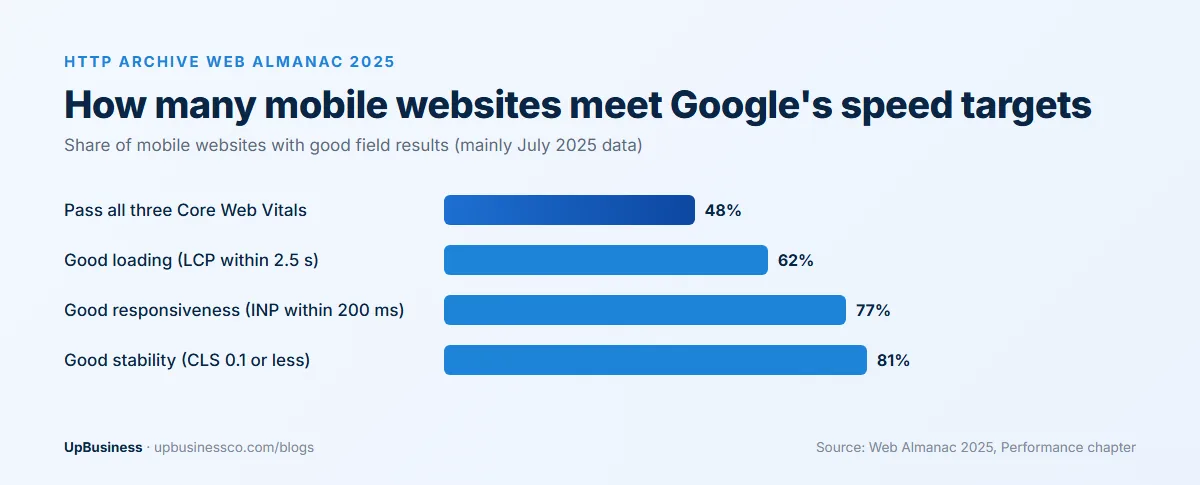
- Only 48% of mobile websites passed all three of Google's Core Web Vitals in the 2025 Web Almanac. Ask every company for written speed targets, not a promise that the site will be "fast".
- 95.9% of the top 1 million home pages failed automated accessibility checks in 2026. Ask which accessibility standard the company will build and test against.
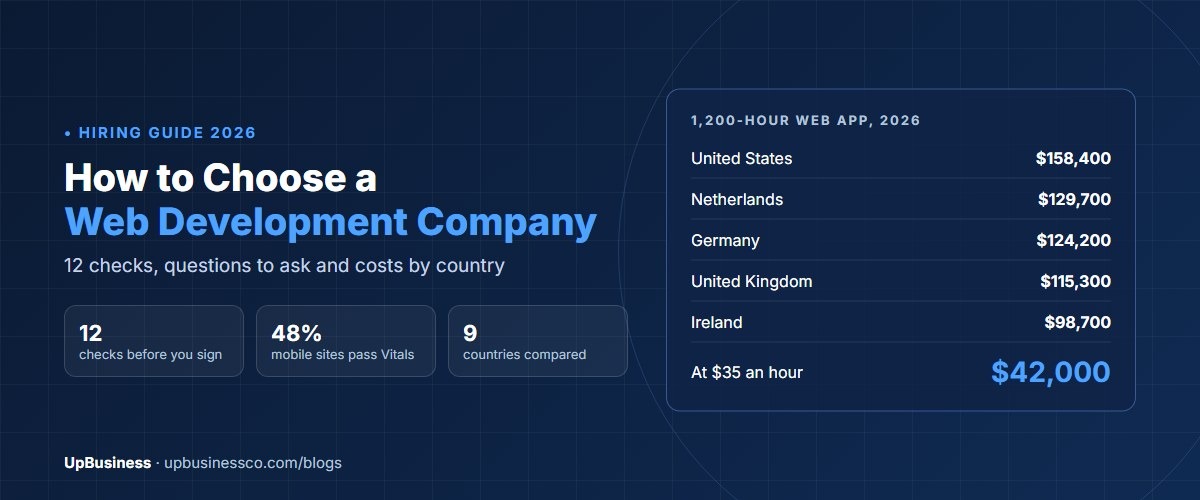
- A 1,200-hour web app costs about $158,400 at the median US government ceiling rate, about £88,000 at the UK contractor median and about $42,000 at $35 an hour.
- In India, the UK and the US, a contractor usually owns the code it writes unless the contract assigns it to you in writing.
- The 8 UpBusiness partner companies that report web development work have average project sizes from $1,000 to $10,000, with a median of $3,750.
How to Choose a Web Development Company: The Short Answer
To choose a web development company, start with a written brief, then shortlist three to five companies that have built sites like yours. Check their live work for speed and accessibility, meet the people who will build your site, get itemised quotes and confirm in writing that you'll own the code, domain, hosting and accounts. The 12 checks below cover each step.
| # | Check | What a good answer looks like |
|---|---|---|
| 1 | A written brief before any quote | The company asks about your users, pages, integrations and goals first |
| 2 | Relevant live work | Two or three sites like yours that you can open and test |
| 3 | Speed on real devices | Written Core Web Vitals targets for mobile |
| 4 | Accessibility | A named WCAG level and manual testing |
| 5 | The right platform | A reason for WordPress, Shopify or custom code that fits your needs |
| 6 | The actual team | Named designer, developer and project lead |
| 7 | Process and visibility | Regular demos and access to the staging site |
| 8 | Itemised pricing | Design, development, testing, content and launch priced separately |
| 9 | Ownership | Code, design, domain, hosting and accounts in your name |
| 10 | SEO during a rebuild | A redirect map from old URLs to new ones |
| 11 | Support after launch | A written support plan with response times |
| 12 | References | One current client you can call |
What Web Development Services Include
Web development services cover everything needed to plan, build and launch a website or web application. A full-service project usually includes discovery (goals, users and scope), information architecture, visual design, front-end development, back-end and CMS set-up, integrations, testing, launch and support after launch. Smaller projects may skip some stages, but discovery and testing are expensive to skip.
Web Design Company vs Web Development Company
A web design company focuses on how the site looks and how visitors move through it: layout, branding, page flows and the design files. A web development company turns that design into working code: templates, the CMS, forms, integrations, speed and security. Many companies do both, but most lean one way.
If your site is mostly marketing pages, a design-led team that also builds can suit you, and you can compare website design companies. If you need logins, payments, bookings or data from other systems, pick a development-led team and check that a designer is on it. Ask to see both the design files and the live site for one past project.
Match the Company to Your Project Type
A company that builds good marketing sites may struggle with a web app, and the other way round. Decide which kind of project you have before you shortlist.
| Project | What the company must show | Where to look |
|---|---|---|
| Business or marketing website | Clear page design, an easy CMS, basic SEO set-up | Web development companies |
| Custom-designed website | Original design, not a lightly edited theme | Custom website development |
| Online store | Payments, product data, a fast checkout | E-commerce website development |
| Web app, portal or SaaS product | Back-end work, security testing, user roles | Web application development |
| Rebuild of a site with search traffic | A redirect map and content migration plan | Website redesign and SEO |
| Ongoing care | Updates, backups, security patches, small changes | Website maintenance |
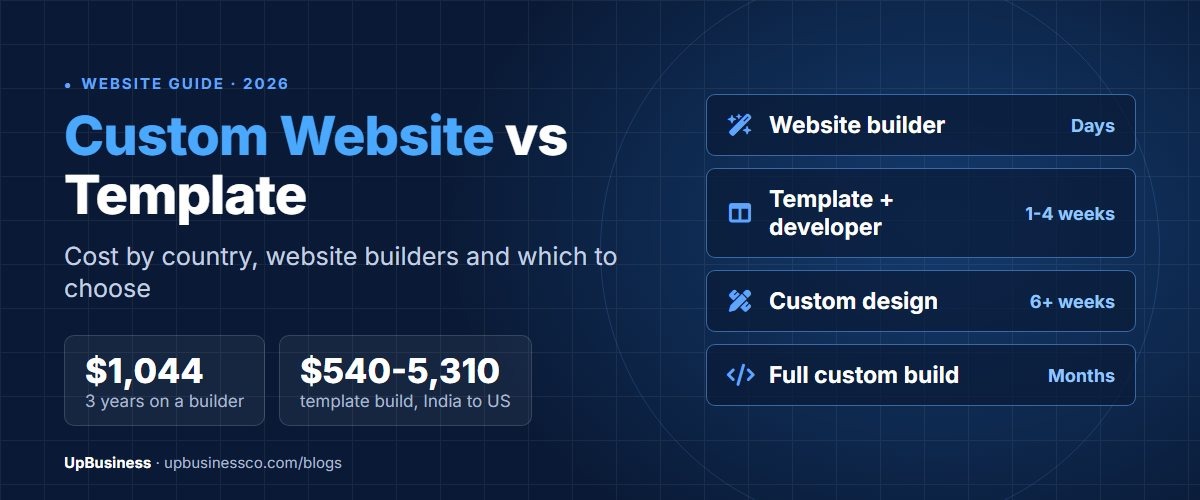
If you're not sure you need a custom build at all, our comparison of custom websites vs template websites sets out the trade-offs, and our ecommerce website cost guide covers online stores.
What Web Development Services Cost in 2026
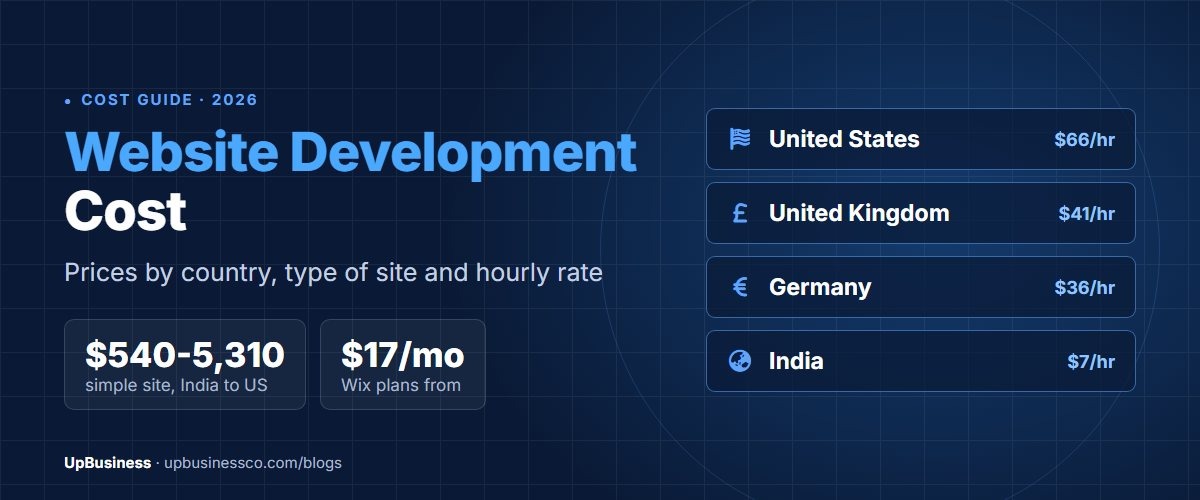
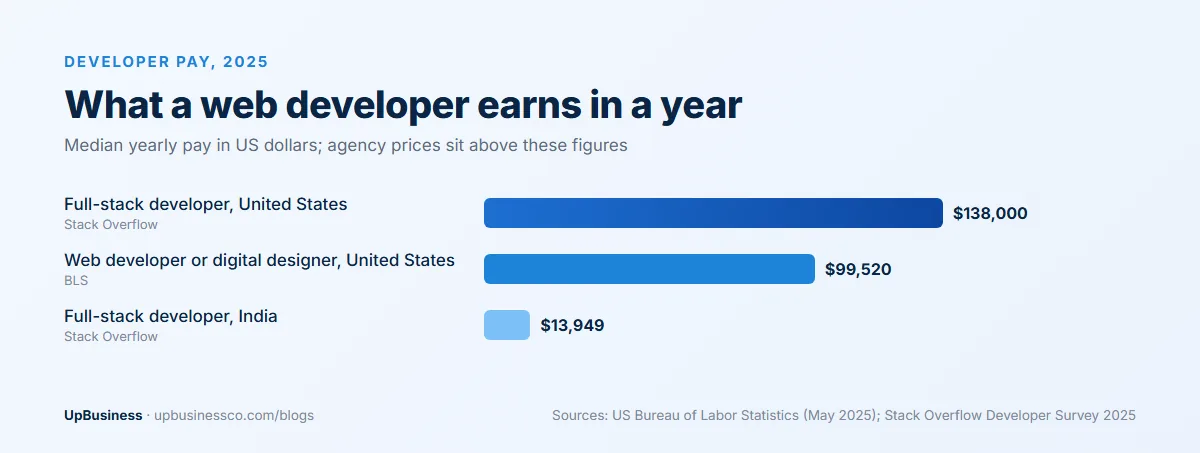
Most of the price of a website is people's time, which is why the team's location has such a big effect on cost. The US Bureau of Labor Statistics puts the median pay of US web developers and digital designers at $99,520 a year in May 2025[1]. The 2025 Stack Overflow Developer Survey puts the median full-stack developer salary at $138,000 in the US and $13,949 in India[2].
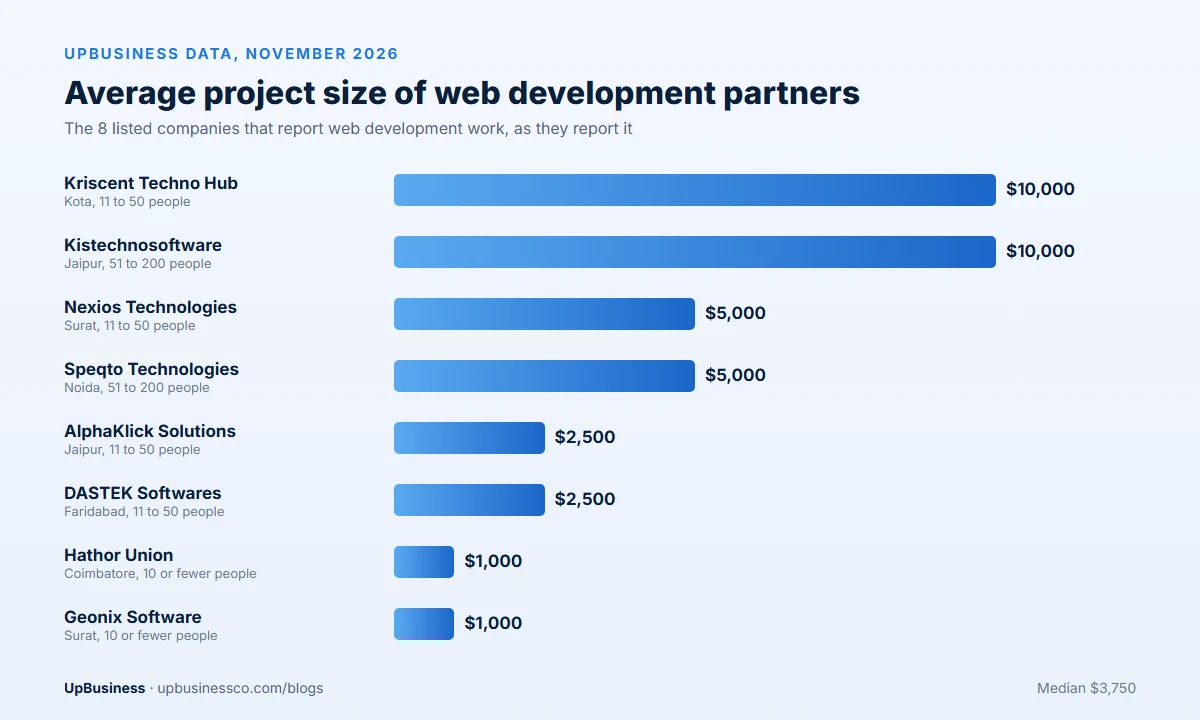
Agency prices sit above salaries, because they cover project management, tools, office costs and profit. As a sense-check, the 8 UpBusiness partner companies that report web development work have average project sizes from $1,000 to $10,000, with a median of $3,750. Our website development cost guide breaks prices down by site type, and our WordPress development cost guide covers WordPress builds.
Web Development Costs by Country
Wherever you are, you can hire a team nearby or one abroad. The table shows a public benchmark for developer time in nine markets. Where the benchmark is a rate, it also shows what 1,200 hours costs, which is roughly a mid-size web app with a customer portal and an admin area.
| Country | Benchmark for developer time | 1,200 hours | Guide for buyers there |
|---|---|---|---|
| United States | Median US government ceiling rate for software developers, about $132 an hour[3] | about $158,400 | US guide |
| United Kingdom | Software engineer contractor median, about £550 a day[4] | about £88,000 | UK guide |
| Germany | Software and web freelancers, median €90 an hour[5] | €108,000 | Germany guide |
| Netherlands | Freelance software developers, average €94 an hour[6] | €112,800 | Netherlands guide |
| Ireland | IT contractors, about €572 a day[7] | €85,800 | Ireland guide |
| Canada | Software design engineers, median wage C$56.49 an hour[8] | Salary data, add employer costs | Canada guide |
| Australia | Software programmers, median A$2,537 a week[9] | Salary data, add employer costs | Australia guide |
| Singapore | Software developers, median S$8,887 a month[10] | Salary data, add employer costs | Singapore guide |
| India | Example partner company rate of $35 an hour | $42,000 | Indian web development companies |
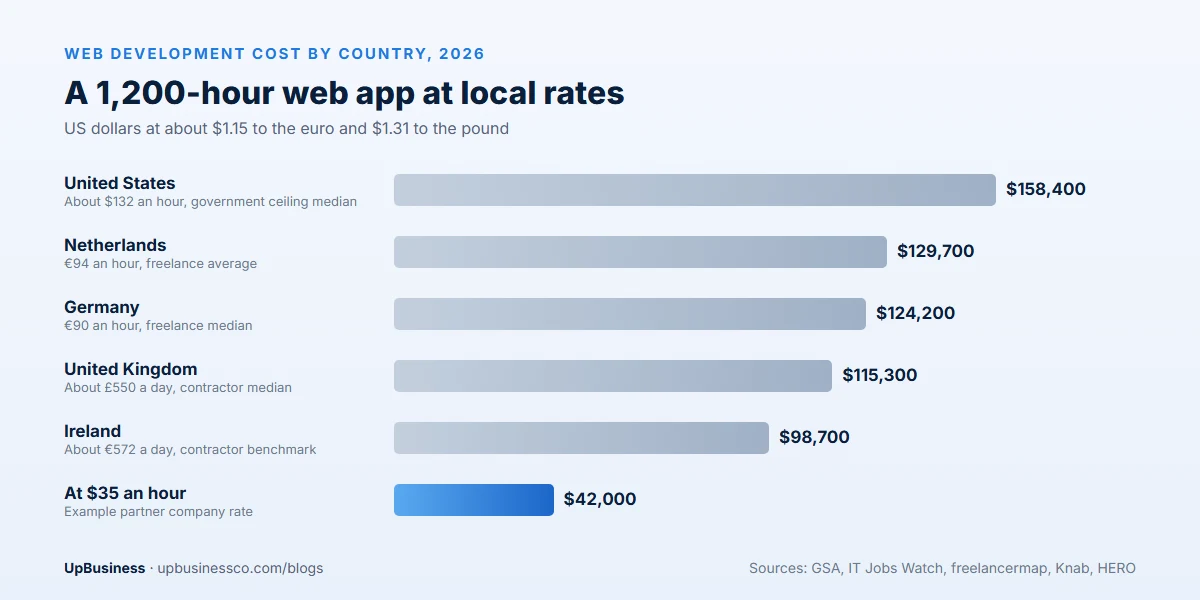
Dollar figures use about $1.15 to the euro and $1.31 to the pound. In the Gulf, compare a local agency quote on the same brief, as our UAE guide explains.
Rate isn't the whole cost. A team abroad needs more of your time for calls, reviews and testing. The contract should say which country's law applies, which currency each invoice uses and how disputes are handled. If your customers are in the EU or UK, ask how forms, analytics and backups will meet the GDPR. Agree on at least two or three shared working hours a day, and keep the domain, hosting and payment accounts on your own company card.
12 Checks Before You Hire a Web Development Company
1. A written brief comes before the quote
A company that sends a fixed price within hours hasn't had time to understand your project. A good one asks about your users, the pages and features you need, your content, your integrations and how you'll measure success. Write those answers down once and send the same brief to everyone. The quotes you get back will then be comparable. Our project brief template gives a structure you can copy.
2. Relevant work you can open and test
Screenshots and award badges tell you little. Ask for two or three live sites similar to yours in size and type, then open them on your phone. Check how quickly they load, whether the menus and forms work and whether the content is easy to update.
3. Speed targets in writing
Speed is part of the build, not something to fix later. Google's Core Web Vitals give clear targets: main content loaded within 2.5 seconds (LCP), a response to taps and clicks within 200 milliseconds (INP) and layout shift of 0.1 or less (CLS), measured at the 75th percentile of real visits[11]. In the 2025 Web Almanac, only 48% of mobile websites passed all three[12]. Ask for these targets in the proposal and for a test on a real mid-range phone before launch.
4. A named accessibility standard
WebAIM's 2026 scan found detectable accessibility failures on 95.9% of the top 1 million home pages, with low contrast text on 83.9% and unlabelled form fields on 51%[13]. These are build habits, and they're cheap to avoid during design. Ask which WCAG level the company builds to (2.1 or 2.2 AA is common) and who tests with a keyboard and a screen reader. Our guide to web design trends 2026 covers the accessibility rules now in force in the EU and US.
5. A platform chosen for your needs
Be careful with a company that recommends the same platform for every client. WordPress is a common choice for content-heavy sites, Shopify for many online stores and custom code for web apps with unusual logic. Ask why they've chosen the platform, what it will cost to run each year and how easy it will be for your team to update pages without calling them.
6. The people who will build your site
A senior person often runs the sales call, and someone else does the work. That's normal, but you should know who that someone is. Ask for the names and roles of the designer, developer and project lead, how many other projects they're handling and whether any work is subcontracted.
7. A process you can see
Ask how often you'll see progress. A good answer is a working demo every one or two weeks on a staging site you can open yourself, plus a shared task list. Long silences followed by a "big reveal" make it hard to catch problems while they're still cheap to fix.
8. Itemised pricing
A single total hides what you're paying for. Ask for design, development, content entry, testing, launch and the first months of support as separate lines. Then compare quotes line by line, as our guide to comparing software development proposals shows. A much lower quote usually means one of those lines is missing.
9. You own the code, design and accounts
Ownership causes more disputes than almost anything else. Under India's Copyright Act, the author of a work is its first owner unless an exception applies, and an assignment of copyright is valid only in writing[14]. UK law also requires a written, signed assignment[15], and in the US, code written by an outside contractor usually stays the contractor's unless the contract transfers it[16]. Your contract should assign the code, design files and content to your company on full payment. The domain, hosting, CMS admin, analytics and code repository should all be in your company's name. Our software development contract checklist covers the clauses to include.
10. SEO protected during a rebuild
Redesigns often lose search traffic because old page addresses stop working. Google recommends mapping every old URL to its new URL and using server-side permanent redirects, such as 301s, kept for at least a year[17]. Ask the company for a redirect map before launch and a check of Search Console in the weeks after it.
11. Support after launch
Many bugs only show up once real visitors arrive. Ask how long free fixes last after launch and what a monthly support plan costs. The plan should state response times for urgent problems and say who handles security updates and backups.
12. A reference you can call
Ask to speak to one current client whose project resembles yours. Ask them about deadlines, communication and what happened when something went wrong. A company with happy clients can usually arrange a short call within a few days.
Questions to Ask a Web Development Company Before You Hire
Use these on the first call. Write the answers down so you can compare companies later.
- Team: Who will design, build and test my site? How many other projects are they on? Will you subcontract any of the work?
- Build: Which platform do you recommend, and why? What speed and accessibility targets will you put in the contract? How do you test on phones?
- Money: What does each line of the quote cover? What would make the price go up? How do you charge for changes?
- Ownership: Will the code, design files, domain, hosting and accounts be in my company's name?
- After launch: How long are fixes free? What does a support plan cost, and how fast do you respond to an urgent problem?
- Proof: Can I see a live site like mine and speak to that client?
How to Score Your Shortlist
Score in two steps. First, drop any company that won't put ownership in writing, won't name the team or can't show live work like yours. Then score the rest from 1 to 5 on each line below, multiply by the weight and add up.
| What you're scoring | Weight |
|---|---|
| Relevant live work | 25% |
| Team and process | 20% |
| Technical quality: speed, accessibility, security | 20% |
| Clarity and fairness of the quote | 15% |
| Support after launch | 10% |
| Reference call | 10% |
Treat a gap of less than 0.3 points as a tie, and let the reference call decide. Our software development company scorecard has a fuller version you can copy.
How to Compare Three Web Development Quotes
Here's a rough illustration of why itemised quotes matter. Three companies quote for the same 15-page business website with a blog, a contact form and a CRM integration.
| Quote A: $3,000 | Quote B: $8,000 | Quote C: $15,000 | |
|---|---|---|---|
| Discovery and sitemap | Not mentioned | 1 workshop | 2 workshops plus content plan |
| Design | A ready-made theme | Custom home page, theme for the rest | Custom design for every template |
| Speed and accessibility | Not mentioned | Core Web Vitals targets | Core Web Vitals and WCAG 2.2 AA with testing |
| CRM integration | A basic form | Form connected to the CRM | CRM connection with lead source tracking |
| Accounts | Hosting on the agency's account | Your accounts | Your accounts |
| Support after launch | None | 30 days of fixes | 60 days of fixes plus a monthly plan option |
Quote A looks cheapest, but it leaves out most of what makes a site work for a business, and it keeps your hosting. Quote C may be more than you need. The useful question is often which lines you need and what each company charges for them. Ask the cheaper companies to price the missing lines before you decide.
How Long a Web Development Project Takes
Timelines depend on scope and on how quickly you supply content and feedback. As a planning guide, a small business website often takes four to eight weeks, a custom-designed site with integrations eight to twelve weeks, and a web application three months or more. Late content is a frequent cause of delay, since pages can't launch until the text and images are ready.
What a Web Development Company Needs From You
Name one person on your side who can make decisions, and agree on a turnaround time for feedback, such as two working days. Have your content ready, or pay for someone to write it. Gather your logo files, brand colours, fonts, photos and logins for tools the site must connect to, such as your CRM or payment provider. Finally, agree on how you'll judge success, such as more enquiries or faster page loads, before the build starts.
Warning Signs in a Web Development Proposal
Watch for these before you sign:
- a price sent within hours, with no questions about your users or content
- no mention of speed, accessibility or testing
- a domain, hosting or CMS account set up in the company's name
- no redirect plan for an existing site that gets search traffic
- a contract that's silent on who owns the code and design
- "unlimited revisions" with no defined scope, which usually ends in arguments about what was agreed
Freelancer, Agency or In-House Team?
A freelancer can suit a small website with a clear scope. An agency or development company makes more sense when the project needs design, development, testing and project management together, or support for years. An in-house team pays off once the site or web app is central to your business and changes every week. The risks differ too: a freelancer may become unavailable, an agency may hand you to a junior team, and hiring takes time. The 12 checks apply to all three.
UpBusiness Data: Web Development Companies (November 2026)
Of the 16 companies listed under web development on UpBusiness, 8 name web development in their own service mix, at 10% to 40% of their work. Those 8 are based in Jaipur and Surat (two each), Coimbatore, Faridabad, Kota and Noida. Four have 11 to 50 people, two have 51 to 200 and two have 10 or fewer.
Their average project sizes, as they report them, run from $1,000 to $10,000, with a median of $3,750. Founding years range from 2014 to 2026, and TrustScores from 70.33 to 73.67. These are self-reported figures from a small group, so use them to sense-check quotes rather than as a market average.
Find a Web Development Company on UpBusiness
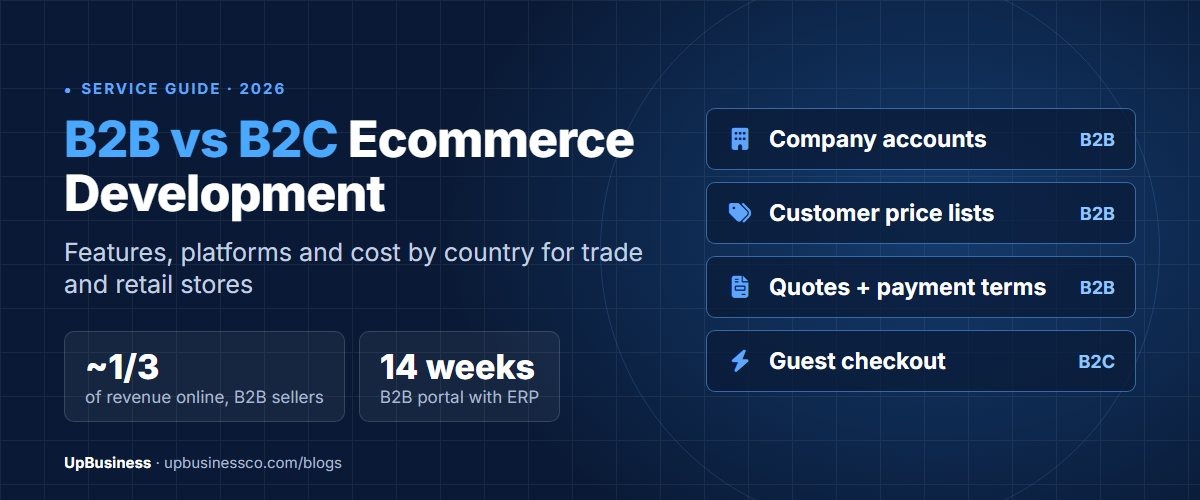
You can browse verified web development companies on UpBusiness and compare team size, location, project sizes and TrustScore before you contact anyone. For online stores, see our guide to B2B and B2C ecommerce development. Or post your project once and let matching partner companies send you quotes you can score with the sheet above.