


Browse our curated list of Custom Software Development Companies
To hire a software development company in India from Germany, write a short brief and shortlist three to five registered companies. Call their past clients and run a small paid discovery phase first. Then sign a contract that grants you exclusive usage rights to the code for every type of use, and sign a GDPR data processing agreement with EU Standard Contractual Clauses before personal data moves. Pay in euros against milestones. India is 3.5 to 4.5 hours ahead, so you share five to six working hours every day.
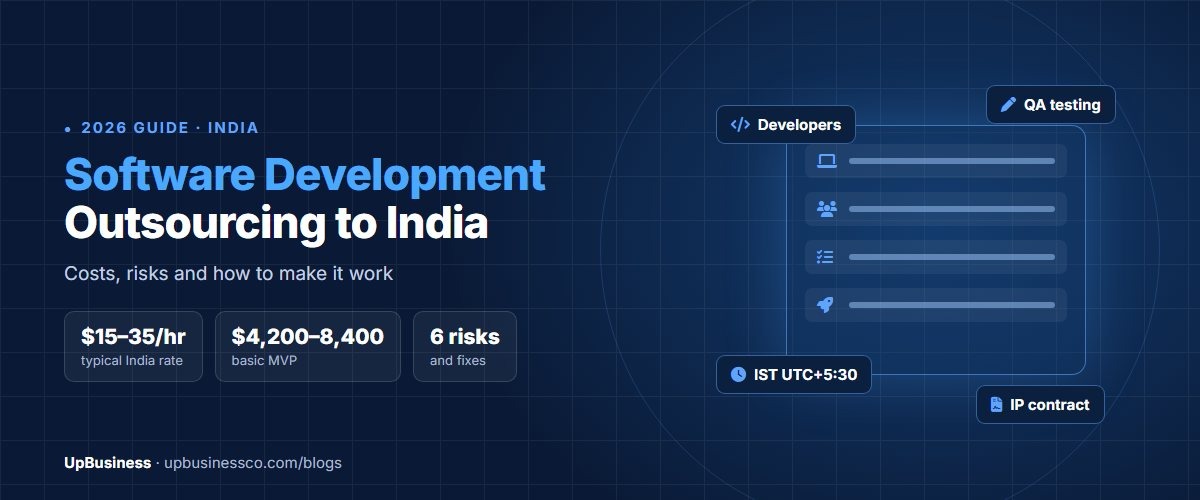
This guide covers what is specific to German buyers: the time overlap, GDPR transfers to India, how German copyright law handles code you commission, works council rules, the reverse charge for VAT, German product rules such as the Impressum and accessibility law, and a worked cost example in euros. For the general case for outsourcing, read our guide to outsourcing software development to India.
Key takeaways
- India is 4 hours 30 minutes ahead of Germany in winter and 3 hours 30 minutes ahead in summer. A normal Indian working day overlaps five hours with Berlin or Munich in winter and six in summer.
- India has no EU adequacy decision. Before personal data goes to an Indian team, you need the EU Standard Contractual Clauses, a transfer impact assessment and an Article 28 processing agreement.
- Under German law, copyright itself can't be transferred. You get usage rights instead, and only for the uses the contract names. So the contract must list every type of use, or you may end up with less than you paid for.
- The Indian company charges no German VAT. You account for 19% under the reverse charge and normally deduct it again as input tax.
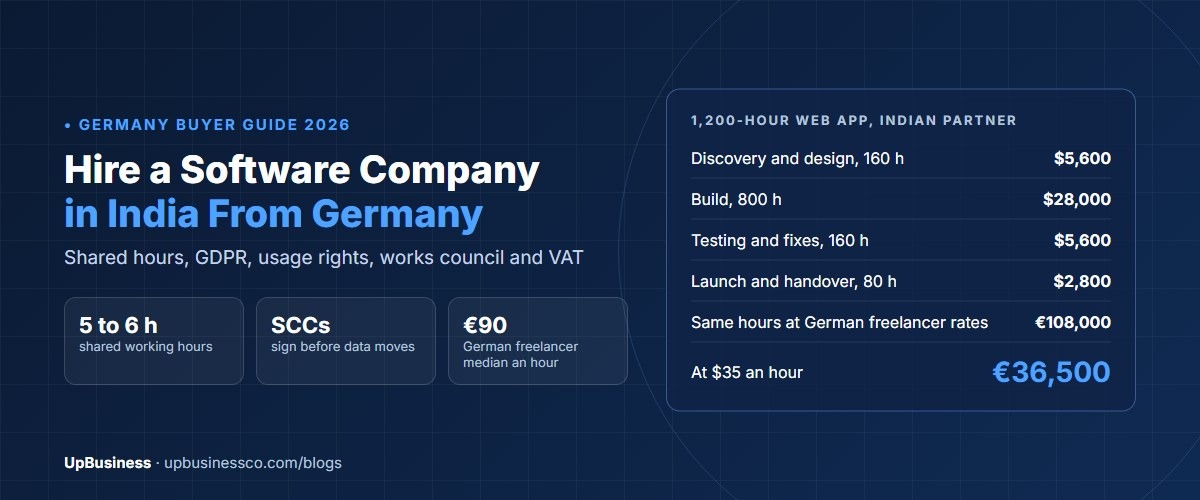
- Software and web development freelancers in Germany charge a median of €90 an hour. The same 1,200-hour build costs about €108,000 at that rate and about €36,500 with an Indian partner at $35 an hour.
Why German Companies Hire a Software Development Company in India
The first reason is the skills shortage. German companies have struggled to hire developers for years, and the Mittelstand feels it most. A mid-sized manufacturer in Baden-Württemberg competes with Berlin startups and global tech firms for the same people. An Indian partner can start a full team in two to four weeks.
The second reason is cost. Freelancers in software and web development in Germany, Austria and Switzerland charge a median of €90 an hour, according to freelancermap's 2026 survey[1]. Indian partner companies usually quote a fraction of that, and the price often includes a project manager and testing.
The third reason is the time zone. India is closer to Germany in time than the US is. Your team and the Indian team share the whole German morning, so questions get answered the same day.
The fourth reason is experience. Indian IT companies have served German carmakers, engineering groups, insurers and SAP customers for decades. Many have teams that know German processes, German quality expectations and SAP in depth.
Partner Company, Freelancers or Your Own Team in India?
| Indian partner company | Indian freelancers | Your own team in India | |
|---|---|---|---|
| Contracts | One for the whole team | One per person | Employment through an employer of record or your own Indian company |
| Who runs the work | The company's project lead | You | Your managers |
| If someone leaves | The company replaces them | You find someone new | You hire again |
| Setup time | Two to four weeks | One to two weeks per person | Three to six months |
| Best for | A defined project or product | Small, separate tasks | A long-term team of ten or more |
For a first project, a partner company is the simplest choice. One contract covers everyone. The company handles hiring, payroll, laptops and Indian employment law. If you need people working only for you for a year or more, read our comparison of dedicated developers and project-based teams.
A note on false self-employment, or Scheinselbständigkeit. German rules on it are aimed at individuals who work like employees but are paid as freelancers. They rarely come up when you buy a project from an Indian company that employs its own team and runs the work. If one named developer works only for you, full time, under your direct instructions, ask your Steuerberater to check the setup.
Working Hours: Five to Six Shared Hours a Day
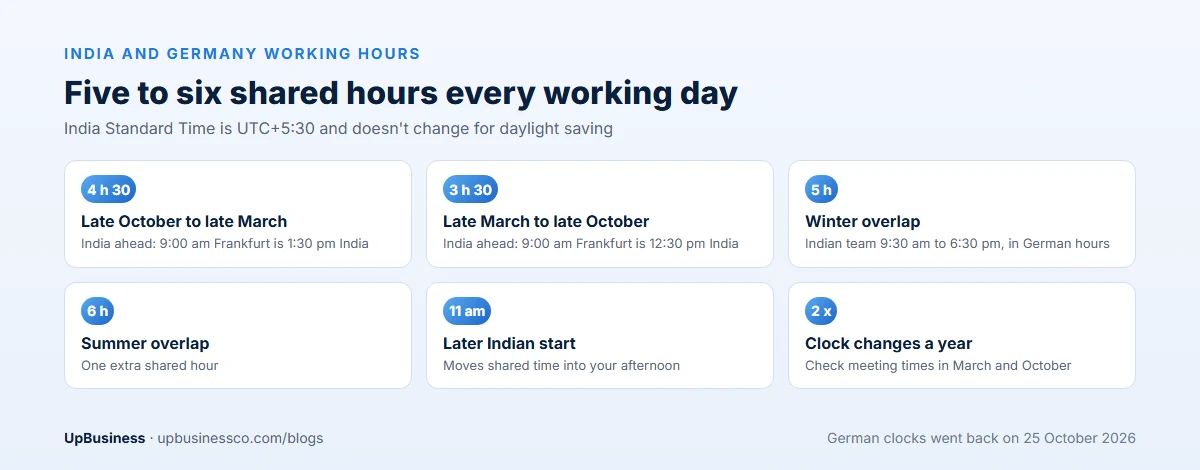
India Standard Time is UTC+5:30 and India doesn't change its clocks. Germany switches between CET and CEST, so the gap changes twice a year:
- From late October to late March (CET), India is 4 hours 30 minutes ahead. 9:00 am in Frankfurt is 1:30 pm in India.
- From late March to late October (CEST), India is 3 hours 30 minutes ahead. 9:00 am in Frankfurt is 12:30 pm in India.
A typical Indian team works from about 9:30 am to 6:30 pm. In winter that is 5:00 am to 2:00 pm in Germany, which gives five shared hours from 9:00 am to 2:00 pm. In summer the Indian day ends at 3:00 pm German time, which gives six shared hours. Many Indian companies with European clients start later, around 11:00 am, which stretches the shared time into your afternoon.
Use the shared hours for the daily call, questions and demos. Write the rest down. German teams are used to clear written specifications, which suits offshore work well.
GDPR: Sending Personal Data to India
This is where German buyers need the most care. German data protection authorities are among the strictest in Europe.
India doesn't have an EU adequacy decision[2]. So any transfer of personal data from Germany to an Indian company needs a transfer tool under Article 46 GDPR. For most buyers that means the EU Standard Contractual Clauses, using the module for a controller sending data to a processor[3]. You also need a transfer impact assessment that looks at how Indian law and practice could affect the data.
Do these five things before data moves:
- Keep personal data out if you can. Developers can build and test most systems with fake or masked data. Only give production access where the work needs it.
- Sign an Article 28 processing agreement, the Auftragsverarbeitungsvertrag. It sets out what data the Indian company handles, for what purpose, its security measures, sub-processors and deletion.
- Attach the Standard Contractual Clauses. Most Indian companies with European clients have signed them before.
- Write the transfer impact assessment. For low-risk data it can be short. For health, financial or employee data, take advice.
- Set a breach clock. You must report a personal data breach to your supervisory authority within 72 hours of becoming aware of it. The Indian company must tell you within hours.
On the Indian side, the Digital Personal Data Protection Act 2023 exempts data about people outside India that an Indian company processes under a contract with a foreign client. So GDPR and your contract do the real work of protecting your customers.
Works Councils: A German Step Many Buyers Miss
If your company has a works council, or Betriebsrat, check one more thing. Under the Works Constitution Act, the works council has a right of co-determination over technical systems that are suited to monitoring employees' behaviour or performance[4]. German courts read "suited" broadly. An HR tool, a time-tracking app, a CRM with activity logs or an internal portal can all fall under it.
So if the Indian team is building software your own staff will use, involve the works council early. Agree what data the system records and who can see it. A works agreement, or Betriebsvereinbarung, signed late can force changes to a finished product. It's cheaper to put the rules in the brief.
Contracts and Code Ownership Under German and Indian Law
German copyright law works differently from English-speaking countries. Copyright itself can't be transferred. Instead, the author grants usage rights, called Nutzungsrechte. For software written by an employee, the employer gets the economic rights automatically[5]. That rule doesn't cover an outside company, so you need a contract.
German law also has the purpose-of-transfer rule. If a contract doesn't list the types of use one by one, the rights granted are limited to what the purpose of the contract needs[6]. A vague clause like "the client receives all rights" may give you less than you think. For example, you may not get the right to sell the software to others or to change it freely.
So the clause should grant you exclusive usage rights, unlimited in time and place, that you can transfer and sublicense, for all known types of use. List them: copying, editing, translating, distributing, making available online, running as a service and licensing to others. Ask for the source code too, and the right to change it.
Indian law adds its own trap. If an assignment doesn't state how long it lasts, India treats it as lasting five years. If it doesn't state where it applies, India treats it as covering India only. Write "worldwide" and "for the full term of protection" into the clause so it works under both laws.
Your contract should also cover:
- Disputes. India doesn't list Germany as a reciprocating country, so a German court judgment can't simply be enforced there. Arbitration avoids that, because both countries enforce awards under the New York Convention. Many German buyers choose German law with arbitration in Frankfurt or Munich, or a neutral seat such as Singapore.
- Acceptance. German contract law treats a software build as a Werkvertrag in many cases, where formal acceptance matters. Write down how and when you accept each milestone.
- Open source. The company lists every open-source library and its licence.
- Handover and exit. You get code, passwords and documents at each milestone, and either side can end the contract with 30 days' notice.
Our software development contract checklist has the full clause list.
VAT, Tax and Invoices
The Indian company won't charge German VAT. For business services bought from abroad, the place of supply is where your business is, and you owe the VAT yourself under the reverse charge[7]. You declare 19% VAT on your return and, if you're entitled to deduct input tax, claim the same amount back. For most businesses the net cost is nil. The invoice should note that the reverse charge applies.
On withholding tax, payments for development services the Indian team performs in India don't normally trigger German withholding. Payments that are really licence fees for existing software or rights can be different under German tax law, so have your Steuerberater confirm how the contract is classified.
On the Indian side, the project is an export of services. The company normally charges no Indian GST and marks the invoice as an export. Ask for invoices with the company's legal name, address, GST number and bank details. Keep them for the period German tax law sets for invoices, currently eight years.
Building for German Users
- Impressum. German websites and apps that serve business purposes must show provider details such as the company name, address and contact details[8]. Put it in the brief.
- Cookie consent. Non-essential cookies and tracking need consent first. Agree the consent tool before the build.
- Accessibility. Since 28 June 2025, the European Accessibility Act applies to many consumer services, including e-commerce, through Germany's Barrierefreiheitsstärkungsgesetz[9]. Write WCAG 2.2 level AA into the acceptance tests.
- Language and formats. German text runs longer than English, so screens must allow for it. Use German date, number and currency formats, and keep all text in translation files.
- Hosting. Many German customers expect data hosted in Germany or the EU. Say so in the brief, and keep the cloud account in your name.
Paying an Indian Company From Germany
Most Indian companies accept euros or US dollars by bank transfer. If you price in euros, you carry no exchange-rate risk. If you price in dollars, a weaker euro makes the project dearer. Pay against milestones: 10% to 20% up front, then a payment after each delivery you have accepted. Never pay into a personal account, and confirm any change of bank details by phone.
What It Costs: A Worked Example in Euros
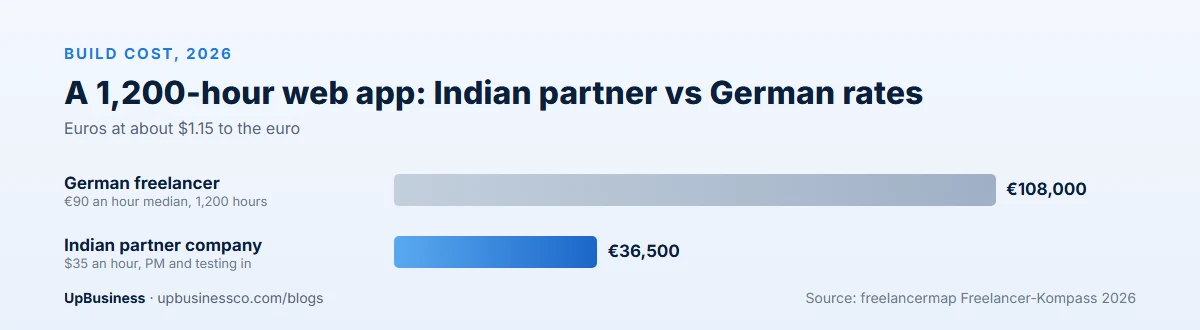
Take a web application with a customer portal, an admin area and payments. It needs about 1,200 hours of work.
| Phase | Hours | Indian partner at $35 an hour | German freelancer at €90 an hour |
|---|---|---|---|
| Discovery and design | 160 | $5,600 | €14,400 |
| Build | 800 | $28,000 | €72,000 |
| Testing and fixes | 160 | $5,600 | €14,400 |
| Launch and handover | 80 | $2,800 | €7,200 |
| Total | 1,200 | $42,000 (about €36,500) | €108,000 |
The German figure uses the 2026 median for software and web development freelancers. The euro figure for the Indian quote uses about $1.15 to the euro. Your quotes will differ, but the gap is often close to three times. A German agency will usually charge more than a single freelancer, because its rate covers project management and testing too.
Two things eat into the saving. The first is your own time: someone must write the brief, answer questions and test the work. The second is rework when the brief is vague. A clear software project brief is the cheapest protection. Our software development cost benchmark has Indian rates by role.
How to Check an Indian Company Before You Sign
- Check the registration. Ask for the company's CIN and look it up on India's Ministry of Corporate Affairs site. Check the GST number too. Our guide on how to verify an Indian software company shows each step.
- Call two past clients in Germany or the EU. Ask how GDPR was handled and what went wrong.
- Meet the actual team on video. Not just the sales lead. Ask the developers to talk you through a past project.
- Ask about security. ISO 27001 is the most common certificate. If you supply the car industry, your customers may require TISAX, the industry's information security assessment, and your partner may need to meet it too[10].
- Run a paid discovery phase. Two to four weeks, fixed price, with a written plan at the end.
Our due diligence checklist and questions to ask a software company go deeper. When proposals arrive, use our software development company scorecard to compare finalists.
Mistakes German Buyers Make
- Sending live customer data on day one. Sign the processing agreement and the clauses first, and use test data where you can.
- Writing "all rights" without listing them. Under the purpose-of-transfer rule, a vague clause can leave you short. List every type of use.
- Forgetting the works council. Tools that could monitor staff need its involvement before rollout.
- Picking the lowest quote. A quote far below the rest usually means missed scope or junior staff.
- Over-specifying everything up front. A detailed Lastenheft helps, but leave room to change course after each demo.
Red Flags
- The company won't grant exclusive, worldwide usage rights in the contract.
- It won't sign an Article 28 agreement or the Standard Contractual Clauses.
- It won't let you meet the developers before you sign.
- It asks for most of the money up front.
- It can't name a client you can call.
- It keeps the code in its own accounts.
Your First 30 Days
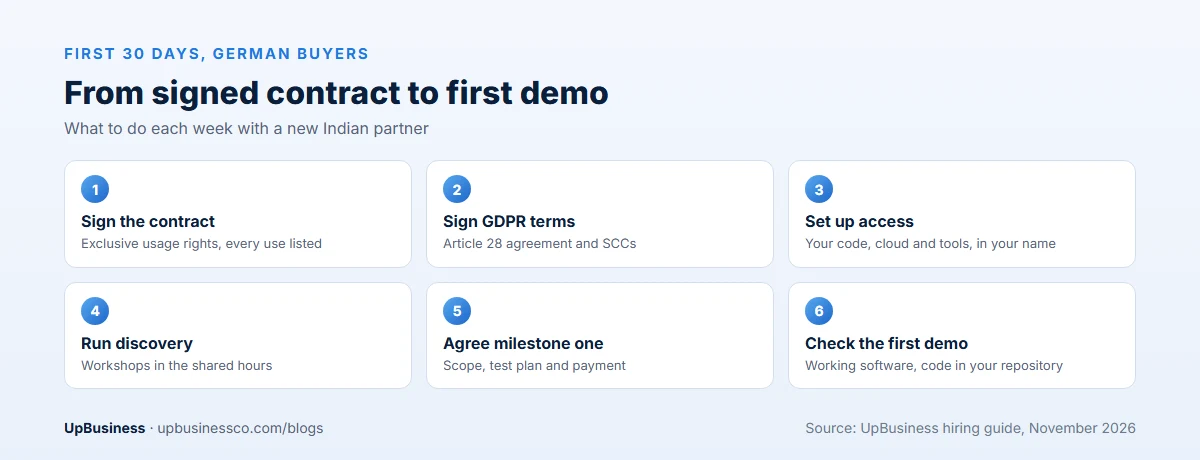
- Week 1: Sign the contract, the processing agreement and the Standard Contractual Clauses. Give access to your code and cloud accounts.
- Week 2: Run discovery workshops in the shared hours. The company writes up the scope, plan and risks.
- Week 3: Agree the first milestone and how you'll accept it. Start the first sprint.
- Week 4: See the first demo. Check the code is in your repository and the team is the one you were promised.
What UpBusiness Partner Data Shows
We looked at the 46 partner companies on our software development page on 31 October 2026, most of them based in India.
- Their TrustScores run from 70.17 to 75.85 out of 100, with a median of 71.67.
- Of the 45 that report an average project size, 22 average $5,000 or less. The median is $10,000.
- 38 of the 46 have 50 employees or fewer.
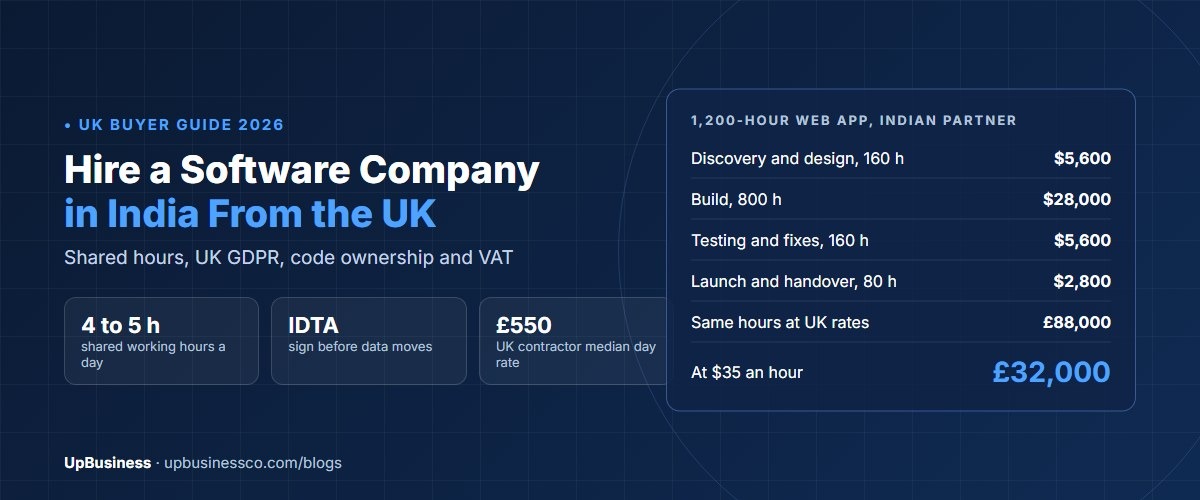
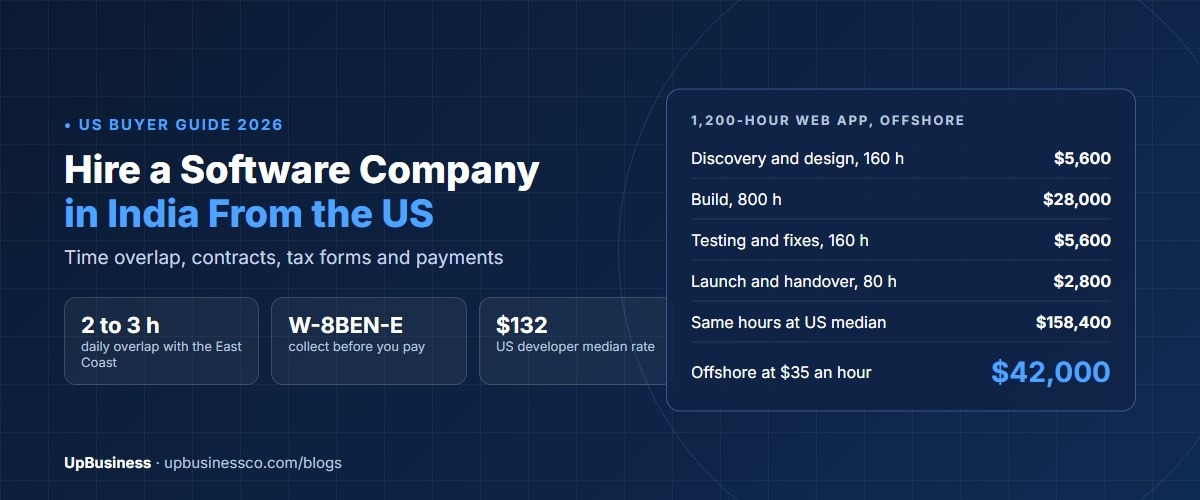
On our custom software development page, 12 companies are listed and 6 of them list custom software as a core service. Smaller companies suit a first project, because your work gets senior attention. If you also buy for a UK or US office, see our guides for UK buyers and US buyers.
How Hiring Works on UpBusiness
Every partner company on UpBusiness has passed five checks reviewed by our team: company details, registration and tax papers, the founder's identity, expertise and three client projects with evidence. Only companies with a TrustScore of 70 or more are listed.
- Post your requirement with the service, a rough budget and that you're based in Germany.
- Get three partner companies matched to your budget, service and industry.
- Compare them side by side, meet them on video and contract with the one you choose. Buyers pay nothing, and there's no commission on the project.
Then follow the steps in this guide: GDPR terms, a full list of usage rights, the works council where needed, milestones and a paid discovery phase. That's how German companies get the saving without the surprises.