


Browse our curated list of Custom Software Development Companies
A software development company scorecard is a table you use to compare your final two to four companies on the same weighted criteria before you sign. You set the criteria and their weights before the final meetings, score each company from 1 to 5 on each one, multiply by the weights and add up. You also add a short list of pass or fail checks that knock a company out whatever its score. It turns a gut decision into one you can explain to your boss, your board or your finance team.
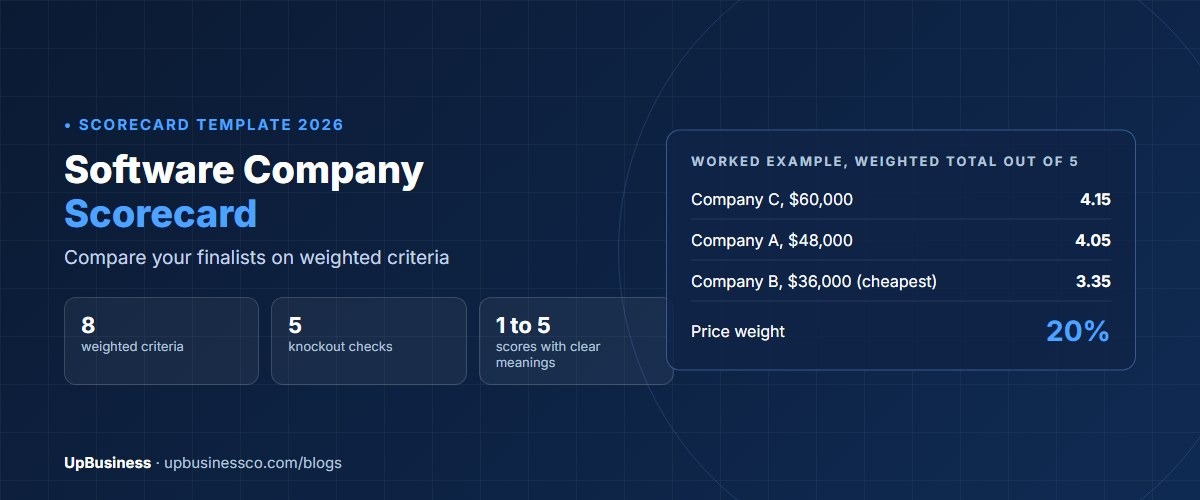
This guide gives you a scorecard you can copy, with eight weighted criteria, five knockout checks, a clear meaning for each score, a fair way to score price and a worked example with three finalists. Buyers in the US, the UK, Europe, the Gulf and Asia can all use it. It starts where line-by-line proposal comparison ends. You've already checked what each quote includes. Now you have to choose.
Key takeaways
- Set the criteria and weights before you meet the finalists. Changing them afterwards lets your favourite win by default.
- Use five knockout checks first: registered company, written code assignment, data protection terms, two client references and the named team.
- Give each score a written meaning. A "4" should mean the same thing to every person scoring.
- Keep price at 15% to 25% of the total, and score it with a formula, not by feel.
- Have two or three people score on their own, then compare. Talk through any criterion where scores differ by two or more points.
When to Use a Software Development Company Scorecard
Use a scorecard at the last step of choosing a partner, after you have:
- Written a project brief and sent it to five to eight companies.
- Read the proposals and cut the list to two to four finalists.
- Checked that each finalist is real, using our guide on how to verify a software company.
- Held a final meeting or a short paid workshop with each one.
Don't use it to score ten companies from their websites. You won't have enough evidence, and the scores will just reflect who has the best sales page.
Large buyers already work this way. US federal rules require buyers to set out evaluation factors and their relative importance before they review proposals[1]. The UK's Procurement Act 2023 asks public buyers to pick the "most advantageous" tender against criteria published in advance, not simply the cheapest[2]. You don't need their paperwork. You do need their discipline.
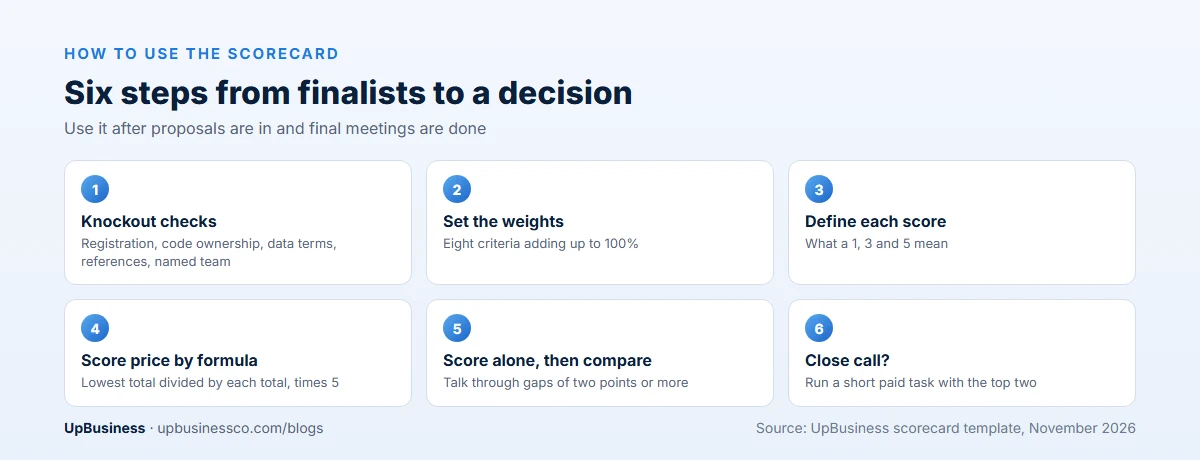
Step 1: Knockout Checks Before Any Scoring
Some things aren't worth points. If a company fails any of these, it's out, however good the rest looks.
| Knockout check | Pass means | Why it's pass or fail |
|---|---|---|
| Registered company | You've checked its registration and tax number in its home country | If it isn't a real company, nothing else matters |
| Code ownership | It will sign a written assignment of all code, worldwide and permanent | Without it, you may not own what you pay for |
| Data protection | It will sign a data processing agreement and any transfer terms your law needs | You carry the legal risk if your customers' data leaks |
| References | Two past clients have spoken to you, not just sent quotes | Anyone can write a case study |
| Named team | The people you met are named in the proposal as the people who'll do the work | Bait and switch is the most common complaint about outsourcing |
Add one or two of your own if your project needs them, such as a security certificate your customers require, or experience with a regulator in your sector.
Step 2: The Weighted Criteria
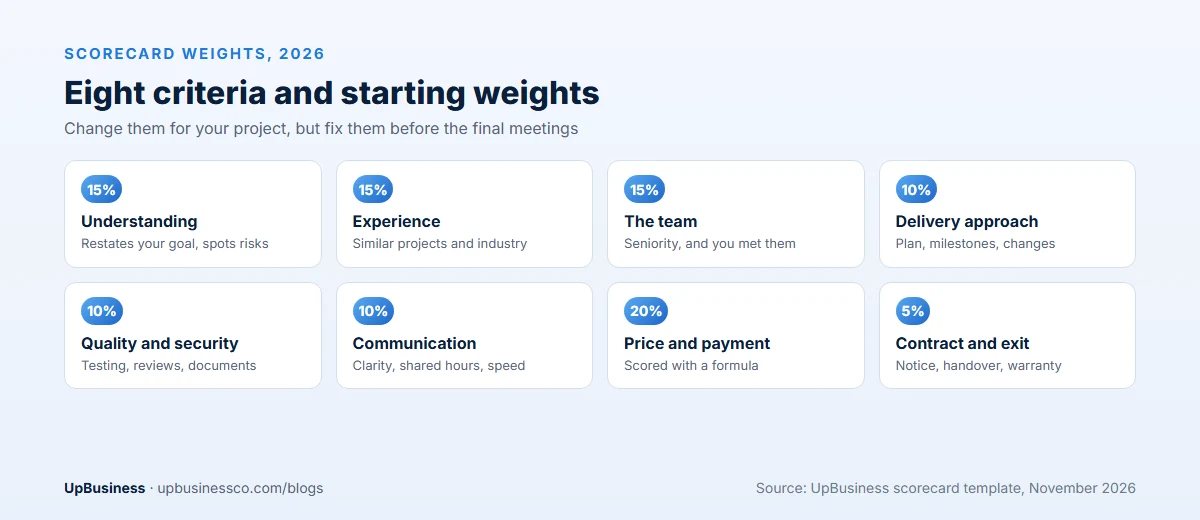
Here are eight criteria and starting weights. Change the weights to suit your project, but keep them adding up to 100%, and write them down before the final meetings.
| Criterion | Weight | What you're judging |
|---|---|---|
| Understanding of your problem | 15% | Did they restate your goal in their own words and spot risks you missed? |
| Relevant experience | 15% | Similar projects, in a similar industry, at a similar size |
| The team | 15% | Seniority, stability, and whether you met the people who'll do the work |
| Delivery approach | 10% | Plan, milestones, demos, how they handle changes |
| Quality and security | 10% | Testing, code reviews, security practice, documentation |
| Communication | 10% | Clear English, shared working hours, how fast they answered during the bid |
| Price and payment terms | 20% | Total cost, running costs, and how payments are tied to delivery |
| Contract terms and exit | 5% | Notice period, handover, warranty, flexibility |
Two notes on weights. First, if your project is a long-term product, raise "The team" and "Communication", because you'll live with those every week. If it's a short, well-defined build, you can raise "Price". Second, don't let any single criterion go above 30%. A scorecard where one line decides everything isn't really a scorecard.
Step 3: Give Every Score a Meaning
The biggest weakness of scorecards is that people score differently. One person's "4" is another's "3". Fix this by writing down what each score means before anyone scores.
| Score | General meaning | Example for 'Relevant experience' |
|---|---|---|
| 5 | Clearly better than we need, with evidence | Three or more similar projects, and a reference client confirmed one |
| 4 | Fully meets what we need, with evidence | Two similar projects with live links or a reference |
| 3 | Meets most of what we need | One similar project, or several in a different industry |
| 2 | Clear gaps we'd have to manage | Related work, but nothing at this size or type |
| 1 | Doesn't meet what we need | No relevant examples |
Write a line like the right-hand column for each criterion. It takes an hour and saves a lot of argument later.
Only score what you have evidence for. If a company says it does "strong testing" but showed you nothing, that's a 2 or 3, not a 5. Ask for the evidence, then score.
Step 4: Score Price With a Formula
Price is the one criterion you can score without opinion. A common method in public buying is:
Price score = (lowest total price / this company's total price) x 5
The cheapest company gets 5. A company twice as expensive gets 2.5. Use the total cost for the same scope, including the first year of hosting, support and licences, not just the build. If one quote leaves out testing or project management, add a fair estimate for it before you score.
To sense-check prices, compare hourly rates against a public benchmark. US government contract ceiling rates for software roles are published[3], and our software development cost benchmark covers Indian rates by role. A price far below every other bid is a warning, not a win. It usually means missed scope, junior staff or a plan to make up the money with change requests.
Step 5: Score on Your Own, Then Compare
Have two or three people score each finalist separately, using the same sheet. Good choices are the person who'll manage the project, someone technical and someone who owns the budget.
- Each person scores every criterion from 1 to 5 and writes one line of evidence for each score.
- Put the scores side by side. Where two people differ by two points or more, talk it through. Usually one of them knows something the other doesn't.
- Agree a final score for each criterion. Don't just average if someone has spotted a real problem.
- Multiply each score by its weight and add up to get a total out of 5.
Keep the sheet. If the project goes wrong, it shows why you chose as you did. If it goes well, you have a template for next time.
Worked Example: Three Finalists
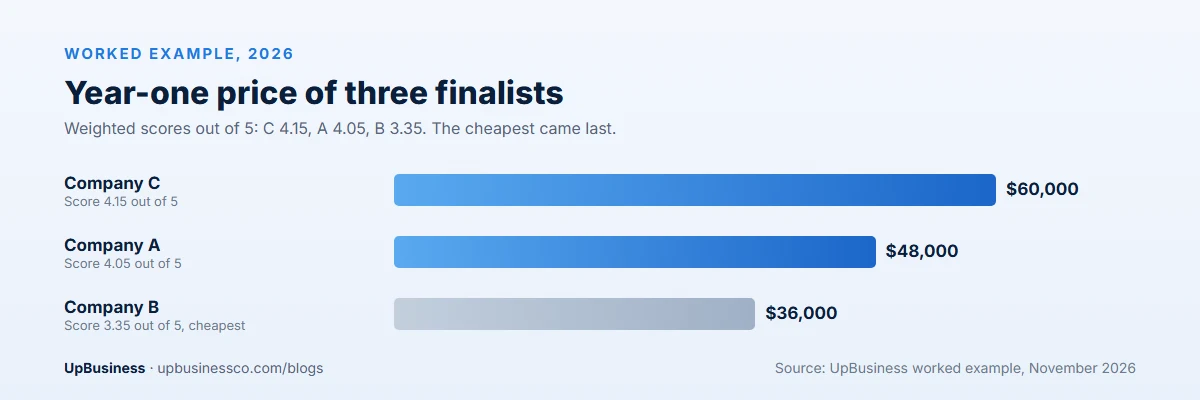
A retailer needs a customer portal with online ordering. Three companies passed the knockout checks. Their total year-one prices were $48,000 for A, $36,000 for B and $60,000 for C.
| Criterion | Weight | Company A | Company B | Company C |
|---|---|---|---|---|
| Understanding of your problem | 15% | 4 | 3 | 5 |
| Relevant experience | 15% | 4 | 3 | 5 |
| The team | 15% | 4 | 3 | 4 |
| Delivery approach | 10% | 4 | 3 | 4 |
| Quality and security | 10% | 4 | 2 | 5 |
| Communication | 10% | 5 | 3 | 4 |
| Price (formula) | 20% | 3.75 | 5.00 | 3.00 |
| Contract terms and exit | 5% | 4 | 4 | 3 |
| Weighted total out of 5 | 100% | 4.05 | 3.35 | 4.15 |
Company B was the cheapest by $12,000, but it came last. Its weak testing and junior team would likely cost more than $12,000 in bugs and delays. Company C scored highest, but it costs $12,000 more than A for a gap of only 0.10 points.
This is where the scorecard helps you think, rather than deciding for you. If budget is tight, A is a sound choice: strong on every line and much cheaper than C. If the portal is central to your business, C's extra depth in quality and experience may be worth paying for. Either way, you can now explain the choice in one paragraph.
When the top two are within about 0.25 points, don't treat the scores as precise. Run a short paid task with both, such as a one-week technical spike, and decide on what you see.
Copy-Ready Scorecard Template
Copy this table into a spreadsheet. Fill in the weights first, then give one copy to each person scoring. The weighted score for each line is the score multiplied by the weight. The total is the sum of the weighted scores.
| Criterion | Weight | Score (1 to 5) | Weighted score | Evidence (one line) |
|---|---|---|---|---|
| Knockout checks passed? | Pass or fail | Registration, code assignment, data terms, references, named team | ||
| Understanding of your problem | 15% | |||
| Relevant experience | 15% | |||
| The team | 15% | |||
| Delivery approach | 10% | |||
| Quality and security | 10% | |||
| Communication | 10% | |||
| Price and payment terms | 20% | Formula | Year-one total for the same scope | |
| Contract terms and exit | 5% | |||
| Total | 100% | Out of 5 |
The evidence column is the most useful part. In six months, nobody will remember why they gave a 4. A line like "showed test reports from two projects, 80% of code covered by automated tests" will still make sense.
How to Change the Weights for Your Project
The starting weights suit a typical first project of three to nine months. Shift them when your project is different:
| Project type | Raise | Lower | Why |
|---|---|---|---|
| Long-term product with a team for a year or more | The team, communication | Price | You'll work with these people every day, and turnover costs more than the hourly rate |
| Short, fixed build with a clear spec | Price, delivery approach | Understanding | The spec already defines the problem, so delivery and cost matter most |
| Regulated work, such as health or finance | Quality and security, experience | Price | One data incident can cost more than the whole project |
| Rescue of a failing project | Experience, understanding | Contract terms | You need a team that has taken over someone else's code before |
| Offshore team in a distant time zone | Communication, delivery approach | Contract terms | Shared hours and written updates decide whether work keeps moving |
Whatever you change, keep a record of the weights you used and why. If someone asks later why the cheapest bid lost, you can show them.
Questions to Ask in the Final Meeting
Use the final meeting to fill in the scores you're unsure about. These questions give you evidence quickly:
- "Tell us what you think the biggest risk in this project is." Tests understanding.
- "Show us a project like this one, and tell us what went wrong." Tests experience and honesty.
- "Who exactly will work on this, and for how many hours a week?" Tests the team.
- "What happens when we change our mind about a feature halfway through?" Tests delivery approach.
- "Show us your test reports and a code review from a recent project." Tests quality.
- "What isn't included in your price?" Tests price honesty.
Our list of questions to ask a software development company has more.
Reference Calls: Five Questions That Matter
A reference call takes 15 minutes and is worth more than any case study. Ask:
- What did they build for you, and how long did it take against the plan?
- What went wrong, and what did they do about it?
- Were the people you met at the start the people who did the work?
- How did they handle extra costs or changes?
- Would you hire them again for something important?
Listen for specifics. "They were great" tells you nothing. "They missed the second milestone by two weeks, told us early and added a developer at their cost" tells you a lot.
Scoring Local and Offshore Companies on the Same Sheet
Many buyers end up with a mix of finalists, such as one local agency and two companies abroad. You can score them on one sheet if you're fair about it.
- Compare full costs. Add travel for one or two workshops to the offshore quotes, and any currency or bank fees.
- Score communication on evidence. Look at how each company answered during the bid: how fast, how clearly and in which hours. Don't mark an offshore company down just for being far away.
- Check the shared hours. Write down how many working hours you'd share with each team each day. Four or more is comfortable. Under two needs strong written updates.
- Use the same knockout checks. Registration, code ownership and data terms matter just as much at home as abroad.
Done this way, the scorecard shows you whether the saving from an offshore team is worth the extra effort for your project, instead of leaving it to instinct.
Common Scorecard Mistakes
- Setting weights after the meetings. People change the weights, often without meaning to, to fit the company they already like.
- Too many criteria. More than ten lines and the weights get so small that nothing matters. Six to nine is enough.
- Scoring the sales team. Score what the delivery team showed you, not how good the pitch was.
- Letting price take over. At 50% of the score, the cheapest bid wins almost every time, whatever the quality.
- Treating a small gap as a big one. 4.05 against 4.15 is close. Use a paid task to decide.
- Skipping the knockout checks. A high score can't fix missing code ownership.
After the Scorecard: Before You Sign
Once you've picked a winner, tell the others politely and keep their details. Your second choice is your backup if contract talks fail.
Then check the contract matches what won the score. If the team, the price or the plan in the contract differ from the proposal, the score no longer holds. Our software development contract checklist lists the clauses to check, and our due diligence checklist covers the final checks.
If you're hiring from abroad, our country guides cover the local rules: hiring from the US, hiring from the UK and hiring from the UAE and Gulf.
What UpBusiness Partner Data Shows
We looked at the 46 partner companies on our software development page on 31 October 2026.
- Their TrustScores run from 70.17 to 75.85 out of 100, with a median of 71.67. The TrustScore covers some of the same ground as the knockout checks, so it's a useful first filter, not a replacement for your own scorecard.
- Of the 45 that report an average project size, 22 average $5,000 or less. The median is $10,000.
- 38 of the 46 have 50 employees or fewer, so ask each finalist how many people would work on your project and whether they've done one your size.
On our custom software development page, 12 companies are listed and 6 of them list custom software as a core service.
How UpBusiness Helps You Build a Shortlist
Every partner company on UpBusiness has passed five checks reviewed by our team: company details, registration and tax papers, the founder's identity, expertise and three client projects with evidence. Only companies with a TrustScore of 70 or more are listed.
- Post your requirement with the service, a rough budget and your timeline.
- Get three partner companies matched to your budget, service and industry. That's a ready-made shortlist for this scorecard.
- Compare them side by side, meet them on video and contract with the one you choose. Buyers pay nothing, and there's no commission on the project.