


Browse our curated list of Custom Software Development Companies
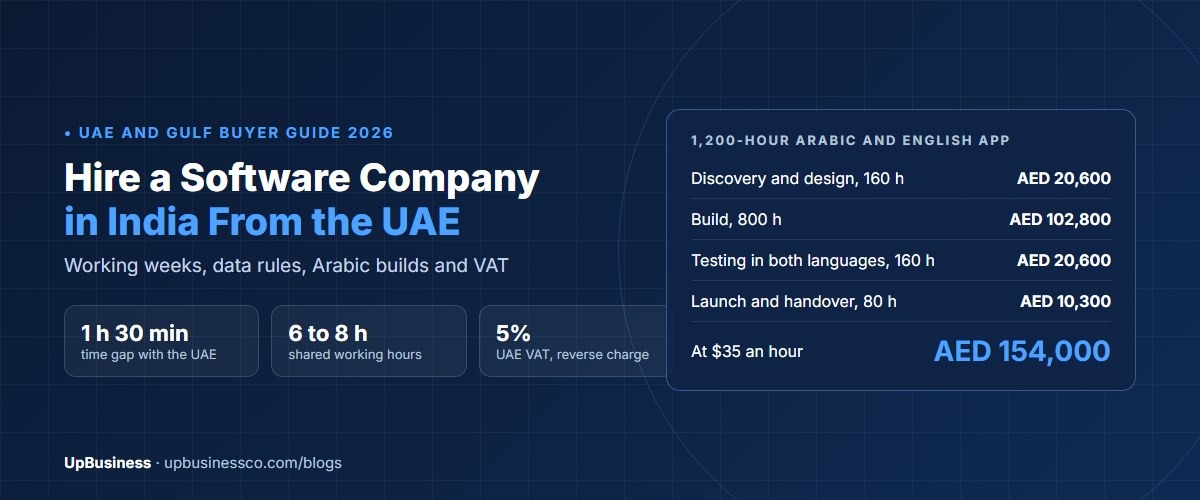
To hire a software development company in India from the UAE or another Gulf country, write a short brief, shortlist three to five registered Indian companies and check their past clients, ideally in the Gulf. Start with a small paid discovery phase. Then sign a contract that assigns all code to you worldwide, sets out where your data may be stored, and handles VAT and any withholding tax. Pay in US dollars or dirhams against milestones. With India only 1 hour 30 minutes ahead of the UAE, you share almost the whole working day.
This guide covers the parts that are specific to buyers in the UAE, Saudi Arabia, Qatar, Kuwait, Bahrain and Oman. That means working weeks, data rules on the mainland and in free zones, Arabic builds, local payment tools, VAT, Saudi withholding tax and a worked cost example. For the general case for outsourcing, read our guide to outsourcing software development to India. We have separate guides for US buyers and UK buyers.
Key takeaways
- India is 1 hour 30 minutes ahead of the UAE and Oman, and 2 hours 30 minutes ahead of Saudi Arabia, Qatar, Kuwait and Bahrain. Neither side changes its clocks.
- The UAE works Monday to Friday. Saudi Arabia, Qatar, Kuwait, Bahrain and Oman mostly work Sunday to Thursday, so an Indian team on a Monday to Friday week shares four working days with them.
- The UAE has three data regimes: the federal law on the mainland, and separate laws in the DIFC and ADGM free zones. Health and some government and banking data have extra rules about where they're stored.
- The Indian company doesn't charge UAE VAT. A VAT-registered UAE business accounts for the 5% itself under the reverse charge. Saudi buyers may need to withhold 5% tax on the payment.
- A 1,200-hour web app at $35 an hour costs about $42,000, or about AED 154,000.
Why Gulf Companies Hire a Software Development Company in India
The first reason is time. The UAE is closer to India than any other major buyer market. A Dubai team and a Pune team are awake and at work at almost the same hours, so a question asked at 10:00 am gets an answer before lunch.
The second reason is cost. Local agencies in Dubai, Riyadh and Doha carry high office and visa costs, and many of them deliver part of the work from India anyway. Hiring an Indian company directly cuts out that layer. Ask any local agency where its developers sit before you compare prices.
The third reason is familiarity. Many Gulf businesses already have Indian managers and staff, and many Indian software companies have done Arabic apps, payment links with Gulf banks and builds for government portals. You don't need to explain the market from scratch.
The fourth reason is trade. The India and UAE trade agreement has been in force since May 2022, and both central banks agreed in 2023 to let trade between them be settled in their own currencies. For services, the practical effect is easier banking between the two countries.
Indian Company, Local Agency or Your Own Team?
| Indian partner company | Local Gulf agency | Your own team in India | |
|---|---|---|---|
| Contracts | One, with a company abroad | One, with a local company | Employment contracts through an employer of record or your own Indian company |
| Who runs the work | The company's project lead | The agency's project lead | Your managers |
| Face-to-face meetings | By visit, often within a few days | Easy | By visit |
| Price | Lowest of the three for a project | Highest, because of local office and visa costs | Low per person, high setup cost |
| Best for | A defined project or product | Work that needs people in your office | A long-term team of ten or more |
For a first project, most Gulf companies do best with an Indian partner company and a few planned visits. Flights between the Gulf and Indian cities are short and frequent, so a two-day workshop in Dubai or Bengaluru at the start is easy to arrange. If you expect to need a large team for years, you can move to your own team later.
Working Hours and Working Weeks Across the Gulf
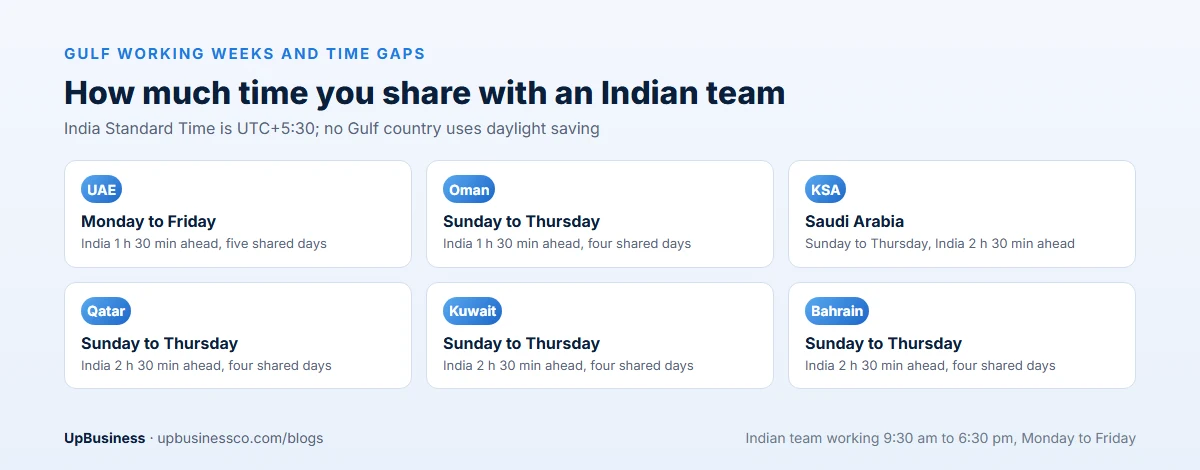
India Standard Time is UTC+5:30. None of the Gulf countries uses daylight saving, so the gap stays the same all year.
| Country | Time zone | India is ahead by | Usual working week | Shared days with an Indian team |
|---|---|---|---|---|
| UAE | UTC+4 | 1 h 30 min | Monday to Friday | Five |
| Oman | UTC+4 | 1 h 30 min | Sunday to Thursday | Four (Monday to Thursday) |
| Saudi Arabia | UTC+3 | 2 h 30 min | Sunday to Thursday | Four (Monday to Thursday) |
| Qatar | UTC+3 | 2 h 30 min | Sunday to Thursday | Four (Monday to Thursday) |
| Kuwait | UTC+3 | 2 h 30 min | Sunday to Thursday | Four (Monday to Thursday) |
| Bahrain | UTC+3 | 2 h 30 min | Sunday to Thursday | Four (Monday to Thursday) |
An Indian team working 9:30 am to 6:30 pm is at work from 8:00 am to 5:00 pm in Dubai and from 7:00 am to 4:00 pm in Riyadh. That's six to eight shared hours a day.
The working week matters more than the clock. If you're in Saudi Arabia or Qatar, Sunday is a normal day for you and a day off in India. Many Indian companies that serve Gulf clients keep one person on call on Sundays, or work a half day on Saturday. Ask for this in the proposal.
Two other points. Many UAE businesses close early on Friday for prayers. And during Ramadan, working hours across the Gulf are shorter, so plan launches and big tests around it. India has its own peak holidays, such as Diwali, which can take a few days out of a sprint.
Data Rules: Mainland, Free Zones and Sector Rules
This is where Gulf buyers differ most from Western buyers. There isn't one rule for the whole region.
- UAE mainland. The federal Personal Data Protection Law (Federal Decree-Law No. 45 of 2021) allows transfers abroad to countries with adequate protection, or under contract terms that protect the data. As of 2026, law firms report that the detailed executive regulations still haven't been published, so most companies rely on the law itself plus written transfer clauses[1].
- DIFC and ADGM. These free zones have their own data protection laws, close to the European GDPR. If your company is set up in either one, you need a transfer clause, usually standard contractual clauses, before data goes to India.
- Health data. UAE health data rules generally require patient data to be stored inside the UAE, with limited exceptions. If you're building a clinic or insurance app, plan for UAE hosting from day one.
- Banks and government. Central bank outsourcing rules, and many government contracts, require approval or local hosting for certain data. Check your own regulator's rules before you sign.
- Saudi Arabia. The Saudi Personal Data Protection Law has been enforced since September 2024 and has its own rules for transfers abroad. Government and some sector data must stay in the Kingdom.
The safest setup is simple. Host the live system with a cloud provider in your own country. Let the Indian team build and test using fake or masked data. Give it access to live systems only through accounts you control, which you can switch off at any time. Put all of this in a data processing agreement attached to the contract.
Arabic, Right-to-Left and Local Integrations
Most Gulf apps need Arabic as well as English. Arabic reads right to left, so the whole layout flips, not just the text. Ask each bidder to show you a live Arabic app they built and to explain how they test right-to-left screens. Get the Arabic copy checked by a native speaker. Machine translation reads badly to customers.
Ask about the local services your app will need:
- Payments. Local gateways, Apple Pay, the Saudi mada card network and buy-now-pay-later services that are popular in the region.
- Identity. UAE Pass in the UAE and Nafath in Saudi Arabia, where your app needs verified users.
- Invoicing. Saudi e-invoicing (FATOORA) if your system issues tax invoices in the Kingdom.
- Maps and addresses. Gulf addresses are often informal, so delivery apps need pin drops and landmarks, not just street names.
A company that has built these before will save you weeks. Put the integrations in your project brief so every quote covers them.
Contracts and Code Ownership
Under India's Copyright Act, code written by an outside company belongs to that company unless it assigns the rights to you in writing. If the assignment doesn't say how long it lasts, it's treated as five years. If it doesn't say where it applies, it's treated as covering India only. So the clause should say the assignment is worldwide, for the full term of copyright, and covers all code, designs and documents.
Your contract should also cover:
- Governing law and courts. Many UAE buyers choose UAE law, DIFC law or arbitration. India lists the UAE as a reciprocating country, including the DIFC and ADGM courts, so a judgment from those courts can be enforced in India like a local decision.
- Language. Write the contract in English. If you might go to UAE federal courts, an Arabic version will be needed, so say which version wins if they differ.
- Data location. Where live data may be stored and who may access it.
- Handover. Source code, passwords and cloud accounts in your name, handed over at each milestone.
- Staff and exit. Named people, your approval for changes and a 30-day exit with help moving to a new team.
Our software development contract checklist has the full clause list.
VAT and Withholding Tax by Country
UAE. The Indian company doesn't charge UAE VAT. If your business is VAT registered, you account for the 5% yourself under the reverse charge and normally reclaim it on the same return. The tax authority has clarified the papers you need to keep to support that claim[2]. The UAE doesn't withhold tax on payments to foreign companies for services.
Saudi Arabia. Saudi law generally requires 5% withholding tax on payments to foreign companies for technical or consulting services, even when the work is done abroad[3]. The tax treaty between India and Saudi Arabia can change this, but you'll need the Indian company's tax residency certificate and the right forms[4]. Agree in the contract whether the price includes or excludes this tax, or you'll argue about 5% of every invoice.
Qatar, Kuwait, Bahrain and Oman. Each has its own VAT and withholding rules, and they aren't the same. Ask your tax adviser before the first payment, and get the Indian company's tax residency certificate on file.
On the Indian side, the company treats your project as an export of services and normally charges no Indian GST.
Paying an Indian Company From the Gulf
Most Indian companies accept US dollars by bank transfer, and many accept dirhams. The dirham is pegged at about 3.67 to the dollar, so pricing in either currency carries little exchange-rate risk. Pay against milestones: 10% to 20% up front, then a payment after each delivery you've tested. Never pay a personal account, and confirm any change of bank details by phone with someone you've met.
What It Costs: A Worked Example
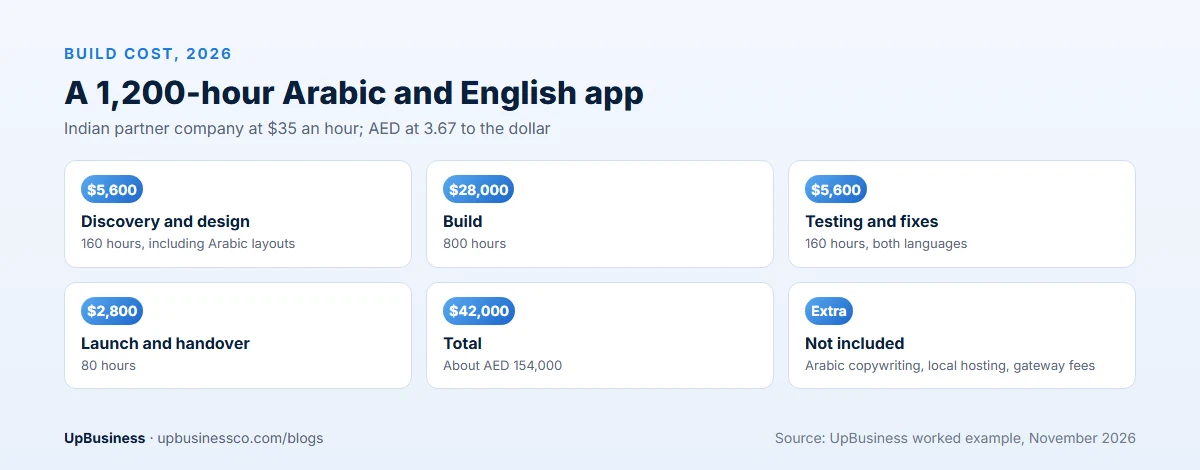
Take a customer app in Arabic and English, with an admin panel and local payments, needing about 1,200 hours.
| Phase | Hours | At $35 an hour | In dirhams |
|---|---|---|---|
| Discovery and design (including Arabic layouts) | 160 | $5,600 | AED 20,600 |
| Build | 800 | $28,000 | AED 102,800 |
| Testing and fixes (both languages) | 160 | $5,600 | AED 20,600 |
| Launch and handover | 80 | $2,800 | AED 10,300 |
| Total | 1,200 | $42,000 | about AED 154,000 |
Get a quote from a local agency on the same brief and compare. Add your own team's time, Arabic copywriting, local hosting and any app store and payment gateway fees. Our software development cost benchmark has rates by role.
How to Check an Indian Company Before You Sign
- Check the registration. Ask for the company's CIN and GST number and look them up. Our guide on how to verify an Indian software company shows each step.
- Call two Gulf clients. Ask about Arabic quality, Sunday cover and how problems were handled.
- Check who does the work. If the company has a Dubai office, ask how many developers sit there and how many in India.
- Meet the developers on video. Ask them to show a live Arabic app they built.
- Run a paid discovery phase. Two to four weeks, fixed price, with a written plan at the end.
Our due diligence checklist and questions to ask a software company go further. When proposals arrive, use our guide to comparing software development proposals.
Setting Up Communication and Security
Close time zones make daily work easy, but only if you set a rhythm early:
- Agree one short daily call, usually between 9:00 and 10:00 am Gulf time.
- Name one person on each side who makes decisions, and one who signs off Arabic text.
- Use one tool for tasks and one for chat. Keep every decision in the task tool, not in WhatsApp groups.
- Hold a demo every two weeks where you see working software in both languages.
- Share a calendar with public holidays for both countries, including Eid dates, which move each year.
For security, keep the basics in your hands. Your company owns the cloud accounts, the code repository and the app store accounts. Each developer gets a personal login with only the access the work needs. Turn on two-step login everywhere, and remove access the day someone leaves the project. Ask whether the company holds ISO 27001. For banking, health or government work, ask your regulator's security rules and give them to the company before it quotes.
Mistakes Gulf Buyers Make
- Leaving Arabic to the end. Right-to-left changes every screen. Design both languages from the start.
- Hosting health or government data abroad. Check the sector rules before you choose a cloud region.
- Ignoring the working week. If you work Sundays, agree how Sunday issues get handled.
- Arguing about withholding tax after the first invoice. Settle it in the contract.
- Picking the lowest quote. A price far below the others usually means missed scope or junior staff.
Red Flags
- The company won't put a worldwide code assignment in the contract.
- It can't show a live Arabic app it built.
- It wants to host your live data on its own servers.
- It won't let you meet the developers before you sign.
- It asks for most of the money up front, or for payment to a personal account.
Your First 30 Days
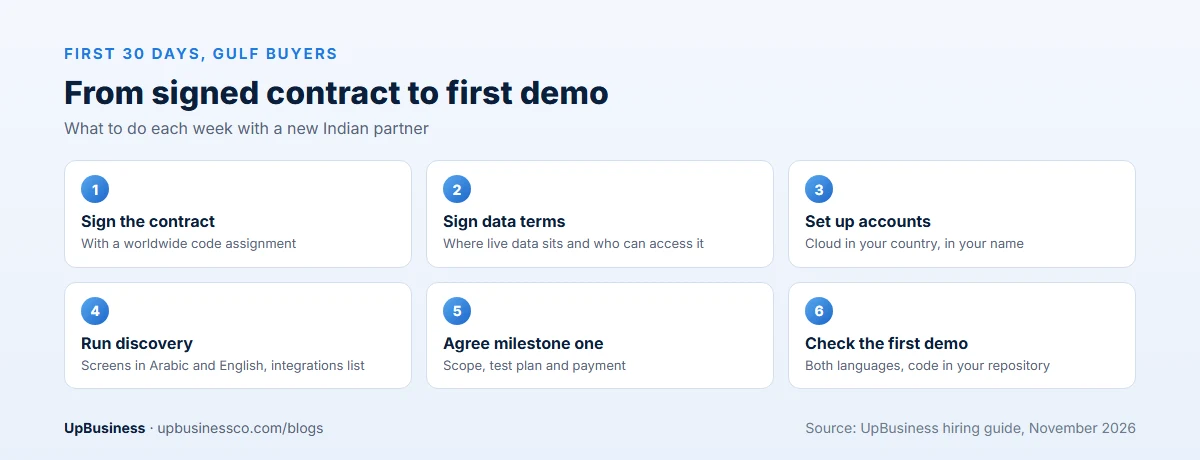
- Week 1: Sign the contract and data processing agreement. Set up cloud accounts in your name and your country, and shared tools.
- Week 2: Run discovery workshops. Agree screens in both languages and the list of local integrations.
- Week 3: Agree the first milestone and how you'll test it. Start the first sprint.
- Week 4: See the first demo, in Arabic and English. Check the code is in your repository.
What UpBusiness Partner Data Shows
We looked at the 46 partner companies on our software development page on 31 October 2026, most of them based in India.
- Their TrustScores run from 70.17 to 75.85 out of 100, with a median of 71.67.
- Of the 45 that report an average project size, 22 average $5,000 or less. The median is $10,000.
- 38 of the 46 have 50 employees or fewer.
On our custom software development page, 12 companies are listed and 6 of them list custom software as a core service.
How Hiring Works on UpBusiness
Every partner company on UpBusiness has passed five checks reviewed by our team: company details, registration and tax papers, the founder's identity, expertise and three client projects with evidence. Only companies with a TrustScore of 70 or more are listed.
- Post your requirement with the service, a rough budget, your country and whether you need Arabic.
- Get three partner companies matched to your budget, service and industry.
- Compare them side by side, meet them on video and contract with the one you choose. Buyers pay nothing, and there's no commission on the project.