


Browse our curated list of Custom Software Development Companies
To hire a software development company in India from the US, write a short brief, shortlist three to five registered companies, check their past clients, and start with a small paid discovery phase. Then sign a US-friendly contract that assigns all code to you, set two to three hours of shared working time each day, and pay in US dollars against milestones. Done this way, US companies often pay a third or less of US rates for the same work.
This guide covers the parts that are specific to hiring from the US: how much working time you really share, what your contract must say under US copyright law, the tax form to collect before the first payment, and how to check a company you've never met. It doesn't repeat the general case for outsourcing. For that, read our guide to outsourcing software development to India.
Key takeaways
- India Standard Time is 9 hours 30 minutes ahead of US Eastern time in summer and 10 hours 30 minutes ahead in winter. India doesn't change its clocks.
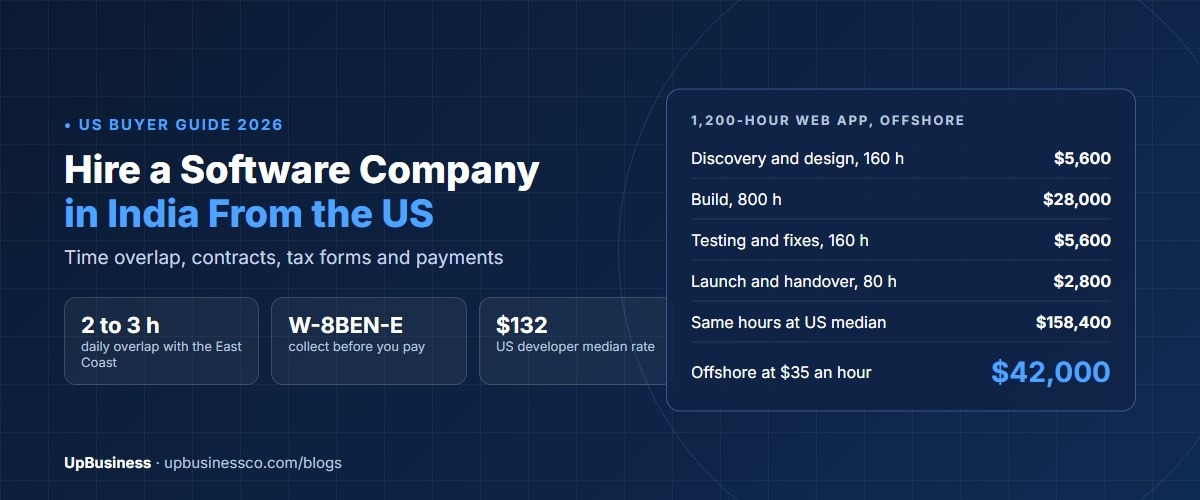
- Expect 2 to 3 hours of shared working time with the East Coast and very little with the West Coast, unless someone shifts their day.
- Under US law, custom software from an outside company isn't automatically yours. Your contract needs a signed assignment of copyright.
- Collect Form W-8BEN-E from the company before you pay it. Payment for work done entirely in India is generally foreign-source income for US tax purposes.
- The median US government ceiling rate for software developers is about $132 an hour. A 1,200-hour build at an offshore rate of $35 an hour costs about $42,000 instead of about $158,400.
Why US Companies Hire a Software Development Company in India
The main reason is cost. The median ceiling rate for software developers and engineers on US government contracts is about $132 an hour[1]. Indian partner companies commonly quote a fraction of that for similar work, with a project manager and testing included.
The second reason is depth. India has one of the largest pools of software engineers in the world, so a company can usually staff a project with the mix you need: front end, back end, mobile, testing and DevOps, without a long hiring search.
The third is time. With the time difference, work can move forward while your US team sleeps. That only helps if the handover is well organised. Done badly, it means every question waits a day.
A company is different from hiring individual developers. One contract covers the whole team. The company replaces people who leave, and a project lead runs the day-to-day work. Our comparison of agency, freelancer and in-house options covers the trade-offs in detail.
Partner Company, Freelancers or Your Own Team in India?
| Indian partner company | Indian freelancers | Your own team in India | |
|---|---|---|---|
| Contracts | One for the whole team | One per person | Employment contracts, usually through an employer of record or your own Indian company |
| Who manages the work | The company's project lead | You | Your managers |
| If someone leaves | The company replaces them | You find someone new | You hire again |
| Setup time | Days to a few weeks | Days | Months |
| Best for | Projects with a clear goal, or a product build | One skill added to a team you run | Long-term product work at scale |
For most US companies hiring in India for the first time, a partner company is the lowest-risk start. If you later want a long-term team, many companies offer a dedicated team model that sits between the two.
When Your Own Team in India Makes More Sense
A partner company isn't always the end point. Some US companies start with a partner and later build their own team in India. That usually makes sense when three things are true: you need ten or more engineers for years, the work is your core product, and you have managers who can run a remote team.
Setting up your own Indian company takes months and brings local payroll, tax and labour rules. An employer of record can hire people for you faster, but you still manage them yourself. Many US companies keep a partner company for new projects and peak work, even after they hire their own staff.
If you think you'll go this way later, ask the partner company up front whether it allows you to hire its staff after a set period, and on what terms. Put the answer in the contract.
Working Hours: How Much Overlap You Really Get
India Standard Time is 5 hours 30 minutes ahead of UTC and doesn't change for daylight saving. The US does, so the gap changes twice a year. US daylight time ends on 1 November 2026, which widens the gap by one hour until March.
| When it's 9:00 am in | Time in India (US summer time) | Time in India (US winter time) |
|---|---|---|
| New York (Eastern) | 6:30 pm | 7:30 pm |
| Chicago (Central) | 7:30 pm | 8:30 pm |
| Denver (Mountain) | 8:30 pm | 9:30 pm |
| San Francisco (Pacific) | 9:30 pm | 10:30 pm |
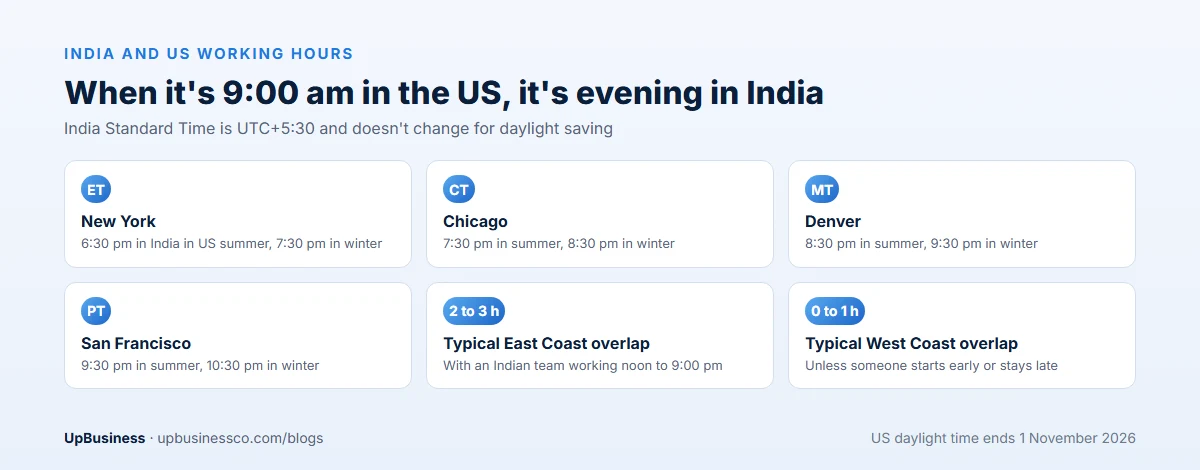
Many Indian companies that work with US clients run a shifted day, such as noon to 9:00 pm India time. That gives the East Coast about two to three hours of shared time each morning. For the West Coast, someone has to bend: an early call for you, or a late one for them.
Use the shared hours for decisions, demos and unblocking. Do everything else in writing. A good rhythm is:
- A 15-minute call in the shared window, two or three times a week.
- A written update from the team at the end of their day, waiting for you in the morning.
- Questions logged in one place, such as a ticket system, with answers by your end of day.
- A demo of working software every one or two weeks.
Agree the shared hours in the contract or the statement of work, not just in a sales call.
Contracts: What a US Buyer Must Include
Most projects use two documents. A master services agreement (MSA) sets the general terms. A statement of work (SOW) describes each project: scope, deliverables, timeline and price. Make sure both cover the points below.
Ownership of the code
This is the clause US buyers miss most often. Under US copyright law, work made by an outside contractor is only a "work made for hire" if it falls into one of nine listed categories and both sides sign a written agreement saying so[2]. Custom software usually isn't one of those categories. So you need a clause where the company assigns all copyright in the code, designs and documents to your company, signed before work starts.
Also ask the company to list any existing code or tools it will reuse, and to give you a permanent licence to use them as part of your product.
Governing law and disputes
Many Indian companies accept US law, often the law of your state, for larger projects. Some prefer Indian law. A common middle ground is international arbitration in a neutral place. Whatever you pick, write it down, along with how much notice either side must give to end the contract.
Confidentiality and data
Include a confidentiality clause that covers every person on the project, including subcontractors. Say where your data may be stored and who may access it. If you handle health data, you'll need a business associate agreement under HIPAA. If you handle data about people in Europe, you'll need GDPR terms.
Payment, acceptance and warranty
Tie payments to milestones you can test, not to dates. Say how long you have to accept each delivery, what happens if it fails, and how long the company will fix bugs for free after launch. Thirty to ninety days is common.
Our software development contract checklist lists every clause, with wording to look for.
Setting Up Communication and Project Management
Most problems with offshore projects are about communication, not code. Set up these basics in the first week, and write them into the statement of work.
- One point of contact on each side. The company names a project lead. You name one person who makes product decisions. Questions don't get lost between five people.
- One place for work. Use a single ticket board, such as Jira, Linear or Trello, that both sides can see. Every task, bug and change request lives there.
- One place for chat. A shared Slack or Teams channel works well. Agree that anything decided in chat gets copied into a ticket.
- Your own accounts. Code repositories, cloud hosting, domains and app store accounts should be in your company's name from day one. Give the team access; don't let them own the accounts.
- A written definition of done. Say what "finished" means for a task: code reviewed, tested, deployed to a test server and shown in a demo.
These habits cost almost nothing and prevent most of the arguments that sink projects.
Paying an Indian Company From the US
Paying is simpler than many buyers expect. Ask for invoices in US dollars, and pay by international wire or through a payments provider the company already uses. Agree who pays transfer fees, so the company receives the full invoice amount.
The tax form to collect
Before the first payment, ask the company for a completed Form W-8BEN-E. It's the IRS form a foreign company uses to show it's not a US business. IRS instructions say the form should reach the payer before the income is paid, and that not providing it when asked may lead to withholding at 30%[3].
For work done entirely in India, the IRS treats payment for personal services as foreign-source income, because the source of service income is where the work is performed[4]. In most cases, that means no US tax withholding. Tax rules depend on your situation, so confirm the details with your accountant, especially if anyone from the company will work on-site in the US.
Indian GST on your invoice
Software services exported from India are generally zero-rated under Indian GST. Registered companies can usually invoice overseas clients without adding the 18% GST, under a Letter of Undertaking filed each year. If a quote for a US client adds Indian GST, ask why.
A safe payment schedule
- A small deposit, usually 10% to 20%, to start.
- Milestone payments after each piece of work you've tested and accepted.
- A final payment after launch and handover of code, logins and documents.
Avoid paying most of the price up front, whoever the company is.
What It Costs: A Worked Example
Take a web app with a customer portal, an admin area and integration with a payment provider, estimated at 1,200 hours. Here's how the build cost compares at a typical offshore partner rate and at the US median.
| Phase | Hours | Offshore at $35 an hour | US median at $132 an hour |
|---|---|---|---|
| Discovery and design | 160 | $5,600 | $21,120 |
| Build | 800 | $28,000 | $105,600 |
| Testing and fixes | 160 | $5,600 | $21,120 |
| Launch and handover | 80 | $2,800 | $10,560 |
| Total | 1,200 | $42,000 | $158,400 |
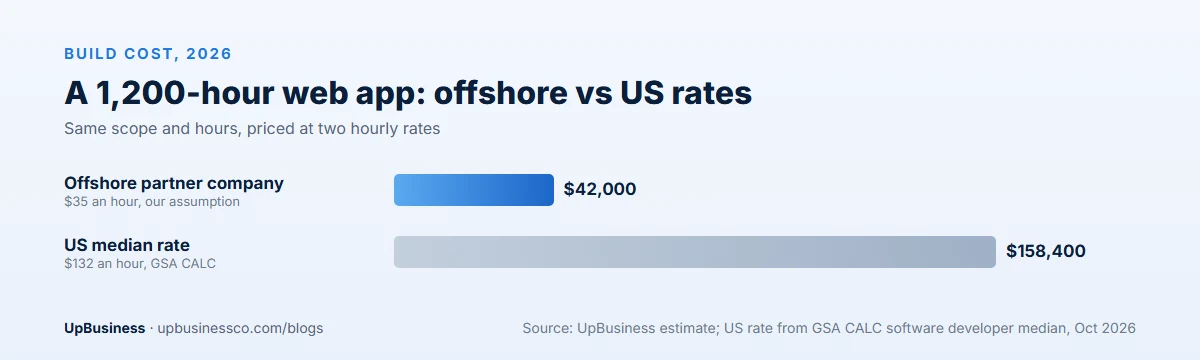
The offshore rate in this example is our assumption, and real quotes vary by company, skills and project. Add the cost of your own time. Plan for someone on your side to spend four to eight hours a week on reviews, questions and demos. Our software development cost benchmark shows ranges by project type.
How to Check an Indian Company Before You Sign
You'll probably never visit the office, so check what you can from a distance.
- Confirm the company is registered. Ask for its incorporation certificate and GST registration, and check that the names match the contract.
- Find out who owns it. Ask for the founders' names and LinkedIn profiles, and meet at least one of them on video.
- Call two past clients, ideally in the US and at a similar budget. Ask what went wrong as well as what went right.
- Meet the actual team. Ask who will work on your project and whether they're employees or subcontractors.
- Look at real work. Ask for a code sample or a short screen-share of a live product they built.
Our guides on how to verify a software development company in India and software company due diligence go through each check step by step.
Security Basics for US Buyers
You don't need a full security audit for a small project. But a few checks protect you from the most common problems.
- Ask how the company controls who can see your code and data, and how it removes access when someone leaves.
- Ask whether developers work on company-managed laptops, and whether those laptops are encrypted.
- Use separate test data. Don't give the team a copy of real customer data unless the project truly needs it.
- Keep passwords and API keys in a shared password manager or secrets store, never in chat or email.
- For larger projects, ask whether the company holds ISO 27001 certification or can share a SOC 2 report. Many smaller firms don't, so ask how they meet the same goals instead.
If your customers are large enterprises, check their security questionnaires early. They often ask about your suppliers, and an offshore partner will need to answer some of those questions too.
Mistakes US Buyers Make
- Choosing on hourly rate alone. A lower rate often means more hours, more rework or a junior team. Compare the total price for the same scope.
- Skipping discovery. Jumping straight to a fixed-price build means the company prices in risk, or cuts corners later.
- No product owner on your side. If nobody answers questions within a day, the team guesses or waits.
- Treating the team as a black box. Ask to see working software every week or two. Status reports alone hide problems.
- Ignoring the handover. Plan from the start how documents, code and knowledge will pass to your team or a new partner.
Red Flags
- A fixed price for a large project after one short call.
- No named team, or a team that changes after you sign.
- Refusing to put code ownership in writing.
- Code repositories, domains or cloud accounts set up in the company's name.
- Asking for most of the money up front.
- Reviews you can't trace to a real client.
Your First 30 Days
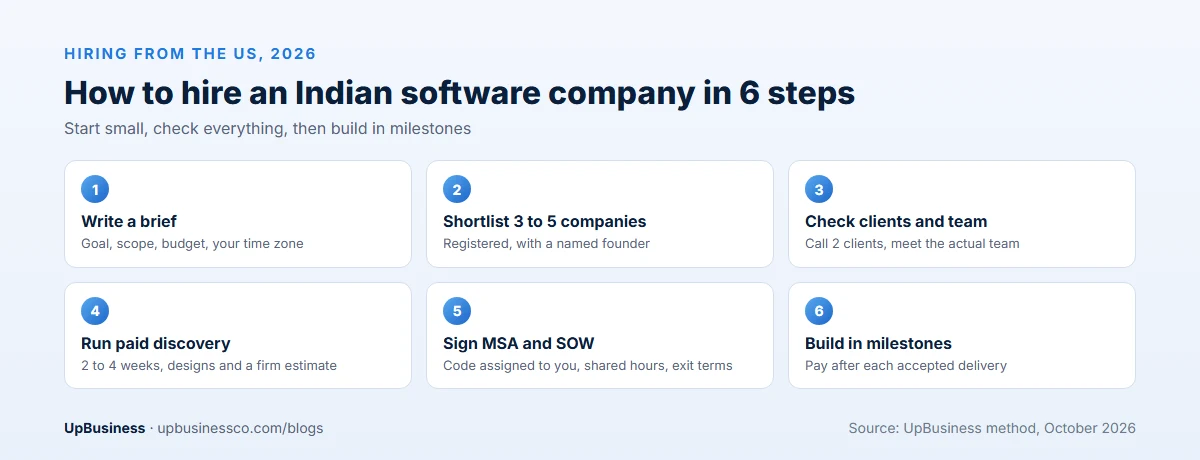
Don't start with the full build. Start with a paid discovery phase of two to four weeks. The company studies your requirements, designs the main screens, plans the architecture and gives you a detailed estimate. You learn how they work before you commit the full budget.
Before discovery starts, write a short brief. Our software project brief template covers what to include. When proposals come back, our guide to comparing software development proposals shows how to line them up fairly.
During the first month, watch for three things. Do they ask good questions? Do they deliver what they said, when they said? And do they tell you about problems early? A company that does all three in month one usually keeps doing it.
What UpBusiness Partner Data Shows
We looked at the 46 partner companies on our software development page on 31 October 2026, most of them based in India.
- Their TrustScores run from 70.17 to 75.85 out of 100, with a median of 71.67.
- Of the 45 that report an average project size, 22 average $5,000 or less. The median is $10,000.
- 38 of the 46 have 50 employees or fewer.
On our custom software development page, 12 companies are listed and 6 of them list custom software as a core service. So you can find a checked company for a focused first project, not just for a large build.
How Hiring Works on UpBusiness
Every partner company on UpBusiness has passed five checks reviewed by our team: company details, registration and tax papers, the founder's identity, expertise and three client projects with evidence. Only companies with a TrustScore of 70 or more are listed.
- Post your requirement with the service, a rough budget and the US time zone you work in.
- Get three partner companies matched to your budget, service and industry.
- Compare them side by side, meet them on video and contract with the one you choose. Buyers pay nothing, and there's no commission on the project.