


Browse our curated list of Software Development Companies
This guide is for founders, operations heads and product owners deciding who should build their software. The choice is between employees you hire, a freelancer and a development company. Every top-ranking article on agency vs freelancer vs in-house development we reviewed in October 2026 was published by an agency or a freelance marketplace, and each one leans towards the model it sells. Here the three models are priced the same way, from government and survey salary data, so you can see what each one really costs before you choose.
Below you'll find the full cost of an employee in five countries and the hourly rate a freelancer needs to earn the same. One project is then priced all three ways over three years, followed by the costs that rarely appear in a quote and a simple way to decide.
Key takeaways
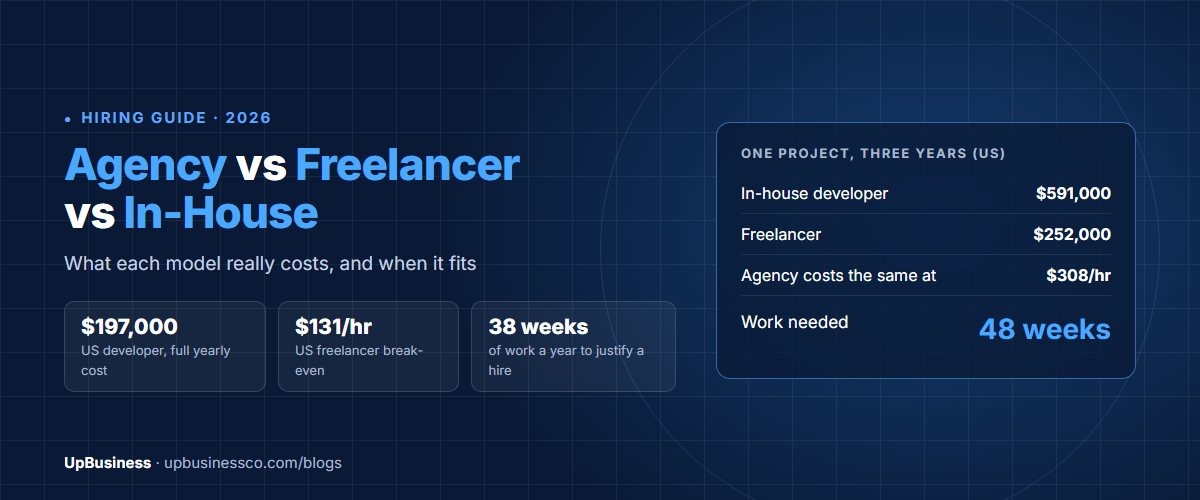
- A US full-stack developer on the 2025 median salary of $138,000 costs an employer about $197,000 a year once benefits are added. Wages are only 70% of what US private employers spend per hour on staff.
- To earn the same as that employee, a US freelancer who bills 1,500 hours a year has to charge about $131 an hour. The same sum gives about $66 in the UK, $64 in Germany, $56 in France and $9 in India.
- Take a project with 24 weeks of build work and 12 weeks of changes a year after that. One US hire costs about $591,000 over three years against about $252,000 for a freelancer, mainly because the employee is paid in the weeks with no work.
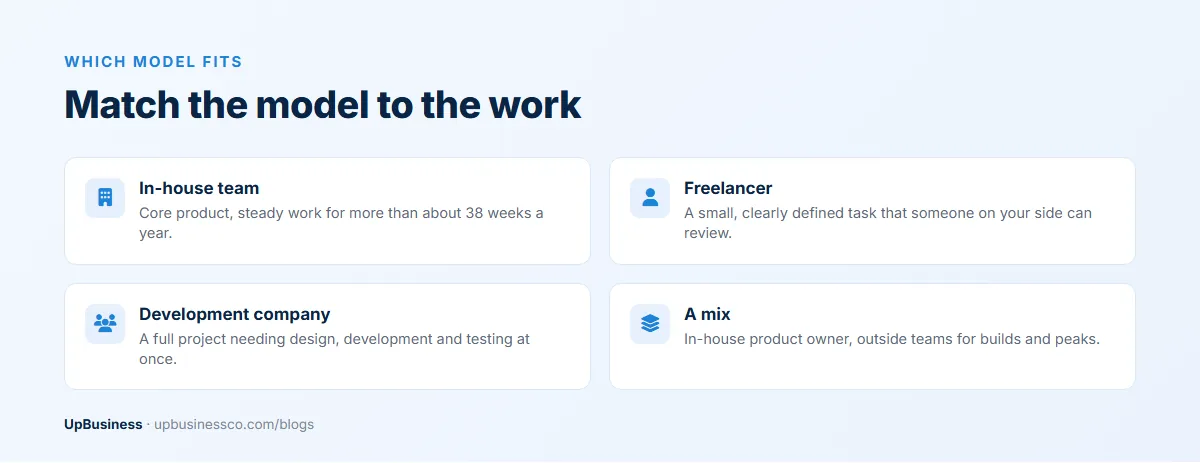
- A full-time hire becomes the cheaper option once you have more than about 38 weeks of work a year for that person, and that threshold is the same in every country in this guide.
Agency vs Freelancer vs In-House: The Quick Answer
Hire in-house when the software is your product and there's steady work for at least most of the year. Use a freelancer for a clear, self-contained task that someone on your side can manage. Choose a development company when the project needs several skills at once, such as design, back end, mobile and testing, and you don't want to build and manage that team yourself.
| In-house team | Freelancer | Development company | |
|---|---|---|---|
| How you pay | Salary and benefits every month | Hourly, daily or per task | Fixed price, monthly team or hourly |
| Best for | Core product with continuous work | Small, well-defined tasks | Full projects needing several skills |
| Time to start | Weeks to months of hiring | Days | Usually a few weeks |
| Who manages the work | You | You | The company's project manager, with you |
| Skills you get | Only who you hire | One person's skills | Designers, developers, testers and a manager |
| Risk if someone leaves | Knowledge leaves with them | Work stops until you replace them | The company replaces the person |
| Cost when there's no work | Full salary continues | Nothing | Nothing, or a smaller retainer |
What a Full-Time Developer Really Costs
A salary is only part of what an employee costs. In June 2026, wages and salaries made up 70.0% of total compensation for US private industry workers, and benefits such as health insurance, paid leave, retirement and payroll taxes made up the other 30.0% [1]. Dividing a salary by 0.70 gives a fair estimate of the full cost of a US employee.
Other countries add different amounts. UK employers pay National Insurance at 15% on pay above £5,000 a year since 6 April 2025 [2], plus at least 3% into a workplace pension on qualifying earnings [3]. For a developer on the UK median, that comes to about 16% on top of salary. In Germany and France, employers pay €27 and €45 in non-wage costs for every €100 of gross earnings, according to the latest comparison published by Germany's statistics office [4].
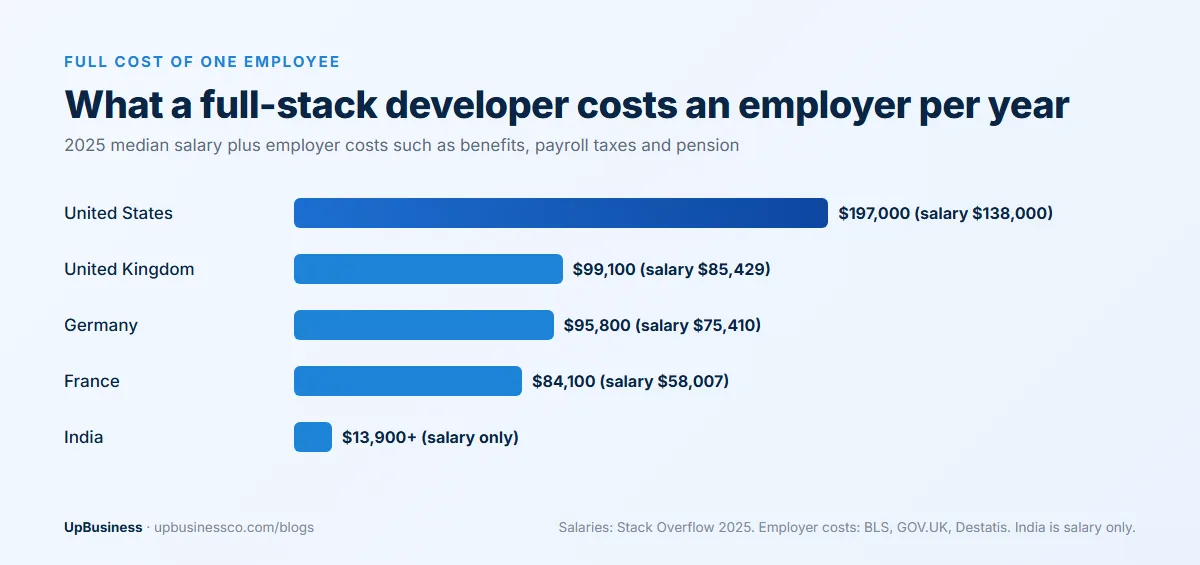
| Country | Median full-stack salary (2025) | Employer costs on top | Full annual cost |
|---|---|---|---|
| United States | $138,000 | About 43% (wages are 70% of compensation) | About $197,000 |
| United Kingdom | $85,429 | About 16% (National Insurance and pension) | About $99,100 |
| Germany | $75,410 | About 27% | About $95,800 |
| France | $58,007 | About 45% | About $84,100 |
| India | $13,949 | Salary only, treat as a floor | At least $13,900 |
All salaries are the 2025 medians for full-stack developers from the Stack Overflow Developer Survey [5]. As a check on the US figure, the Bureau of Labor Statistics puts the median wage for all US software developers at $135,980 in May 2025 [6]. India is shown at salary only. Employer contributions there depend on how pay is split and on statutory wage ceilings, and the real cost is somewhat higher.
Equipment, software licences, office space and training come on top of these figures. Hiring has its own cost too, covered further down.
What a Freelance Developer Has to Charge
Freelancers pay their own benefits, holidays, equipment and the time they spend finding clients, so their hourly rate is usually well above an employee's salary divided by working hours. A useful way to judge a freelancer's rate is to ask what they would need to charge to earn the same as an employee.
Assume a freelancer bills 1,500 hours a year out of roughly 2,080 working hours, with the rest going on holidays, admin and winning new work. To match the full cost of an employee, they need to charge that full cost divided by 1,500.
| Country | Employee salary per hour | Freelancer rate that earns the same | Cost of one freelancer week (40 hours) |
|---|---|---|---|
| United States | About $66 | About $131 | About $5,260 |
| United Kingdom | About $41 | About $66 | About $2,640 |
| Germany | About $36 | About $64 | About $2,550 |
| France | About $28 | About $56 | About $2,240 |
| India | About $7 | About $9 (salary-only floor) | About $370 |
Rates you'll be quoted vary widely around these figures. A senior specialist charges more, and someone building a portfolio charges less. If a quote is far below the break-even rate for that country, ask how the freelancer covers testing, holidays and support after delivery, because those gaps tend to come back to you. About 13.9% of developers in Stack Overflow's 2025 survey work as independent contractors, freelancers or self-employed [5]. Finding one is rarely the hard part. Checking their work takes more effort.
Agency vs Freelancer vs In-House Cost: One Project Priced Three Ways
Hourly rates hide the biggest difference between the models: what you pay for time when there's no work. Take a customer portal that needs 24 person-weeks of development in the first year, then 12 person-weeks a year of changes and fixes in years two and three. That's 48 person-weeks of work over three years.
- Hiring one US developer for three years costs about $197,000 a year, or $591,000 in total. They'll take about six months to build what a team of three could build in two, and for much of the time after launch you're paying for capacity the project doesn't use.
- A freelancer working 48 weeks at about $5,260 a week costs about $252,000 over three years, with $126,000 of that in year one. You only pay for the weeks worked, but you manage the work and carry the risk if the freelancer moves on.
- With a development company, the useful number is the break-even rate. For an agency to cost more than the in-house hire on this project, it would have to charge more than about $308 an hour across the same 48 weeks. Compare that figure with the hourly rates in the quotes you receive, remembering that a company's rate also covers project management and testing.
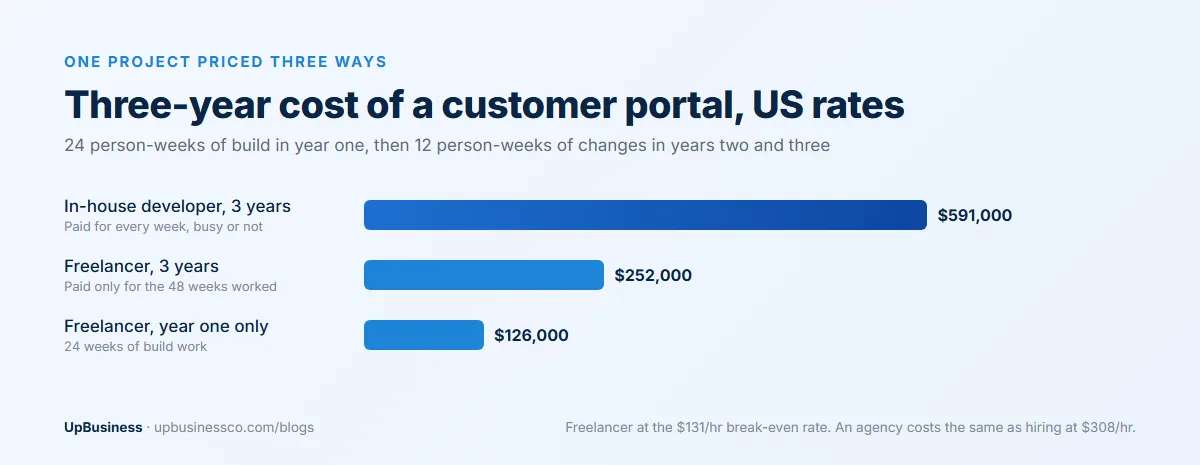
| Country | In-house, 3 years | Freelancer, 3 years | Agency rate at which it costs the same as hiring |
|---|---|---|---|
| United States | About $591,000 | About $252,000 | About $308 an hour |
| United Kingdom | About $297,000 | About $127,000 | About $155 an hour |
| Germany | About $287,000 | About $123,000 | About $150 an hour |
| France | About $252,000 | About $108,000 | About $131 an hour |
| India | At least $41,800 | At least $17,900 | About $22 an hour |
The picture changes when the work is continuous. If your developer has a full year of work, about 46 working weeks, the US cost per week falls to about $4,290, which is less than a freelancer's $5,260. The crossover sits at about 38 weeks of work a year. Below that, paying by the week is cheaper. Above it, an employee is cheaper. Because both sides of that sum scale with local salaries, the 38-week threshold holds in every country in the table.
The weekly cost is also only part of the decision. A development company usually puts two to four people on a project at once, so the same 24 weeks of work can be delivered in two or three months rather than six. If launching sooner is worth money to you, that counts in the agency's favour.
The Hidden Costs Behind Each Model
Quotes and salaries leave out several costs that often decide which option turns out cheaper.
Hiring and replacing staff
Hiring takes time before any work starts. SHRM's 2026 benchmarking data, from more than 4,600 organisations, puts the median time to fill a non-executive role at 39 calendar days, and over two in three organisations reported struggling to fill open positions [7]. Notice periods and the first weeks of getting up to speed come on top. When someone leaves, Gallup estimates that replacing an employee costs between half and twice their annual salary [8]. For the US developer above, that's roughly $69,000 to $276,000 of salary, a cost that freelancers and development companies largely absorb themselves.
Your own management time
With employees and freelancers, someone on your side plans the work, reviews it, tests it and decides what comes next. If nobody in your company can judge code quality, that gap shows up later as bugs and rework. A development company includes a project manager and usually a tester, but you still need a person who answers questions, approves designs and signs off each milestone.
Knowledge and continuity
Software is cheaper to run when more than one person understands it. If everything depends on a single freelancer or a single in-house developer, plan for the day they leave. Ask for documentation and keep the code in a repository your company owns. Access to hosting and other accounts should sit with you, not with one individual.
Ownership of the code
With employees, the work they produce usually belongs to the employer. With freelancers and development companies it depends on the contract, so make sure it assigns ownership of the code, designs and documents to you on payment. Our software development contract checklist lists the clauses to check.
Freelancer vs Agency: Which Is Better for Your Project?
The choice between a freelancer and an agency comes down to how much of the project you can manage yourself.
- A freelancer suits a task with a clear brief and a clear end, such as a landing page, an integration, a plugin or a set of bug fixes. Someone on your side still needs to review the work.
- An agency is the safer pick when the project needs design, front end, back end, mobile or testing together. The same goes when nobody on your side has a technical background, or when a missed deadline would cost real money.
- Either can work when you're adding one specialist to an existing team led by your own engineer. Here a freelancer is often cheaper, and a company is safer if you need the role covered without gaps.
Freelance platforms and talent networks are one way to find individuals. Our guides to alternatives to Upwork, Fiverr and Toptal compare them with hiring a verified company.
In-House vs Outsourcing Software Development
Outsourcing usually means handing the work to a development company, often in another country. It turns a fixed cost into a variable one and gives you a full team without hiring it. The trade-offs are less day-to-day control, the effort of writing clear briefs, and, across borders, fewer shared working hours.
Many companies settle on a mix. They keep a small in-house group that owns the product, the architecture and the priorities, and they use a development company or freelancers for builds, peaks in demand and specialist skills. In our view the product owner is the role to keep in-house, because that's where the knowledge of your customers sits.
If you're weighing an offshore team, our guide to outsourcing software development to India covers costs, risks and how to make it work. If you've already decided on a company and are choosing how to pay it, see dedicated developers vs project-based teams.
Which Should You Choose?
| Your situation | Usually the best fit | Why |
|---|---|---|
| Software is your product and work is continuous | In-house, with outside help for peaks | Above about 38 weeks of work a year, an employee costs less per week |
| A new product or MVP, no technical team yet | Development company | A full team starts quickly and you don't carry salaries before launch |
| A small, clearly defined task | Freelancer | Lowest cost for short work someone can review |
| An existing team needs one extra skill | Freelancer or company | Freelancer for price, company for continuity |
| A project that must launch by a fixed date | Development company | Several people work at once, and the company covers absences |
| Regulated data or strict security needs | In-house lead with a vetted company | Control stays with you while the build is shared |
Whichever model you pick, write the project down first. A short brief with the goal, the main features, the deadline and the budget range makes freelancer and company quotes comparable. It also shows whether you really have enough steady work to justify a hire. Our software project brief template is a good place to start.
When to Switch From One Model to Another
- Move from a freelancer to an agency when the project has grown beyond one person's skills, deadlines keep slipping, or you're spending more time managing than the work saves.
- Bring the work in-house when the product has steady work all year and you're ready to hire a technical lead. Plan the handover: ask the company for documentation and a few weeks of overlap with your first hires.
- Add outside help when your in-house team is fully booked with the core product and new work keeps waiting. A company or freelancer can take on separate projects without changing your team.
Before any switch, make sure you hold the code repository, the hosting accounts, the domain and the design files. Moving is far cheaper when nothing has to be recovered from the people you're leaving.
What UpBusiness Partner Data Shows
On UpBusiness, 38 verified companies are listed for software development. Thirty-seven are based in India and one in the United States, and their TrustScores sit between 70 and 76. The average project sizes they report run from $100 to $100,000, with a median of $10,000, and half of them fall between $1,000 and $13,800.
| Service page | Verified companies | Median average project size | Middle half of companies |
|---|---|---|---|
| Software development (all) | 38 | $10,000 | $1,000 to $13,800 |
| Custom software development | 10 | $10,000 | $1,000 to $25,000 |
| Web development | 14 | $5,000 | $1,000 to $10,000 |
| Mobile app development | 20 | $10,000 | $1,400 to $25,000 |
Team size makes a clear difference. The 12 companies with 1 to 10 people report a median average project of $1,000, close to freelance pricing, while the 25 companies with 11 to 200 people both sit at $10,000. Against the costs earlier in this guide, a $10,000 project is about 5% of what one US developer costs an employer in a year. It's also roughly two weeks of a US freelancer at the break-even rate. These figures are self-reported by the companies and come from a small group, so use them as a reference point when you compare quotes rather than as a price list.
Find a Software Development Partner on UpBusiness
If a development company fits your project, you can compare verified software development companies on UpBusiness by TrustScore, team size, location and project size. You can also go straight to custom software, web development and mobile app development partners. Before you sign, our guides on verifying a software development company and comparing proposals help you check what each quote includes. Or post your project once and compare the replies side by side. The software development cost benchmark adds wider project cost data.
The Bottom Line
An employee is the cheapest way to get software built only when there's enough work to keep them busy most of the year. For a US developer, the full cost is about $197,000 a year, and a freelancer needs about $131 an hour to earn the same. On a project with gaps between busy periods, paying for the weeks you use, through a freelancer or a development company, usually costs far less than hiring. Count the weeks of work you really have, add the hidden costs of hiring and managing, and choose the model that fits the work you need over the next few years.