
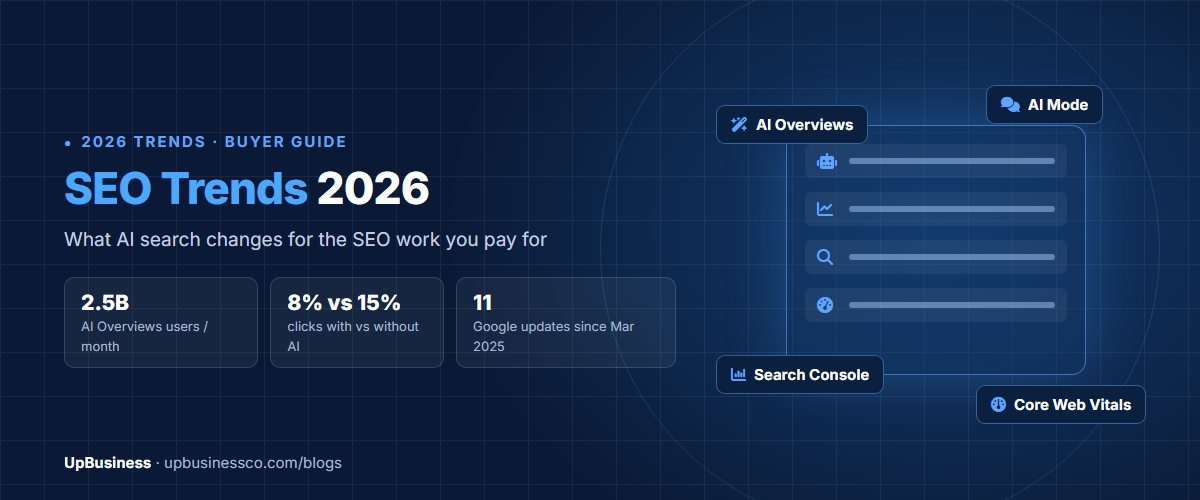


Many lists of SEO trends 2026 start with tactics. For anyone paying for SEO, the bigger change is what a results page now looks like and how people use it. Google says AI Overviews have more than 2.5 billion monthly users, and AI Mode passed 1 billion monthly users within a year of launch[1]. When an AI summary appears, people click a regular result about half as often as when it doesn't[2].
This guide is written for the person who hires and manages an SEO partner company: a founder, a marketing head or a business owner. It covers which trends should change the work you pay for and which ones are mostly sales talk. We've drawn on Google's own documentation, three click studies published between July 2025 and February 2026, Google's update history and our analysis of the 9 approved SEO companies on UpBusiness. Where the sources disagree or have limits, we say so.
Key takeaways
- AI Overviews have over 2.5 billion monthly users and AI Mode over 1 billion, according to Google's May 2026 keynote. AI answers are now an everyday part of search.
- Pew found that 8% of visits to a results page with an AI summary led to a click on a regular result, against 15% without one. Ahrefs puts the drop in top-result click-through rate at 58% on AI Overview keywords.
- Google's guide says work aimed at generative AI search is still SEO, with no special files, markup or chunking needed for Google.
- Since 31 August 2026 every site can see its AI Overview and AI Mode impressions in Search Console, so you can ask an SEO partner company to report them.
The SEO Trends 2026 Buyers Should Plan Around
Here are the seven changes that matter most when you're budgeting for SEO or reading a proposal. Each one gets its own section below, with the evidence behind it.
| Trend | What changed | What it means for your SEO spend |
|---|---|---|
| AI answers in search | AI Overviews and AI Mode reach billions of users a month | Pages need to be worth citing as well as worth ranking |
| Fewer clicks per search | Click-through rates fall when an AI Overview appears | Judge SEO on leads and sales, not traffic alone |
| AI reporting | Search Console shows AI impressions for every site | Ask for AI impressions in the monthly report |
| AEO and GEO | Google says this work is still SEO | Be careful with add-on fees for AI tricks |
| Quality over volume | Spam policies target scaled, low-value content | Fewer, better pages beat content quotas |
| Page experience | INP is the responsiveness metric in Core Web Vitals | Technical audits should include field data |
| Local, product and video | Business profiles, product feeds and video feed AI answers | Keep listings and feeds in the scope of work |
AI Overviews and AI Mode Are Now Part of Everyday Search
A year ago, AI Mode was new and AI Overviews still felt like a test. That's no longer true. Google's CEO told the I/O 2026 audience that AI Overviews have more than 2.5 billion monthly active users and that AI Mode passed 1 billion in about a year[1]. These are Google's own figures rather than audited ones, but even allowing for that, AI answers are now the first thing a large share of searchers see.
The way these answers are built matters for content. According to Google, AI Overviews and AI Mode may use a "query fan-out" technique, running several related searches across subtopics and data sources to put a response together[3]. In our view, that method favours a page that covers a topic properly over a cluster of thin pages, each written for one keyword variant.
India has moved quickly too. AI Mode was available in English and Hindi before Google added Bengali, Kannada, Malayalam, Marathi, Tamil, Telugu and Urdu in October 2025[4]. If you sell to customers in India, content in the languages they search in is now a real option for AI answers as well as regular results.
The entry requirements haven't changed. To appear as a supporting link, a page has to be indexed and eligible to show in Google Search with a snippet, and there are no extra technical requirements beyond that[3].
Fewer Clicks per Search, and the Clicks Look Different
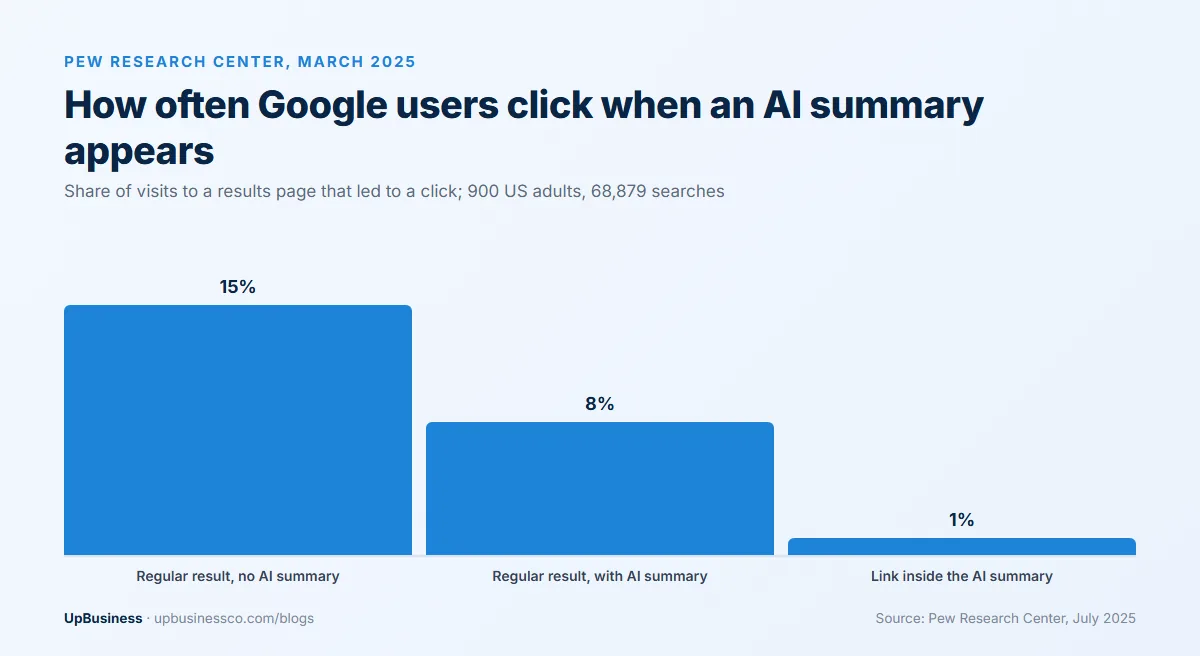
Three studies from the past 18 months point the same way, though they measure different things. Pew Research Center tracked the browsing of 900 US adults in March 2025, covering 68,879 Google searches. About 18% of those searches produced an AI summary. When one appeared, people clicked a regular result in 8% of visits, against 15% when there was no summary.
They clicked a link inside the summary in about 1% of visits. They were also more likely to end their browsing session altogether (26% against 16%)[2].
Ahrefs looked at 300,000 keywords using Search Console data. On keywords that showed an AI Overview in December 2025, the top result's click-through rate was 58% lower than Ahrefs' model predicted it would have been without one[5]. That's a modelled comparison on desktop data, and Ahrefs is careful to call it a correlation.
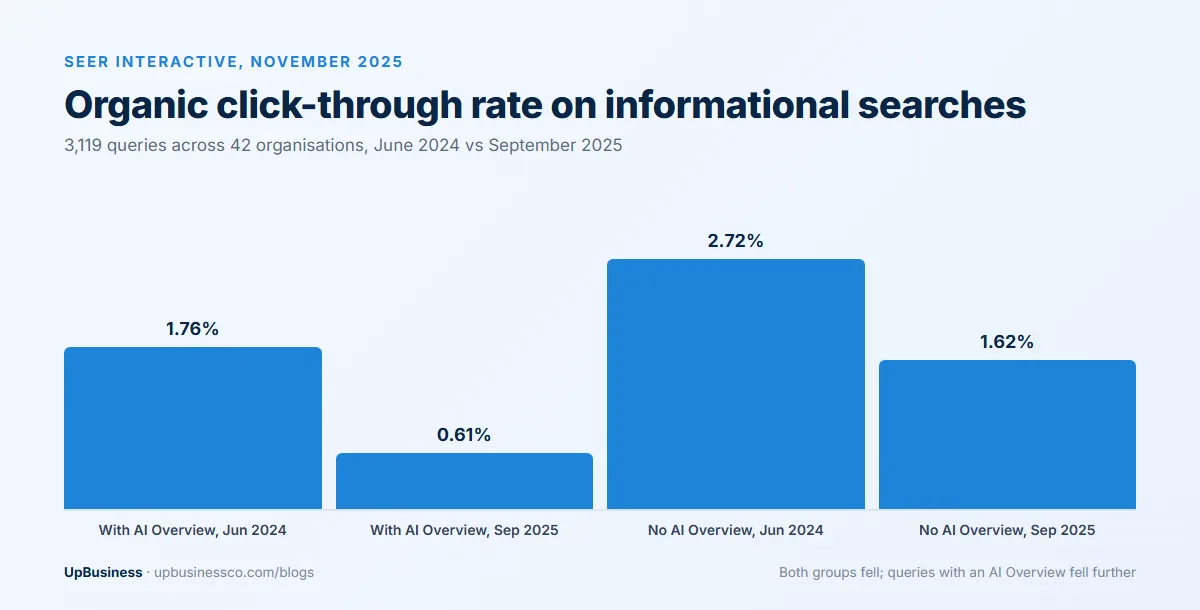
Seer Interactive studied 3,119 informational queries across 42 organisations. Organic click-through rate on queries with an AI Overview fell from 1.76% in June 2024 to 0.61% in September 2025. Queries without an AI Overview fell too, from 2.72% to 1.62%[6]. Pages cited inside the AI Overview did better than pages that weren't (0.70% against 0.52% in the third quarter of 2025), though Seer says it can't prove the citation caused the difference.
Google reads the data differently. In its view, clicks from results pages with AI Overviews are "higher quality", meaning people are more likely to spend more time on the site they land on[3]. Google hasn't published numbers for that, so treat it as a claim worth testing in your own analytics.
All three studies focus mainly on informational searches. Commercial searches, such as someone looking for a supplier or comparing prices, have been studied less, and the early data suggests AI answers reach them too.
In a May 2026 analysis of 500,000 prompts that lean towards buying intent, Peec AI found AI Overviews on about 87% of them, and on 88.5% of prompts where someone was comparing products[7]. Peec's labels are assigned by its own models and the sample isn't typical of Google overall, so read it as a signal rather than a market figure. A practical response is to stop treating total organic traffic as the main measure of SEO. Enquiries, sales and branded searches tell you more, and they're harder to inflate.
AI Visibility Now Shows Up in Search Console
Until this year, nobody outside Google could see how often a site appeared in AI answers. On 3 June 2026 Google announced new Search Console reports showing impressions in AI Overviews, AI Mode and AI Overviews in Discover, by page and by country. By 31 August 2026 the reports had reached every website worldwide[8]. Clicks from these features still sit in the standard Performance report under the Web search type[3].
Google added a control at the same time. A site owner can now opt out of appearing in generative AI features from inside Search Console. Sites that opt out won't get traffic or impressions from those features, and Google says the setting isn't used as a ranking signal for regular results[8].
For a business that wants buyers to find it, opting out usually costs more than it saves. A publisher whose income depends on page views might weigh it differently. Either way, ask your SEO partner company to add AI impressions by page to the monthly report, next to clicks and leads. If the report still shows only keyword rankings, it's out of date.
The new report tells you more when you read it page by page. A page with plenty of AI impressions but few clicks is probably answering the question well enough that people don't need to visit. That still builds awareness, but it won't fill your inbox.
A page that gets AI impressions and still earns clicks usually offers something a summary can't, such as a price table, a calculator or a detailed comparison. Ask your SEO partner company to point out both kinds each month and explain what it plans to change as a result.
"AEO" and "GEO" Are Still SEO, According to Google
Answer engine optimisation and generative engine optimisation are now common line items in SEO proposals. Google addressed them directly in a guide last updated in July 2026, which says work aimed at generative AI search is still SEO[9]. It also says you don't need new machine-readable files, AI text files, markup or Markdown to appear in Google Search, and that adding them will neither help nor harm your visibility.
The same guide says there's no need to break content into tiny pieces or to add special schema.org markup for AI features.
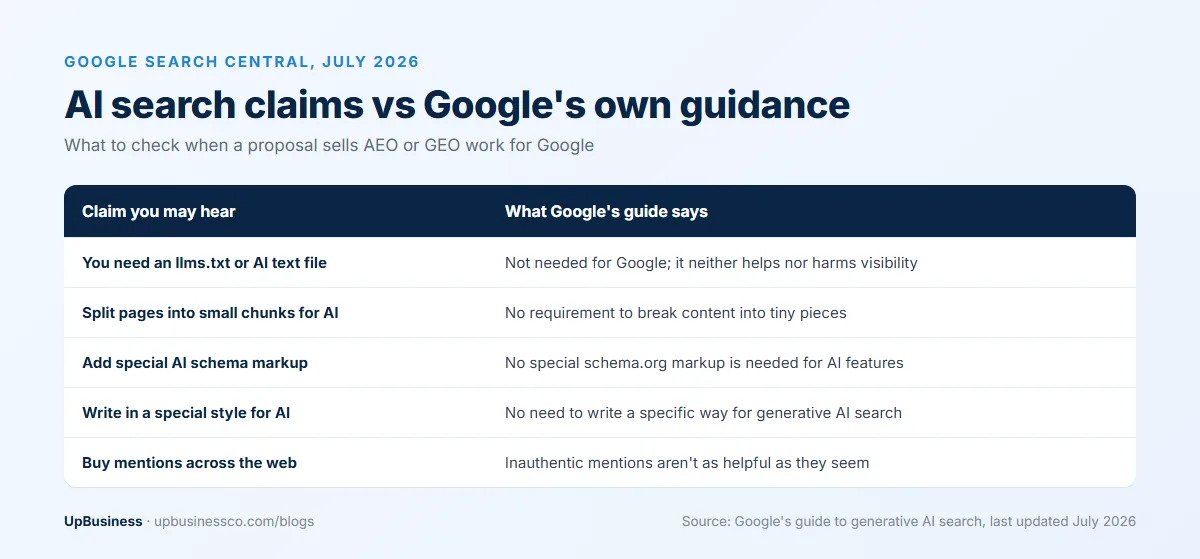
The guide is just as direct about shortcuts. In Google's words, many suggested "hacks" aren't effective, and chasing inauthentic mentions across the web isn't as helpful as it might seem[9]. Structured data is still worth having, because it helps with rich results in regular search.
There's one important limit to all of this. Google's guide covers Google. ChatGPT, Perplexity and other assistants pick sources their own way, and some SEO companies now offer separate work aimed at them. That can be reasonable. Before you pay for it, ask what the work involves, which tools it targets and how the company will measure results. A vague promise of "AI visibility" with no measurement plan is a reason to push back.
What those assistants reward is starting to show up in the data. Ahrefs studied 75,000 brands across ChatGPT, AI Mode and AI Overviews and found that mentions on YouTube had the strongest link with AI visibility, a correlation of about 0.74, followed by brand mentions on other websites at 0.66 to 0.71.
Domain Rating, Ahrefs' measure of backlink strength, came in at only 0.27 to 0.33[10]. Ahrefs is clear that correlation isn't causation. Still, if a proposal is mostly link building, it's fair to ask how the company will earn genuine coverage of your brand, such as press mentions, partner pages or videos, because that appears to count for more in AI answers.
Quality Beats Volume, and Google's Spam Policies Say So
Google folded its helpful content system into its core ranking systems in March 2024[11]. Since then, quality has been judged as part of every core update rather than by a separate system. Its spam policies describe scaled content abuse as generating many pages mainly to manipulate rankings, and the policy applies no matter how the content is created[12].
Google doesn't ban AI-assisted writing. Its guidance says generative AI can help with research and with structuring original content. Producing many pages with AI tools without adding value for users, though, may break the spam policies. Google also asks site owners to fact-check AI output before publishing, including titles, meta descriptions, structured data and image alt text[13].
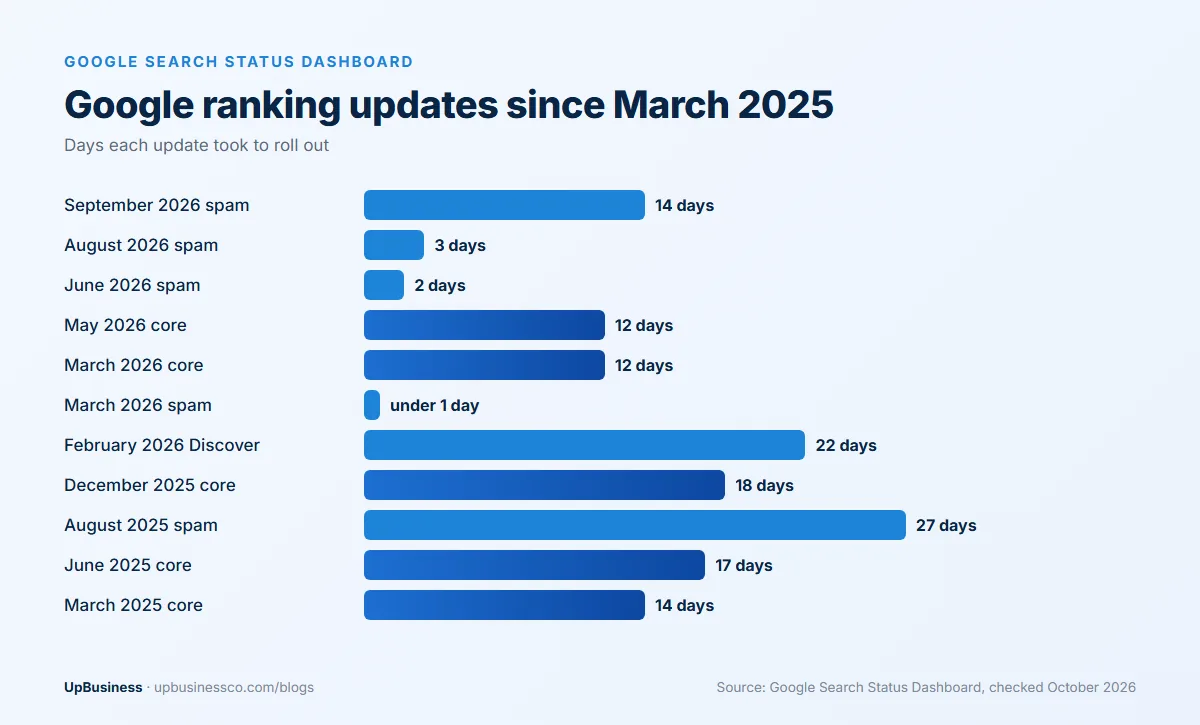
Updates keep arriving. Google's Search Status Dashboard lists 11 ranking updates between March 2025 and September 2026: five core updates, five spam updates and one Discover update. Rollouts took anywhere from under a day to 27 days[14].
For a buyer, the lesson is about the scope of work. A proposal built around "100 articles a month" is a risk if nobody can tell you who writes them, who checks the facts and what original information goes into each one. Ten well-researched pages with real numbers, named reviewers and clear answers are a better use of the same budget.
Page Experience: INP Is the Number to Watch
Interaction to Next Paint (INP) took over from First Input Delay in the Core Web Vitals on 12 March 2024. A page has good responsiveness when its INP is 200 milliseconds or less, measured at the 75th percentile of real visits. Above 500 milliseconds counts as poor[15].
This isn't new in 2026, but it still matters, because responsiveness problems tend to come back whenever a site adds new scripts, plugins or tracking tags. A technical SEO audit should use field data from Search Console's Core Web Vitals report rather than a single lab test of the home page. If a partner company is also redesigning the site, agree an INP target in writing before the build starts.
Local, Product, Image and Video Content Feed AI Answers
AI answers draw on more than web pages. Google's guide says Merchant Center and Google Business Profiles can help products and services show up in AI responses as well as other search results. It also says its generative AI features can bring in relevant images and video[9].
For a local service business, that makes an accurate Google Business Profile part of SEO rather than a separate admin task. Opening hours, services, photos and replies to reviews all count. For an online store, the product feed matters as much as the product pages. If a proposal leaves out Business Profile or Merchant Center work and you rely on either, ask why.
The same applies if you sell outside India. A company serving buyers in the US, the UK or the Gulf should check that its Business Profile, address format and service areas match each market it targets, and that product feeds show prices in the buyer's currency.
What SEO Trends 2026 Mean When You Hire an SEO Partner Company
The changes above should show up in how a proposal is written. Use this table to check one before you sign.
| Part of the proposal | What a current proposal includes | Question to ask |
|---|---|---|
| Reporting | Clicks, AI impressions by page, enquiries and sales alongside rankings | Which numbers will you report each month, and from which tools? |
| Content | Fewer, deeper pages with original data and a named reviewer | Who writes and fact-checks each page? |
| Technical work | Indexing, crawl issues and Core Web Vitals from field data | What is the current INP, and what's the target? |
| AI search work | Based on Google's guidance, with separate measurement for other assistants | What exactly will you do for AI answers, and how will we see the effect? |
| Local and product | Google Business Profile and Merchant Center where relevant | Is profile and feed work included in the monthly fee? |
| Promises | Work committed each month, with no ranking guarantees | What happens if a core update hits the site? |
Google's own advice on hiring an SEO is still the clearest test for promises: no one can guarantee a #1 ranking on Google, and if someone guarantees first place, you should find someone else[16]. Treat promised citations in AI Overviews the same way. No outside company controls which pages Google cites.
Watch for these warning signs in AI-era proposals:
- a fee for an llms.txt file or "AI schema" presented as a requirement for Google
- guaranteed appearances in AI Overviews or AI Mode by a set date
- a monthly content quota with no mention of research, fact-checking or review
- reports built only on keyword positions, with no enquiry or sales data
- bought mentions or links described as "AI visibility building"
Prices haven't changed as much as the work. Our guide to SEO agency pricing in India breaks down monthly retainers by tier, and our overview of professional SEO services explains what each type of SEO work includes. If you're also using AI tools in your own marketing, our guide to AI in digital marketing covers where they help and where people should stay in charge.
UpBusiness Data: How SEO Companies Describe Their Work (October 2026)
Our analysis of the 9 approved SEO companies on UpBusiness gives a snapshot of how the market is adjusting. Two of the nine mention AEO or GEO in the profile summary shown on their listing, alongside SEO and paid advertising. The other seven describe their work in terms of SEO, paid ads, websites or wider digital marketing, without naming AI search.
The group is mostly small and mid-sized. Five have 11 to 50 people and four have ten or fewer. Three are based in Pune, with the rest in Ahmedabad, Bengaluru, Indore, Ludhiana, New Delhi and Noida. Their average project sizes, as they report them, range from about $260 to $52,600, with a median of $2,600.
These figures come from self-reported profiles in a small group, so use them to shortlist rather than as a market survey. They do suggest that AI search work is still a specialism here rather than a standard part of every SEO offer.
Find an SEO Partner Company on UpBusiness
You can browse verified SEO companies on UpBusiness and compare their team size, location and project sizes before you contact anyone. If SEO is one part of a bigger plan, our digital marketing companies cover paid ads, social and content as well, and our digital marketing cost guide helps you set a budget. Or post your project once with your site, goals and monthly budget, then compare the proposals you get using the table above.