

Most business owners already know ranking on Google matters. Fewer understand why their own SEO efforts haven't produced much — usually because SEO isn't one activity, it's several working together, and doing one well while ignoring the others rarely moves the needle.
Modern SEO blends technical optimization, content strategy, user experience, and authority building, backed by continuous measurement. Businesses that invest in it properly build a channel that keeps generating qualified traffic long after the campaign that built it wraps up — which is exactly the compounding advantage paid advertising can't offer.
This guide covers what SEO services actually include, why they matter more now than they used to, how a real engagement runs, what it costs in 2026, and how to pick a partner who won't waste the budget.
SEO Services, Defined Simply
SEO services are the professional work involved in improving how a website ranks, and how much qualified traffic it earns from search engines. The point isn't the ranking itself — it's getting in front of people actively searching for what you sell, at the moment they're deciding.
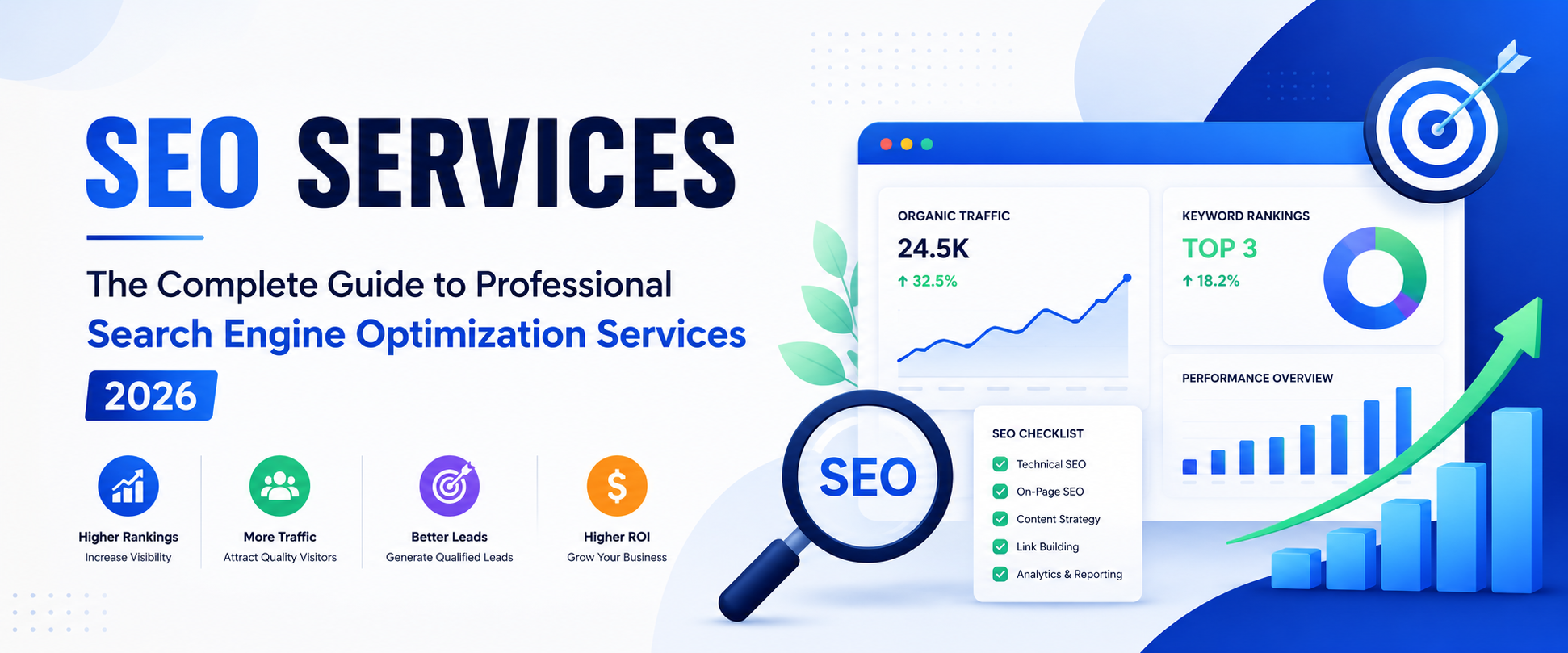
A real SEO engagement typically covers technical SEO, keyword research, on-page optimization, content strategy, link building, and some combination of local, ecommerce, or enterprise-specific work — plus the reporting that tells you whether any of it is working. These pieces reinforce each other: content without technical SEO underneath it struggles to get indexed properly, and technical SEO without content has nothing worth ranking.
Why Skipping SEO Gets More Expensive Every Year
Search behavior keeps shifting — Google's AI Overviews, ChatGPT, and Perplexity are increasingly where research starts, not just a traditional results page. Businesses that treat SEO as optional aren't just missing traffic today; they're losing ground to competitors compounding their visibility while they wait.
The case for investing comes down to a few things working together: organic traffic converts well because it's people actively searching, not people interrupted mid-scroll; strong rankings put you in front of buyers during the exact stage they're deciding; the technical and UX work SEO requires — site speed, mobile usability, clean navigation — improves the experience for every visitor, not just search engines; and unlike paid ads, the traffic SEO generates keeps arriving after the invoice is paid, which is what makes its long-run ROI hard for other channels to match.
Also Read, Digital Marketing Cost in India 2026: Pricing Guide
What's Actually Inside a Professional SEO Engagement
Technical SEO
Technical Seo is the infrastructure layer — site speed, Core Web Vitals, mobile responsiveness, sitemap and robots.txt configuration, schema markup, and making sure search engines can actually crawl and index the site properly. Skip this and no amount of great content will rank consistently, because the site is invisible to the systems doing the ranking.
On-page SEO
Onpage seo optimizes individual pages for relevance and engagement — keyword placement, title tags, meta descriptions, header structure, internal linking, and image optimization. This is the layer most people picture when they hear "SEO," but it only works once the technical foundation is solid underneath it.
Off-page SEO
Off page Seo builds authority outside the website itself — link building, digital PR, brand mentions, citations, and outreach. Backlinks remain one of the strongest ranking signals search engines use, largely because they're a hard-to-fake indicator that other sites consider your content worth referencing.
Content optimization
Content Optimizaion makes sure pages genuinely match what a searcher is trying to accomplish, not just what keyword they typed. This covers content audits, gap analysis, topic clustering, and refreshing older content that's started losing ground — often a faster win than publishing something entirely new.
SEO isn't One Service — It's Several, Depending on Your Business
Local SEO
Local Seo focuses on map-pack visibility and location-based search — Google Business Profile optimization, citation management, review generation, and location page work. This is the right fit for restaurants, medical practices, law firms, and any business whose customers search "near me."
Ecommerce SEO
Ecommerce Seo centers on product and category page visibility — product schema, faceted navigation management, and internal linking structured around how shoppers actually browse. Getting this wrong on a large catalog site tends to compound badly, since thin or duplicate product pages can quietly drag the whole domain down.
Enterprise SEO
Enterprise Seo deals with the scale problem: sites with thousands of pages need site architecture work, international SEO, automation, and governance frameworks that a small-business SEO plan was never built to handle.
SEO consulting
Seo Consulting is a different engagement entirely — strategic guidance for businesses that already have an internal marketing team and need direction, audits, or executive-level reporting rather than hands-on execution.
Also Check, Digital Marketing Services

Browse our curated list of Top Companies on UpBusiness
The Seven-Step Path From Audit to Ranking
A serious SEO engagement runs roughly the same sequence regardless of provider: audit the current state to find technical issues and content gaps, research keywords based on volume, competition, and actual business relevance, analyze competitors to spot where they're vulnerable, fix technical issues so the site can be crawled and indexed properly, develop content that matches real search intent, build authority through links and digital PR, and monitor performance continuously — because SEO isn't a project with an end date, it's an ongoing practice that degrades the moment you stop paying attention to it.
What SEO Actually Costs in 2026, By Engagement Type
Pricing varies more than almost any other marketing service, mostly because "SEO" can mean a $500/month local listing cleanup or a $50,000/month enterprise program — genuinely different scopes wearing the same label. A large 2026 industry survey polling hundreds of SEO providers found the average agency retainer landing around $3,200/month, with the most common project-based range sitting between $2,500 and $5,000, and hourly consulting most commonly priced $100–$150/hour.
| Engagement Type | Typical Monthly Cost |
|---|---|
| Small business SEO | $500 – $2,500 |
| Local SEO | $750 – $3,500 |
| Ecommerce SEO | $2,000 – $10,000+ |
| SaaS SEO | $3,000 – $15,000+ |
| Enterprise SEO | $5,000 – $50,000+ |
| SEO consulting | $100 – $300+/hour |
What actually moves the price within these ranges: how competitive your industry is, how large and technically messy the existing site is, how many locations or regions you're targeting, and how much content and link-building work the current gap actually requires. The number worth focusing on isn't the lowest quote — it's the projected return relative to what's being spent, since a cheap retainer that produces nothing is the most expensive option on the table.
Picking an SEO Partner Without Getting Burned
Look for real experience in your specific industry rather than generic SEO credentials — ranking a local law firm and ranking an ecommerce catalog draw on different playbooks. Ask for case studies with actual numbers attached, not vague claims of "improved visibility." A trustworthy agency explains their process in concrete terms and sets realistic expectations rather than vague promises — and the clearest warning sign in this industry is anyone guaranteeing specific rankings, since no legitimate provider controls what Google's algorithm does. Consistent, clear communication and regular reporting matter more over a 12-month engagement than they seem to at the start, because SEO's slow feedback loop makes it easy for a bad partnership to drift for months before the lack of results becomes obvious.
The Toolkit Behind Every Serious SEO Team
Professional SEO work leans on a fairly standard stack: Google Search Console, Screaming Frog, and PageSpeed Insights for technical diagnostics; Ahrefs, Semrush, or Google Keyword Planner for keyword research; Surfer SEO, Clearscope, or Frase for content optimization; and Google Analytics 4, Looker Studio, or Microsoft Clarity for measuring what's actually happening after the work ships. None of these tools do the strategic thinking — they surface the data a skilled team uses to make decisions, which is why the tools an agency uses matter far less than how well they interpret what those tools show.
SEO Looks Different by Industry — Here's How
SaaS companies need strategies built around product-led growth and long sales cycles, since a single blog post rarely closes a deal the way it might for a simpler purchase. Ecommerce sites live or die on product and category page optimization at scale. Healthcare organizations have to prioritize trust and compliance signals as heavily as keywords, given how sensitive that vertical is to credibility. Law firms lean hard on local visibility and high-intent keyword targeting, since most legal searches are already close to a buying decision. B2B companies generally emphasize thought leadership and account-based content over broad consumer-style keyword chasing, reflecting how much longer and more considered a B2B purchase decision actually is.
Where SEO is Headed From Here
AI search optimization
Content now needs to work for Google's AI Overviews, ChatGPT, and Perplexity, not just a traditional results page — which shifts weight toward clear, citable answers over keyword density.
Topical authority
Search engines increasingly reward comprehensive coverage of a subject over a single well-optimized page, rewarding depth over one-off wins.
User experience signals
Speed, engagement, and usability keep gaining weight as ranking factors, not losing it.
Entity-based SEO
Search engines are getting better at understanding entities and relationships between them, not just matching strings of text — which raises the value of structured, well-organized content.
First-party data
As third-party tracking keeps eroding, owned audience data is becoming a more central input to content and targeting decisions.
Turning This into an Actual Plan
Start with a real audit rather than assumptions about what's wrong. Get specific on goals and KPIs before picking channels or tactics. Identify the actual keywords and audience segments worth targeting. Evaluate agencies or consultants against the criteria above rather than price alone. Build a roadmap that spans well beyond the first 90 days, since SEO's payoff curve is genuinely longer than most other marketing channels. Invest in both content and technical work — neither compensates fully for the other. And commit to monitoring results consistently, because SEO rewards continuous attention far more than a one-time push.
Ready to Build an SEO Strategy That Actually Compounds?
At UpBusiness, we connect businesses with verified SEO agencies and consultants across local, ecommerce, SaaS, and enterprise SEO. Contact UpBusiness to find a partner matched to your industry and get a realistic read on what your specific SEO investment should look like.
Concluion
SEO remains one of the highest-leverage digital marketing investments available, precisely because it compounds instead of resetting every month. Professional SEO services combine technical groundwork, content strategy, and authority building into something that keeps paying off well after the invoice is settled — which is a different kind of return than most marketing spend produces.
As AI-powered search reshapes what "visibility" even means, the businesses that invest in genuine topical authority now — not shortcuts — are the ones positioned to still be found when the next shift happens. Whether you're a startup, an ecommerce brand, a SaaS company, or an enterprise organization, the right SEO partner can turn organic search into the one growth channel that gets cheaper, not more expensive, the longer you invest in it.
Browse our curated list of Top Companies on UpBusiness