


Browse our curated list of Software Development Companies
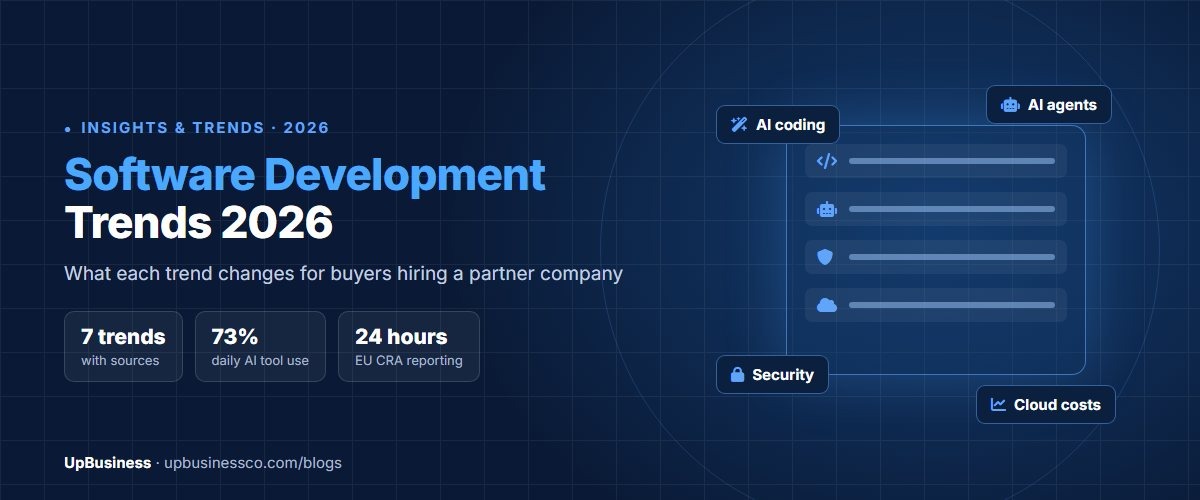
Software development trends 2026 come down to one shift for anyone hiring an outside team. AI is now part of how most partner companies write, test and run software, and the rules on security and personal data have started to catch up with it.
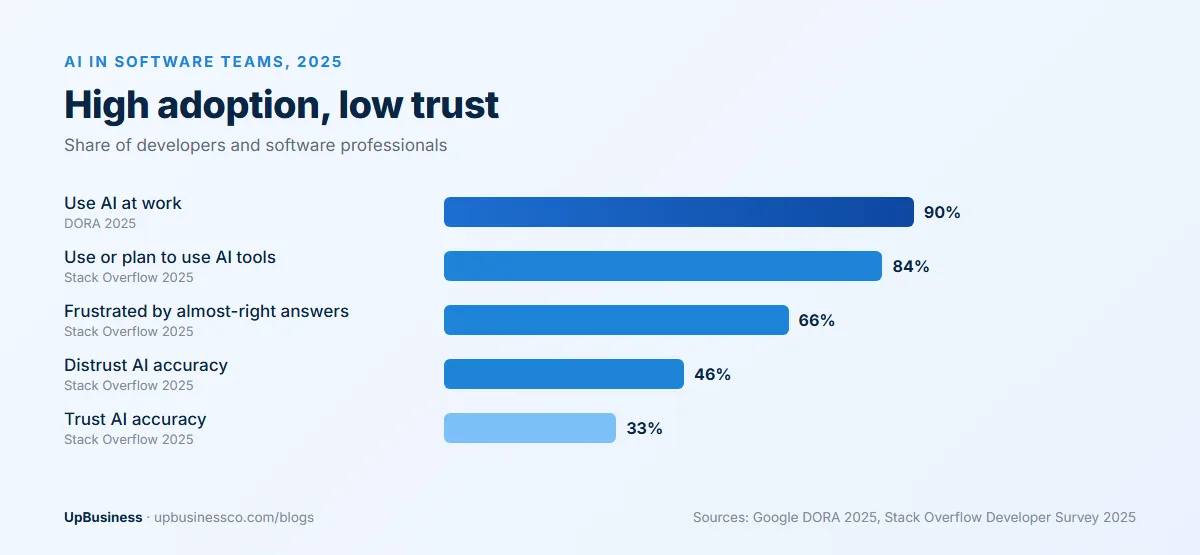
In Stack Overflow's 2026 survey of more than 30,000 developers, 73% of people who use AI coding assistants use them every day[1]. Yet a year earlier, 46% of developers said they distrust the accuracy of AI output, against 33% who trust it[2].
This guide is written for the person doing the buying: a founder, an operations head or an IT manager about to brief a software development company. It doesn't list every trend in the industry. It covers the seven that change what you should put in a brief, what a fair quote looks like and which clauses belong in the contract, with the source for every number.
Key takeaways
- AI coding tools are routine: 90% of the nearly 5,000 professionals in Google's 2025 DORA research use AI at work, so ask every partner company how its team reviews AI-written code.
- Gartner expects 40% of enterprise apps to include task-specific AI agents by the end of 2026, up from under 5% in 2025, and also expects over 40% of agentic AI projects to be cancelled by the end of 2027.
- Since 11 September 2026, makers of software sold in the EU have had to report actively exploited vulnerabilities within 24 hours, and India's DPDP Rules bring most data duties into force in May 2027.
- Flexera's 2026 survey puts wasted cloud spend at 29%, the first rise in five years, so a quote should include monthly running costs as well as the build price.
Software Development Trends 2026 at a Glance
Each row below is covered in its own section. The last column is the practical part: what to add to your brief, your shortlist questions or your contract.
| Trend | What the data says | What to change as a buyer |
|---|---|---|
| AI coding assistants are standard | 73% of AI tool users use them daily (Stack Overflow 2026) | Ask how AI-written code is reviewed and tested |
| AI agents inside business software | 40% of enterprise apps with task-specific agents by end of 2026 (Gartner forecast) | Start with one narrow agent and a measurable pilot |
| Security checks move earlier | AI code had a security flaw in 45% of Veracode's test tasks | Put security testing and fix times in the scope |
| New reporting rules | EU CRA reporting from 11 September 2026; India DPDP duties from May 2027 | Assign vulnerability and breach duties in the contract |
| Cloud and AI running costs | 29% of cloud spend wasted (Flexera 2026) | Ask for a monthly running-cost estimate and usage caps |
| Typed, mainstream stacks | TypeScript became GitHub's most used language in August 2025 | Prefer stacks other teams can take over |
| A larger global talent pool | India added more than 5 million GitHub developers in 2025 | Choose on proven work, not on location alone |
If you need the basics first, such as what a software development company does or how engagement models work, our software development services guide covers them. For prices, the software development cost benchmark has the rates and project sizes.
1. AI Coding Assistants Are Now Standard Practice
Nearly every team you speak to will use AI while writing code. Google's 2025 DORA report found AI use among software professionals at 90%, with a median of two hours a day spent working with it[3]. Over 80% of those respondents said AI made them more productive, and 59% said it improved code quality.
The same research shows the catch. Only 24% of DORA respondents trust AI output a lot or a great deal. In Stack Overflow's 2025 survey, 66% said their biggest frustration is AI answers that are almost right but not quite, and 45% said debugging AI-generated code takes longer[2]. Developers have adjusted: in the 2026 survey, 93% said they need to see where an AI answer came from before they trust it[1].
This changes two things for a buyer. First, AI use doesn't automatically make your project cheaper. DORA describes AI as an amplifier, helping teams that already work well and exposing the gaps in teams that don't. A company with weak testing will simply produce untested code faster.
Second, the question to ask has moved on from "do you use AI?" to "what happens to AI-written code before it reaches my product?" A good answer names a person who reviews every change, automated tests that run on each pull request and a rule about which code or data never goes into an AI tool. If the team can't describe that process in a couple of minutes, treat it as a gap, whatever the hourly rate.
A few warning signs are worth knowing. One is a quote that promises a large discount because of AI while the testing plan stays the same as before. Another is a team that can't show you test results from a recent project. A third is reluctance to agree that your source code or customer data stays out of public AI tools. None of these rules a company out on its own, but each deserves a direct question before you sign.
2. AI Agents Are Moving Into Business Software
An AI agent is software that can carry out a task on its own, such as checking an order, updating a record or drafting a reply, instead of only answering a question. Gartner predicts that 40% of enterprise applications will include task-specific AI agents by the end of 2026, up from less than 5% in 2025[4]. Developers are already using agents themselves. In Stack Overflow's 2026 results, coding agents were used by 66% of the AI users who responded[1].
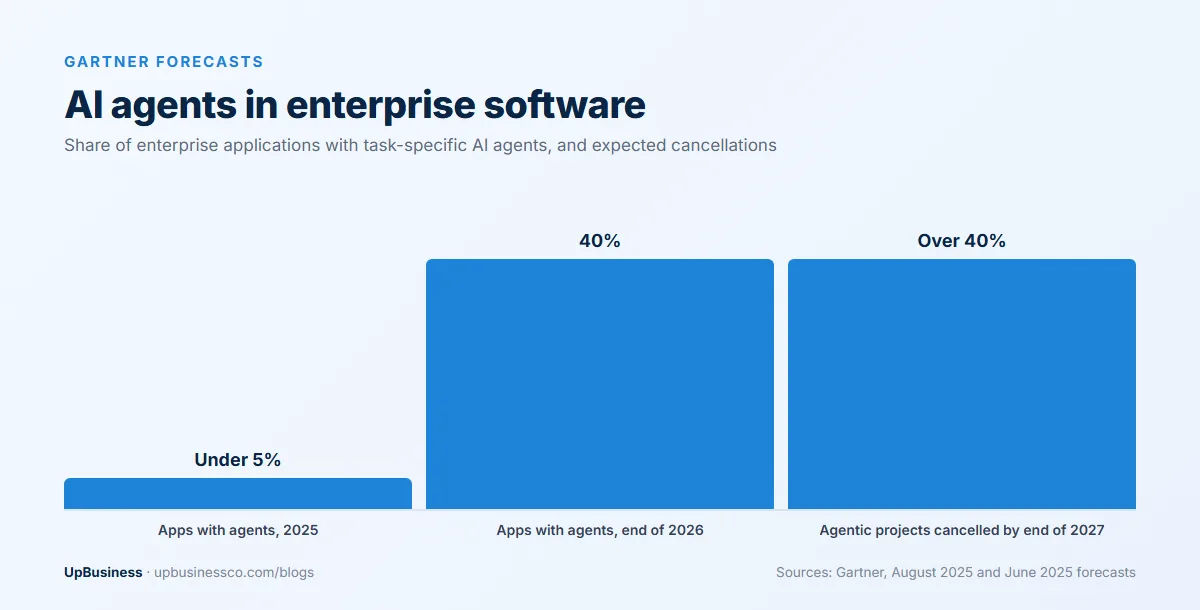
Gartner has also issued a warning in the other direction. It expects over 40% of agentic AI projects to be cancelled by the end of 2027, citing rising costs, unclear business value and weak risk controls[5]. Many products sold as agents are rebranded chatbots or automation scripts.
The practical response is to keep the first agent narrow. Pick one task with a clear before-and-after number, such as the time it takes to approve an invoice, and ask the partner company to build a pilot against that measure before anything goes company-wide. The brief should also say what the agent may not do on its own, for example sending money or deleting records. Our guide to hiring an AI agent development company goes through the scoping in more detail.
3. Security Checks Are Moving Earlier in the Build
Faster code writing has made security review more important. In Veracode's 2025 study of more than 100 large language models across 80 coding tasks, AI-generated code introduced a security flaw in 45% of cases[6]. Java was the weakest language in the test, with a failure rate above 70%.
GitHub's Octoverse 2025 report points the same way. Broken access control, where users can reach data or actions they shouldn't, was flagged in more than 151,000 repositories, up 172% in a year, and it is now the most common CodeQL alert. There is better news in the same report: the average time to fix critical vulnerabilities fell from 37 days to 26[7].
For your project, this means security can't be a test at the end. Ask for dependency scanning and code scanning on every pull request, a named person who signs off access-control logic, and a target time to fix critical issues once they're found. For anything that handles payments or personal data, budget for an independent test before launch. Our VAPT testing cost guide shows what that costs and how to scope it.
4. New Rules Put Reporting Duties Into Your Contract
Two sets of rules matter for most buyers who sell software or handle customer data. One already applies, and the other brings most of its duties into force in May 2027.
The EU Cyber Resilience Act covers products with digital elements sold in the EU. From 11 September 2026, manufacturers must report actively exploited vulnerabilities and severe incidents: an early warning within 24 hours of becoming aware, a full notification within 72 hours and a final report later[8]. The duty also covers products already on the market. If your company sells a software product into Europe, you are the manufacturer, even when an outside team wrote the code.
In India, the Digital Personal Data Protection Rules were notified in November 2025 with an 18-month phased rollout. Most duties apply from May 2027[9]. A software company that handles your customers' personal data acts as your data processor, and you remain responsible for keeping that data safe.
| Date | What starts | Who it affects |
|---|---|---|
| 11 September 2026 | EU CRA reporting of exploited vulnerabilities and severe incidents | Anyone selling software products in the EU |
| November 2026 | Consent manager provisions under India's DPDP Rules | Platforms that rely on registered consent managers |
| May 2027 | Most DPDP Rules duties, including security safeguards and breach notice | Businesses handling personal data of people in India |
| 11 December 2027 | Main CRA obligations, including security requirements by design | Manufacturers of products with digital elements |
Neither rule can be handed to a partner company completely, but the contract can split the work. It should say who monitors for vulnerabilities after launch, how fast the team must tell you about a security issue (well inside 24 hours if the CRA applies), who keeps the list of third-party components and what happens to personal data when the contract ends. Our software development contract checklist has clause wording you can adapt.
5. Cloud and AI Running Costs Need Their Own Budget Line
The build price is only part of what software costs. Flexera's 2026 State of the Cloud report, based on more than 750 cloud decision-makers, estimates that 29% of cloud spend is wasted, the first increase in five years, and links the rise to AI workloads[10]. Managing cloud spend was named a top challenge by 85% of respondents, and 63% now have a FinOps team to control it.
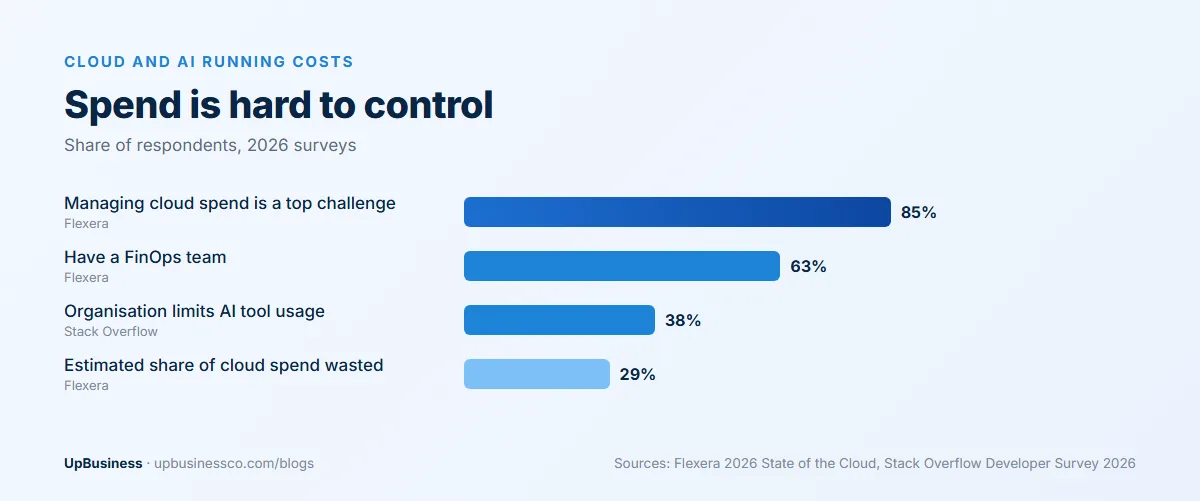
AI features add a cost that grows with use. Stack Overflow's 2026 survey found that 38% of respondents' organisations set usage limits on AI tools and 21% are spending more on them[1]. A chatbot or document tool that costs very little in testing can cost far more once thousands of customers use it every day.
Ask for a monthly running-cost estimate alongside the quote, broken into hosting, database, AI model usage and monitoring, at two or three levels of usage. Ask the team to set spending alerts and usage caps from the first release. And make sure the cloud accounts are opened in your company's name. That way the bills come to you, not to the partner company. If you're moving existing systems, our cloud migration services guide covers the cost side of that work.
6. Typed Languages and Mainstream Stacks Win on Handover
In August 2025, TypeScript overtook both Python and JavaScript to become the most used language on GitHub by contributor count[7]. GitHub links the change partly to AI, saying typed languages make agent-assisted coding more reliable in production. The same report counts more than 1.1 million public repositories that use an LLM SDK.
Stack Overflow's 2026 results show the mainstream is still wide. JavaScript is used by 62% of respondents, with SQL, HTML/CSS and Python at 58% each[1]. For a buyer, that is a reason to be cautious about unusual frameworks. A stack that thousands of developers know is easier to hire for, easier to audit and easier to hand to another company if the relationship ends.
It's fair to ask each partner company why it chose its proposed stack for your project, and to be wary of an answer that only says the team prefers it. A good proposal explains the choice in terms of your product, such as how many users you expect, which systems it must connect to and who will maintain the code later.
7. The Global Talent Pool Keeps Growing
More than 180 million developers now build on GitHub, and more than 36 million joined in 2025 alone. India added over 5 million of them, about 14% of all new accounts, and GitHub projects India will reach 57.5 million developers by 2030[7].
The industry behind those developers is large but growing more slowly. Nasscom's Strategic Review 2026 estimates India's technology industry revenue at about $315 billion for FY2026, up 6.1%, with roughly 135,000 net new jobs and $10 to $12 billion of AI-related revenue[11]. Stack Overflow's 2026 survey also found that the share of respondents working as an organisation of one rose from 4% to 10%[1].
That gives buyers in the US, UK, Europe and the Middle East more choice than before, but it also widens the gap between good and weak companies. Location tells you little on its own. Past projects you can check, the named people who will work on yours and a written process for testing and security tell you far more. Our due diligence checklist lists the records to ask for.
What We See Among Verified Software Development Companies
Our analysis of the 38 verified software development companies listed on UpBusiness in October 2026 shows how these trends reach smaller partner companies. Most list several services rather than one. Mobile app development and custom app development are the most widely offered, at 20 companies each.
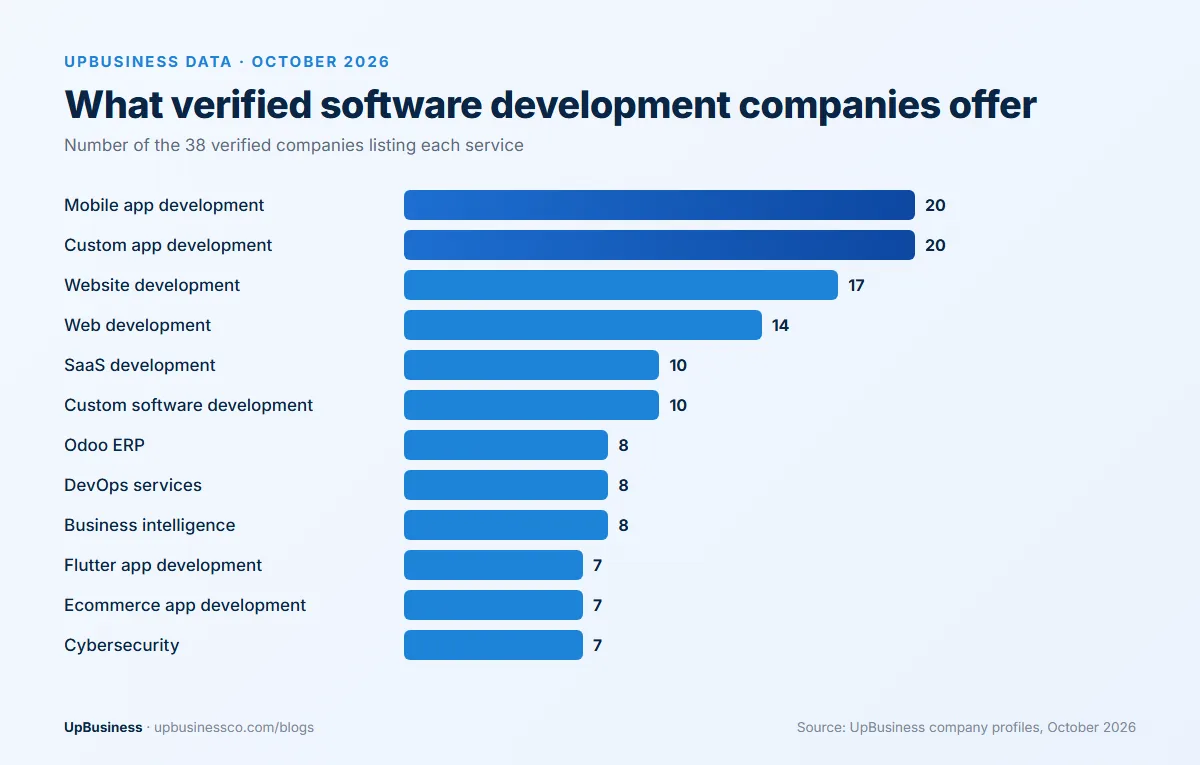
The same companies set a median minimum project of $530, and half have between 11 and 50 people. So a buyer with a small first project can still reach a team large enough to cover design, development, testing and DevOps. Fewer companies list DevOps or cybersecurity as a separate service, so if your project depends on either, ask each shortlisted team who does that work and whether that person is an employee.
What Hasn't Changed
None of these trends replaces the basics. A project still goes well or badly mostly because of how clearly the scope is written, who is actually on the team and how often you see working software. AI tools can speed up a well-run project, but they can't fix a vague brief or a missing tester.
The same applies to price. A lower hourly rate means little if the quote leaves out testing, support or running costs. Comparing proposals line by line, on the same scope, still tells you more than any trend report.
How to Brief a Partner Company in 2026
The trends above turn into a short set of additions to a normal brief. Our software project brief template has the full structure; these are the 2026 additions.
- Describe how you expect AI to be used on your project, including any code, documents or customer data that must stay out of AI tools.
- Ask for the review and testing process for AI-written code, with the name of the person who approves changes.
- If you plan an AI agent, name the single task it should do first and the number you'll use to judge the pilot.
- Include security testing in the scope, with a target time to fix critical issues and an independent test before launch for sensitive data.
- Ask for a monthly running-cost estimate at different usage levels, plus spending alerts from day one.
- Set out who handles vulnerability reports and personal data duties, especially if you sell in the EU or handle data of people in India.
- Ask why the proposed stack suits your product and how easily another team could take it over.
Sending the same brief to three companies makes their answers comparable. A team that answers these points clearly in its proposal is usually one that already works this way.
Find a Software Development Partner Company
You can browse verified software development companies on UpBusiness by service, including mobile app development, SaaS development, DevOps and cybersecurity. Each company has passed checks on its registration, founder identity and client projects. If you'd rather not search, post your project once and we'll match you with suitable companies, free and with no commission.