

AI consulting services help a company decide what to build with AI, prove that it works, and plan how to roll it out safely. The need is clear. In IBM's 2025 survey of 2,000 CEOs across 33 countries, only 25% of AI projects had paid back as expected. Just 16% had been scaled across the company[1]. A good consultant's job is to move your projects into that smaller group. They do it by picking the right use cases, checking the data, and agreeing how to measure success before money goes into a build.
This guide is for business owners, operations leads and IT heads who are thinking of hiring an AI consultant. It covers what consultants do, what they cost, when you need one and how to pick one. If you already know what you want built, our custom AI development services guide covers the build itself.
Key takeaways
- Gartner predicted that at least 30% of generative AI projects would be dropped after proof of concept by the end of 2025. It cited poor data quality, weak risk controls, rising costs and unclear business value[2].
- The 10 partner companies on our AI consulting page report a median average project size of $17,500. Eight of them report $10,000 or more.
- A three-week assessment done in-house by two US analysts would cost about $17,000 in pay and benefits, based on BLS pay data. So the real question is skill, not price.
- Only 4 of those 10 partner companies list AI consulting among their main skills. The other six are mainly build teams.
What Are AI Consulting Services?
AI consulting is advice that turns "we should use AI" into a short list of priced, measurable projects. A consultant reviews your processes, data and systems. They rank the options, say whether to build or buy, and set up governance (the rules and checks for using AI safely). The output is decisions and a plan, not software. Still, many projects end with a small proof of concept, which is a basic working test of the idea.
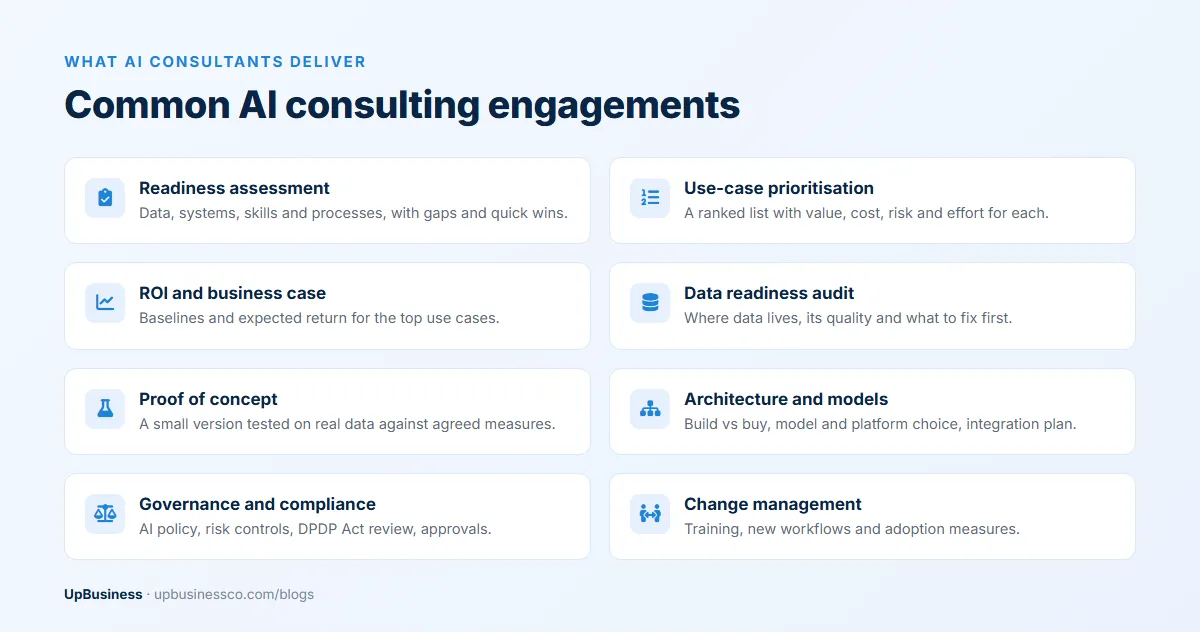
What AI Consultants Actually Deliver
| Engagement | What you get | Best for |
|---|---|---|
| AI readiness assessment | A review of your data, systems, skills and processes, with gaps and quick wins | Companies starting out |
| Use-case ranking | A ranked list of AI options with value, cost, risk and effort for each | Leaders with many ideas and a limited budget |
| ROI and business case | Starting measurements and the expected return for the top use cases | Getting budget approved |
| Data readiness audit | Where the data lives, its quality, owners and access, and what to fix first | Any project that uses company files or records |
| Proof of concept | A small working version tested on real data against agreed success measures | Testing a use case before a full build |
| Architecture and model choice | Build or buy advice, model and platform choice, plan to connect systems | Technical planning |
| Governance and compliance | AI usage policy, risk controls, privacy review, sign-off steps | Regulated or customer-facing use |
| Change management | Training, new workflows and uptake measures | Getting people to use the tools |
The output to check hardest is the ranked roadmap. Each use case on it should have an expected value, a cost range, a success metric and an owner. If a consultant's final report lacks those four things for every item, it is a talking paper, not a plan.
When You Need an AI Consultant, and When You Don't
You probably need one in four cases. You have many AI ideas but no clear priorities. Leaders want a business case before they approve budget. Your data is spread across many systems. Or you work in a regulated field such as finance, health or insurance.
You may not need one if you already know the use case, your data is in fair shape, and the work is mainly a build. In that case, go straight to a development partner. Spend the consulting budget on a well-planned first version. If the question is whether to buy an existing tool instead, our comparison of custom AI and off-the-shelf AI covers that choice.
There is a middle option too. Some companies hire a consultant for a two- or three-week readiness assessment only. Then they run the build with a separate development company. That keeps the advice apart from whoever is paid to build.
How Much Do AI Consulting Services Cost?
Price depends on scope, seniority and location. Published rate guides vary a lot. Two kinds of real data give a better guide. The first is what partner companies report. On our AI consulting page, the 10 listed partner companies report average project sizes from $1,000 to $50,000. The median is $17,500 (October 2026). Eight of the ten report $10,000 or more.
The second is what the same work would cost you in-house. The US Bureau of Labor Statistics puts the median pay of management analysts at $101,860 a year (May 2025)[3]. Wages are about 70% of what an employer pays in total once benefits are added[4]. That puts the full cost of one analyst at about $2,800 a week.
| Worked example: a three-week readiness assessment | Rough cost |
|---|---|
| Two in-house US analysts for three weeks (6 person-weeks at about $2,800) | About $16,800 |
| Two AI consultants at the US contract median of $183 an hour (240 hours) | About $43,900 |
| Median average project size, UpBusiness AI consulting partners | $17,500 |
| What the in-house figure leaves out | AI skills, benchmarks from other industries, hiring time |
This is a rough comparison, not a quote. The in-house team would still need AI know-how that most general analysts do not have. But it shows that a well-planned assessment from a partner company costs about the same as doing it yourself. It also costs far less than the same hours at US contract rates. Prices rise fast with more teams in scope, more scattered data, a proof of concept added, or more senior people on the job.
AI Consultant Hourly Rates: What Contract Data Shows
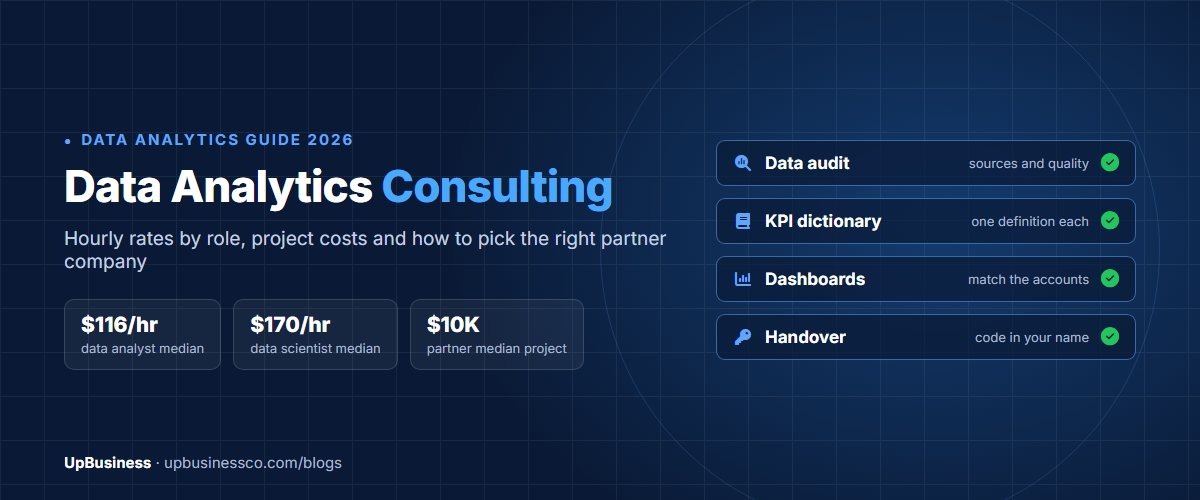
Most rate guides that rank for this search are written by firms that sell consulting. Few show where their numbers come from. For a rate you can check, we pulled every AI and Machine Learning job type from the US government's CALC price database. It lists the top hourly rates that contractors have agreed on federal GSA schedule contracts[5]. On 21 October 2026, that gave 331 rates from 105 contractors.
| Experience required | Rates | Median top rate | Middle half |
|---|---|---|---|
| 0 to 4 years | 137 | $154 an hour | $126 to $195 |
| 5 to 9 years | 135 | $196 an hour | $165 to $244 |
| 10 years or more | 59 | $223 an hour | $188 to $277 |
| All AI and Machine Learning categories | 331 | $183 an hour | $149 to $236 |
Treat these as a reference point, not a price list. They are top rates for US government buyers. Commercial firms, mainly large strategy firms, can charge more. Job titles also vary. The 14 job types labelled as consultants, strategists or advisers had a median of $178 an hour, close to the overall figure. At the overall median, an eight-hour day costs about $1,460.
AI Consulting Pricing Models
| Pricing model | How it works | Watch out for |
|---|---|---|
| Fixed-price assessment | A set scope, such as a readiness assessment or roadmap, for an agreed fee | Vague outputs; ask for a written list |
| Time and materials | Billed by the hour or day for the people involved | Open-ended scope; set a cap and milestones |
| Monthly retainer | Ongoing advice hours each month | Paying for hours you don't use |
| Outcome-linked | Part of the fee depends on agreed results | Agree exactly how results will be measured |
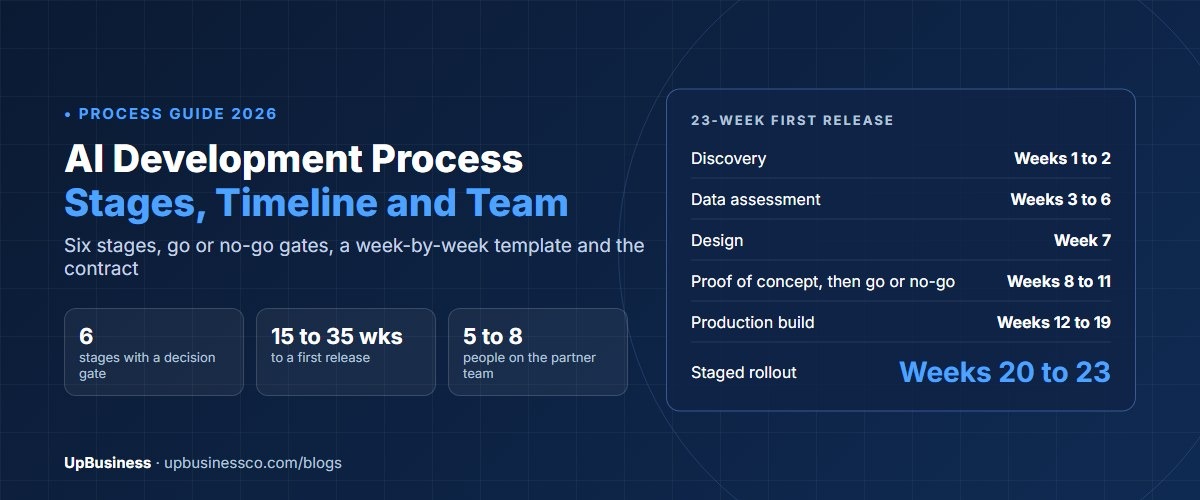
For a first project, a fixed price with a written list of outputs is usually the safest choice. Both sides then know exactly what "done" means. Move to time and materials or a retainer once you trust the team and the scope is truly open. For how each stage of a build is usually contracted, see our guide to the AI development process.
What a Good First Engagement Looks Like
- Interviews and process mapping, to show where time and money go today in the departments in scope.
- A data review of what exists, its quality, who owns it and how to get to it.
- Use-case scoring for value, how doable it is, risk and cost.
- A business case with starting numbers and target gains for the top two or three use cases.
- A step-by-step roadmap with build or buy choices, budget ranges and the skills needed.
Give the data review plenty of time. Gartner predicts firms will drop 60% of AI projects that lack AI-ready data through 2026[6]. A consultant who skips the data review is guessing. The pilot problem is just as real. MIT's NANDA project reported in 2025 that about 95% of generative AI pilots at companies were failing to show a clear financial gain[7]. The simplest way to stay out of that group is to agree a starting point and a success metric before the pilot begins.

Browse our curated list of Top AI Consulting Companies
AI Use-Case Scoring: A Worked Example
Use-case ranking is the step that turns a long wish list into two or three projects. Here is how a simple scoring sheet might look for a mid-size distributor with three ideas. The scores are only an example. They use a 1 to 5 scale where 5 is best, so a low-risk or low-cost idea scores high in those columns.
| Use case | Value | Feasibility | Risk | Cost | Total |
|---|---|---|---|---|---|
| Pull data from supplier invoices | 4 | 5 | 4 | 4 | 17 |
| Assistant that answers customer order questions | 4 | 3 | 3 | 3 | 13 |
| Demand forecasting across all products | 5 | 2 | 3 | 2 | 12 |
The forecasting idea has the highest value. But it scores low on feasibility, because sales history sits in three systems with different product codes. Invoice extraction wins for three reasons. The documents already exist. Success is easy to measure (fields captured correctly, hours saved). And a person catches any mistake before payment. A good consultant would advise starting there, fixing the product codes at the same time, and coming back to forecasting in six months. That kind of reasoning, written down for each idea, is what you are paying for.
AI Governance and Regulation by Region
Governance used to be an extra. It is now a core part of many consulting projects. The rules differ by market, and some already apply.
| Market | What applies | What a consultant should cover |
|---|---|---|
| European Union | AI Act: banned practices and AI literacy duties from February 2025, transparency rules from August 2026, high-risk rules from December 2027[8] | Sorting each use case by risk, staff AI training, transparency notices |
| United Kingdom | UK GDPR, with the ICO's guidance on AI and data protection[9] | Data protection impact assessments, lawful basis, explaining decisions |
| United States | Sector rules plus the voluntary NIST AI Risk Management Framework[10] | Mapping risks to the NIST framework, sector rules |
| India | DPDP Act and Rules, 2025, with an 18-month phase-in[11] | Consent, purpose limits and safeguards for personal data in prompts and logs |
| Any market | ISO/IEC 42001, a standard for AI management systems that you can be certified against[12] | Whether certification is worth it for your customers |
This is a summary, not legal advice. A consultant should flag which rules apply to you and bring in a lawyer for anything high-risk. They should not act as one.
AI Consulting for Small Businesses
A small business rarely needs a full strategy programme. A one- or two-week project is often enough. It picks one use case, checks the data and sets up a ready-made tool. Off-the-shelf products cover many small-business needs. Think of drafting emails, answering common customer questions and reading receipts. So ask the consultant to suggest existing tools first, and custom work only where nothing fits.
Independent consultants and small boutique firms tend to suit this size of job best. Agree a fixed price, a single success metric and a short handover, so your own team can run the tool afterwards.
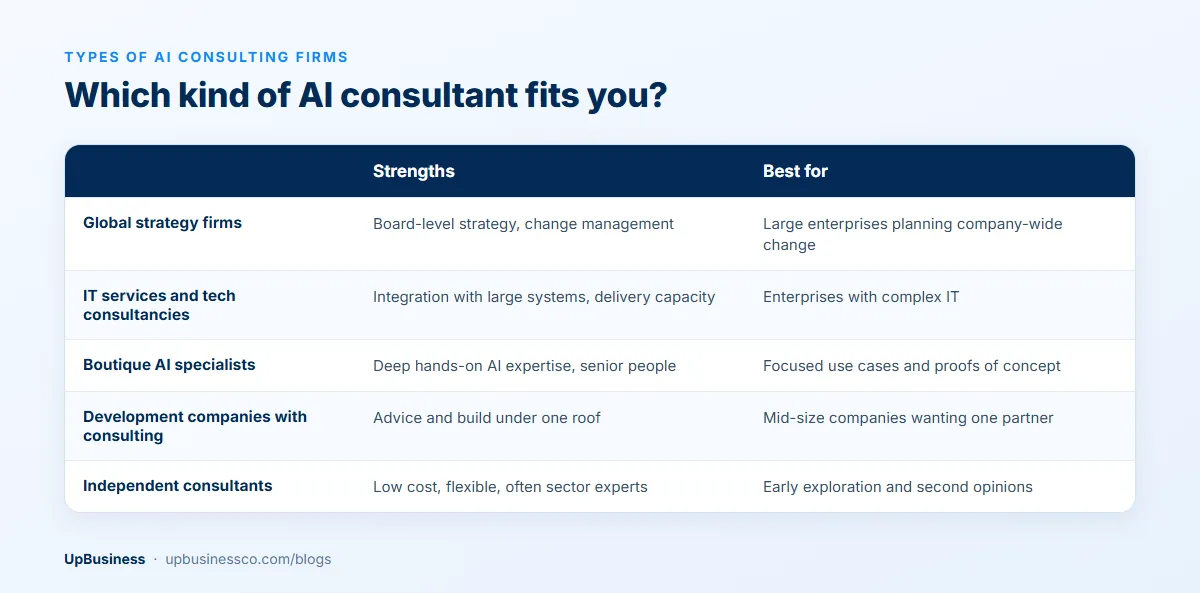
Types of AI Consulting Firms
| Type | Strengths | Best for |
|---|---|---|
| Global strategy firms | Board-level strategy, change management, large programmes | Large enterprises planning company-wide change |
| IT services and technology consultancies | Linking with large systems, capacity to deliver | Enterprises with complex IT systems |
| Boutique AI specialists | Hands-on AI skills, senior people on your project | Focused use cases and proofs of concept |
| Development companies with a consulting arm | Advice and build under one roof, faster handover | Mid-size companies that want one partner |
| Independent consultants | Lower cost, flexible, often sector experts | Early research and second opinions |
What UpBusiness Partner Data Shows
The 10 partner companies on our AI consulting page have TrustScores from 70.24 to 74.33. Their teams range from 1-10 people to 201-500. Only 4 of the 10 list AI consulting among their main skills, at 20% to 25% of their work. The other six focus mainly on building, such as custom AI solutions, app development, Salesforce or ERP.
That fits the "development company with a consulting arm" type in the table above. It is a practical choice for a mid-size company, since the people who advise you can also build the result. But their advice may lean towards what they build. If independence matters, ask whether they would suggest an off-the-shelf tool when it fits better, and how often they have done so.
How to Prepare for an AI Consulting Engagement
Have these ready before the first meeting. You will get more from the same budget.
- A short list of the processes that cost the most time or money today.
- A list of where key data lives, including systems, shared drives and spreadsheets.
- Starting numbers for the processes in scope, such as volumes, handling time and error rates.
- A named owner from the business side, not only IT.
- Known limits, such as a budget range, compliance rules and systems that can't change.
What the Final Deliverable Should Contain
- A ranked list of use cases with expected value, cost, risk and effort.
- Starting and target metrics for each use case it recommends.
- A data readiness summary with the fixes needed first.
- Build or buy advice, with the reasons.
- A roadmap in phases, with owners, budget ranges and decision points.
- Governance advice for each market you work in.
Red Flags When Hiring an AI Consultant
- Suggests a specific tool or model before they understand your problem.
- Can't show a project they advised on that is now live.
- Promises a return without measuring where you are today.
- Skips data quality, security or privacy.
- Delivers a strategy with no costs, owners or timelines.
- Proposes a large programme lasting many months before any small, fixed-price first step.
Questions to Ask an AI Consultant Before You Sign
- Which of your past ideas are now live, and what did they change?
- Who exactly will work on our project, and how senior are they?
- What will we get at the end, item by item?
- How will you measure where we are today before you suggest anything?
- Have you ever advised an off-the-shelf tool over building, and when?
- If you also build, what stops your advice favouring your own services?
- Which AI and privacy rules apply to us, and when would you bring in a lawyer?
How to Choose an AI Consulting Partner
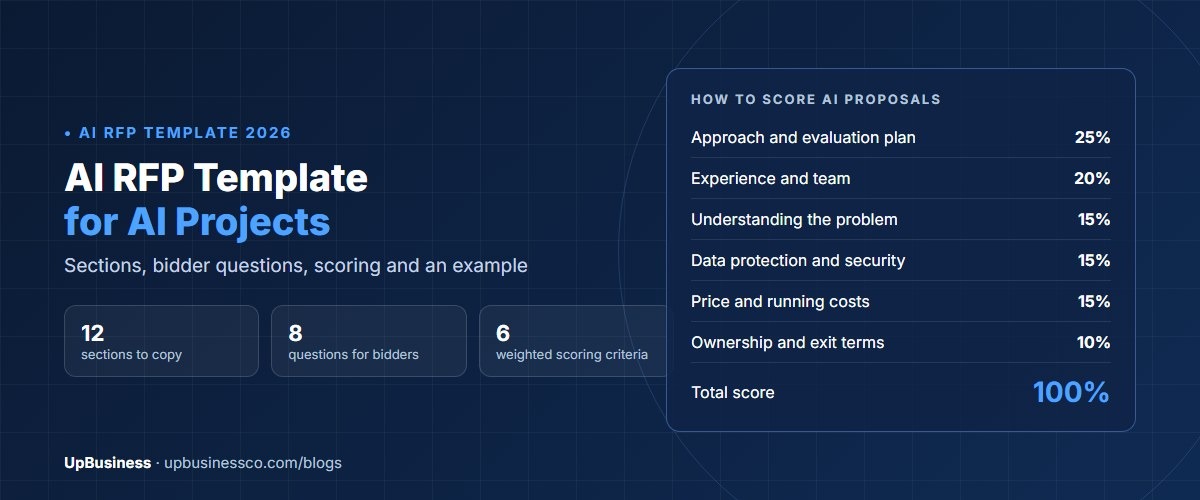
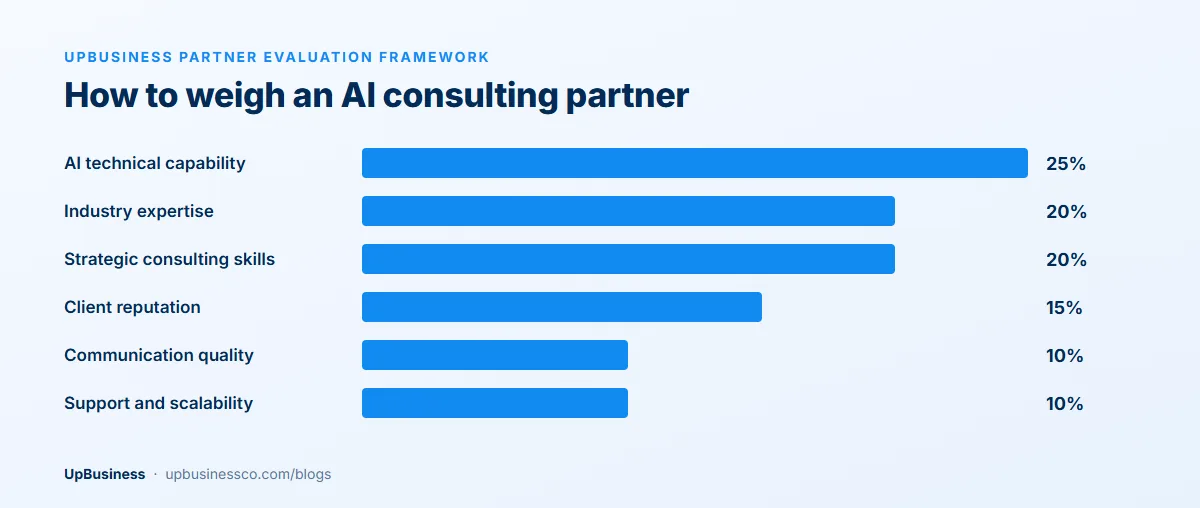
Score each partner company on your shortlist from 1 to 10 on each point. Multiply by the weight and compare the totals. The weights below are our suggestion. You can adjust them to what matters most for your project.
| Criterion | Weight | What to check |
|---|---|---|
| AI technical skill | 25% | Can they explain the trade-offs between methods and models in plain words? |
| Industry know-how | 20% | Have they worked on problems like yours, in your sector? |
| Strategy consulting skills | 20% | Do they tie every idea to a business metric? |
| Client track record | 15% | References you can call and advised projects that are now live |
| Clear communication | 10% | Clear written outputs without jargon |
| Support and growth | 10% | Can they help with the build, or hand over cleanly to whoever does it? |
Our list of questions to ask an AI development company adds questions on contracts and data rights. If the first use case is a chatbot that answers from company files, see how to evaluate a RAG chatbot proposal.
Consulting Firm, In-House Team or Development Partner?
| Option | Strength | Limitation |
|---|---|---|
| AI consulting firm | Independent advice, experience across industries, fast start | May not build; check the handover to delivery |
| In-house AI team | Deep business knowledge, long-term ownership | Slow and hard to hire for |
| Development partner with consulting | Advice and delivery under one roof | Advice may lean towards what they build |
Many companies mix these. For example, they get an outside assessment, then a partner-led build, while they hire one or two people to own AI in-house. For larger programmes across many departments, our enterprise AI development guide covers how the build side grows. If you plan to sell an AI product rather than use AI in-house, the AI SaaS development guide covers the unit economics (what each customer costs and earns you).
The Bottom Line
A good AI consultant saves you from costly mistakes. These include the wrong use case, data that is not ready, or a pilot with no way to measure success. Start with a fixed-price assessment. Judge consultants on results that went live. And make sure every idea comes with a cost, an owner and a metric.
When you are ready, compare verified AI consulting companies, browse all artificial intelligence partner companies or post your project on UpBusiness to get matched.
Browse our curated list of Top AI Consulting Companies