


Browse our curated list of Data Analytics Companies
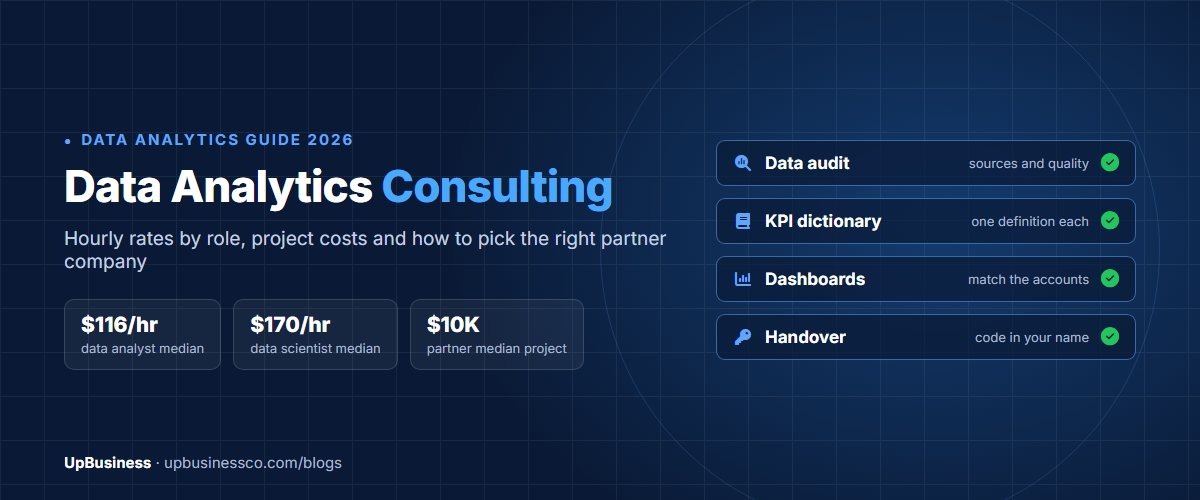
Data analytics consulting is paid, outside help to turn the data your business already collects into reports, dashboards and answers that people use to make decisions. A consultant or partner company audits your data sources, fixes how the data is stored and joined, builds the reporting layer and trains your team to run it. In the US, the median ceiling rate for a data analyst on federal GSA contracts is $116 an hour, and $170 for a data scientist[1]. This guide is for founders, finance heads and operations managers who want to know what a data analytics consulting engagement includes, what it costs, how to compare it with hiring, and how to pick the right partner.
Key takeaways
- Across 4,896 GSA contract rates pulled in October 2026, data analysts have a median ceiling of $116 an hour, BI specialists $127, data engineers $150 and data scientists $170.
- A typical first dashboard project of about 200 hours costs roughly $20,000 to $25,000 at US contract rates. On UpBusiness, the median average project size for data analytics partner companies is $10,000.
- An in-house data scientist costs about $171,800 a year once benefits are added to the $120,230 BLS median wage, so consulting usually wins for projects under a year.
- Licences are a separate bill. Power BI Pro costs $14 a user a month and Tableau starts at $15, while Google's Data Studio has a free tier.
What Does a Data Analytics Consultant Do?
A data analytics consultant connects business questions to the data that can answer them. In practice the work moves through five stages, and most engagements cover two or three of them rather than all five.
| Stage | What the consultant does | What you get |
|---|---|---|
| Assessment | Interviews the people who make decisions, lists every data source, checks quality and access | A data audit, a list of questions worth answering and a prioritised roadmap |
| Data foundation | Builds pipelines that pull data from your CRM, accounting, store or ERP into one warehouse and cleans it | A single, documented source of truth that refreshes on a schedule |
| Reporting and BI | Designs the data model, KPI definitions and dashboards in Power BI, Tableau or Data Studio | Dashboards people open every week, with agreed metric definitions |
| Advanced analytics | Forecasts, segments customers, finds the drivers of churn or margin | Models and analysis with a clear business recommendation |
| Enablement | Trains staff, sets access rules and writes run books | A team that can maintain and extend the work without the consultant |
Two neighbouring services often get mixed up with analytics consulting. Building predictive models that run inside a product is Machine Learning development, and our Machine Learning development cost guide covers that budget. Advice on where AI fits in your business is AI consulting, covered in our AI consulting services guide. Analytics consulting sits before both, because neither works on messy, scattered data.
Where Data Analytics Consulting Pays Off First
The quickest returns usually come from questions that a manager already answers by hand every week. These are common starting points, by team.
| Team | Typical question | Usual output |
|---|---|---|
| Sales | Which products, regions and reps drive margin, not just revenue? | Margin dashboard by product, region and rep |
| Finance | Where is cash tied up and what will the next 13 weeks look like? | Cash and receivables view with a rolling forecast |
| Operations | Which stock lines are overstocked or about to run out? | Inventory health report with reorder alerts |
| Marketing | Which channels bring customers who stay and buy again? | Cohort and channel attribution report |
| Customer service | Why do customers contact us, and which issues lead to churn? | Ticket driver analysis joined to account data |
Pick one of these as the first project. A single dashboard that a leadership team opens every Monday builds more support for data work than a large platform nobody uses yet.
Data Analytics vs Data Science Consulting: Which Do You Need?
Data analytics consulting explains what happened and why, using reports, dashboards and analysis. Data science consulting predicts what will happen next using statistical and Machine Learning models. The difference matters for your budget, since data scientists bill at higher rates and need cleaner data to start.
Most businesses with fewer than a few hundred staff need analytics first. If your sales, finance and operations teams still argue about whose revenue number is right, a forecasting model will not help yet. Fix the definitions and the reporting, then add prediction once the history is trustworthy.
Which Engagement Type Fits Your Problem?
Partner companies sell analytics work in a handful of standard shapes. Matching the shape to your problem is the fastest way to avoid paying for work you don't need.
| Your situation | Engagement to buy | Typical length | Pricing model |
|---|---|---|---|
| Data is spread across tools and nobody trusts the numbers | Data audit and roadmap | 2 to 4 weeks | Fixed price |
| Leaders want one weekly view of sales, cash or operations | Dashboard build on existing data | 4 to 8 weeks | Fixed price per phase |
| Reports break every month because data is pulled by hand | Data warehouse and pipeline setup | 6 to 16 weeks | Fixed price or time and materials with a cap |
| You have dashboards but need regular analysis and changes | Analytics retainer | Ongoing, often with a minimum term | Monthly retainer for a set number of hours |
| Clean history exists and you want forecasts or segments | Data science project | 6 to 12 weeks | Fixed price per model with acceptance tests |
| Your team will own analytics but lacks skills | Training and enablement | 1 to 4 weeks | Day rate or fixed workshop fee |
If you can't place yourself in this table, start with the audit. A short assessment that ends in a written roadmap is the cheapest way to learn which of the other engagements you need, and it gives every bidder the same scope to quote against. The lengths shown are rough planning ranges and stretch when source data is messy.
How Much Does Data Analytics Consulting Cost?
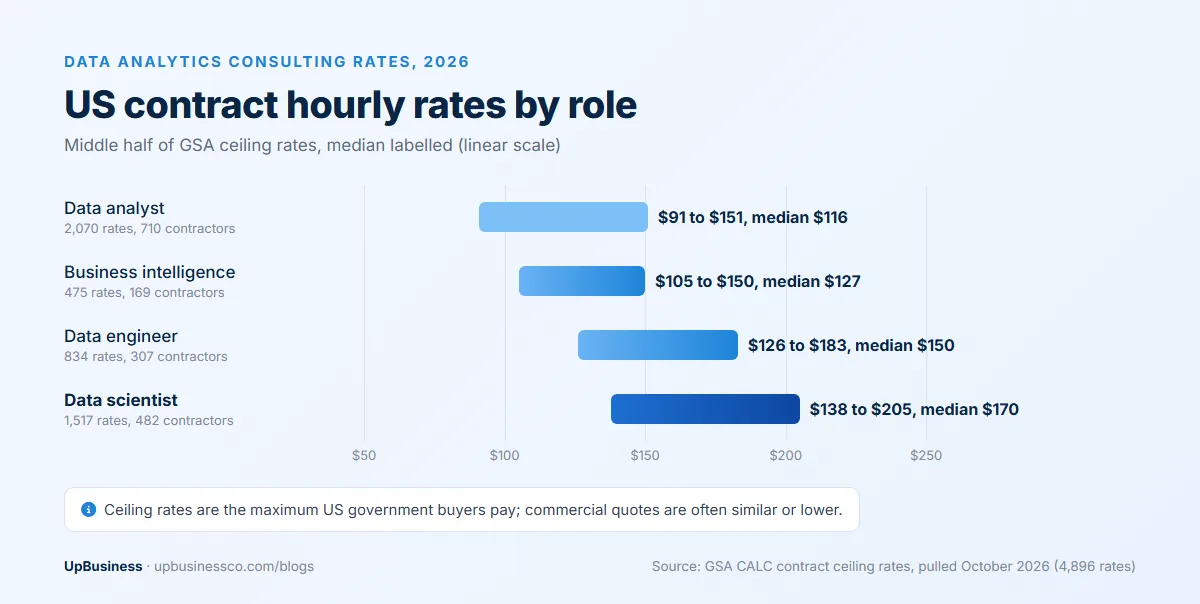
Data analytics consulting usually costs $91 to $205 an hour at US contract rates, depending on role and seniority, and small fixed-price projects such as an audit or first dashboard typically land between $10,000 and $25,000. Rates from partner companies in India and Eastern Europe are lower, while large consulting firms charge more.
Most rate guides you will find online give ranges without saying where they came from. To get a checkable baseline, we pulled the US General Services Administration's CALC database of contract labour rates in October 2026[1]. These are ceiling rates, the maximum a contractor may charge US government buyers, so commercial quotes from the same firms are often similar or lower.
| Role (GSA labour category) | Rates found | Median ceiling rate | Middle half of rates |
|---|---|---|---|
| Data analyst[1] | 2,070 from 710 contractors | $116 an hour | $91 to $151 |
| Business intelligence[1] | 475 from 169 contractors | $127 an hour | $105 to $150 |
| Data engineer[1] | 834 from 307 contractors | $150 an hour | $126 to $183 |
| Data scientist[1] | 1,517 from 482 contractors | $170 an hour | $138 to $205 |
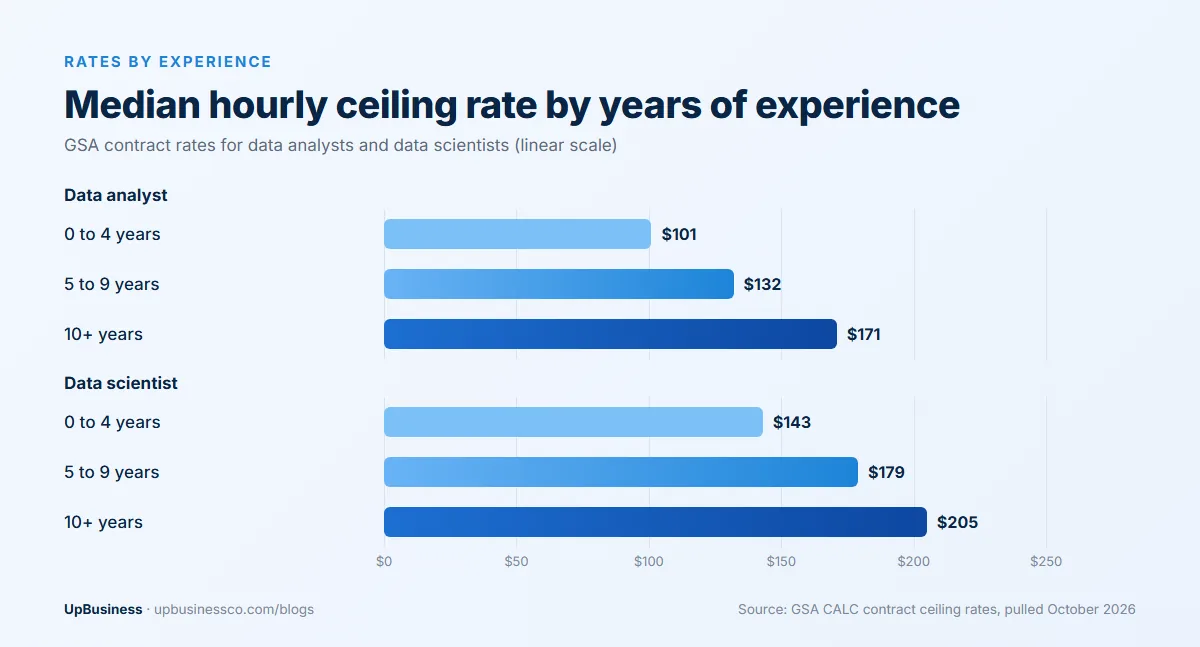
Experience moves the price more than job title. Data analysts asking for up to 4 years of experience have a median ceiling of $101 an hour, rising to $132 at 5 to 9 years and $171 at 10 years or more. Data scientists move from $143 to $179 to $205 across the same bands[1]. When a proposal shows one blended rate, ask how many hours each seniority level will bill.
Commercial agency guides land in a similar zone. WebFX reports that companies paid big data consultants $200 to $350 an hour in 2026[2], which matches the top of the data scientist range. RaftLabs puts boutique software consulting in the US and UK at $150 to $250 an hour, with Indian firms at $25 to $75[3]. That geographic gap is the main reason many buyers in North America, Europe and the Gulf hire analytics partner companies in India for build work while keeping strategy reviews local.
What each budget level usually buys
| Budget (USD) | Realistic scope | What should be in the proposal |
|---|---|---|
| Under $5,000 | A data audit for one department, or one dashboard on a single clean source | Named sources, 5 to 10 KPIs with definitions, one round of changes |
| $5,000 to $25,000 | Audit plus a first dashboard set joining 2 to 4 sources | Data model diagram, refresh schedule, access rules, handover training |
| $25,000 to $75,000 | A cloud data warehouse, automated pipelines and dashboards for several teams | Pipeline monitoring, data quality checks, documentation, a support period |
| $75,000 and up | Company-wide data platform, governance and advanced analytics | Phased plan with gates, named team, security review, exit terms |
Costs that sit outside the consulting fee
Three bills often surprise buyers. First, BI licences: Power BI Pro is $14 a user a month and Premium Per User is $24, both paid yearly[4]. Tableau Standard starts at $15 a user a month and Enterprise at $35, billed annually[5], and Google's Data Studio has a self-service tier at no cost with a paid Pro version for teams[6]. Second, warehouse and pipeline tools, which bill on storage, compute or rows moved and grow with your data. Third, the time your own staff spend in workshops, testing and fixing source data, which is easy to forget in the budget but often runs to a few hours a week per department during the build.
Worked Example: What a First Dashboard Project Costs
Here is an illustrative estimate for a common first project. A 60-person distribution business wants one weekly dashboard for sales, gross margin and stock, pulling from its CRM, accounting system and inventory tool. The hour estimate below is a typical shape for this scope, not a quote.
| Phase | Hours | Main output |
|---|---|---|
| Discovery and KPI definitions | 24 | Agreed definitions for revenue, margin and stock turn |
| Data extraction and modelling | 80 | Pipelines from 3 sources into one model with daily refresh |
| Dashboard build | 60 | Sales, margin and stock pages with filters by region and product |
| Testing against finance numbers | 24 | Dashboard totals that match month-end accounts |
| Training and handover | 12 | Two training sessions, a run book and admin access |
| Total | 200 |
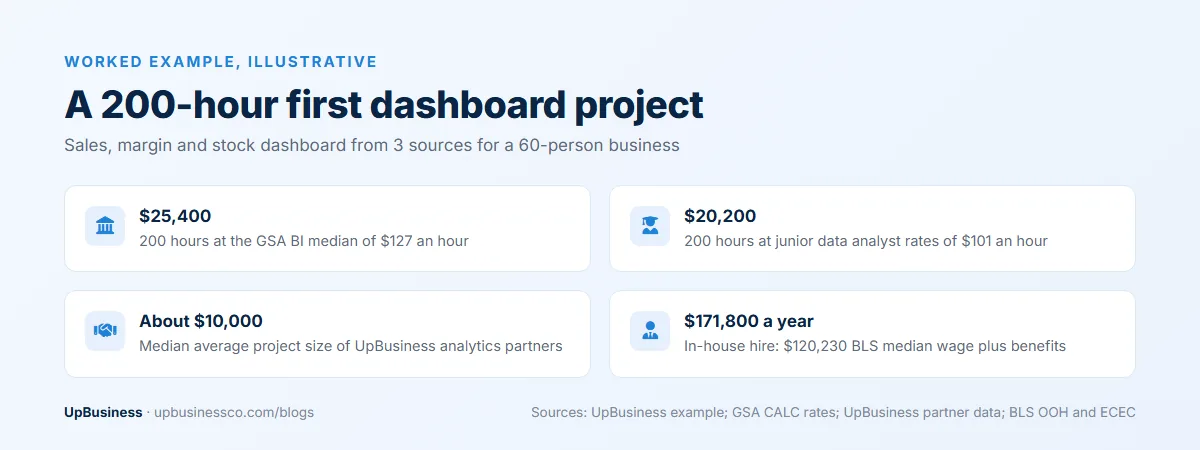
At the GSA median for BI work of $127 an hour, 200 hours comes to $25,400. Using junior data analyst rates of $101 an hour, it falls to $20,200[1]. A partner company in India quoting near the UpBusiness median of $10,000 would cover the same scope at roughly $50 an hour. Add Power BI Pro for 15 users at $14 a month[4], which is $2,520 a year.
Now compare hiring. The median wage for US data scientists, a BLS group that also includes business intelligence analysts, was $120,230 in May 2025[7]. Wages make up 70.0% of private employer compensation costs, with benefits the other 30.0%[8], so the full cost is about $171,800 a year before recruiting, tools and management time. If you need one dashboard project and light monthly support, consulting costs a fraction of that. If you need a full-time analyst for years, the sums move toward hiring, often with a partner company building the foundation first. Our comparison of agency, freelancer and in-house costs works through the same choice for development teams.
Is Data Analytics Consulting Worth It for a Small Business?
For a business with fewer than 50 staff, the answer depends on how much time already goes into building reports by hand. If an owner or finance lead spends half a day a week copying numbers from an accounting tool, a store and a CRM into spreadsheets, a project under $5,000 that automates one weekly report pays for itself within months at most salary levels. If the business runs on one system with good built-in reports, a consultant adds little yet.
Keep the first scope small: one department, one or two sources and a short list of KPIs. Use the free or low-cost tier of a BI tool you already have access to, and ask the partner to train someone in-house to make small changes, so you are not paying hourly rates for every new filter.
Deliverables to Expect and How to Accept Them
Analytics projects go wrong when "done" is never defined. Ask for each deliverable to come with a test you can run yourself before you sign off and pay the final milestone.
| Deliverable | Acceptance test |
|---|---|
| KPI dictionary | Each metric has one written definition, an owner and the source field it comes from |
| Data model or warehouse | Totals match your accounting system for at least two closed months |
| Pipelines | Data refreshes on schedule for two weeks without manual fixes, and failures send an alert |
| Dashboards | Named users can open them on the access level agreed, and load times stay acceptable |
| Documentation | A new staff member can follow the run book to add a field or fix a failed refresh |
| Code and credentials | All code is in your repository and all accounts are in your company's name |
Data Security and Compliance Questions to Ask
An analytics partner will see customer, payroll or financial data, so treat access as seriously as any other supplier with your records. Ask where data will be processed and stored, who on the team gets access, whether production data is copied to their machines, and how access is removed at the end. If you hold data on people in the EU or UK, the GDPR requires a written contract with any processor setting out what they may do with personal data[9]. Similar duties exist under privacy laws in the US states, Canada, Australia, the Gulf and India, so ask the partner which ones it has worked under.
Good partners prefer to work inside your cloud account with role-based access rather than taking extracts away. They also mask or aggregate personal fields in dashboards that don't need them. If a bidder asks for a full database export on day one, ask why.
UpBusiness Partner Data: Who Offers Data Analytics Consulting
Our data analytics companies page lists 7 verified partner companies as of October 2026. Their TrustScores run from 70.24 to 75.85, with a median of 71.26. Reported average project sizes range from $500 to $25,000, with a median of $10,000: one partner reports $500, one $1,000, three $10,000 and two $25,000. Team sizes run from 1 to 10 employees up to 201 to 500, and four of the seven are based in Noida, with the others in Jaipur, Ahmedabad and Mumbai.
One finding matters for buyers. Only one of the seven lists data analysis among its top three specialisations, splitting its focus across data analysis, analytics dashboards and finance data analysis. The other six are full-service software companies whose top areas are app development, SaaS, AI or ERP work, with analytics as one capability. That isn't a problem for dashboard and pipeline projects tied to systems they already build, such as an ERP or a SaaS product. For a pure analytics or data science engagement, ask each shortlisted partner for two analytics projects of similar size, the BI tool used and a sample of the KPI documentation they handed over.
How to Choose a Data Analytics Consulting Partner
Start by writing down the decisions you want the data to support, not the tools you think you need. A brief that says "the sales director needs weekly margin by product line, matching the accounts" gets far better proposals than "we need a Power BI dashboard". Our software project brief template works well for analytics projects too.
Then check these points with every bidder:
- Relevant proof. Ask for a project on the same BI tool and a similar data source, with a screenshot and the KPI dictionary, anonymised if needed.
- Who does the work. Get the names and seniority of the people who will build your model and dashboards, and how many hours each will bill.
- Discovery first. Prefer partners who propose a paid assessment before quoting the full build. Fixed prices without seeing your data are guesses.
- Testing against finance. The proposal should say how dashboard numbers will be reconciled with your accounts.
- Ownership and exit. Code, models and accounts belong to you, with a handover plan in the contract.
- Support after launch. Ask what a monthly support block costs and how fast broken refreshes get fixed.
When proposals arrive, compare them line by line on hours, roles, deliverables and exclusions, as our guide to comparing software development proposals explains. If your data lives in old on-premise systems, read our cloud migration guide too, since moving to the cloud often comes before a modern data stack.
Red Flags in Data Analytics Proposals
- Promises of "AI-powered insights" before anyone has looked at your data quality.
- A fixed price for a warehouse and dashboards with no list of sources or KPIs.
- Dashboards built on manual spreadsheet exports that someone must refresh by hand.
- Licences, warehouses or code repositories set up in the partner's name.
- No mention of reconciling numbers with finance, or of documentation.
- A single blended hourly rate with no breakdown of who bills what.
If you'd like quotes from verified partner companies, post your project on UpBusiness with your data sources, the decisions you want to support, your BI tool and your budget, and compare the proposals side by side.