


Browse our curated list of Data Engineering Companies
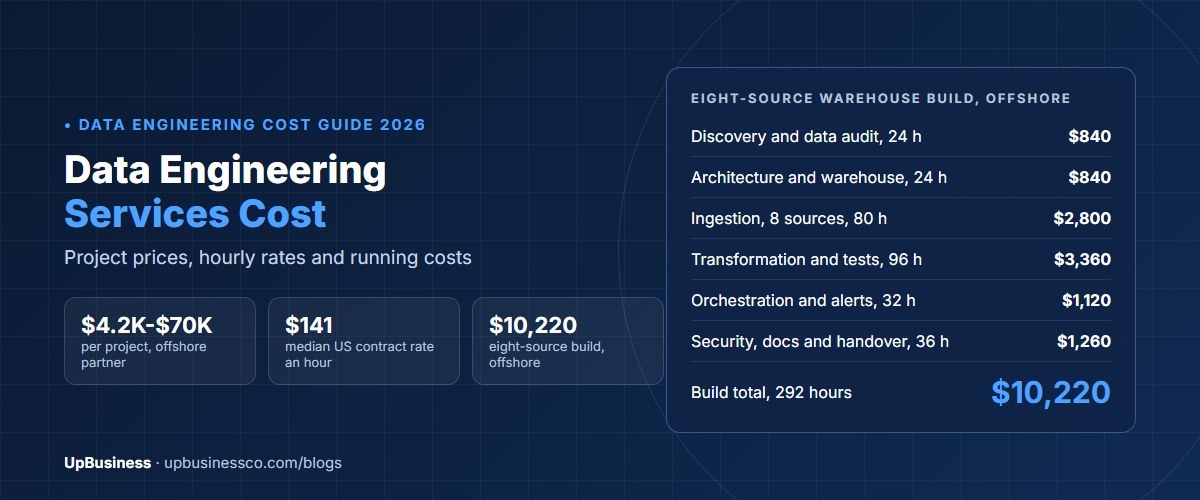
Data engineering services cost about $4,200 to $70,000 per project in 2026 with an offshore partner company, depending on how many data sources you connect and how complex the pipelines are. Ongoing support usually runs $1,400 to $5,600 a month. US rates are far higher: the median US government contract ceiling rate for data engineers is about $141 an hour[1]. A company connecting eight sources to one warehouse, for example, pays about $10,220 to build it in our worked budget.
This guide is for the person who approves the budget: a founder, a head of finance or operations, or a product or analytics lead whose reports depend on clean data. You'll see what data engineering services include, how partner companies price them, what each type of project costs, a worked budget, the running costs people forget and how to tell whether the work is done well.
Key takeaways
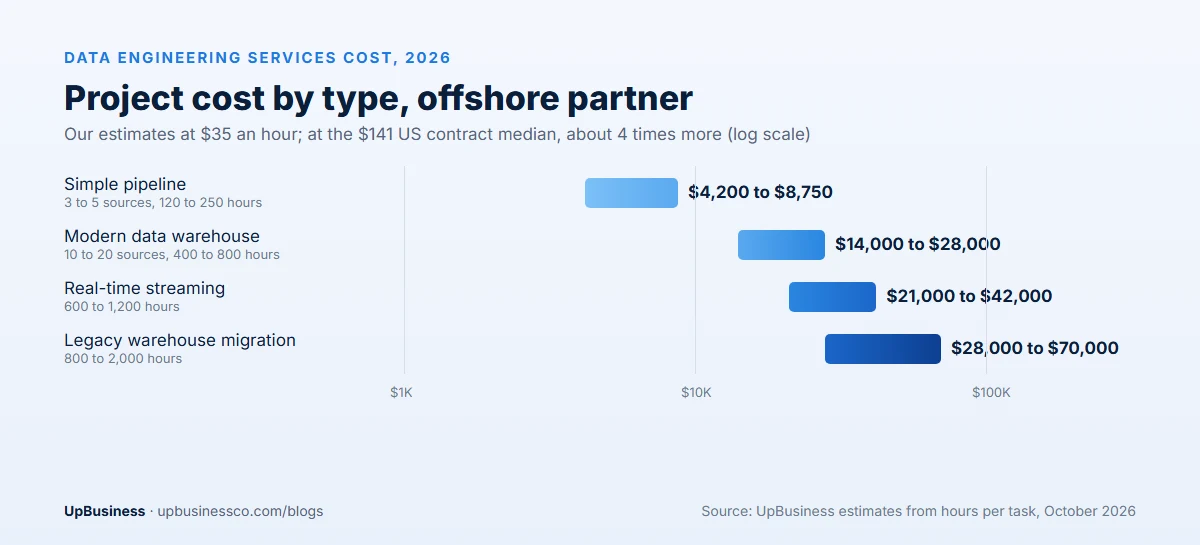
- A simple pipeline from 3 to 5 sources into a warehouse costs $4,200 to $8,750 with an offshore partner company. A full modern data warehouse costs $14,000 to $28,000.
- US government contract ceiling rates for data engineers have a median of about $141 an hour, across 643 rates from 285 contractors. Offshore partners often charge around $35.
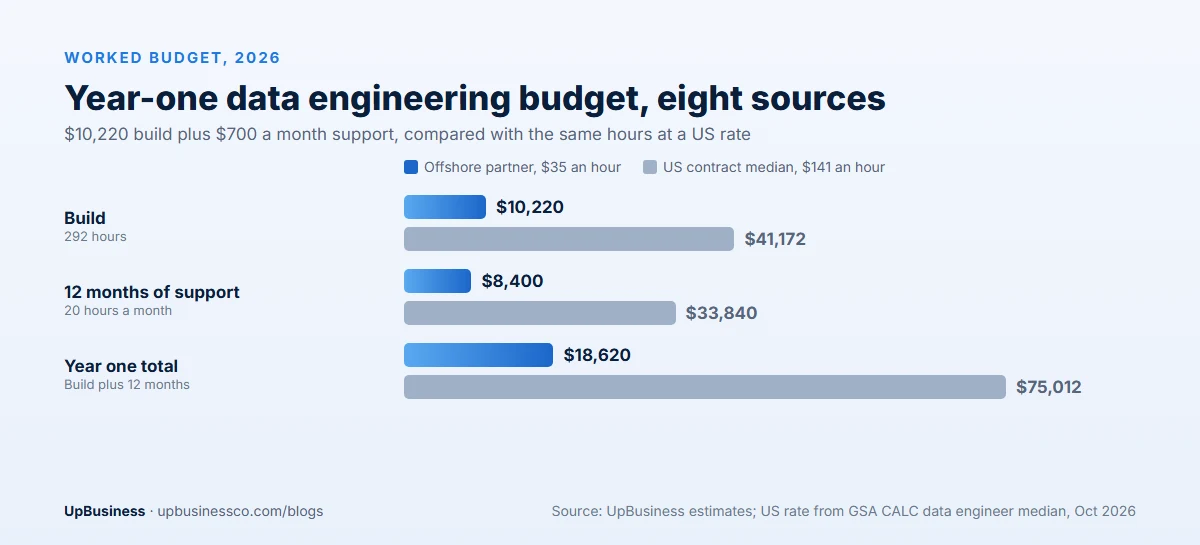
- Our worked eight-source build is 292 hours: $10,220 offshore and about $41,170 at $141 an hour.
- Warehouse and connector bills come on top of the build fee. Ask for a monthly running cost estimate before you sign.
- Pay for tested, documented pipelines you own, not just for data that arrives. Data quality tests and alerts are part of the job.
How Much Do Data Engineering Services Cost in 2026?
Data engineering services cost in 2026 depends on four things: how many sources you connect, how much data moves, how fresh it needs to be and how messy it is today. Moving daily sales data from three tools into one warehouse is a small job. Streaming live events from an app and a factory floor is a large one.
Our estimates below use an offshore partner rate of $35 an hour. For the US comparison, we use $141 an hour, the median ceiling rate for data engineer roles on US government (GSA) contracts. Ceiling rates are the most a contractor may charge government buyers, so private US agency quotes vary around them.
| Project type | Hours | Offshore partner ($35/h) | US rate ($141/h) |
|---|---|---|---|
| Simple pipeline, 3 to 5 sources | 120 to 250 | $4,200 to $8,750 | $16,900 to $35,300 |
| Modern data warehouse, 10 to 20 sources | 400 to 800 | $14,000 to $28,000 | $56,400 to $112,800 |
| Real-time streaming pipeline | 600 to 1,200 | $21,000 to $42,000 | $84,600 to $169,200 |
| Legacy data warehouse migration | 800 to 2,000 | $28,000 to $70,000 | $112,800 to $282,000 |
| Ongoing support and new sources | 40 to 160 a month | $1,400 to $5,600 a month | $5,640 to $22,560 a month |
These are build and support fees. They don't include your cloud warehouse, connector tools or dashboard licences, which you pay to those providers directly.
What Data Engineering Services Include
Data engineering is the plumbing behind your reports, dashboards and AI tools. It moves data from the systems you use every day into one place, cleans it and keeps it flowing. A complete project covers seven parts.
| Service | What the partner does | Share of build hours |
|---|---|---|
| Discovery and data audit | Lists every source, owner and report, and finds gaps and quality problems | 5% to 10% |
| Architecture | Chooses the warehouse, tools and data model, and plans for growth and cost | 5% to 10% |
| Ingestion | Connects sources with ready-made connectors or custom API code | 20% to 30% |
| Transformation | Turns raw tables into clean, tested models that match how the business works | 25% to 35% |
| Orchestration and monitoring | Schedules jobs, retries failures and sends alerts when data is late or wrong | 8% to 12% |
| Security and access | Sets roles, masks personal data and logs who sees what | 5% to 8% |
| Documentation and handover | Writes a data dictionary, runbooks and trains your team | 4% to 8% |
Transformation usually takes the most hours. It is where raw records become trusted numbers, such as one definition of an active customer that every team uses. If a proposal spends most of its hours on ingestion and very few on transformation and testing, expect messy reports later.
Data engineering is different from analytics. Engineers build and run the pipelines. Analysts and BI specialists use the clean data to answer questions. If you mainly need dashboards and insight, read our data analytics consulting guide too.
Data Engineer Hourly Rates in 2026
We pulled every data engineer rate on the US government's GSA schedule on 30 October 2026[1]. These are ceiling rates, the most a contractor may charge government buyers.
| Experience | Number of rates | Median ceiling rate |
|---|---|---|
| 0 to 4 years | 310 | $133 an hour |
| 5 to 9 years | 273 | $147 an hour |
| 10 years or more | 60 | $162 an hour |
| All data engineer rates | 643 | $141 an hour |
The middle half of all rates sits between about $119 and $163 an hour. Offshore partner companies in India, Eastern Europe and Latin America commonly quote $25 to $60 an hour for the same role, which is why we use $35 as our base rate. A lower rate only saves money if the work is tested and documented, so always check the quality steps covered later in this guide.
How Data Engineering Companies Price Their Work
Most data engineering partner companies use one of four pricing models.
| Pricing model | Typical price | Best for | Watch out for |
|---|---|---|---|
| Fixed-price project | $4,200 to $70,000 offshore | A clear scope, such as connecting known sources | Change requests that add cost later |
| Time and materials | $25 to $60 an hour offshore | Unclear data, discovery-heavy work | No cap; ask for a monthly budget limit |
| Dedicated data engineer | $4,500 to $9,000 a month offshore | Long-running platforms with steady work | Paying for idle hours |
| Support retainer | $1,400 to $5,600 a month offshore | Keeping pipelines running and adding sources | Slow response to broken jobs |
A good approach for most companies is a fixed-price build after a short paid discovery, then a support retainer. Discovery usually takes one to two weeks and costs $840 to $2,800 offshore. It turns a guess into a real scope, which makes the fixed price safer for both sides.
What Drives the Cost of Data Engineering?
- Number of sources. Each source adds connection, testing and upkeep. Ready-made connectors are faster than custom API code.
- Data freshness. Daily updates are cheap. Hourly updates cost more. Real-time streaming can double or triple the build hours.
- Data quality today. Duplicate customers, missing IDs and free-text fields take time to clean and test.
- Volume. Billions of rows need careful design to keep cloud bills under control.
- Security and compliance. Health, finance and personal data need masking, access controls and audit logs.
- Legacy systems. Old on-premise databases and file exports add work, especially during a migration.
Ready-Made Connectors vs Custom Pipelines
One of the biggest choices in any data project is how to pull data out of your tools. You can pay for ready-made connectors, or you can have your partner write custom code. Each has a place, and most good projects use both.
Ready-made connectors are the quickest route for popular tools such as payment platforms, CRMs, ad platforms and store builders. Setting one up often takes a few hours, and the connector provider keeps it working when the source tool changes its API. The trade-off is a monthly bill that grows with the volume of data you move. For a company with a handful of busy sources, that bill can end up larger than the hours a partner would spend writing and maintaining the code.
Custom pipelines make sense for in-house databases, niche tools without a connector, very large volumes, or data that needs special handling before it leaves the source. They cost more to build, usually 10 to 30 hours per source, and someone must fix them when the source changes. In return, there is no per-row fee and you control every detail.
A sensible rule is to start with ready-made connectors for common tools, then move the busiest sources to custom code once their connector bill passes the cost of a few support hours a month. Ask your partner to show this trade-off for each source in the proposal.
Data Engineering Cost by Company Stage
What you need, and what you should spend, changes as a company grows.
Early-stage companies with a few tools usually need one simple pipeline into a low-cost warehouse and a handful of clean tables. Budget $4,200 to $8,750 offshore, and keep the design simple so it is cheap to run. Many teams at this stage over-build, paying for streaming and complex tools they won't use for years.
Growing companies with 10 or more tools and several teams asking for reports need a proper data warehouse, shared definitions and tests. Budget $14,000 to $28,000 offshore for the build, then a support retainer. This is usually the stage where one wrong number in a board report makes the case for doing it properly.
Large companies often face migrations from older systems, strict security rules and many teams with their own data. Projects run from $28,000 to $70,000 offshore and up, and usually move in phases so that reports keep working while the new platform is built.
Worked Example: Data Engineering Budget for an Eight-Source Company
Here is a plan for a growing online business that wants one trusted place for sales, marketing and finance data. It connects eight sources, including its store, payment tool, CRM, product database, web analytics and three ad platforms, into a cloud warehouse with daily updates.
| Build task | Hours | Offshore ($35/h) | US rate ($141/h) |
|---|---|---|---|
| Discovery and data audit | 24 | $840 | $3,384 |
| Architecture and warehouse setup | 24 | $840 | $3,384 |
| Ingestion for 8 sources (6 connectors, 2 custom APIs) | 80 | $2,800 | $11,280 |
| Transformation models and data tests | 96 | $3,360 | $13,536 |
| Orchestration, monitoring and alerts | 32 | $1,120 | $4,512 |
| Security, documentation and handover | 36 | $1,260 | $5,076 |
| Build total | 292 | $10,220 | $41,172 |
After launch, the company keeps a support retainer of 20 hours a month, or $700 offshore, to fix broken connectors, add fields and add one new source every few months. Year one comes to about $18,620 offshore ($10,220 build plus 12 months at $700). At $141 an hour, the same work costs about $75,000.
Running Costs: Warehouse, Tools and Support
The build fee is only part of the bill. Data platforms charge for storage and computing, and many connector tools charge by the volume of rows they move. Ask your partner to estimate these before you sign.
| Running cost | How it is billed | What to ask |
|---|---|---|
| Cloud warehouse | Storage plus computing time or data scanned | What will our monthly bill be at today's volume and at twice the volume? |
| Connector tools | Usually by rows or volume moved each month | Which sources use paid connectors, and which use free or custom code? |
| Orchestration and monitoring | Free open-source tools or a monthly plan | Who hosts it, and who gets the alerts? |
| Support retainer | Monthly hours | How fast do you respond when a pipeline breaks? |
Pricing differs by provider. Google BigQuery, for example, bills on-demand queries by the amount of data scanned, with the first 1 TiB each month free[2]. Snowflake bills computing in credits, and the price per credit depends on your edition and cloud region[3]. Good design, such as partitioned tables and only refreshing what changed, keeps these bills low.
How to Keep Data Engineering Costs Down
- Start with the reports that matter most. Connect the sources behind your top three reports first, then add more.
- Pick daily updates unless you truly need faster. Freshness is one of the biggest cost drivers in both build hours and cloud bills.
- Clean up obvious problems at the source. Merging duplicate customers in your CRM is cheaper than fixing them in every pipeline.
- Use a paid discovery. One to two weeks of discovery prevents expensive surprises in a fixed-price build.
- Watch the monthly cloud bill. Ask for a cost report and a review after the first three months.
How to Check the Quality of Data Engineering Work
Data pipelines can look fine on launch day and break quietly a month later. Check these before you accept the work:
| Check | What good looks like |
|---|---|
| Data tests | Every key table has tests for missing values, duplicates and broken links between tables |
| Alerts | Your team gets a message when a job fails or data is late |
| Documentation | A data dictionary explains every table and field in plain words |
| Code in your repository | All pipeline code sits in a repository your company owns |
| Access control | Each person sees only the data they need, and personal data is masked |
| Cost report | A monthly view of warehouse and connector spend |
Ask the partner to show the tests running and a failure alert during handover. If they can't, the pipelines probably aren't tested.
Red Flags in a Data Engineering Proposal
- No discovery step. A fixed price without looking at your data is a guess.
- No data tests. Without tests, wrong numbers reach reports before anyone notices.
- Accounts in the partner's name. Your company should own the warehouse, tools and code.
- Real-time for everything. Most reports only need daily or hourly data, and real-time costs far more.
- No running cost estimate. A cheap build with an expensive monthly bill is not cheap.
- Tool lock-in. Custom code that only the partner understands makes it hard to switch later.
Data Engineering for AI and Machine Learning Projects
AI tools are only as good as the data behind them. A chatbot that answers from your documents, a sales forecast or a Machine Learning model all need clean, fresh data. Many AI projects spend more time on data work than on the model itself.
If you plan AI work, ask your data engineering partner to plan for it from the start. Our Machine Learning development cost guide, RAG chatbot cost guide and AI integration services guide show what those projects cost once the data is ready. Larger companies can also read our enterprise AI development guide.
In-House Data Engineer vs Freelancer vs a Verified Partner on UpBusiness
You can get data engineering done in three common ways. The right choice depends on how much ongoing work you have and how fast you need it.
| In-house data engineer | Freelancer | Verified partner on UpBusiness | |
|---|---|---|---|
| Typical cost | A full salary plus benefits and tools | $25 to $150 an hour | $25 to $60 an hour offshore |
| Who checks their claims | Your hiring process | You do | UpBusiness verifies documents and client work |
| Cover when someone leaves | Hard to replace quickly | None | Team cover |
| Best for | Large, constant data work | Small, well-defined jobs | Projects and support at offshore rates |
A single freelancer can be great for a small pipeline. A partner company brings architects, engineers and testers together, which matters for bigger builds. Hiring in-house makes sense once you have steady, full-time work.
How to Choose a Data Engineering Partner
Ask these questions before you sign:
- Have you built pipelines from the same sources and into the same warehouse we plan to use?
- How many hours go to ingestion, transformation, testing and documentation?
- What will our warehouse and connector bills be each month?
- How do you test data, and who gets the alerts?
- Will all code and accounts be in our company's name?
- What does support cost after launch, and how fast do you respond?
Compare at least three quotes line by line. Our guide to comparing software development proposals shows how, and our software project brief template helps you write a clear scope first. For wider price benchmarks, see our software, AI and marketing project cost benchmark.
When you're ready, post your project on UpBusiness with your sources, data volume and budget, and we'll match you with verified data engineering partner companies.