


Browse our curated list of Machine Learning Companies
This guide is for founders, operations heads and product owners who want a model built for their business and need a realistic budget before they ask for quotes. Typical examples are a demand forecast, a churn or fraud score, a document classifier or an image check. Machine learning development cost depends less on the algorithm than on your data, how accurate the model has to be, and who keeps it working after launch.
The top-ranking price guides for machine learning that we reviewed in October 2026 all come from development companies. Their estimates for the same proof of concept range from about $10,000 to $75,000, with few sources. Here every figure is built the same way, from 2025 salary data by country, public GPU prices and UpBusiness partner data. That lets you see where each part of a quote comes from.
Key takeaways
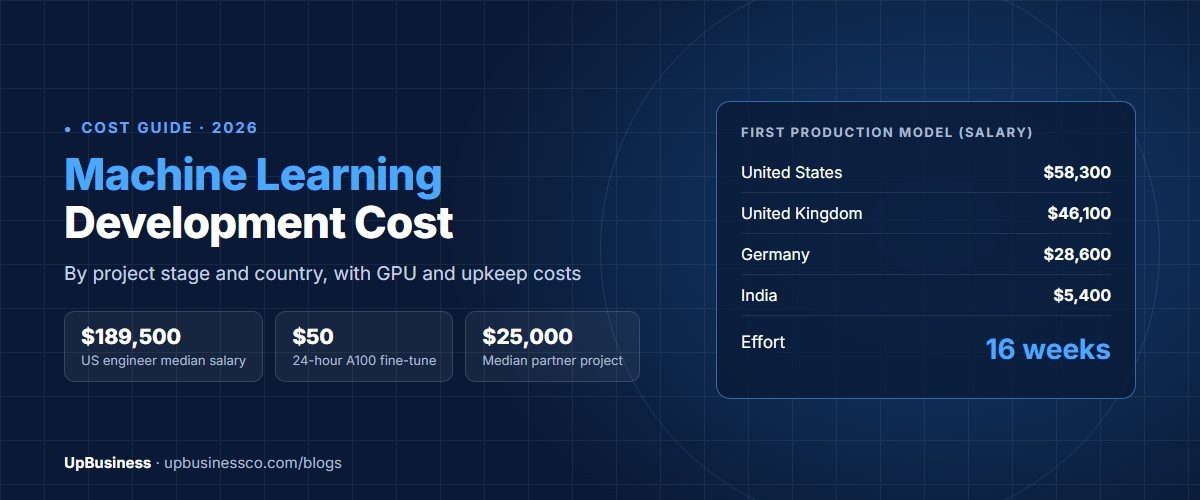
- A first production model takes about 16 person-weeks. That works out at roughly $58,300 in US engineer salary, $46,100 in the UK, $28,600 in Germany, $22,500 in France and $5,400 in India, before a partner's overheads.
- The median AI and Machine Learning engineer earns $189,500 in the US and $17,436 in India, according to Stack Overflow's 2025 survey. Where the team sits often changes the budget more than the type of model does.
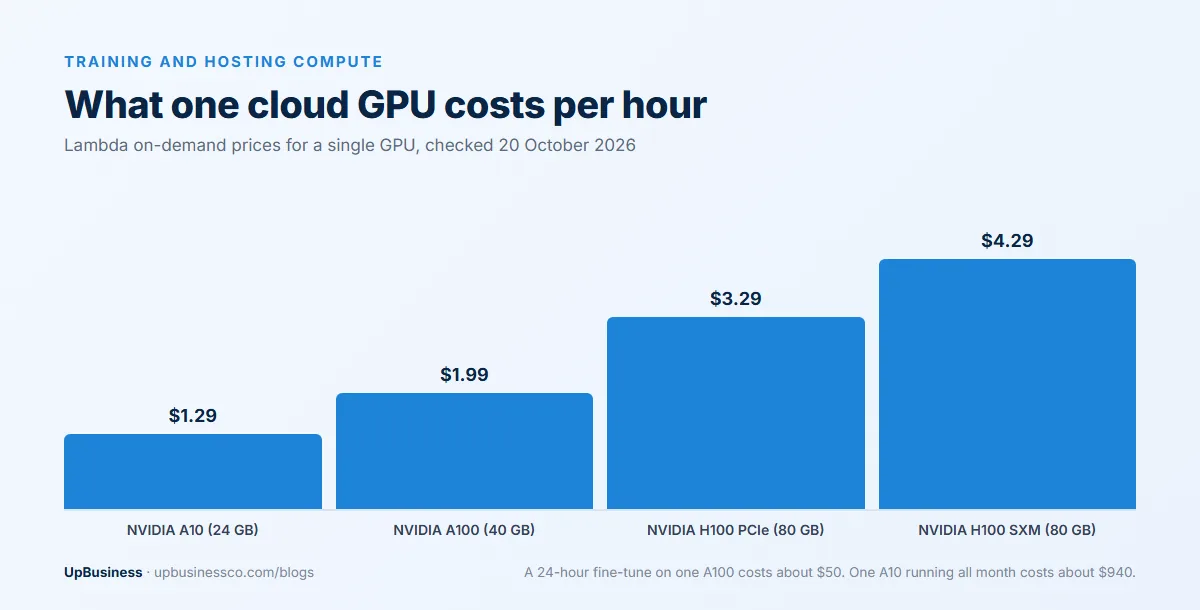
- Training compute is usually a small line. Fine-tuning a pre-trained model for 24 hours on one rented A100 GPU costs about $50 at Lambda's list price of $1.99 an hour.
- On UpBusiness, 8 verified machine learning companies report a median average project of $25,000, close to the salary cost of a US proof of concept alone.
How Much Does Machine Learning Development Cost in 2026?
Based on the scopes in this guide, a machine learning build from proof of concept upwards costs about $2,000 to $117,000 in engineer salary, depending on the work and the country of the team. Keeping a model accurate after launch adds roughly $4,400 to $47,400 a year. The table below shows typical effort for each stage. The stages build on each other, so the 16 person-weeks for a first production model include the data audit and proof of concept.
| Project stage | Typical effort | What's usually included |
|---|---|---|
| Data audit and feasibility | 2 person-weeks | Review of your data, the business goal, a baseline and a go or no-go decision |
| Proof of concept | 6 person-weeks | One model trained on existing data, tested offline against the baseline |
| First production model | 16 person-weeks | Data pipeline, model, an API or batch job, basic monitoring and handover |
| Custom deep learning model | 32 person-weeks | Image, audio or text model with labelled data, tuning and deployment |
| Monitoring and retraining | About 13 person-weeks a year | Drift checks, retraining on new data, fixes when inputs change |
The effort figures are UpBusiness estimates for a partner working on a typical business problem with data that already exists. Missing or messy data, strict accuracy targets and regulated industries all push them up.
Machine Learning Development Cost by Country
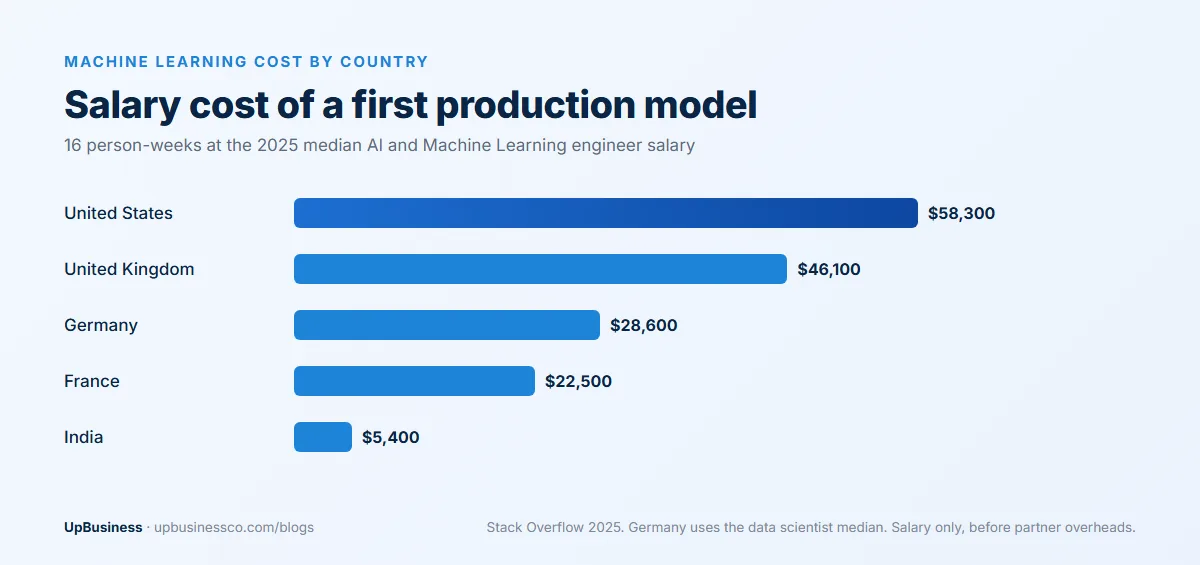
| Project stage | US | UK | Germany | France | India |
|---|---|---|---|---|---|
| Data audit and feasibility (2 person-weeks) | $7,300 | $5,800 | $3,600 | $2,800 | $670 |
| Proof of concept (6 person-weeks) | $21,900 | $17,300 | $10,700 | $8,400 | $2,000 |
| First production model (16 person-weeks) | $58,300 | $46,100 | $28,600 | $22,500 | $5,400 |
| Custom deep learning model (32 person-weeks) | $117,000 | $92,200 | $57,100 | $45,000 | $10,700 |
| Monitoring and retraining, per year | $47,400 | $37,400 | $23,200 | $18,300 | $4,400 |
Every figure here is a salary floor for the engineering time. Expect partner quotes above them, because a company adds project management, data engineering, testing, infrastructure and margin.
How we calculated these figures
Each cost multiplies the effort by one week of the 2025 median salary for an AI and Machine Learning engineer from the Stack Overflow Developer Survey [1]. Those medians are $189,500 in the US, $149,756 in the UK, $73,089 in France and $17,436 in India. The survey doesn't publish that role for Germany, so we use the German data scientist median of $92,812 instead. As a cross-check, the US Bureau of Labor Statistics puts the median wage for US data scientists at $120,230 in May 2025, with jobs projected to grow 35% by 2035 [2].
Machine Learning Engineer Hourly Rate
Dividing those salaries by 2,080 working hours gives the salary cost of one hour of each role.
| Country | AI and Machine Learning engineer | Data scientist | Data engineer | Engineer salary per hour |
|---|---|---|---|---|
| United States | $189,500 | $145,000 | $150,000 | About $91 |
| United Kingdom | $149,756 | $73,516 | $102,106 | About $72 |
| Germany | Not published | $92,812 | $92,812 | About $45 (data scientist) |
| France | $73,089 | $60,328 | $78,890 | About $35 |
| India | $17,436 | $11,624 | $27,898 | About $8 |
All salaries are 2025 medians from Stack Overflow [1]. Partner hourly rates sit well above these figures, because a rate also covers unbilled time, tools, management and profit. Our guide to AI developer rates breaks down hourly and monthly pricing in more detail.
A project rarely needs only one role. A data engineer usually builds the pipelines that feed the model, a data scientist or engineer builds and tests the model, and someone deploys it and sets up monitoring. Small partners combine these roles in one or two people. Larger projects split them.
What Drives the Cost of a Machine Learning Project
Data is usually the biggest cost driver, and it's easy to underestimate. Gartner predicts that through 2026, organisations will abandon 60% of AI projects that aren't supported by AI-ready data [3]. If your records sit in spreadsheets, several systems or free text, expect a large share of the budget to go on collecting, cleaning and labelling them before any model is trained.
The other drivers are easier to plan for:
- The type of problem. A forecast or a yes or no score on tabular data is cheaper than a model that reads images, audio or free text.
- The accuracy you need. Pushing accuracy from good to very good can take longer than the first version did, and some problems never reach the level people hope for.
- Labelling. If examples have to be tagged by hand, such as marking defects on photos, that work is paid per item or per hour and grows with the size of the dataset.
- Integration. Sending predictions into your CRM, ERP or app adds back-end work. On some projects that takes as long as the model itself.
- Compliance. Personal, health or financial data adds reviews, access controls, audit logs and sometimes explanations for each decision.
How Much Does It Cost to Build a Machine Learning Model?
The cost of building a single model depends mostly on the kind of data it learns from. These are typical starting points for one model in production, measured in the same person-weeks as the tables above.
| Type of model | Common uses | Typical effort to first production model |
|---|---|---|
| Prediction on tabular data | Demand forecasts, churn, credit or fraud scores, lead scoring | 12 to 16 person-weeks |
| Text classification and extraction | Routing tickets, tagging documents, pulling fields from invoices | 14 to 20 person-weeks |
| Recommendation | Product or content suggestions, next best offer | 16 to 24 person-weeks |
| Computer vision | Defect detection, counting, reading images or video | 24 to 32 person-weeks |
Starting from a pre-trained model cuts these numbers. Many image and text tasks no longer need a model built from scratch. A partner can fine-tune an existing open model on your examples instead, with far less data and compute. For image projects, our partners in computer vision consulting can tell you early whether that route fits.
Worked Example: A Demand Forecast From Start to Year One
Take a retailer with three years of sales history in one system that wants a weekly demand forecast for 2,000 products. The data audit and proof of concept take about 8 person-weeks between them. If the forecast beats the current spreadsheet method, the build continues to a production model at about 16 person-weeks in total, with forecasts written back to the stock system each night.
| Year-one cost line | Team in India | Team in the US |
|---|---|---|
| Build to first production model (16 person-weeks) | $5,400 | $58,300 |
| Monitoring and retraining for the rest of the year (about 6 person-weeks) | $2,000 | $21,900 |
| Hosting a nightly batch job | A small cloud server | A small cloud server |
| Salary floor for year one | About $7,400 | About $80,200 |
Both columns count engineer salary only. On UpBusiness, India-based machine learning partners report a median average project of $25,000, which shows how much a real quote adds for management, data engineering, testing and margin. If the audit finds that sales data for some stores is missing or inconsistent, budget extra weeks for cleaning before the proof of concept starts.
Machine Learning Model Training Cost
Compute is usually a small part of the total. Models on tabular data often train on ordinary servers, and many image or text models are fine-tuned on one rented GPU in hours or days. These are Lambda's on-demand prices for a single GPU, checked on 20 October 2026 [4].
| GPU | Memory | Price per GPU-hour | Example |
|---|---|---|---|
| NVIDIA A10 | 24 GB | $1.29 | Serving a mid-sized model 24/7 costs about $940 a month |
| NVIDIA A100 | 40 GB | $1.99 | A 24-hour fine-tuning run costs about $50 |
| NVIDIA H100 PCIe | 80 GB | $3.29 | Larger training jobs and faster experiments |
| NVIDIA H100 SXM | 80 GB | $4.29 | 100 hours on 8 GPUs costs about $3,400 at the single-GPU rate |
Prices on AWS, Google Cloud and Azure differ by region, commitment and instance size, so ask each partner which hardware they plan to use and for how long. Training a large language model from scratch is a different order of cost, and few business projects need it.
Ongoing Costs: Monitoring, Retraining and Hosting
A machine learning model gets less accurate as the world changes. Customers behave differently, products change and new kinds of fraud appear. The model has to be checked and retrained to keep up. A well-known 2015 paper by Google engineers found that real-world machine learning systems commonly carry massive ongoing maintenance costs [5]. In our cost table, monitoring and retraining takes about a quarter of an engineer's time, or roughly $4,400 a year in Indian salary and $47,400 in US salary.
Hosting comes on top. A model that runs on a schedule, such as a nightly forecast, may cost little to host. A model that answers every request in real time needs a server running all day, and with a GPU that can reach about $940 a month for one A10 at Lambda's list price. Agree before launch who watches the model's accuracy, how often it's retrained and what happens when it falls below an agreed level.
Build, Buy or Use an API?
Custom machine learning is worth it when the model uses data only your business has and the result changes a real decision, such as how much stock to order or which claims to check. For general tasks like transcription, translation, document reading or a chatbot, a ready-made service or a large language model API is usually cheaper and faster. A sensible test is to try the ready-made option on a sample of your own data first, and pay for custom work only where it falls short. Our guide to build vs buy AI compares costs, and custom AI development services covers what a full custom build involves.
In-House Machine Learning Team vs a Partner Company
A full-time AI and Machine Learning engineer on the US median salary of $189,500 costs an employer about $271,000 a year. Wages are only 70% of what US private employers spend per hour on staff [6]. That makes sense when models are central to the product and there's work all year. For a first model or a single project, a partner company is usually cheaper, and you can hire later once the model proves its value. Our comparison of agency vs freelancer vs in-house shows where the break-even point sits.
Machine Learning Project Cost Estimation: What a Quote Should Include
A clear quote lets you compare partners on the same terms. Check that each one covers:
- A data audit at the start, with a decision point before the main build.
- The success measure, such as accuracy, error rate or money saved, and how it will be tested on data the model hasn't seen.
- Data work: cleaning, labelling and pipelines, with the effort shown separately from the model itself.
- The approach, whether a pre-trained model, a cloud service or a model built from scratch, and why.
- Infrastructure for training and hosting, with expected monthly costs and whose cloud account they sit in.
- Integration with your systems, and who builds it.
- Monitoring and retraining after launch, with a price and a schedule.
- Ownership of the code, the trained model files and the training data. Our software development contract checklist covers the clauses.
Warning Signs in a Machine Learning Quote
- A promised accuracy figure before the partner has seen your data. Honest partners give a range after the data audit.
- No separate line for data preparation, when your data lives in several systems or spreadsheets.
- A fixed price for a large build with no proof of concept or decision point in between.
- Nothing about monitoring, retraining or hosting after launch.
- Vague answers on who owns the trained model and whether it can run without the partner's platform.
Our list of questions to ask an AI development company helps you test these points in a first call.
How to Reduce Machine Learning Development Cost
- Start with a data audit and a proof of concept, and only fund the full build if the results beat your current process.
- Pick one decision to improve first, with a clear measure, rather than a broad "AI platform".
- Use pre-trained models and managed cloud services where they fit, and keep custom work for the part that uses your own data.
- Fix data collection early. A month spent making sure new records are complete saves rework on every retraining.
- Choose batch predictions over real-time ones when the business can wait a few hours, because hosting costs far less.
What UpBusiness Partner Data Shows
On UpBusiness, 8 verified companies are listed for machine learning. All 8 are based in India and work with clients worldwide, and their TrustScores sit between 70 and 74. The average project sizes they report run from $10,000 to $50,000, with a median of $25,000, and their minimum project sizes have a median of $3,000. Six of them have 11 to 50 people and two have 51 to 200.
| Service page | Verified companies | Median average project size | Range of average project sizes |
|---|---|---|---|
| Machine learning | 8 | $25,000 | $10,000 to $50,000 |
| All artificial intelligence services | 27 | $10,000 | $100 to $50,000 |
The machine learning median sits well above the wider AI median of $10,000, which fits the data work and testing these projects need. It's about the salary cost of a six-week US proof of concept ($21,900), and roughly 4.6 times the Indian salary floor for a first production model ($5,400). The gap is expected, because project prices include project management, data engineering, infrastructure and margin, and many projects cover more than one model. The figures are self-reported by a small group, so use them as a reference point when you compare quotes.
Find a Machine Learning Partner on UpBusiness
You can compare verified machine learning companies on UpBusiness by TrustScore, team size, location and project size, or browse all artificial intelligence companies. Use the quote checklist above as your brief, or post your project once and compare the replies line by line.
The Bottom Line
Machine learning development cost is mostly people's time, and a large share of that time goes on data. Across the five countries in this guide, a proof of concept costs about $2,000 to $21,900 in engineer salary. A first production model costs about $5,400 to $58,300, and keeping it accurate adds a yearly cost on top. Check your data first, prove the idea on a small scale, and ask every partner to quote against the same checklist, including what happens after launch.