
Custom SaaS Development: Complete Guide to Building Scalable SaaS Products in 2026
Introduction -Many businesses invest in software only to discover that off-the-shelf solutions cannot support their workflows, growth plans, or customer expectations.
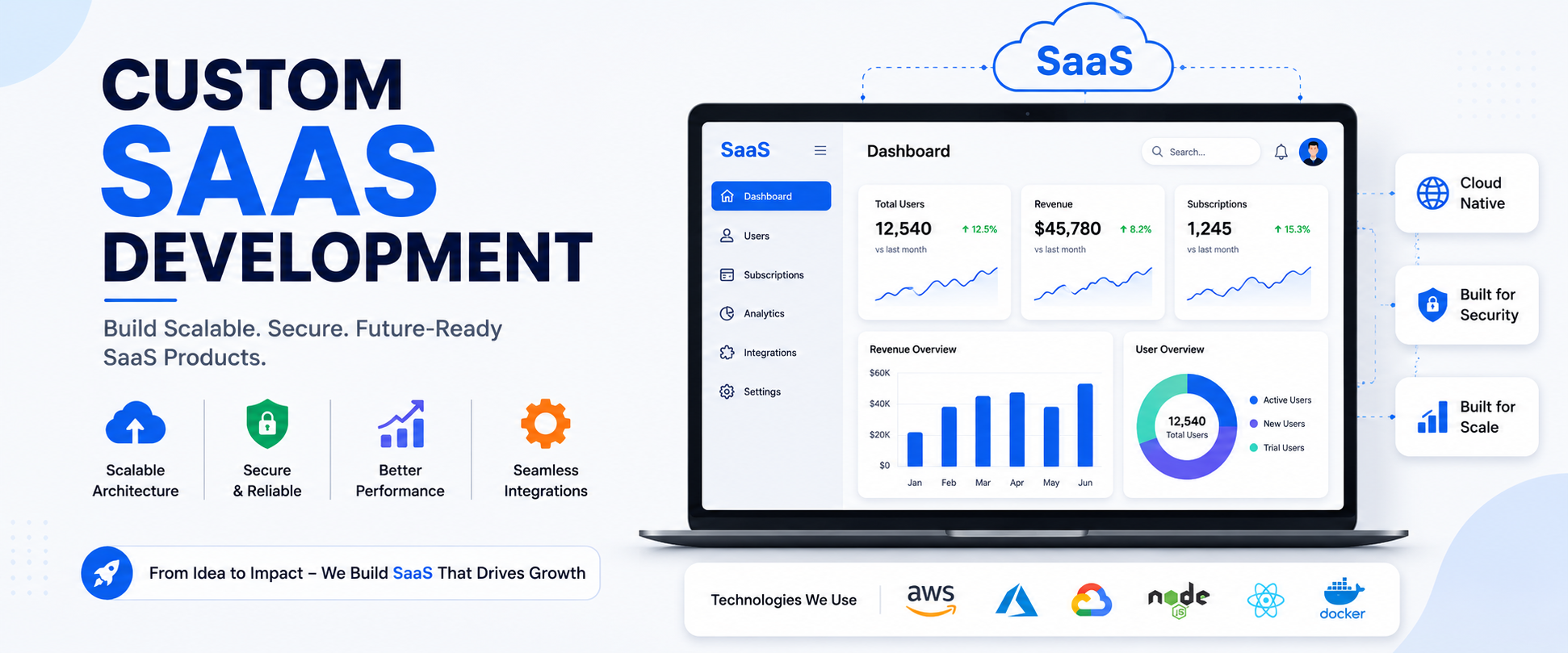
As organizations digitize operations and launch new products, the demand for custom SaaS development continues to increase. Companies need software that aligns with their business model, scales with customer demand, integrates with existing systems, and creates a competitive advantage.
Unfortunately, many businesses make costly mistakes during SaaS development. Common challenges include choosing the wrong development partner, underestimating infrastructure requirements, overlooking security, and launching products without validating market demand.
For startup founders, CTOs, product managers, and enterprise buyers, understanding the SaaS development process is essential for making informed technology investments.
This guide explains everything you need to know about custom SaaS development, including benefits, development processes, costs, vendor selection, and future trends shaping the SaaS industry.
Quick Answer - Custom SaaS development is the process of designing, building, deploying, and maintaining software applications delivered through the cloud on a subscription basis. Unlike generic software products, custom SaaS solutions are built specifically for a company's workflows, customers, and business goals.
Businesses choose custom SaaS development to:
-
Build unique products
-
Create recurring revenue models
-
Improve scalability
-
Enhance customer experiences
-
Integrate with existing systems
-
Gain competitive advantages
Custom SaaS solutions are commonly developed by specialized SaaS development companies, SaaS consulting firms, and enterprise software development providers.
What Is Custom SaaS Development?
Custom SaaS development refers to building cloud-based software applications specifically designed to meet the requirements of a business, industry, or customer segment.
Unlike traditional software that is installed locally, SaaS applications are hosted in the cloud and accessed through web browsers or mobile applications.
Examples include:
-
CRM platforms
-
Project management software
-
HR management systems
-
Marketing automation tools
-
Financial management platforms
-
AI-powered business applications
Industry Relevance
Organizations increasingly prefer SaaS because it reduces infrastructure management, simplifies software updates, and enables global accessibility.
For startups, SaaS creates recurring revenue opportunities.
For enterprises, SaaS improves operational efficiency and supports digital transformation initiatives.
Why SaaS Is Dominating Modern Software
Several factors contribute to SaaS adoption:
Benefits of Custom SaaS Development
Tailored Business Workflows
Custom SaaS applications align with specific operational processes instead of forcing teams to adapt to generic software.
Competitive Advantage
Businesses can create unique features unavailable in off-the-shelf solutions.
Better Integration
Custom platforms integrate with:
-
CRM systems
-
ERP software
-
Marketing tools
-
Analytics platforms
-
Payment gateways
Organizations exploring technology partners often evaluate software providers through trusted marketplaces like UpBusiness, where businesses can compare verified vendors across Technology Development, Web Development, Mobile App Development, and Artificial Intelligence categories.
Improved Security
Security requirements can be designed around industry regulations and organizational policies.
Long-Term Cost Efficiency
Although development costs may be higher initially, organizations avoid recurring expenses associated with multiple disconnected software tools.
SaaS Development Examples
Custom SaaS applications can serve nearly every industry.
Business Operations
-
Workforce management platforms
-
Project collaboration tools
-
Document management systems
Sales and Marketing
-
CRM software
-
Marketing automation platforms
-
Customer engagement systems
Finance
-
Budget planning tools
-
Accounting platforms
-
Subscription management software
Healthcare
-
Patient portals
-
Telemedicine platforms
-
Healthcare workflow systems
AI-Powered SaaS
Modern SaaS platforms increasingly integrate AI capabilities such as:
-
Predictive analytics
-
Customer support automation
-
Content generation
-
Intelligent recommendations
Businesses looking for AI development expertise often combine SaaS development with Artificial Intelligence implementation to enhance automation and personalization.
SaaS Development Process
Step 1: Market Research
Identify:
-
Customer problems
-
Competitor offerings
-
Market demand
-
Revenue opportunities
Step 2: Product Strategy
Define:
-
Target audience
-
Core features
-
Pricing model
-
Business goals
Step 3: MVP Development
Many startups begin with SaaS MVP development services to validate demand before investing in full-scale development.
An MVP should include:
-
Core functionality
-
User authentication
-
Basic workflows
-
Essential reporting
Step 4: UI/UX Design
Create intuitive user experiences that minimize learning curves and improve adoption.
Step 5: Development
Build:
-
Front-end interfaces
-
Back-end architecture
-
APIs
-
Databases
-
Security systems
Step 6: Testing
Validate:
-
Performance
-
Security
-
Usability
-
Scalability
Step 7: Deployment
Launch the application on cloud infrastructure.
Step 8: Continuous Improvement
Monitor performance and release new features based on customer feedback.
Essential SaaS Developer Skills
Successful SaaS projects require multidisciplinary expertise.
Technical Skills
-
Cloud architecture
-
API development
-
Database management
-
Front-end development
-
Back-end engineering
-
Security implementation
Product Skills
-
User experience design
-
Product strategy
-
Customer research
Business Skills
-
Revenue modeling
-
Analytics interpretation
-
Growth optimization
Development teams with experience in scalable SaaS application development typically deliver stronger long-term outcomes than general software teams without SaaS specialization.
Common Challenges in SaaS Development
Custom SaaS vs Off-the-Shelf Software
| Factor | Custom SaaS Development | Off-the-Shelf Software |
| Flexibility | High | Limited |
| Customization | Extensive | Minimal |
| Scalability | Designed for growth | Vendor dependent |
| Ownership | Greater control | Limited control |
| Time to Launch | Longer | Faster |
| Competitive Advantage | Strong | Limited |
Businesses with unique workflows generally benefit more from custom SaaS software development solutions than generic software platforms.
In-House vs Outsourced SaaS Development
| Factor | In-House Team | SaaS Development Company |
| Hiring Cost | High | Lower |
| Management Effort | High | Moderate |
| Expertise Access | Limited | Broad |
| Scalability | Slower | Faster |
| Time to Market | Longer | Faster |
| Resource Availability | Variable | Dedicated |
Many startups choose SaaS development companies because building internal teams requires significant time and investment.
Cost Factors in SaaS Development
The total cost of custom SaaS development depends on:
-
Project complexity
-
Number of features
-
Integrations
-
Security requirements
-
Compliance requirements
-
Development team location
-
Infrastructure requirements
Rather than focusing solely on development cost, organizations should evaluate long-term business value, scalability, and maintenance requirements.
How to Choose the Right SaaS Development Company
When evaluating providers, consider:
Platforms that verify both businesses and reviews help buyers make more confident purchasing decisions.
Best Practices for Successful Custom SaaS Development
Building a successful SaaS product requires more than writing code. The most successful SaaS companies focus on customer needs, scalability, security, and continuous improvement.
Validate Before Building
Many SaaS projects fail because businesses invest heavily in development before confirming market demand.
Before development begins:
-
Identify a clear business problem
-
Conduct customer interviews
-
Validate willingness to pay
-
Analyze competing solutions
-
Define a unique value proposition
Start with an MVP
Launching a Minimum Viable Product (MVP) allows businesses to test assumptions and gather feedback before expanding functionality.
Benefits include:
-
Faster market entry
-
Lower development risk
-
Reduced upfront investment
-
Real-world customer validation
Design for Scalability
Scalability should be planned from day one.
Consider:
-
Cloud-native architecture
-
API-first development
-
Multi-tenant SaaS architecture
-
Performance monitoring
-
Automated deployment pipelines
Prioritize Security
Security is no longer optional.
Include:
-
Role-based access controls
-
Data encryption
-
Secure authentication
-
Audit logging
-
Regular security testing
Invest in User Experience
A powerful product with poor usability often struggles to retain customers.
Focus on:
-
Simple onboarding
-
Clear navigation
-
Mobile responsiveness
-
Fast loading times
-
Customer feedback loops
Measure Everything
Track:
-
User acquisition
-
Customer retention
-
Churn rate
-
Feature adoption
-
Customer lifetime value
Analytics-driven decision-making helps SaaS businesses optimize growth and profitability.
Future Trends in SaaS Development (2026 and Beyond)
The SaaS industry continues to evolve rapidly. Organizations planning new products should prepare for the following trends.
AI-Native SaaS Applications
Artificial Intelligence is becoming a core component of modern SaaS platforms.
Expected capabilities include:
-
Intelligent automation
-
Predictive recommendations
-
AI-powered workflows
-
Conversational interfaces
-
Automated reporting
Businesses increasingly combine SaaS products with AI development services to create smarter user experiences.
Hyper-Personalization
Future SaaS applications will deliver highly customized experiences based on:
-
User behavior
-
Customer preferences
-
Historical activity
-
Business objectives
Vertical SaaS Growth
Industry-specific SaaS products are becoming more popular.
Examples include:
-
Healthcare SaaS
-
Legal SaaS
-
Construction SaaS
-
Financial SaaS
-
Manufacturing SaaS
These solutions often outperform generic platforms because they address specialized workflows.
Low-Code and No-Code Integration
Businesses increasingly want the ability to customize workflows without relying entirely on developers.
Future SaaS products will include:
-
Visual workflow builders
-
Drag-and-drop automation
-
Citizen developer tools
Advanced Analytics and Business Intelligence
Organizations expect SaaS platforms to provide actionable insights rather than raw data.
Future SaaS solutions will focus on:
-
Predictive analytics
-
Real-time dashboards
-
Automated decision support
-
Performance forecasting
Multi-Cloud and Hybrid Architectures
Businesses want flexibility and resilience.
Future SaaS platforms are likely to support:
-
Multi-cloud deployments
-
Hybrid environments
-
Enhanced disaster recovery
-
Improved compliance management
UpBusiness Vendor Evaluation Framework™
Selecting the wrong development partner can significantly increase project costs and risks.
To simplify vendor selection, use the UpBusiness Vendor Evaluation Framework™.
Evaluation Criteria
| Criteria | Weight |
| SaaS Development Experience | 20% |
| Technical Expertise | 20% |
| Security & Compliance | 15% |
| Scalability Experience | 15% |
| Client Reviews & Reputation | 10% |
| Communication & Transparency | 10% |
| Post-Launch Support | 10% |
Scoring Method
Rate each provider from 1–10 in every category.
Formula:
Vendor Score = (Criteria Score × Weight)
The highest total score indicates the strongest overall fit.
Practical Application
Before signing a contract:
-
Shortlist providers
-
Compare capabilities
-
Verify references
-
Review project methodology
-
Assess communication quality
-
Evaluate support commitments
This framework helps reduce vendor selection risk and improves project outcomes.
Why Businesses Choose UpBusiness
Choosing a SaaS development partner is one of the most important decisions a business can make.
Many vendor marketplaces focus primarily on listings. UpBusiness takes a trust-first approach.
Verified Service Providers
Every listed company undergoes a verification process before being featured.
Verified Reviews
Businesses can make decisions based on trusted feedback rather than anonymous reviews.
Transparent Vendor Comparison
Compare providers across:
-
SaaS Development
-
Artificial Intelligence
-
Web Development
-
Mobile App Development
-
Technology Services
Reduced Vendor Selection Risk
Trust evaluation helps businesses identify qualified providers and avoid costly mistakes.
Conclusion
Custom SaaS development allows businesses to build software that aligns directly with their goals, workflows, and customer needs.
Whether you're launching a startup product, modernizing enterprise operations, or creating a new recurring revenue stream, a well-planned SaaS strategy can deliver significant long-term value.
Key takeaways:
-
Validate market demand before investing heavily.
-
Start with an MVP whenever possible.
-
Prioritize scalability and security from the beginning.
-
Choose development partners carefully.
-
Focus on customer experience and continuous improvement.
-
Prepare for AI-driven SaaS innovation.
The success of a SaaS project often depends as much on selecting the right development partner as it does on the technology itself.
Businesses looking to compare trusted SaaS development providers, AI specialists, technology partners, and marketing experts can use UpBusiness to discover verified companies, compare verified reviews, and make more informed purchasing decisions.
Browse our curated list of Top Companies on UpBusiness