


Browse our curated list of MVP Development Companies
Search for MVP development cost and you'll find ranges from $5,000 to $500,000, almost all of them published by agencies that sell MVP builds. Very few show how they got there. This guide takes a different route. It builds the cost up from what an MVP team actually is (a few people for a number of weeks) and prices that team with published salary data from the US, the UK, Germany and India.
It's written for founders and product owners planning a first version, and for anyone comparing quotes from MVP partner companies in different countries. We cover cost by type of MVP, the India vs US gap, how long an MVP takes, fixed fees most quotes leave out and what AI tools really change. We've also included data from the 6 verified MVP development companies on UpBusiness.
Key takeaways
- A typical SaaS-style MVP takes about 48 person-weeks of work. At median full-stack developer pay, that's about $127,400 of salary in the US and $12,900 in India, before any agency overheads or margin.
- The 6 verified MVP companies on UpBusiness report average project sizes from $500 to $25,000, with a median of $10,000.
- Fixed platform costs are small but easy to forget. Apple's developer program costs $99 a year and Google Play a one-time $25, and Apple takes 15% on paid apps for developers earning under $1 million.
- AI coding tools don't automatically make an MVP cheaper. In METR's 2025 trial, experienced developers using early-2025 AI tools took 19% longer on real tasks.
How Much Does It Cost to Build an MVP in 2026?
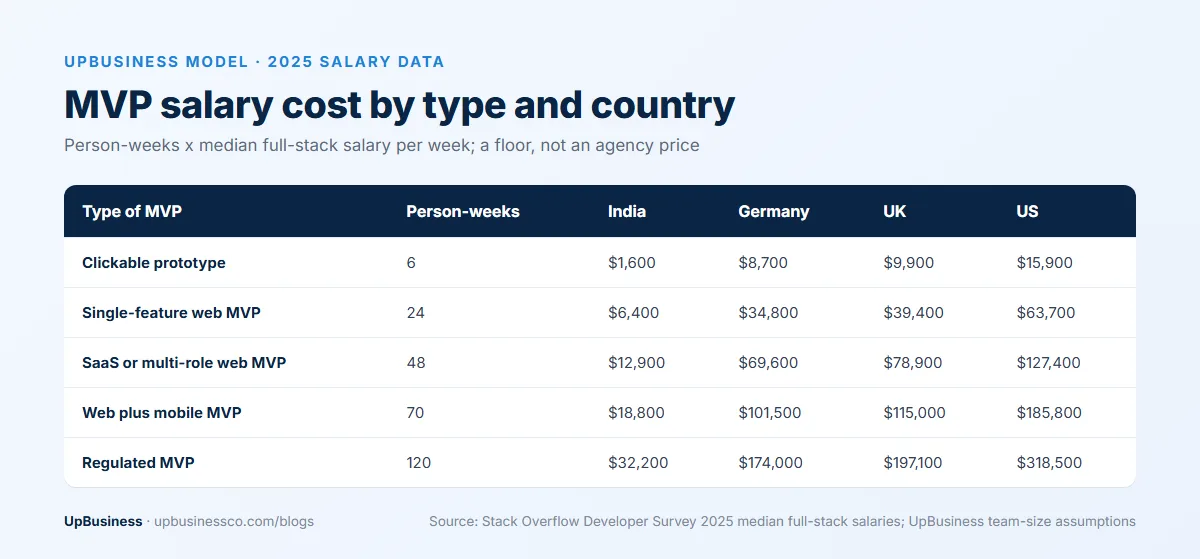
MVP development cost in 2026 depends mostly on scope and on where the team is based. A single-feature web MVP needs roughly 24 person-weeks of work, a SaaS-style product about 48, and a web plus mobile MVP about 70. Priced at median developer salaries, that ranges from about $6,400 in India to $63,700 in the US for the smallest build, and it climbs from there.
The table below shows the salary cost of each type of MVP. Treat these numbers as a floor, not a price. An agency quote will be higher because it also covers project management, tools, office costs, risk and profit. A quote far below the floor for the country the team is in is a reason to ask what's been left out.
| Type of MVP | Typical team and time | Person-weeks | India | US |
|---|---|---|---|---|
| Clickable prototype (design only) | 2 people, 3 weeks | 6 | $1,600 | $15,900 |
| Single-feature web MVP | 3 people, 8 weeks | 24 | $6,400 | $63,700 |
| SaaS or multi-role web MVP | 4 people, 12 weeks | 48 | $12,900 | $127,400 |
| Web plus mobile MVP | 5 people, 14 weeks | 70 | $18,800 | $185,800 |
| Regulated MVP (fintech, health) | 6 people, 20 weeks | 120 | $32,200 | $318,500 |
How we worked these out: we took the 2025 median full-stack developer salary for each country from the Stack Overflow Developer Survey ($138,000 in the US, $85,429 in the UK, $75,410 in Germany and $13,949 in India)[1], divided by 52 to get a weekly figure and multiplied by person-weeks. The team sizes and timelines are our planning assumptions for a focused first version.
Real teams mix roles that earn more or less than a full-stack developer. Read the results as rough guides. For a cross-check, the US Bureau of Labor Statistics puts the median US software developer wage at $135,980 in May 2025, close to the survey figure[2].
Salary isn't the whole cost of employing someone. In June 2026, wages and salaries made up 70.0% of what US private employers spent on compensation, with benefits making up the other 30.0%[3]. If you build the same 48 person-week SaaS MVP with your own US hires, the employer cost is closer to $182,000 than $127,400, before laptops, software and office space.
MVP Development Cost in India vs the US, UK and Germany
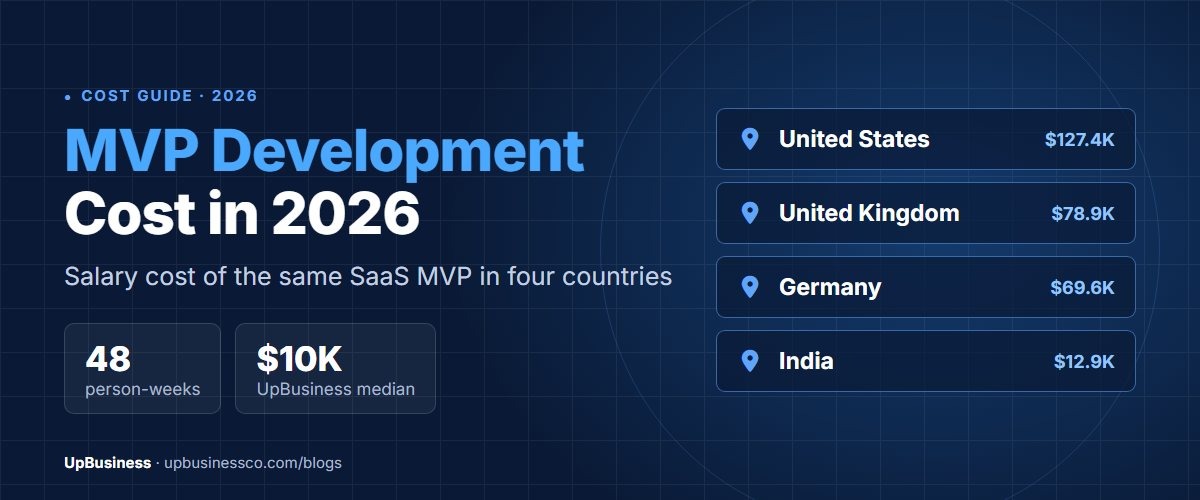
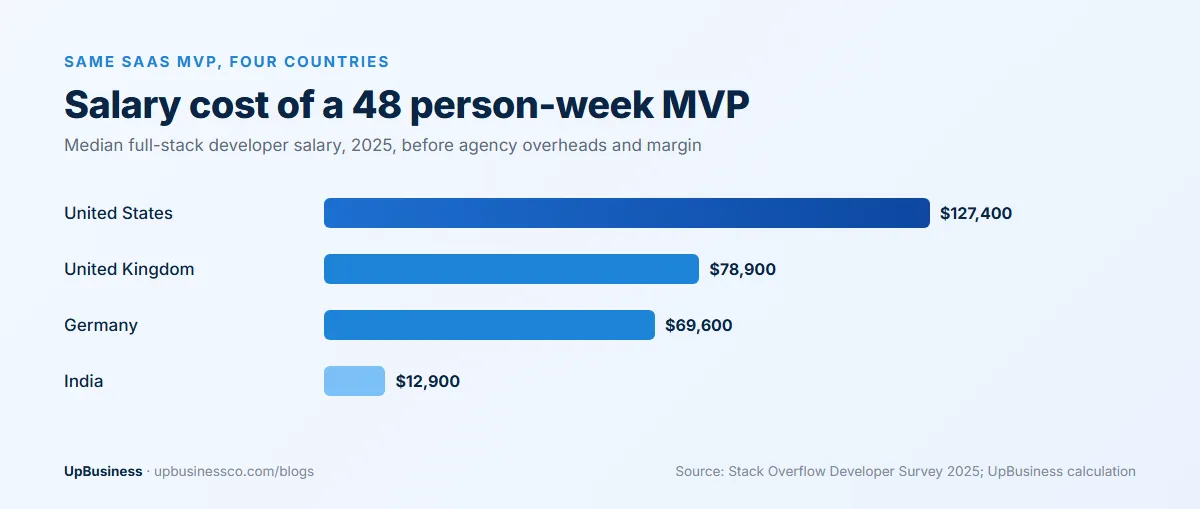
The gap between countries is the biggest single factor in an MVP budget, often bigger than the difference between a simple and a complex product. On the salary data above, the same 48 person-week SaaS MVP costs about $127,400 in the US, $78,900 in the UK, $69,600 in Germany and $12,900 in India.
That doesn't mean an Indian team is always the cheaper choice once you add everything up. Time zone overlap, how much of your own time goes into managing the work and how clearly the team writes and tests code all affect the final cost. A cheap build that has to be rewritten six months later is expensive. Our software development cost benchmark has more on how Indian project prices compare with US salaries, and our guide to dedicated developers vs project-based teams explains which engagement model suits an MVP.
Survey salary data has limits too. Stack Overflow respondents choose to take part, and median pay hides a wide range within each country. Senior developers and specialists in AI or security cost well above the median everywhere.
What Drives the Cost of an MVP
Once the country is fixed, a few scope decisions explain most of the difference between a $10,000 quote and a $40,000 one.
Number of user roles
Every type of user (customer, admin, partner, support agent) needs its own screens, permissions and testing. A marketplace with buyers, sellers and an admin panel is close to three products. If you can launch with one role and handle the others by hand, the build gets much smaller.
Integrations
Payments, email, maps, a CRM or an accounting tool each add set-up, error handling and testing time. A payment flow also needs refunds, failed payments and receipts, and those cases take longer to build than a simple successful payment. List every integration in your brief, even the ones you think are small.
Platforms
A responsive web app is usually the cheapest way to test an idea. Adding native iOS and Android apps adds design, testing and app store work. A cross-platform framework such as Flutter can cut that cost. Our Flutter app development cost guide looks at the numbers.
Compliance and security
Health, finance and children's products carry legal requirements that change the architecture, the testing and the paperwork. They also usually need a security test before launch. Our guide to VAPT testing cost covers what that adds.
Design depth
A clean design built on a ready-made component library is far cheaper than a custom visual identity with animation. For an MVP, the first option is usually enough to learn what users want.
MVP Cost by Product Type
Product type changes the scope more than the industry does. Here's how common MVP types map onto the person-weeks above, with the India and US salary floors for each. As before, these are planning assumptions for a focused first version.
| Product type | What the first version includes | Person-weeks | India | US |
|---|---|---|---|---|
| Internal tool or dashboard | One user role, login, forms, reports | 24 | $6,400 | $63,700 |
| Booking or scheduling app | Customer and admin roles, calendar, payments, reminders | 48 | $12,900 | $127,400 |
| B2B SaaS product | Teams, roles, subscriptions, admin panel, one integration | 48 | $12,900 | $127,400 |
| Two-sided marketplace | Buyers, sellers, admin, listings, payments, messaging | 70 | $18,800 | $185,800 |
| AI assistant or chatbot | Chat interface, knowledge base, answer testing, admin | 48 plus testing | $12,900+ | $127,400+ |
| Fintech or health app | Several roles, compliance controls, audit logs, security testing | 120 | $32,200 | $318,500 |
A marketplace is the type founders most often underestimate. Each side needs its own sign-up, profile and dashboard, and the payment flow has to split money between parties. Many marketplaces start by building one side properly and running the other side by hand for the first few months.
A Worked Budget: SaaS MVP With an Indian Team
Here's how a 48 person-week SaaS MVP might break down over 12 weeks with a team of four. The weekly cost uses the Indian median full-stack salary from the Stack Overflow survey ($13,949 a year, about $268 a week)[1].
| Phase | Weeks | Who | Person-weeks | Salary cost |
|---|---|---|---|---|
| Discovery and scope | 1 | Product lead, designer, developer | 3 | $800 |
| Design | 2 | Designer, product lead | 4 | $1,100 |
| Build | 7 | Two developers, tester, product lead | 28 | $7,500 |
| Testing and launch | 2 | Full team | 8 | $2,100 |
| Fixes after launch | 3 (part time) | Developer, tester | 5 | $1,300 |
| Total | 12 to 15 | 48 | $12,900 (phases rounded) |
An agency quote for this work will be higher than $12,900, because the salary figure leaves out management, tools, office costs and profit. Add the fixed platform costs covered below, plus a reserve for scope that grows once real users arrive. We'd keep about 15% of the budget aside for that, because almost every MVP learns something in its first month that changes the plan.
How to Cut MVP Cost Without Cutting Quality
The cheapest MVP is the one with the fewest moving parts. Launch with one user role where you can, and handle admin work by hand until volumes justify building it. Start on the web unless your idea only works on a phone. Use established services for login, payments and email instead of building your own, because each one you build is code you'll maintain for years.
Fix the scope before the build starts and keep a written list of "later" features. New ideas will come up every week, and most of them should wait until real users have tried the first version. Cutting testing is the one saving that rarely pays off, since the bugs it would have caught reach your first customers instead.
No-Code MVP Cost
A no-code tool can get a simple MVP in front of users for far less than custom code. Bubble, one of the best-known platforms, lists its Starter plan at $59 a month and its Growth plan at $209 a month, both billed annually[4]. Add the time of whoever builds it, whether that's you or a freelancer, and a basic no-code MVP can launch for a small fraction of the custom build costs above.
The trade-off comes later. Your product lives on the platform, its pricing and limits become yours, and moving to custom code usually means rebuilding rather than exporting. No-code works well for testing demand, internal tools and simple marketplaces. It's a weaker choice when the product depends on complex logic, heavy data processing or strict compliance, because those are the areas where you'll hit the platform's limits first.
How Long Does It Take to Build an MVP?
Using the same planning assumptions, a clickable prototype takes about 3 weeks, a single-feature web MVP about 8 weeks, a SaaS-style MVP about 12 weeks and a web plus mobile MVP about 14 weeks. A regulated product can take 20 weeks or more, mostly because of security, compliance and review work.
Two of the most common causes of delay are changing scope while the build is running and slow decisions on the client side. A founder who answers questions within a day keeps a 12-week project on track. One who takes a week per decision can turn it into six months.
MVP vs Prototype vs Proof of Concept
These three terms get mixed up, and the difference matters for cost because each one answers a different question.
| Proof of concept | Prototype | MVP | |
|---|---|---|---|
| Question it answers | Can this be built? | Will people understand and want it? | Will people use it and pay for it? |
| Who sees it | Your team | Test users and investors | Real customers |
| Working code | Partly, often throwaway | Usually none (clickable design) | Yes, production code |
| Rough effort | 1 to 4 weeks | About 3 weeks | 8 to 20 weeks |
If you're unsure whether people want the product, a prototype is the cheapest way to find out. If the main risk is technical, such as whether an AI model can do the job well enough, start with a proof of concept. Build the MVP once both answers look good.
Fixed Costs That MVP Quotes Often Leave Out
Some costs don't depend on the team at all. They're small, but they belong in the budget.
| Cost | Amount | When it applies |
|---|---|---|
| Apple Developer Program | $99 a year | Any iOS app |
| Google Play developer account | $25 one time | Any Android app |
| App Store commission (Small Business Program) | 15% of paid apps and in-app purchases | Developers earning under $1 million a year |
| AI model usage | Priced per million tokens | Any MVP with AI features |
| Hosting, email and monitoring tools | Varies by usage | Every MVP |
Apple charges $99 per membership year for its developer program[5], and Google Play charges a one-time $25 registration fee[6]. Under Apple's Small Business Program, the commission on paid apps and in-app purchases is 15% for developers who earned no more than $1 million in proceeds in the previous calendar year[7]. Ask every partner company whose accounts these sit in. They should be in your company's name.
What an AI MVP Costs to Run
AI features add a running cost that grows with usage. Model it before you build. Model prices vary a lot. Anthropic, for example, lists Claude Sonnet 5.5 at $2 per million input tokens and $10 per million output tokens, and Claude Haiku 5.5 at $0.10 and $0.50 for prompts up to 100,000 tokens[8].
Here's a rough example. Say an MVP has 1,000 active users, each sending 30 messages a month, with about 2,000 tokens going in and 500 coming out per message. That's 60 million input tokens and 15 million output tokens a month. On Sonnet 5.5 it comes to about $270 a month. On Haiku 5.5 it's about $13.50.
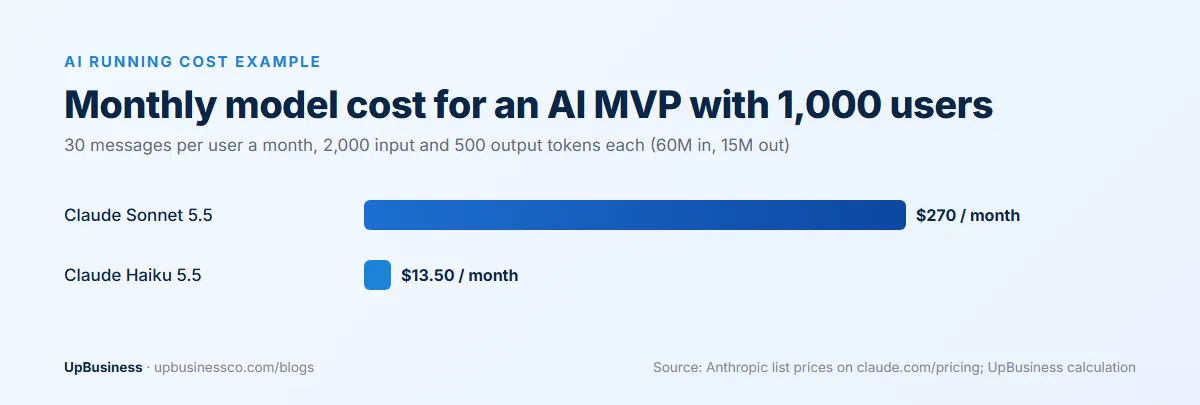
The cheaper model isn't always good enough, which is why an AI MVP needs a test set of real questions and a way to measure answer quality. Budget a few extra weeks of build time for that testing, on top of the person-weeks above.
Do AI Coding Tools Make MVPs Cheaper?
Many pitches now promise a cheaper MVP because "AI writes the code". The evidence is mixed. In a randomised trial run by METR, 16 experienced open-source developers worked on 246 real tasks. With early-2025 AI tools they took 19% longer, although they expected to be 24% faster and still believed afterwards that AI had sped them up[9]. METR has since flagged that result as out of date for newer tools.
In our view, AI tools help most with prototypes, boilerplate and tests, and least with the parts that decide whether an MVP survives: data design, security and edge cases. A quote that's half the usual price because of AI deserves a closer look at who reviews the code and who fixes it when it breaks.
How to Get an Accurate MVP Quote
The fastest way to get comparable quotes is to send every partner company the same brief. It should list the user roles, the core actions each role takes, the integrations, the platforms and any compliance needs. Our software project brief template gives a structure you can copy.
When the quotes come back, check whether each one includes design, testing, deployment, app store set-up and a few weeks of fixes after launch. Then compare them line by line. Our guide to comparing software development proposals shows a simple way to do it. Before you sign, make sure the contract gives you the source code and every account. Our software development contract checklist covers IP, payments and exit terms.
Watch for these warning signs in an MVP quote:
- a fixed price sent within hours, before anyone has asked about your users or integrations
- no line for testing, or testing described as "included" with no detail
- a price far below the salary floor for the country the team works in
- app store, hosting or code repository accounts set up in the agency's name
- no plan for the weeks after launch, when most real bugs appear
UpBusiness Data: MVP Development Companies (October 2026)
Our analysis of the 6 verified MVP development companies on UpBusiness gives a picture of the Indian market. Four are based in Noida, one in Ahmedabad and one in Mumbai. Team sizes range from one company with 1 to 10 people to one with 201 to 500; two have 11 to 50 staff and two have 51 to 200.
Their average project sizes, as they report them, run from $500 to $25,000, with a median of $10,000. That median sits close to our $12,900 salary floor for a 48 person-week SaaS MVP in India, which suggests many of these projects are smaller, single-feature builds. Founding years range from 2004 to 2024, and TrustScores from 70.2 to 75.9. All six list other services too, such as mobile apps, SaaS products or AI features. Ask each one for MVP work in your product category.
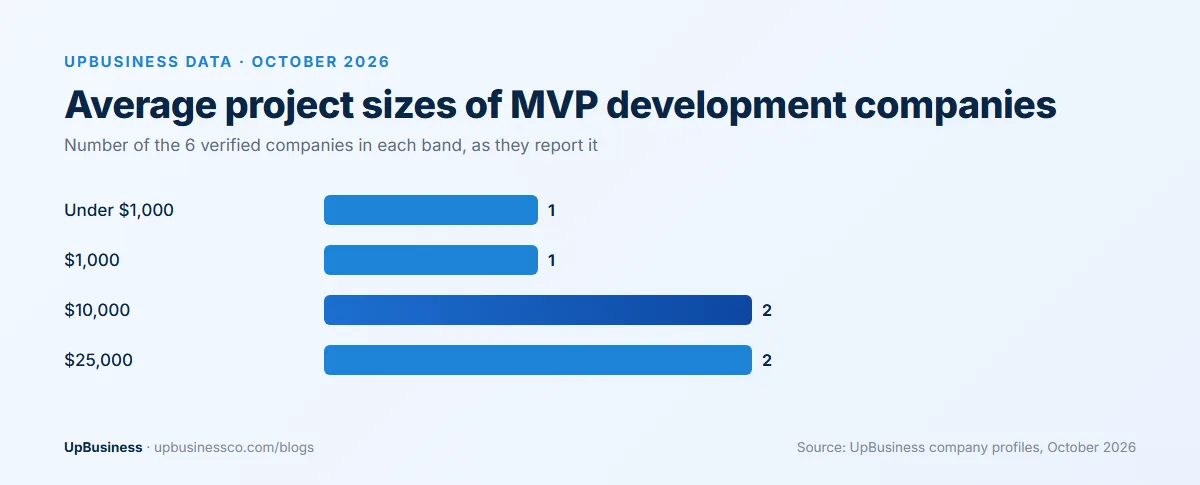
These are self-reported figures from a small group, so use them to sense-check quotes rather than as a market average. Our guide to SaaS product development covers what comes after the MVP.
Find an MVP Development Partner on UpBusiness
You can browse verified MVP development companies on UpBusiness and compare team size, location, project sizes and TrustScore before you contact anyone. If you're building a subscription product, see our SaaS startup development companies as well. Or post your project once and let matching partner companies send you quotes you can compare side by side.