

Browse our curated list of Custom Software Development Companies
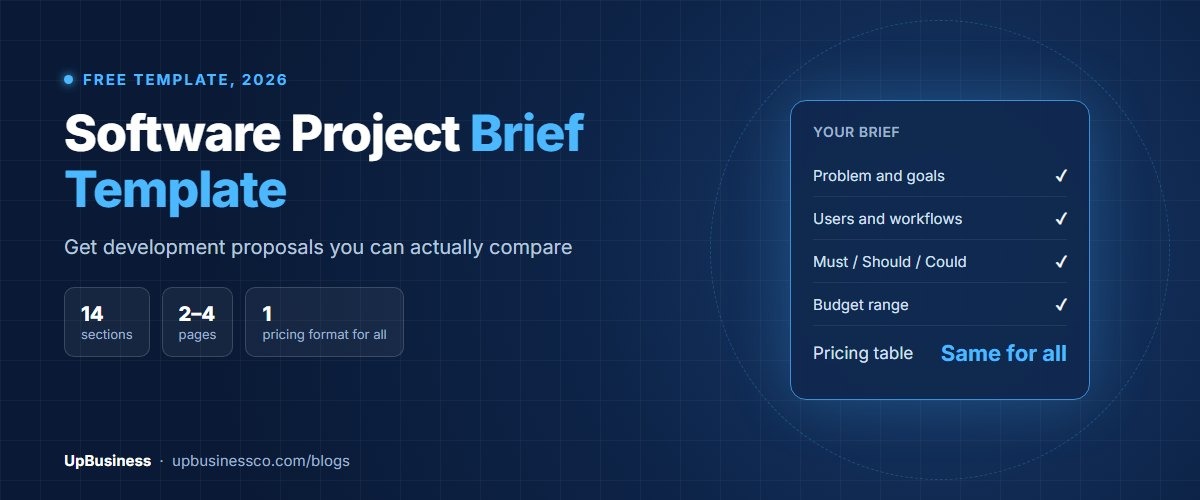
A software project brief template is a fill-in document that gives every development company the same facts about your project, from the problem and the people who’ll use the software to the systems it has to connect to, your budget range and your deadline. If you skip it and describe the project on a call instead, each company fills the gaps with its own guesses, and you end up holding five proposals that were priced on five slightly different projects.
We’ve written this for the person doing the buying, usually a founder, an operations or IT head or a product owner who has to get software built by an outside company and wants quotes they can judge fairly. Internal project briefs (the kind project managers write for their own teams) cover different ground, so this one sticks to what development companies need from you and what you need back from them.
The template below also tells companies how to answer, with one pricing format and a request to list their assumptions and exclusions, so the proposals come back in a shape you can lay side by side. Copy it, set aside an afternoon to fill it in, and send exactly the same version to every company on your shortlist.
If you only have a minute
- PMI research found that inaccurate requirements management was the main reason for nearly half (47%) of projects that failed to meet their goals[1]. Fixing that in a brief costs far less than fixing it halfway through the build.
- Sort features into Must, Should, Could and Won’t, and follow the DSDM method’s advice of keeping Must Have work to no more than about 60% of the effort, so there’s room to absorb surprises[2].
- Include a budget range, since companies scope a $5,300 project very differently from a $52,600 one, and without a range you can’t compare their answers.
- In India, code written by an outside company isn’t automatically yours. Copyright can only be assigned in a signed written document[3], so say in the brief that the contract will include a full assignment.
Why Most Software Briefs Get Proposals You Can’t Compare
Most briefs describe the idea and then stop. A line like “we need a booking app for our clinics, Android and iOS, with payments” feels clear to the person who wrote it, but the company reading it has to guess how many clinics there are, whether staff need their own app, which payment gateway you use, whether patient records are involved, who designs the screens and who looks after the app once it’s live.
Different companies guess differently, so one might quote $6,300 for a basic app built on a template while another quotes $29,500 for a custom system with an admin panel and integrations (these are illustrative figures, and both quotes can be honest answers to the same vague brief). The problem doesn’t end at the quote stage either. In PMI’s research, inaccurate requirements management was the primary cause in 47% of projects that missed their goals[1], and a brief that answers the obvious questions up front is the earliest point where you can head that off.
The Software Project Brief Template
Work through these 14 sections in order. The example column follows an imaginary project (a booking app for a chain of six physiotherapy clinics) so you can see roughly how much detail is useful.
| Section | What to write | Example |
|---|---|---|
| 1. About your company | Who you are, what you sell, size and location, and who will own the project | Six physiotherapy clinics in Pune, 40 staff; the operations head owns the project |
| 2. The problem | What isn’t working today and what it costs you | Bookings come by phone and WhatsApp; about one in five slots goes unfilled after cancellations |
| 3. Goals and success measures | Two to four measurable outcomes and how you’ll check them | Online bookings above 50% of the total within six months; fewer empty slots |
| 4. Users | Every type of user, roughly how many, and what each needs to do | Patients (about 3,000 a month), front-desk staff (12), physiotherapists (25), owners (2) |
| 5. Key workflows | Three to five step-by-step tasks the software must support | Patient books, pays a deposit, gets a reminder and reschedules; staff see the day’s schedule |
| 6. Features by priority | Must, Should, Could and Won’t have, in a list | Must: booking, payments, reminders. Could: exercise videos. Won’t: telehealth calls |
| 7. Platforms | Web, Android, iOS, admin panel, languages | Android and iOS apps for patients, a web panel for staff, English and Marathi |
| 8. Integrations and existing systems | What it must connect to, with names and any API documents | Existing clinic software for records, a payment gateway, WhatsApp reminders |
| 9. Data, security and compliance | Personal or sensitive data, where it may be stored, who can see what | Patient names, phone numbers and visit notes; data stored in India; staff see only their clinic |
| 10. Design | What exists and what you need designed | Logo and brand colours exist; all screens need design |
| 11. Budget range and timeline | A realistic range, a target launch date and any fixed dates | $10,500–15,800 for the first release; launch before April |
| 12. After launch | Support, hosting, maintenance and who runs the system | Twelve months of support and hosting quoted separately |
| 13. Ownership and contract terms | Code ownership, accounts in your name, payment by milestones | Full copyright assignment; app store and cloud accounts in our company’s name |
| 14. How to respond | Proposal format, deadline, questions process and how you’ll decide | Use the pricing table below; questions by email until the 10th; decision within two weeks |
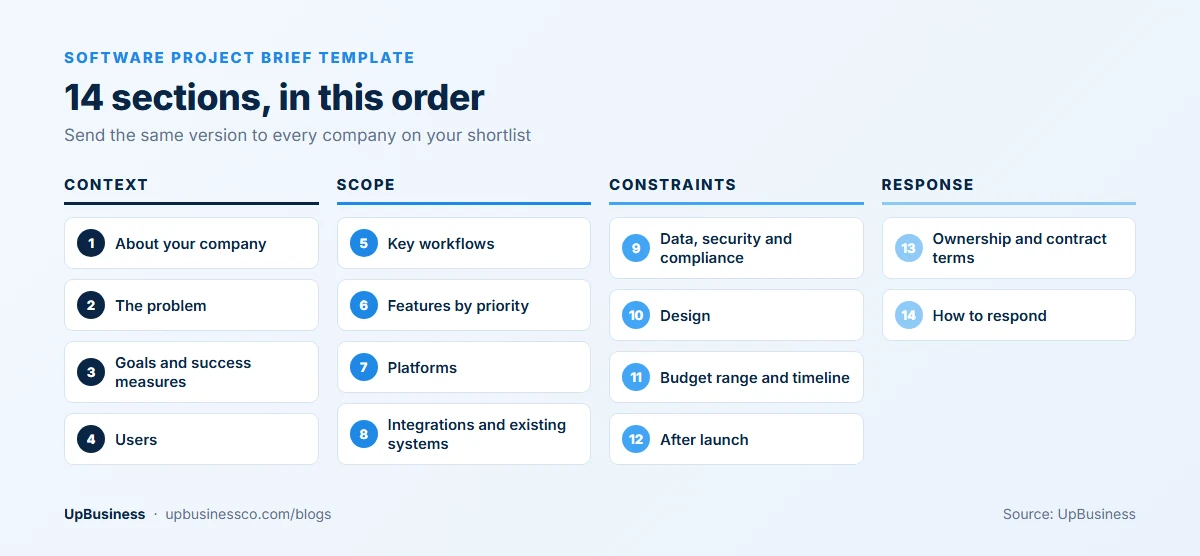
For most projects this comes to two to four pages. Attach whatever you already have, whether that’s screenshots of the current process, the spreadsheet your staff update every morning or a sample report, because a company learns more from those in five minutes than from another page of description.
How to Fill In Each Section of a Software Development Brief
The problem, goals and users
Start with what goes wrong today, in plain numbers if you have them. “Staff spend about two hours a day confirming appointments by phone” tells a company far more than “we want to improve efficiency”, and it gives you something to measure after launch. Good companies design around those goals, so they’re worth the time.
List every type of user, including the people inside your company. Admin panels, staff dashboards and owner reports can easily be half the build, and they’re the part buyers most often leave out because they’re thinking about the customer-facing app.
Features: Must, Should, Could and Won’t
Sort every feature into four groups, a method called MoSCoW. Must Haves are the minimum the product can’t launch without, Should Haves are important but have a workaround, Could Haves are nice to have, and Won’t Haves are agreed to be out of this release[2]. The DSDM guidance behind the method suggests keeping Must Have work to no more than about 60% of the total effort[2], which gives the team room to cut Could Haves if something takes longer than planned instead of missing the launch.
It’s tempting to skip the Won’t list, but writing down what’s out of this release stops
one company from quietly pricing in features that another company left out, which is one of the usual reasons two quotes for the same brief end up far apart.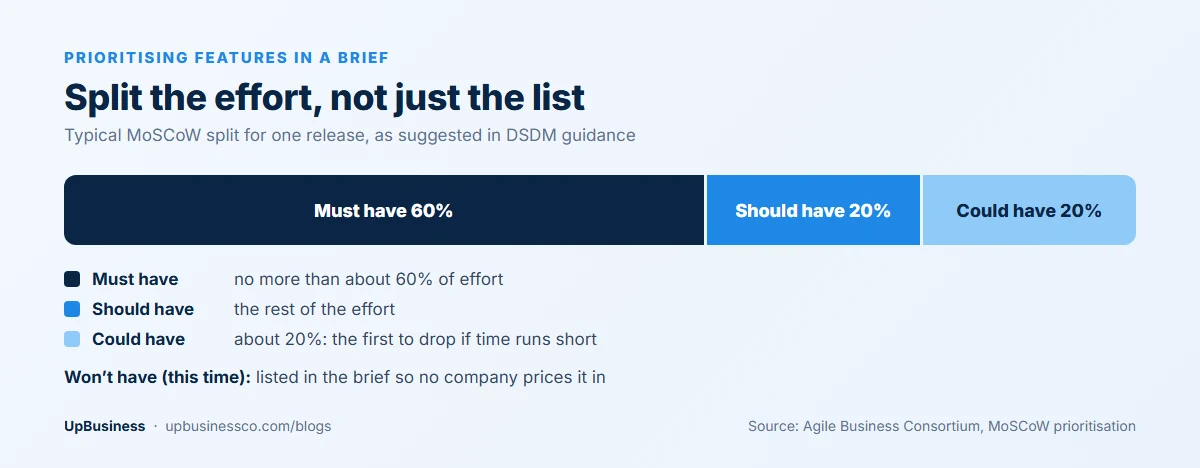
Integrations, data and the quality you expect
Name every system the software has to talk to, and attach API documents or whatever technical details you have (even a line such as “clinic records software, cloud-based, has a REST API” helps). Integrations are where estimates tend to differ most, because each company has to guess how much work the other system will make, so the more specific you are here the closer the quotes will be.
Say what personal data the system will hold. India’s Digital Personal Data Protection Rules were notified in November 2025 with an 18-month phased timeline, and they require companies to inform affected people promptly if a personal data breach happens[4]. A company that knows the system will store health or financial data should price in access controls, logging and secure hosting from the start. Add any quality expectations too, such as how fast pages should load, how many people will use it at once and which browsers or phones it must support.
Budget range and timeline
Plenty of buyers leave the budget out in the hope of getting a lower quote, but in practice it tends to work against them. Without a range, one company proposes a stripped-down build and another proposes everything it can think of, and neither tells you what your money would actually buy. A range such as “$10,500–15,800 for the first release” lets every company show what it would build for that amount, and that’s a much fairer comparison.
Give a target launch date and say whether it’s fixed, for example because of a busy season, a funding milestone or a regulatory deadline, or whether it can move. A fixed date changes how a company plans and staffs the work, and it may change the price.
Ownership, accounts and payments
Under India’s Copyright Act, an assignment of copyright isn’t valid unless it’s in writing and signed, and it should identify the work, the rights, the duration and the territory[3]. Paying for the code doesn’t make it yours on its own. Say in the brief that the contract will assign all code, designs and documents to your company, and that the app store, domain, cloud and code repository accounts will be opened in your company’s name. If you plan to pay by milestones, mention that here as well so companies can plan their proposals around it.
Tell Companies Exactly How to Respond
Most templates we looked at stop after describing the project, but this is the part that makes proposals comparable. Ask every company to fill in the same pricing table and answer the same questions in the same order, so you’re not trying to match one company’s “Phase 2” against another’s “Sprint 4”.
| Phase or item | Roles involved | Estimated hours | Cost (excluding GST) | Duration |
|---|---|---|---|---|
| Discovery and planning | ||||
| UX and UI design | ||||
| Development: patient app | ||||
| Development: staff web panel | ||||
| Integrations | ||||
| Testing and launch | ||||
| Support and hosting, per month after launch |
Below the table, ask each company to state:
- whether the price is fixed or time and materials, and their hourly rates by role,
- every assumption they’ve made (for example, “the clinic software’s API supports booking updates”),
- what is excluded, such as content entry, third-party licence fees or app store charges,
- the team who will actually do the work, with experience, and who your day-to-day contact is,
- their proposed payment milestones and what you’ll see at each one,
- GST as a separate line, so every total is compared on the same basis,
- two or three similar projects they’ve delivered, with a reference you can call.
When two quotes are far apart, the assumptions and exclusions usually explain most of the difference, so treat a proposal that won’t list them with some caution, however good the price looks.
Say How You’ll Choose
It helps to put your decision criteria in the brief. Companies write better answers
when they know what you care about, and agreeing the weights early also helps your own team stick to them later, when the cheapest quote starts to look tempting. Something like this works for most projects:| Criterion | Weight |
|---|---|
| Understanding of the problem and proposed approach | 25 |
| Relevant experience and references | 20 |
| Team that will do the work | 15 |
| Total cost, including support after launch | 20 |
| Timeline and how realistic it is | 10 |
| Ownership, security and contract terms | 10 |
Our guide to comparing software development proposals explains how to score each proposal against these weights and which red flags should end a conversation early.
What to Leave Out of a Brief
Leave out anything that turns the brief into a technical specification, because that slows the process down without making the quotes any better. Unless you have a real reason (say, an in-house team that will take over the code), don’t pick the programming language or framework for them. Detailed screen designs and database structures are the development company’s job during discovery. And a long list of “nice ideas” with no priorities is risky, since companies tend to price every unsorted item as if it were a Must.
Project Brief, RFP or Statement of Work?
People often use these three names for the same thing, but they’re written at different stages and by different people.
| Document | Who writes it | When | Purpose |
|---|---|---|---|
| Project brief | You, the buyer | Before you contact companies | Explain the project and ask for comparable proposals |
| Request for proposal (RFP) | You, usually with procurement | Larger or formal buying processes | A longer brief with formal rules, legal terms and scoring |
| Statement of work (SOW) | Both sides, usually drafted by the company you choose | After selection, before work starts | The agreed scope, deliverables, timeline and price that become part of the contract |
For most small and mid-sized projects, a good brief is enough to get started. A formal RFP is worth the extra effort when several departments have to sign off, or when your company’s purchasing rules ask for one.
UpBusiness Data: What Buyers Put in Their Briefs
We looked at the 8 genuine project briefs buyers submitted on UpBusiness between August and October 2026, leaving out staff accounts and test entries. That’s a small sample, so read it as an early pattern rather than a survey, but the pattern was very consistent. Every brief included a budget range and a deadline (our form asks for both), and 7 of the 8 were filled in by the person who’d make the final decision.
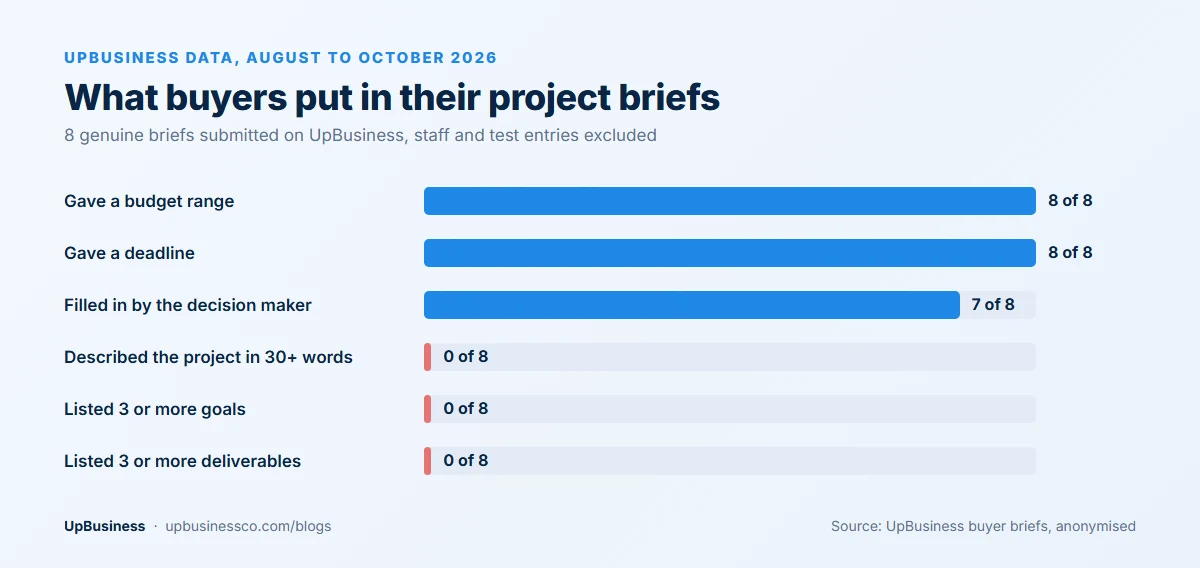
Where the briefs were thin was the description of the project itself. None of the 8 described the project in more than 30 words, and each one listed only one or two goals, one or two deliverables and one or two questions for the companies. The projects covered design, IT, consulting, custom software and lead generation work, all 8 budgets were under $5,300 (the most common range was $1,050–2,600), and five of the seven briefs posted through the project form weren’t planning to start for at least 60 days.
So buyers are already good at giving the money and the dates, and what’s usually missing is the part that tells a company what to build. If your own start date is a couple of months away, that’s plenty of time to work through sections 2 to 9 of the template before you send it to anyone.
Send Your Brief to Partner Companies on UpBusiness
You can post your project on UpBusiness using a guided form that covers the same ground as this template: your goals, deliverables, budget range, timeline and questions. It’s matched with verified custom software development companies, mobile app developers and software outsourcing companies that fit your project, so you can compare their replies in one place.