

Browse our curated list of Mobile App Development Companies
Send the same app idea to five development companies in India and the quotes can run from $4,200 to $42,100. That spread rattles most first-time buyers, but usually nobody is lying. One team has pictured a few screens and a login. Another has pictured payments, an admin panel and a backend built for 100,000 users.
So the real work starts before you ask for quotes. Once you know what an app like yours should cost, the quotes start to make sense, and the odd ones stand out.
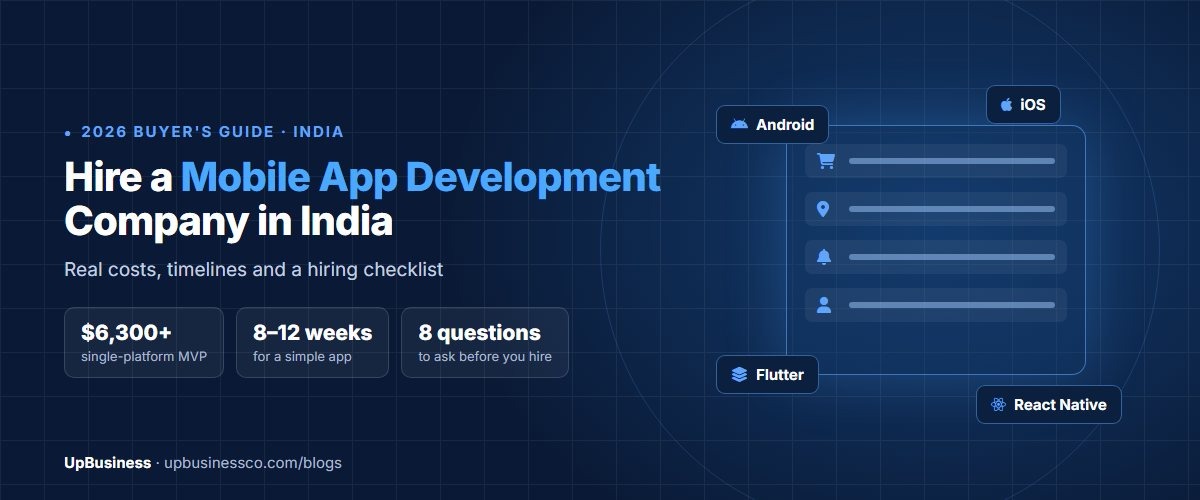
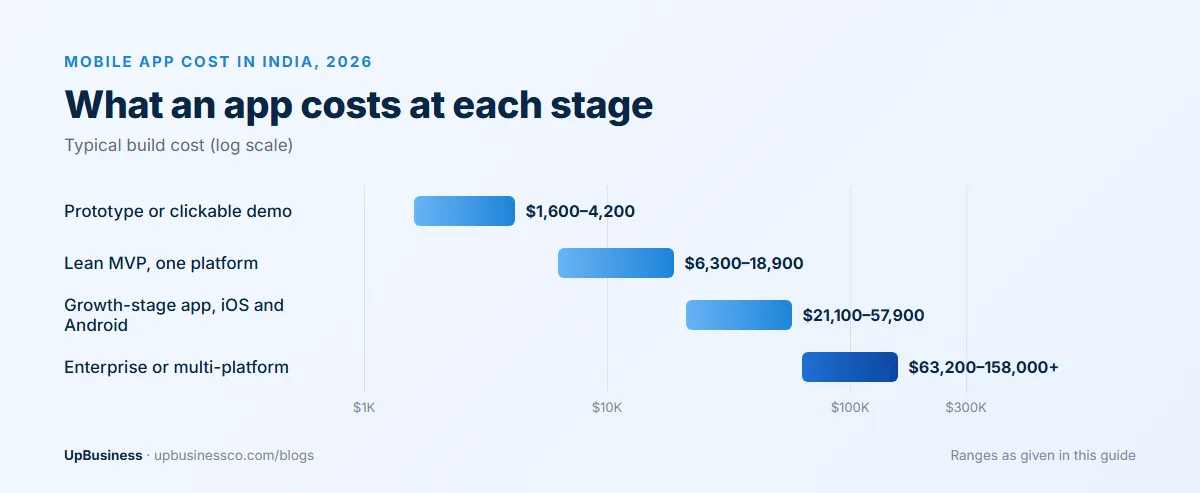
If you only want the numbers: a clickable prototype costs about $1,600–4,200, an MVP on one platform $6,300–18,900, a growing product on iOS and Android $21,100–57,900, and an enterprise build anywhere from $63,200 to $158,000 or more[1]. Simple apps take 8–12 weeks, moderately complex ones 4–6 months, and enterprise platforms 7–12 months or longer[1]. After launch, expect to spend 15–20% of the build cost every year on maintenance[2].
Why Indian Businesses Keep Building Apps
India downloads more apps than any other country. Sensor Tower counted 25.5 billion downloads in 2025, up from 24.6 billion in 2024, and people spent 1.23 trillion hours inside apps[3].
Spending is another story. The same report says India isn't in the top 20 markets for consumer spending on apps. People here install freely and rarely pay.
If your plan depends on paid downloads or subscriptions, that's a hard road. The apps that do well in India tend to save the user time or money, or help a business run its own operations. Think of a dealer placing repeat orders from a phone instead of calling your sales team every week.
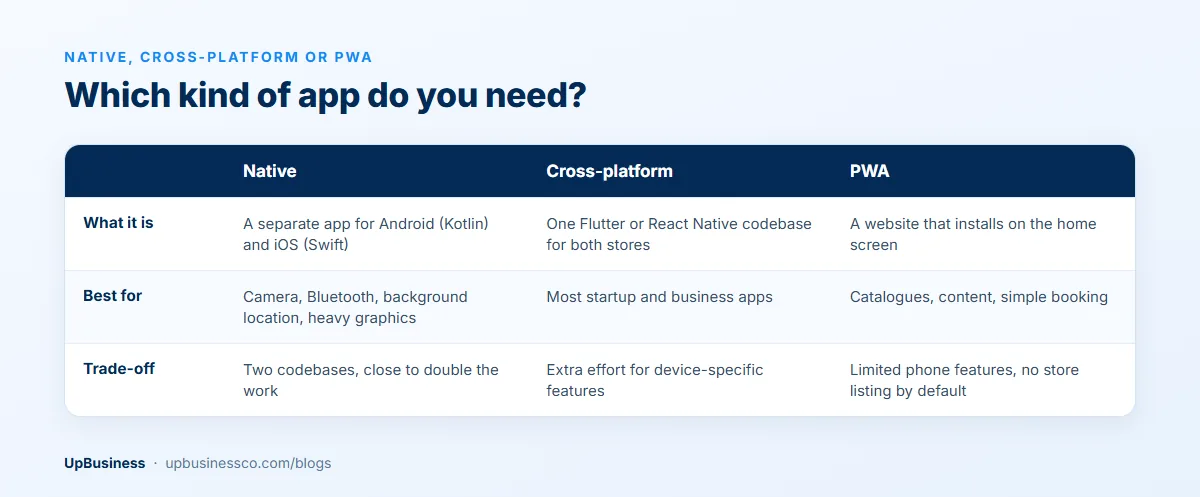
Native, Cross-Platform or PWA: Which One You Need
Settle this before you collect quotes. It changes the budget more than almost any feature will.
| Approach | What it means | Best for | Trade-off |
|---|---|---|---|
| Native (Kotlin for Android, Swift for iOS) | A separate app for each platform | Apps that lean on the camera, Bluetooth, background location or heavy graphics | Two codebases, so close to double the work if you need both stores |
| Cross-platform (Flutter, React Native) | One codebase that ships to Android and iOS | Most startup and business apps | Some extra effort for very device-specific features |
| Progressive web app (PWA) | A website that can be installed on the home screen | Catalogues, content and simple booking flows | Limited access to some phone features and no store listing by default |
Start with the phone your users actually carry. Android runs on about 94% of phones in India[4], so an India-only consumer app that launches on iOS first is usually starting in the wrong place.
Flutter and React Native let one codebase ship to both stores, and they typically cut the initial build cost by 25–40% compared with two native apps[1]. For most startups, that makes cross-platform the better first build. Native earns its higher price when the app depends on phone hardware or heavy graphics, or when you only need one platform anyway.
Already decided? You can compare teams that specialise in Flutter, React Native, Android or iOS development.
Mobile App Development Cost in India (2026)
The bands below are typical 2026 prices from Indian development firms[1]. The last column is our own summary of what quotes at each level usually include.
| Stage | Typical cost | What you usually get |
|---|---|---|
| Prototype or clickable demo | $1,600–4,200 | Designed screens you can tap through, for testing with users or showing investors |
| Lean MVP, one platform | $6,300–18,900 | The core features, one platform, a basic admin panel and store launch |
| Growth-stage app, iOS and Android | $21,100–57,900 | Both platforms, payments, notifications, analytics and a backend that can grow |
| Enterprise or multi-platform | $63,200–158,000+ | Several user roles, ERP or CRM integrations, security reviews and compliance work |
You'll see cheaper quotes too. Zartek, for one, puts a tightly scoped MVP with 3–5 core features on a single platform at $3,200–5,300[2]. That price is real, but it only holds if you refuse to add features halfway through. Budgets rarely break on the first quote; they break on the stream of small changes that follows it.
Hourly rates explain why so many overseas companies hire here. Quality Indian firms typically charge $10–40 an hour, while US agencies charge $80–150[2].
What Pushes the Price Up
Integrations are the cost buyers underestimate most. Each third-party connection, whether it's a payment gateway, SMS, maps or your CRM, adds roughly $530–2,100 once it's built and tested properly[2].
Next, count the apps rather than the idea. A food delivery business needs a customer app, a rider app and an admin panel. That's three products, and an honest quote prices them that way.
The backend is the part you never see and often the part you pay most for. In one sample MVP budget, the app itself took about 43% of the money and the backend and APIs another 21%[1].
Personal data adds work as well. If the app collects names, phone numbers or locations, consent and data protection have to be designed in. India's DPDP Rules give companies until 13 May 2027 to meet the full requirements[5], and adding this later costs more than building it in now.
Costs That Usually Aren't in the Quote
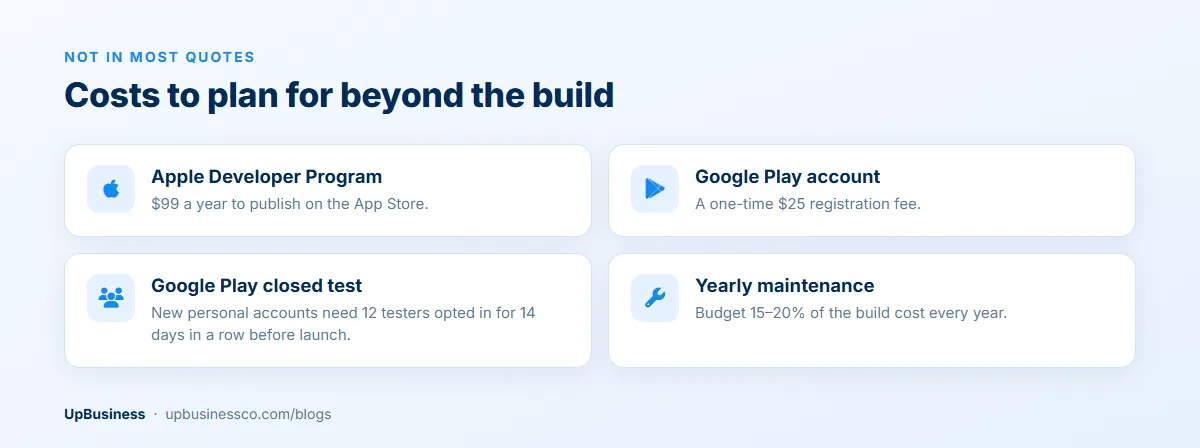
Store accounts are cheap but easy to forget. Apple charges $99 a year for its developer program[6], and Google Play takes a one-time $25 registration fee[7].
Google's testing rule catches plenty of first launches off guard. Personal developer accounts created after 13 November 2023 have to run a closed test with at least 12 testers, opted in for 14 days in a row, before the app can go live[8]. Build those two weeks into your launch date.
Hosting, push notifications, OTP messages and map APIs arrive as monthly bills. Ask the developer to estimate them at the number of users you expect in your first year.
Then there's maintenance, at 15–20% of the build cost every year[2]. Android and iOS both ship major updates annually, and an app that isn't kept up to date eventually starts misbehaving on new phones.
If you want one number to plan with, add 25–30% to the quoted build price. That covers store fees, first-year maintenance and launch marketing[2].
What We See on UpBusiness
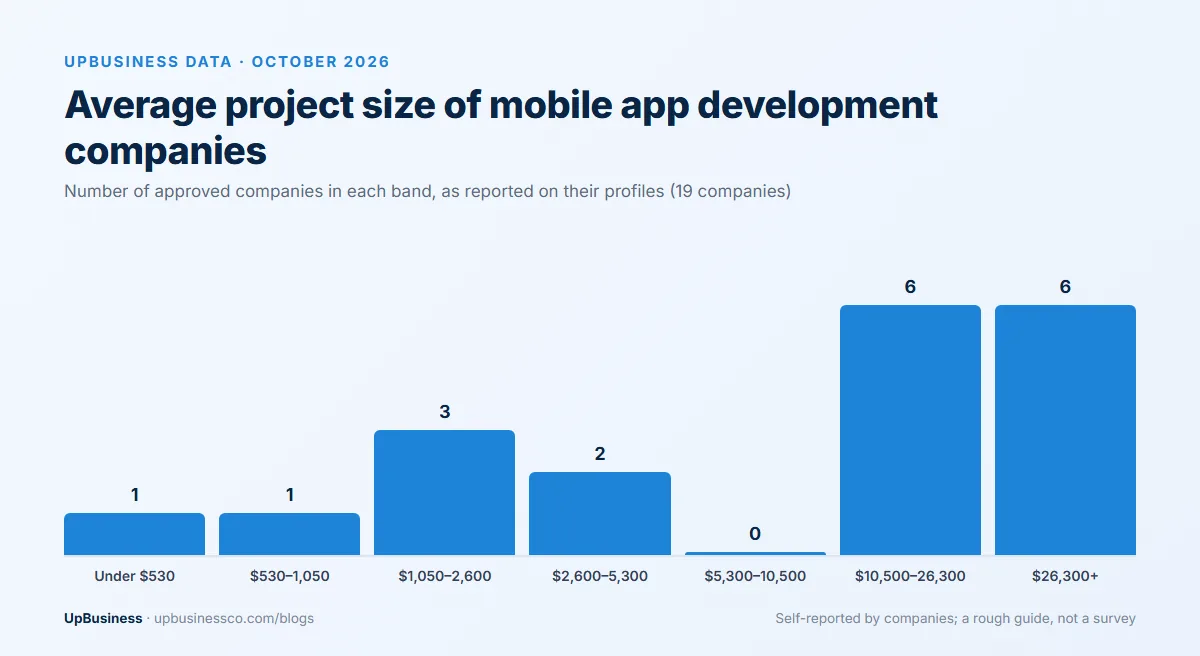
We also looked at what the 19 approved mobile app development companies on UpBusiness report on their own profiles (October 2026). The numbers are self-reported and the group is small, so read them as a rough guide rather than a survey.
The median minimum project is about $1,050 and the median average project is around $10,500. Six of the 19 will take on work under $530, but 12 of them say their typical project is $10,500 or more, so a small brief can still get a reply as long as you're upfront about the budget.
Most of them are mid-sized teams: ten have 11–50 people, five have 51–200, three have fewer than ten and one has 201–500. Noida and Surat have the most of them, with four and three companies.
How App Development Works, Step by Step
Good teams follow roughly the same path. The percentages come from a sample startup MVP budget[1] and show where the money usually goes.
- Discovery (about 8–9% of the budget). Decide who the app is for, what version one must do and what can wait. A team that quotes from a one-line brief without this step is guessing.
- Design (about 14–15%). Wireframes first, then real screens. Put the clickable version in front of five or six real users before anyone writes code, because changing a screen now takes hours and changing it after development takes weeks. If you want design handled separately, look at mobile app design companies.
- App development (about 43%). Usually done in two-week sprints. Ask for a build you can install on your own phone at the end of each one.
- Backend and APIs (about 21%). The server, database, admin panel and every integration.
- Testing and launch (about 12–14%). Test on budget Android phones over patchy mobile data, not only on the flagship in the office. Store submission and review come after that. If your developer is light on QA, a specialist mobile app testing team is worth the money.
Keep some budget and developer time for the three months after release. That's when you learn what people actually do with the app, and it's rarely what the wireframes assumed.
How to Choose a Mobile App Development Company
Every agency portfolio looks good. The difference shows up in how a team answers specific questions, so ask these on the first call.
Questions to Ask Before You Hire
- Show me two or three apps you built that are live on the Play Store or App Store. Can I speak to one of those clients?
- Who exactly will work on my app? Are they your employees or freelancers you bring in?
- Would you use Flutter, React Native or native for this app, and why?
- What's included in the price: backend, admin panel, store submission, a bug-fix warranty?
- Who will own the source code, the developer accounts and the cloud accounts?
- What will maintenance cost per month after launch?
- How will you handle users' personal data under the DPDP rules?
- Which low-cost Android phones do you test on?
Red Flags
Be wary of a fixed price on a one-paragraph brief. Without a discovery step that number is a guess, and you'll pay for the gap later through change requests.
Be just as careful with a team that has no live apps to show, only design mockups. And never let a developer publish your app under their own developer account. Register the Apple and Google accounts in your company's name and keep the logins yourself.
Finally, look at how they want to be paid. A large upfront payment with no milestones, or a contract that says nothing about testing, a warranty period or support after launch, tells you a lot about how the project will go.
The safest way to start is a short paid discovery or design phase. You come out of it with a clear scope and a fixed quote, and you've seen how the team works before committing the full budget.
Reviews from past clients fill in the rest. Companies in our Mobile App Development category are verified, and you can compare their TrustScores and profiles before you shortlist. Or post your project and let verified teams come to you.
Freelancer, Agency or In-House Team?
| Option | Works well when | Watch out for |
|---|---|---|
| Freelancer | A small MVP, a tight budget and a very clear spec | One person is a single point of failure, and testing is often thin |
| Agency | You need design, backend, testing and launch handled in one place | Higher hourly cost, so check who actually writes the code |
| In-house team | The app is your core product and you'll keep improving it for years | Hiring takes months and salaries are a fixed cost |
One setup we see work well: an agency builds version one, then you hire one or two developers in-house and the agency hands over the code with proper documentation. Write that handover into the contract at the start, because it's much easier to agree before the project begins than after it ends.