
Web development services cover everything needed to plan, design, build, launch and look after a website or web application. In practice, two companies quoting for “web development” can be offering very different things: one may deliver a five-page site on a ready-made theme, while another plans a portal with logins, payments and a CRM connection. Knowing what’s included is the fastest way to compare quotes fairly.
This guide explains what web development services in India include, the main types of project, how a project runs, the pricing models and costs, and how to choose a web development company. For detailed price ranges by type of website, see our website development cost guide.
If you only have a minute
- A full web development service usually covers planning, UI/UX design, front-end and back-end development, a content management system, integrations, testing, launch and maintenance. Check which of these each quote actually includes.
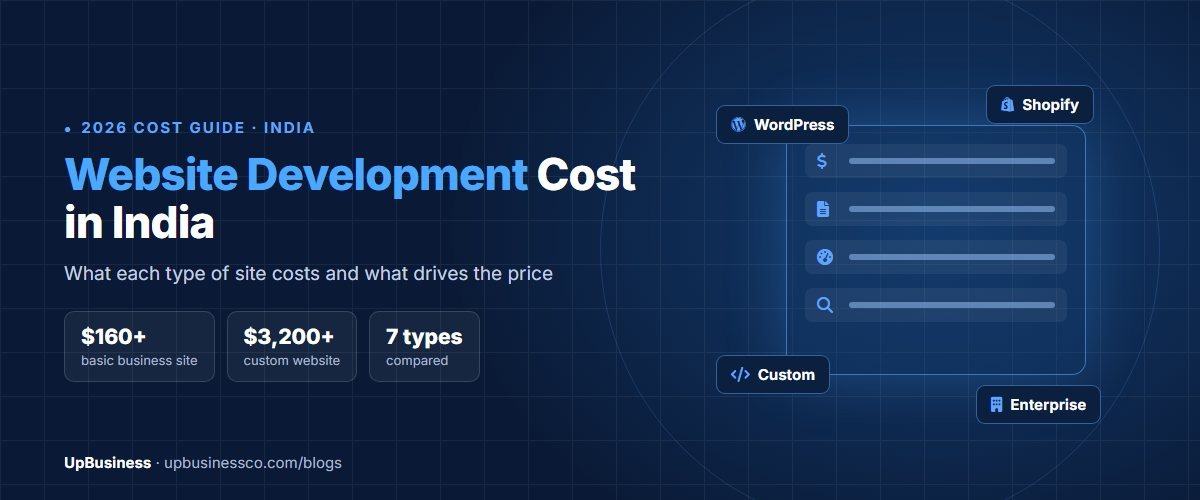
- A 2026 Indian price guide puts a basic WordPress business site at $160–320 and a custom WordPress site at $840–2,600[1]. Web applications such as portals and dashboards typically start higher.
- Budget for maintenance from day one: one Indian development company puts it at 15–20% of the build cost every year[2].
- Choose on relevant past work, a clear process, speed targets on mobile and written ownership of the code, not on the lowest quote.
What Web Development Services Include
Use this as a checklist when you read a proposal. If an item isn’t mentioned, ask whether it’s included or priced separately.
| Service | What it covers | Question to ask |
|---|---|---|
| Planning and discovery | Goals, audiences, sitemap, features and content plan | Will you produce a written scope and sitemap before design starts? |
| UI/UX design | Wireframes and page designs for mobile and desktop | How many design rounds are included? |
| Front-end development | Everything visitors see and click, built to the approved designs | Which framework or theme will you use, and why? |
| Back-end development | Databases, logins, business logic and APIs | Where will the data be stored, and who can access it? |
| Content management system | An editor such as WordPress, Shopify or a headless CMS so your team can update pages | Will our team be trained to edit content? |
| Integrations | Payment gateway, CRM, ERP, WhatsApp, analytics | Which integrations are in the price? |
| Testing | Device, browser, form, speed and security checks | Will we get a test checklist to sign off? |
| Launch | Hosting setup, domain, SSL, redirects and analytics | Who sets up hosting, and in whose name? |
| Maintenance | Updates, backups, monitoring, fixes and small changes | What does the monthly retainer include? |
Types of Web Development Projects
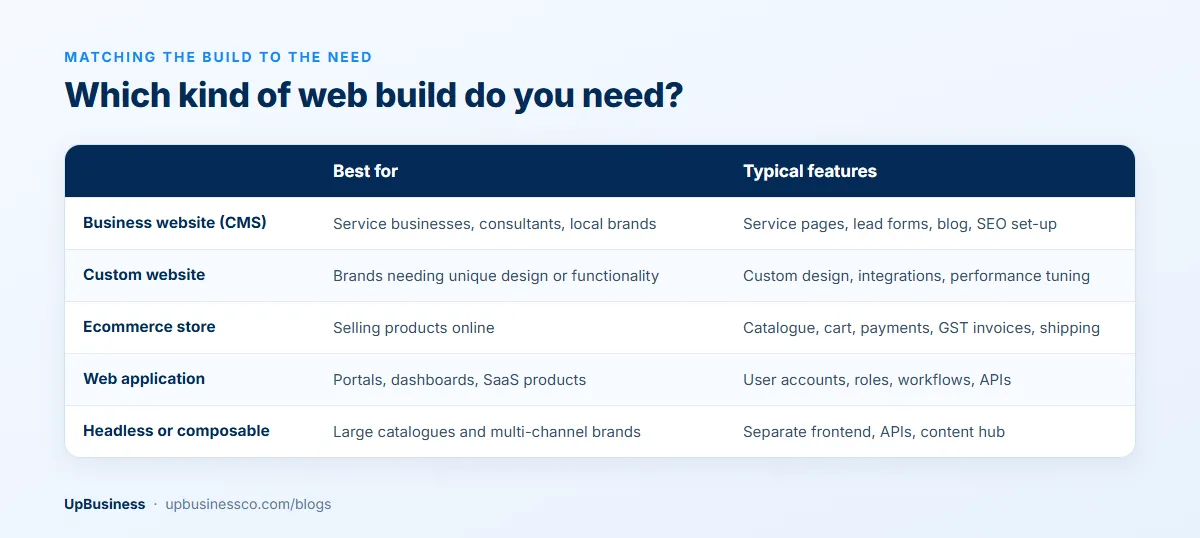
Most projects fall into one of five types, and the type decides the price, timeline and kind of company you need far more than the number of pages does.
| Build type | Best for | Typical features |
|---|---|---|
| Business website (CMS) | Service businesses, consultants, local brands | Service pages, lead forms, blog, SEO setup |
| Custom website | Brands needing unique design or functionality | Custom design, integrations, performance tuning |
| Ecommerce store | Selling products online | Catalogue, cart, payments, GST invoices, shipping |
| Web application | Portals, dashboards, SaaS products | User accounts, roles, workflows, APIs |
| Headless or composable | Large catalogues and multi-channel brands | Separate front end, APIs, content hub |
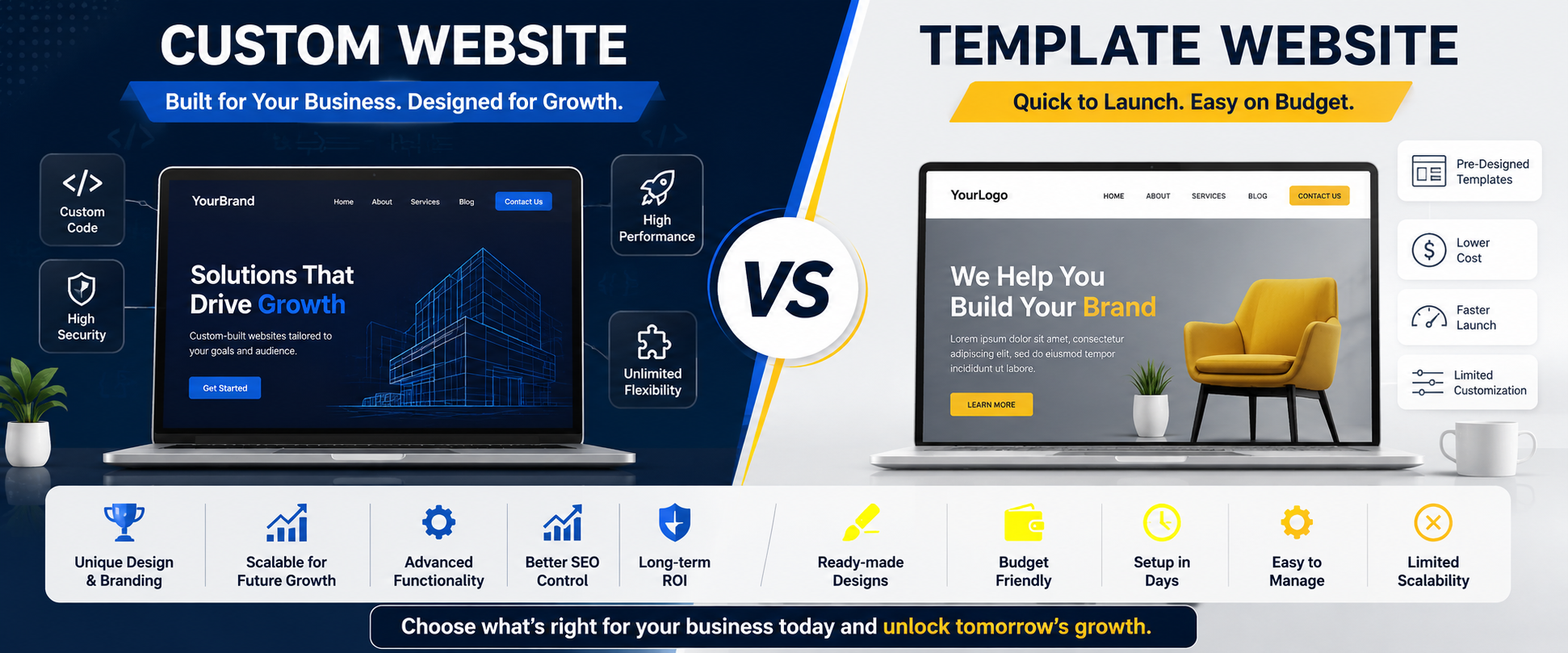
If you’re deciding between a theme-based site and a custom build, our guide to custom vs template websites covers that choice. For online stores, see ecommerce web development services, and for products people log into, our SaaS application development guide.
How a Web Development Project Runs
A well-run project moves through the same stages whatever its size. The difference between a smooth project and a painful one is usually whether the early stages were done properly.
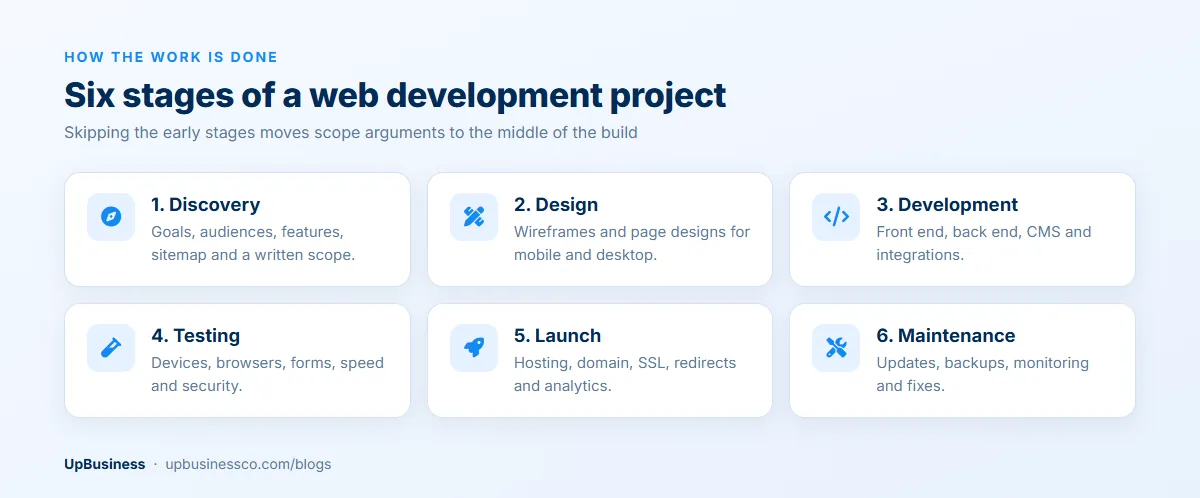
Be cautious of any company that wants to start coding straight after the first call. Skipping discovery doesn’t make the project faster; it moves the arguments about scope to the middle of the build, where they cost the most. Equally, launch isn’t the end. Plugins, frameworks and browsers change, and a site nobody maintains gets slower and less secure every month.

Browse our curated list of Top Web Development Companies
Pricing Models and What Web Development Costs in India
Indian web development companies usually price in one of three ways: a fixed price for an agreed scope, time and materials at an hourly or monthly rate, or a monthly retainer for ongoing work. Indian development teams typically bill around $15–35 an hour for custom web application work[2].
| Type of project | Typical cost in India (2026) | Source |
|---|---|---|
| Basic WordPress business website | $160–320 | WordPress cost guide[1] |
| Professional corporate website | $320–840 | WordPress cost guide[1] |
| Custom WordPress website | $840–2,600 | WordPress cost guide[1] |
| Business web app with CRM integration | $1,050–2,100 | Web application guide[2] |
| Custom internal tool, dashboard or portal | $5,300–31,600 | Web application guide[2] |
The same web application guide recommends budgeting 25–30% above the initial quote for the first year and 15–20% of the build cost every year for maintenance[2]. Hosting, payment gateway fees and API costs for SMS or WhatsApp come on top. Our website development cost guide breaks these down in more detail.
Why Speed Belongs in the Scope
Page speed has a measurable effect on revenue. Portent’s study of 5.6 million sessions across 20 sites found that an ecommerce site loading in 1 second had a conversion rate 2.5 times higher than one loading in 5 seconds[3].
Google’s Core Web Vitals give you concrete targets to write into the proposal: Largest Contentful Paint within 2.5 seconds, Interaction to Next Paint of 200 milliseconds or less and Cumulative Layout Shift of 0.1 or less, measured at the 75th percentile of real visits[4]. Ask the company to commit to these on mobile and to share the test results before launch.
What UpBusiness Data Shows About Web Development Companies
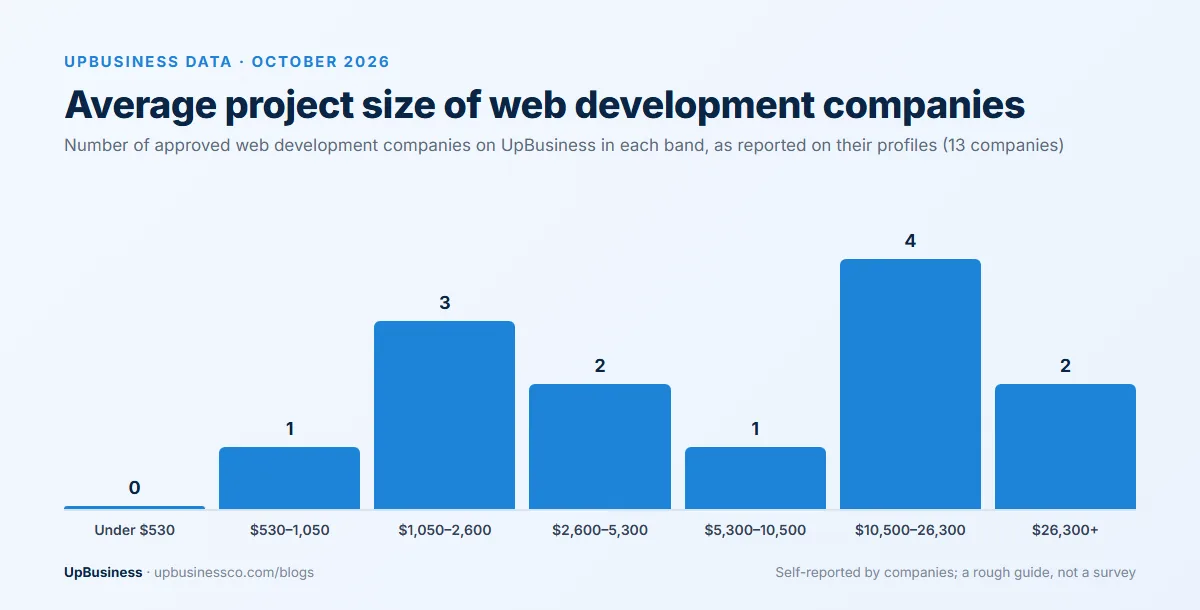
The 13 approved web development companies on UpBusiness report a median average project size of $5,300, with six of them at $10,500 or more. Entry points are lower: at least half of them have minimum projects of $1,050 or less, so a smaller business site is within reach of most. Nine of the thirteen have between 11 and 200 employees, and the typical company has been in business for about nine years. Healthcare is the industry they mention most often. These figures are self-reported on company profiles (October 2026).
How to Choose a Web Development Company in India
- Relevant work: ask for live sites similar to yours in type and size, then open them on your phone and judge how they feel to use.
- Process: ask them to walk you through discovery, design, development, testing and launch, and who you’ll talk to at each stage.
- Technology choice: a company should explain why a platform suits your project, not use the same one for every client.
- Speed and quality: agree Core Web Vitals targets on mobile and a testing checklist in the proposal.
- Ownership: under India’s Copyright Act, an assignment of copyright is valid only in writing[5], so the contract should assign all custom design and code to your company.
- Accounts: the domain, hosting, CMS admin and every paid licence should be registered in your company’s name.
- Support: get the maintenance retainer and what it covers in writing before launch.
Our guide to comparing software development proposals shows how to score quotes with fixed weights, so the cheapest one doesn’t win by default.
Red Flags in a Web Development Proposal
- One total price with no breakdown into design, development, integrations and testing.
- No discovery or planning stage before design starts.
- No mention of mobile speed, testing or who fixes bugs after launch.
- Hosting, domain or licences set up in the company’s own name.
- Nothing in writing about who owns the code and designs.
Find Web Development Companies on UpBusiness
On UpBusiness you can compare verified web development companies, custom website developers, web application developers and ecommerce website developers by TrustScore, project size and profile, and add website maintenance support after launch. You can also post your project once and get proposals from verified partner companies against the same brief.
Keep Reading
- Website Development Cost Guide for Businesses in 2026
- Custom Website vs Template Website in India (2026)
- Ecommerce Web Development Services
Browse our curated list of Top Web Development Companies