

Ecommerce Web Development Services
Launching an online store takes an afternoon now. Building one that converts, stays fast when traffic spikes and doesn't need rebuilding in eighteen months is much harder, and it's the part most ecommerce businesses underestimate.
Below we walk through what ecommerce web development involves, the kinds of stores and services on offer, what builds cost in 2026, and how to pick a partner you won't have to replace a year later.
What Ecommerce Web Development Actually Involves
Ecommerce web development means designing, building, integrating and maintaining a website that takes money, rather than one that only shows information. That difference is bigger than it sounds. A normal website has to look good and load quickly. A store also has to process payments safely, keep stock levels accurate, handle customer accounts and order history, and stay up when a sale or a festive weekend sends traffic through the roof.
In practice the work covers the frontend shoppers see, the backend that runs orders and stock, payment gateway integration, cart logic, security, and a growing pile of third-party connections. CRM, ERP and marketing tools are the usual ones, and more stores now add an AI personalisation layer on top.
Which Type of Store Are You Actually Building?
B2C Ecommerce
B2C Ecommerce sells straight to individual shoppers. Fashion, electronics and beauty stores are the typical examples, the kind most people picture when they hear "online store." Here the priority is usually speed to purchase: quick browsing, an easy checkout and as few steps as possible between interest and payment.
B2B Ecommerce
B2B Ecommerce sells to other businesses, and that changes the brief a lot. You need bulk ordering, prices negotiated per account, links to the buyer's procurement system and approval steps that a consumer store never has to think about.
Marketplace Ecommerce
Marketplace Ecommerce brings many sellers and buyers onto one platform, the way Amazon does. It's the hardest of the four to build, because on top of everything a normal store does it has to manage sellers, split payments and work out commissions.
D2C Ecommerce
D2C Ecommerce is a brand selling directly to customers with no retailer in between. It's increasingly common, and it leans heavily on the brand's own marketing, since no marketplace algorithm is sending shoppers your way.
Choosing the wrong model early is expensive. A B2C storefront patched up six months later to handle B2B bulk orders usually costs more than building it properly the first time.
The Different Types of Ecommerce Development
Custom Ecommerce development
Custom Ecommerce development builds the store around your own requirements. It's the right call when your workflows, integrations or customer experience really don't fit a template.
Enterprise Ecommerce development
Enterprise Ecommerce development handles large catalogues, several stores, operations in many countries and a lot of automation. It's designed for scale from the first day instead of being stretched to fit later.
B2B Ecommerce development
B2B Ecommerce development focuses on bulk ordering, tiered pricing, account-based buying and procurement integrations. The feature set looks very different from a consumer store.
Marketplace development
Marketplace development builds the system that lets many sellers manage their own products and orders in one shared store. It's hard to get right, and we'd rarely hire a team for it unless they've built a marketplace before.
Headless Ecommerce development
Headless Ecommerce development separates the storefront people see from the commerce engine behind it. You get more freedom over the shopping experience and usually better speed. Brands that plan to sell through a website, an app and an in-store kiosk from one backend increasingly start here.
The Ecommerce Development Process, Start to Launch
It starts with discovery and planning: business analysis, a look at the market and competitors, and a written list of requirements before anything is designed. Skip it and scope creep usually shows up about three weeks into development.
Next comes UI and UX design. The team maps how shoppers find products, how they move through checkout and how all of it works on a phone, because most ecommerce traffic now arrives on mobile.
Then the build. Frontend development covers the responsive pages, product pages and interactive parts shoppers touch. Backend development covers product data, customer accounts, orders, stock and security behind the scenes.
Payment gateway integration connects Stripe, PayPal, Razorpay, Authorize.Net or whatever mix suits the payment habits of your market.
Before launch, testing checks that everything works, holds up under load, is secure and behaves on different devices. After go-live, the team should watch the site closely through the first days of real traffic.
And then maintenance: security patches, speed tuning and new features, for as long as the store runs. An ecommerce site is never really finished.
Also Read, Website Development Cost in India 2026: Full Guide
The Features an Ecommerce Website Can't Launch Without
Start with a product management system you can trust for the catalogue and stock. If the inventory data is wrong, nothing else matters.

Browse our curated list of Top E-Commerce Development Companies
Search and filters decide whether shoppers find what they came for or leave, and that gets more important as the catalogue grows. A secure checkout with several payment options has a direct effect on how many carts get abandoned. And mobile layout is no longer optional, since a phone is how most shoppers will ever see your store.
Customer accounts with order tracking bring people back in a way guest checkout never does. AI product recommendations can lift average order value noticeably when they're done well, which is why they've moved from a nice extra to a normal line item in 2026 builds. Finally, connect analytics from day one, so "the site is live" turns into "we know what's working."
Picking the Right Platform
| Platform | Best For | Scalability | Customization |
|---|---|---|---|
| Shopify | Small to mid-size businesses | High | Medium |
| Magento (Adobe Commerce) | Enterprise businesses | Very high | Very high |
| WooCommerce | WordPress-based businesses | Medium | High |
| BigCommerce | Growing businesses | High | Medium |
| Headless commerce | Large enterprises, multi-channel brands | Very high | Very high |
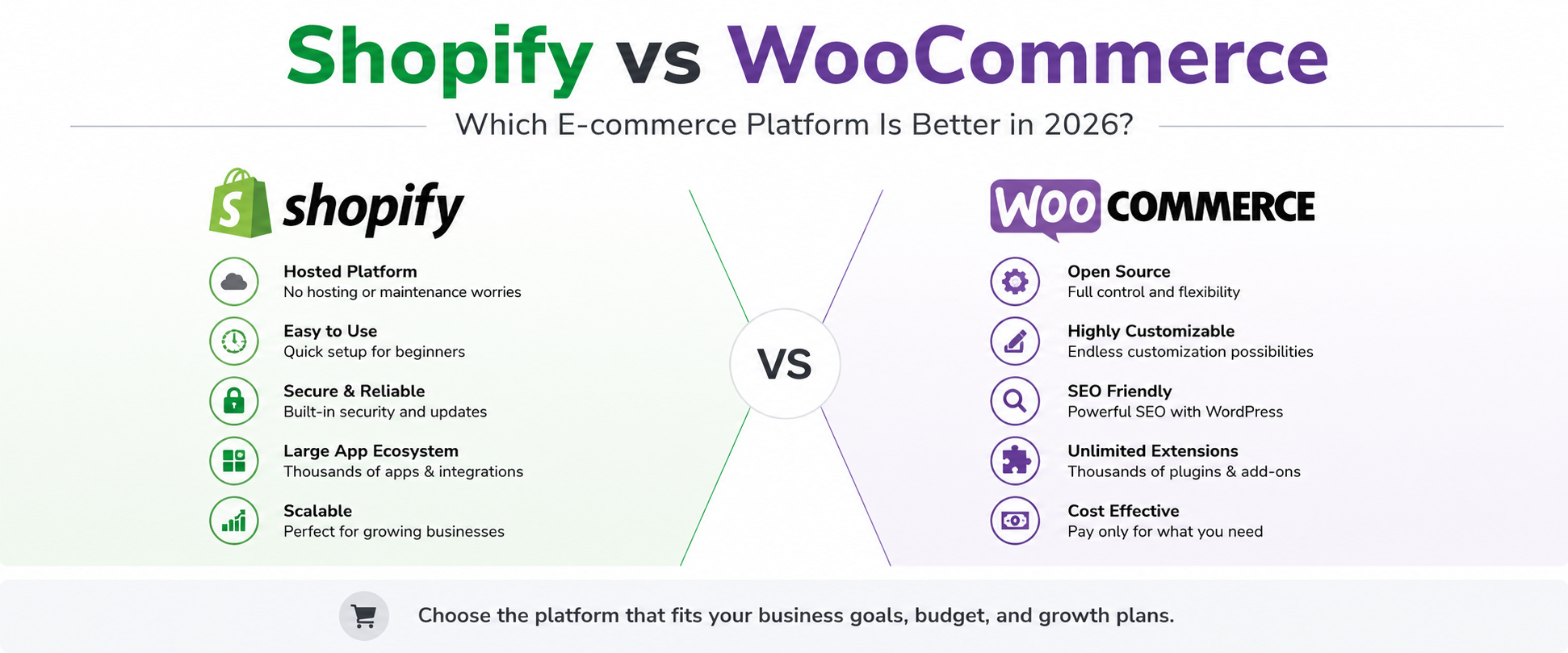
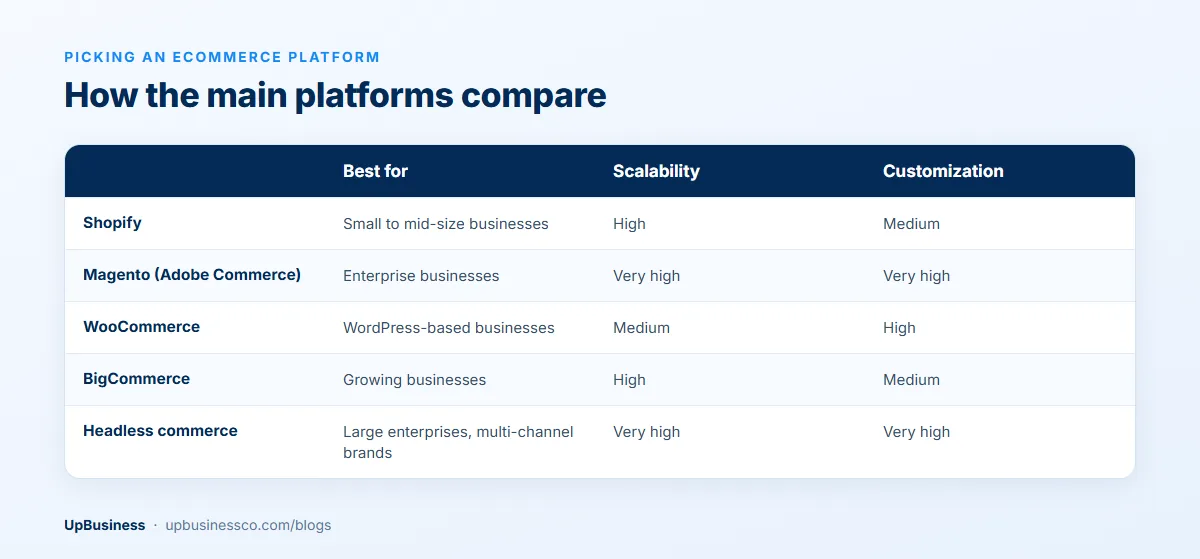
Pick the platform that fits how you plan to grow, not the one your agency happens to like. Shopify and BigCommerce get you live fastest with the least technical work. Magento and headless setups cost more and take longer, but they remove limits that smaller platforms eventually hit. WooCommerce sits in the middle. It's very flexible, but only as reliable as the hosting and plugin upkeep behind it.
Ecommerce Website Development Cost in 2026
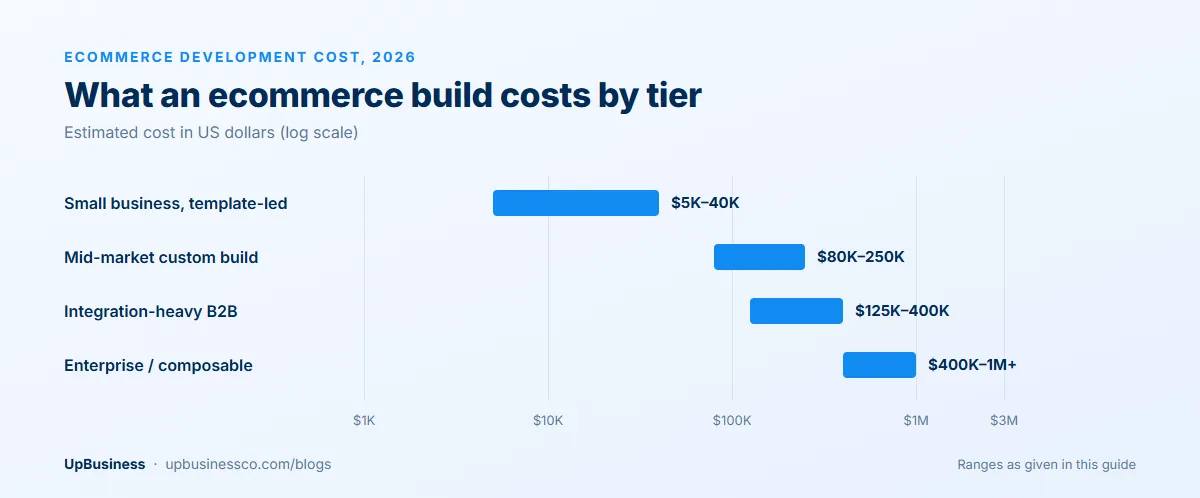
Prices vary more here than for almost any other kind of website, because "ecommerce site" can mean a Shopify store on a theme or a full enterprise platform. The tiers below are rough global ranges in US dollars. Indian projects are often priced lower, so treat them as a guide, not a quote.
| Tier | Typical Scope | Estimated Cost (2026) |
|---|---|---|
| Small business / template-led | Hosted platform, commercial theme, standard payments and shipping, small catalog | $5,000 – $40,000 |
| Mid-market custom build | Custom storefront, several integrations, moderate catalog complexity | $80,000 – $250,000 |
| Integration-heavy B2B | Bidirectional ERP/PIM/OMS integration, custom B2B workflows | $125,000 – $400,000 |
| Enterprise / composable | Headless or multi-brand architecture, global operations, advanced automation | $400,000 – $1,000,000+ |
For India, current 2026 sources generally put a serious custom build at $4,200–18,900 for most funded D2C and retail brands. Enterprise or headless builds start at around $21,100 and can run well past $105,000 for large multi-store operations.
Where you land in those ranges depends on the platform, how complex the catalogue is, how many integrations you need and how deep they go (ERP, CRM, PIM), any custom checkout or subscription logic, security and compliance needs, and more and more often, how ready for AI the setup has to be.
Also Read, SaaS Application Development 2026 Cost, Process & Benefits
On UpBusiness, 4 verified companies list ecommerce development among their services. Their minimum project sizes range from $53 to $5,300, and the typical project sizes they report range from $260 to $26,300 (UpBusiness data, October 2026).
What AI and Agentic Commerce Are Adding to the Price Tag
This is new, and many older cost guides ignore it. AI personalisation, vector search, shopping assistants you can chat with and AI-driven checkout flows (sometimes called agentic commerce) are now their own budget line. What they cost depends on how far you take them. Ask partner companies to price AI features separately so you can judge each one on its value.
Be choosy here instead of saying yes to AI everywhere. A recommendation engine that lifts average order value pays for itself quickly. A chat assistant added because it's fashionable, with no clear job to do, just costs money. AI projects in every other field fall into the same trap.
Selling Online in India: Payments, Fees and GST
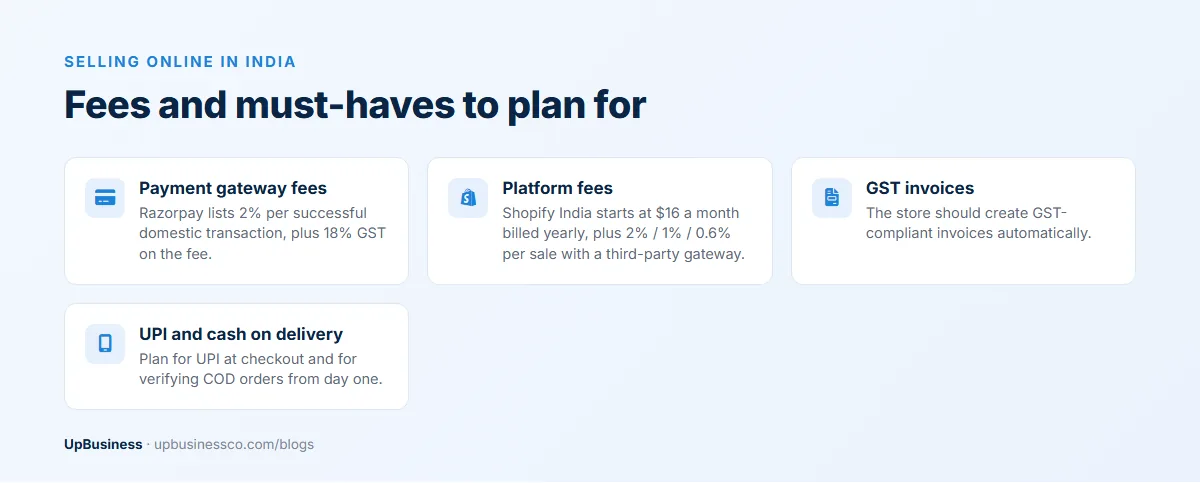
Payment gateways take a cut of every sale. Razorpay lists 2% per successful domestic transaction plus 18% GST on the fee, and international cards cost more.
Your platform takes its share too. On Shopify India, plans start at $16 a month billed yearly. If you use a third-party payment provider, Shopify adds a 2% fee on the Basic plan, 1% on Grow and 0.6% on Advanced.
A few India-specific basics belong in the brief from day one. The store should create GST-compliant invoices automatically. Plan for UPI at checkout and for verifying cash-on-delivery orders, because many Indian shoppers expect both. And if you also sell on marketplaces, set up stock and order sync from the start rather than bolting it on later.
Questions to Ask Before Hiring an Ecommerce Development Company
Ask about platform certifications and how deep their experience goes. A team that's great on Shopify isn't automatically ready for an enterprise Magento build, because the two need different skills.
Look for real ecommerce work, beyond general web projects. A checkout that copes with failed payments, refunds and partial orders is a different job from a marketing site. When you review the portfolio, ask for results such as conversion lift, faster pages or revenue growth, and don't judge on looks alone.
Check their security and compliance practices, because a breach on a store exposes customers' payment details on top of taking the site down. And agree on post-launch support before you sign. A store is never done, and a partner who disappears after launch leaves you with problems you never planned to handle alone.
Ecommerce Trends Worth Building For in 2026
AI shopping features are the big one. Personalised recommendations and chat-based shopping are moving from something that sets a store apart to something shoppers simply expect.
Headless commerce keeps growing as brands want one backend to power their website, app and physical stores at the same time. Voice shopping is a smaller slice, though it's growing. Mobile-first is no longer a trend at all, just the starting assumption for every build. And AR previews are catching on in furniture and fashion, where seeing a product in your own room or on yourself measurably cuts returns.
Your Post-Launch Checklist
Going live is where the real work starts. Get the SEO basics in place so people can find the store. Watch analytics and conversion data closely in the first few weeks, when real shoppers expose problems no pre-launch test caught.
Keep working on page speed, because even small delays cost sales. Run A/B tests on checkout and product pages instead of guessing what's underperforming, and keep improving the experience based on how people actually shop. Once the core store is stable, look at selling across more channels. And set money aside for new features. The stores that stay competitive keep shipping improvements long after launch.
Ecommerce Website Development Cost in 2026: Conclusion
An online store is less about the storefront than the system the rest of the business runs through: marketing, fulfilment and keeping customers coming back. Getting the store type, platform and scope right at the start costs more upfront than cutting corners. It's still cheaper than the rebuild that follows a bad early decision.
So if you're launching a first store, moving an old one to a new platform or scaling into an enterprise or headless setup, choose the partner carefully. They'll shape your conversion rate, how well the store scales and how often you have to redo all this over the next five years.
Browse our curated list of Top E-Commerce Development Companies