

Shopify vs WooCommerce:
Opening an online store is easy now. The hard part is choosing a platform you won't regret in eighteen months. Choose badly and you either pay for things Shopify would have handled for free, or you run into a customisation wall WooCommerce would never have put in your way.
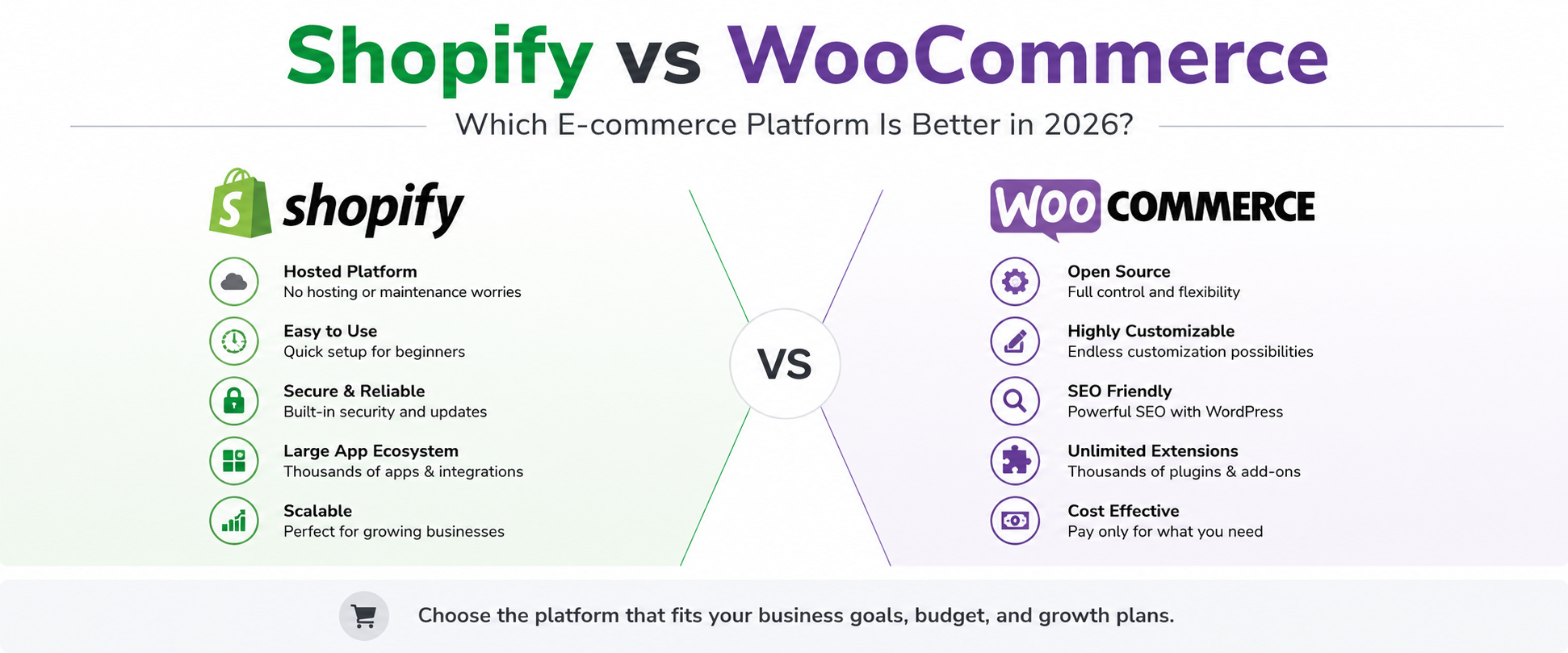
For most businesses the choice comes down to Shopify vs WooCommerce. Both run millions of stores around the world, but they solve the problem in nearly opposite ways. Shopify is a fully hosted, all-in-one platform. WooCommerce is a free, open-source plugin that turns a WordPress site into a store.
The quick answer: choose Shopify if you want a fast launch, predictable monthly costs and no technical upkeep. Choose WooCommerce if SEO and content marketing are central to how you plan to grow, or if you need customisation that Shopify's apps can't provide. Neither is better for everyone. The right one depends on your budget, your technical help and how much control you want over the backend.
What is Shopify vs WooCommerce?
Shopify is a cloud-based, fully hosted ecommerce platform. You don't manage servers, security patches or uptime, because Shopify handles all of that. That's exactly why it's the usual choice for non-technical founders who'd rather spend their time selling than looking after servers.
WooCommerce is an open-source plugin that runs on WordPress, which sits behind a large share of the web. Installing it turns a WordPress site into a full store, but you (or your host) become responsible for hosting, backups, security and speed. In return you get complete control over how the store is built.
Both platforms are used by very large numbers of stores. WooCommerce runs on WordPress, which powers about 40% of all websites (W3Techs), while Shopify is a hosted platform for merchants who'd rather pay a monthly fee for a managed service. WooCommerce users range from hobby shops to major retailers.
Also Read, AI in Digital Marketing: 2026 Founder's Guide
Why This Comparison Actually Matters in 2026
Online shoppers now expect fast pages, a store that works well on a phone and some personalisation. More and more, they also expect your product to come up when they ask an AI assistant for a recommendation, as well as when they search Google. The wrong platform limits how well you can do any of that. Slow pages lose sales. Thin customisation forces workarounds that cost more later. And a setup that needs a lot of upkeep, without anyone to do it, loses sales during the very traffic spikes you were hoping for.
How Each Platform Actually Works
With Shopify, you sign up, pick a theme, add products, connect payment gateways, set shipping rules and launch. Shopify takes care of hosting, security, PCI compliance and speed in the background. The whole idea is that you never have to think about servers.
With WooCommerce, you buy hosting, install WordPress, install the WooCommerce plugin, set up the store, add the plugins you need, adjust the theme and launch. Hosting, backups, security and speed are now yours to manage, or your paid host's. It's more work, but no part of the store is locked behind someone else's platform decisions.
Quick Comparison
| Feature | Shopify | WooCommerce |
|---|---|---|
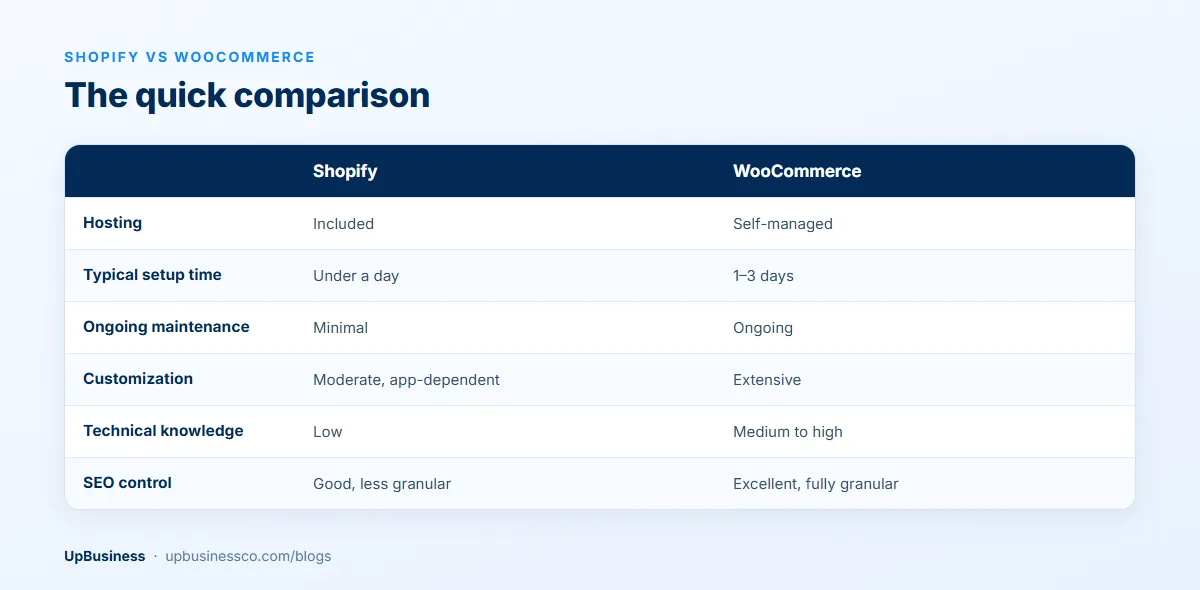
| Hosting | Included | Self-managed |
| Typical setup time | Under a day | 1–3 days |
| Ongoing maintenance | Minimal | Ongoing |
| Customization | Moderate, app-dependent | Extensive |
| Technical knowledge needed | Low | Medium to high |
| SEO control | Good, less granular | Excellent, fully granular |
Shopify vs WooCommerce Pricing in 2026
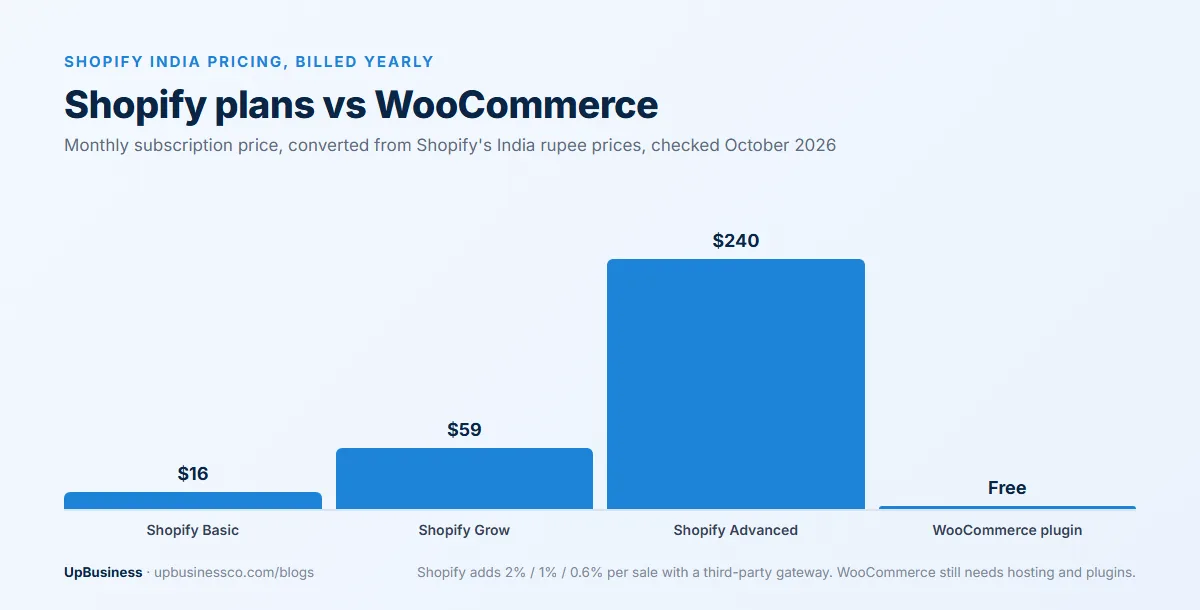
Shopify's India plans work out to about $16 a month (Basic), $59 (Grow) and $240 (Advanced) billed yearly, converted from the rupee prices on Shopify’s India pricing page (checked October 2026). If you use a third-party payment provider instead of Shopify Payments, Shopify adds a transaction fee of 2% on Basic, 1% on Grow and 0.6% on Advanced. Premium apps and themes cost extra.
The WooCommerce plugin itself is free. The real costs are hosting, a domain and any premium plugins or development work you need. Depending on how custom the build gets, that can be almost nothing or far more than Shopify. Payment gateways popular in India, such as Razorpay (which lists 2% per successful domestic transaction plus 18% GST on the fee), work with WooCommerce for UPI, cards and netbanking.
So don't compare sticker prices. Compare the total cost at your size. For a small, simple store, WooCommerce is usually cheaper. For a growing store that would otherwise need several paid plugins and regular developer time, Shopify's predictable monthly fee often works out about the same. Before you decide, add up your first year of subscriptions, apps or plugins, hosting, payment fees and developer time.
Also Read, Digital Marketing Cost in 2026: Complete Pricing Guide for Businesses
Selling in India: GST, Payments and Cash on Delivery
Both platforms can produce tax invoices, but check that your setup handles GSTIN, HSN codes and state-wise tax correctly. Indian shoppers expect UPI, cards, netbanking and wallets at checkout, so confirm your gateway supports all of them on the platform you choose.
Cash on delivery needs planning too. Verifying COD orders and handling returns to origin both eat into margins. For shipping, connect a courier aggregator for rates, labels and tracking. And on pricing, Shopify bills Indian plans in rupees, while WooCommerce costs depend on your hosting and plugins.
SEO: Where the Two Platforms Really Diverge
WooCommerce has the edge here. Because it's built on WordPress, it comes with a mature set of SEO tools: plugins such as Yoast and Rank Math, full control over URLs, detailed schema markup options and a capable blog for content marketing. If organic search will be a main source of growth, WooCommerce gives you more to work with.

Browse our curated list of Top Shopify Development Companies
That doesn't make Shopify's SEO weak. Automatic sitemaps, SSL by default, fast hosting and sensible built-in settings cover the basics well. What it lacks is the same fine control. URL structures are more rigid, and advanced technical SEO often means relying on an app instead of changing something directly.
Our take: if content marketing and organic search are central to your growth, WooCommerce's flexibility usually wins. If you want solid SEO basics without managing them yourself, Shopify holds its own.
Performance and Security
Shopify's strength is consistency. Hosting, CDN, caching and scaling are handled for you, so every store gets fast, reliable performance without any tuning. Security works the same way, with SSL, PCI compliance and updates all managed by Shopify.
WooCommerce performance is a range rather than a number. It depends on the quality of your hosting, how lean your theme is and how many plugins are piled on. A well-tuned WooCommerce store on good managed hosting can match or beat Shopify. A badly set up one on cheap shared hosting with too many plugins will be noticeably slower. Security follows the same pattern: more control, and full responsibility for keeping the store safe.
If steady performance without ongoing effort matters more to you than being able to tune it yourself, that's a real point for Shopify.
The Hidden Costs of Choosing the Wrong Platform
Most businesses compare the sticker price. The expensive mistakes show up later.
Scenario 1: Shopify, then outgrowing it. A growing B2B company launches on Shopify because it's quick to set up. Twelve months later it needs custom pricing workflows and marketplace features that Shopify wasn't built for. It ends up paying for expensive custom apps and a stack of subscriptions, and still hits limits a WooCommerce build would never have had.
Scenario 2: WooCommerce without the people to run it. A startup launches on WooCommerce to save money upfront. Within six months it's dealing with plugin conflicts, hosting problems and a slow site, because nobody on the team had time to handle what self-hosting involves. It pays for developers, loses sales while the site is slow and spends more overall than Shopify would have cost.
In neither case was the platform bad. It just didn't match the people and money the business had.
Which Industries Tend to Prefer Which Platform
| Industry | Common Choice | Why |
|---|---|---|
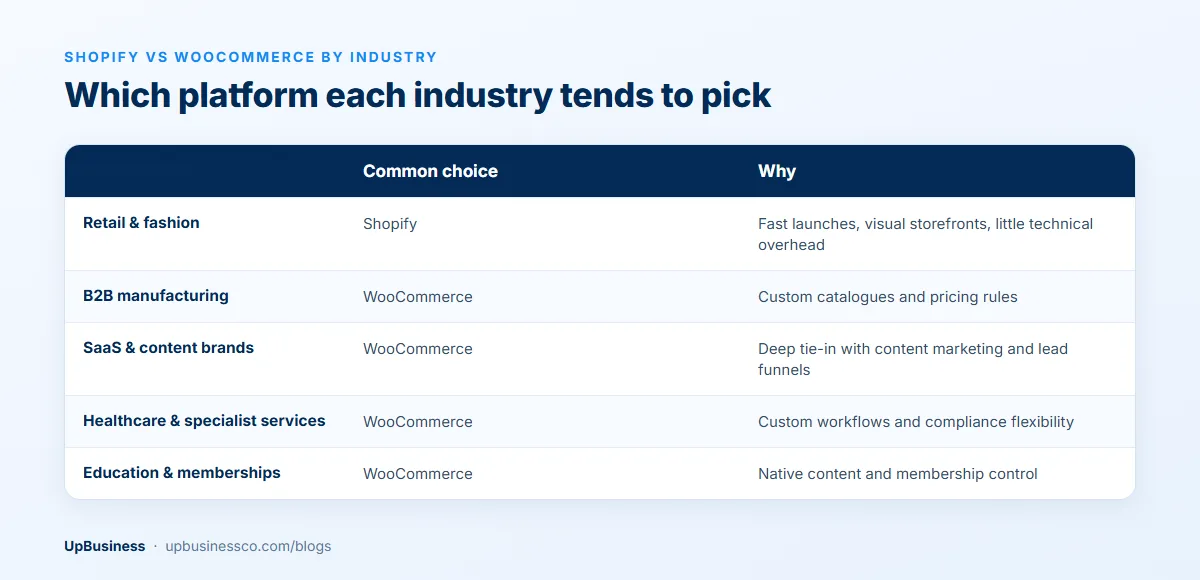
| Retail & Fashion | Shopify | Fast launches, visual storefronts, minimal technical overhead |
| B2B Manufacturing | WooCommerce | Custom catalogs and pricing rules Shopify's app ecosystem struggles with |
| SaaS & content-driven brands | WooCommerce | Deep integration with content marketing and lead-gen funnels |
| Healthcare & specialized services | WooCommerce | Custom workflows and compliance flexibility |
| Education & membership sites | WooCommerce | Native content and membership control |
These are patterns, not rules. A retail brand with strong technical help can do very well on WooCommerce, and a B2B company that values simplicity over customisation can make Shopify work.
How to Choose
Shopify is usually the better fit if you want to launch fast, have little technical help, prefer predictable monthly costs and would rather spend your time selling than managing servers.
WooCommerce is usually the better fit if organic search is a big growth channel, you need customisation Shopify's app store can't provide, you already know WordPress, or you have the technical people (in-house or hired) to look after a self-hosted store.
Ecommerce Trends Shaping 2026
AI personalisation, shopping through chat assistants, headless setups, voice search and first-party data are becoming things shoppers expect rather than extras. Both platforms support them to different degrees. Shopify keeps building AI tools into its main plans, while WooCommerce relies on plugins to keep up. Neither choice shuts you out of these trends. Shopify usually lets you adopt them faster out of the box, and WooCommerce gives you more say in exactly how they work.
Conclusion
There's no winner for everyone in the Shopify vs WooCommerce debate, and any comparison that names one is oversimplifying. Shopify wins on simplicity, reliability and the technical work it saves you. It suits startups and growing brands that want to focus on sales. WooCommerce wins on flexibility, SEO control and ownership, which suits businesses that grow through content and organic search, or that need customisation no app store can fully match.
Before deciding, be honest about your goals, budget, technical help and growth plans, and about how much you value SEO control compared with managed simplicity. The right platform fits where your business is today and where it's heading, whichever one has the bigger market share.
Need Help Choosing the Right Ecommerce Platform?
UpBusiness lists verified partner companies that build and scale ecommerce stores on Shopify, WooCommerce and custom platforms. You can compare their profiles and project sizes, then contact the ones that fit your brief.
Browse our curated list of Top Shopify Development Companies