
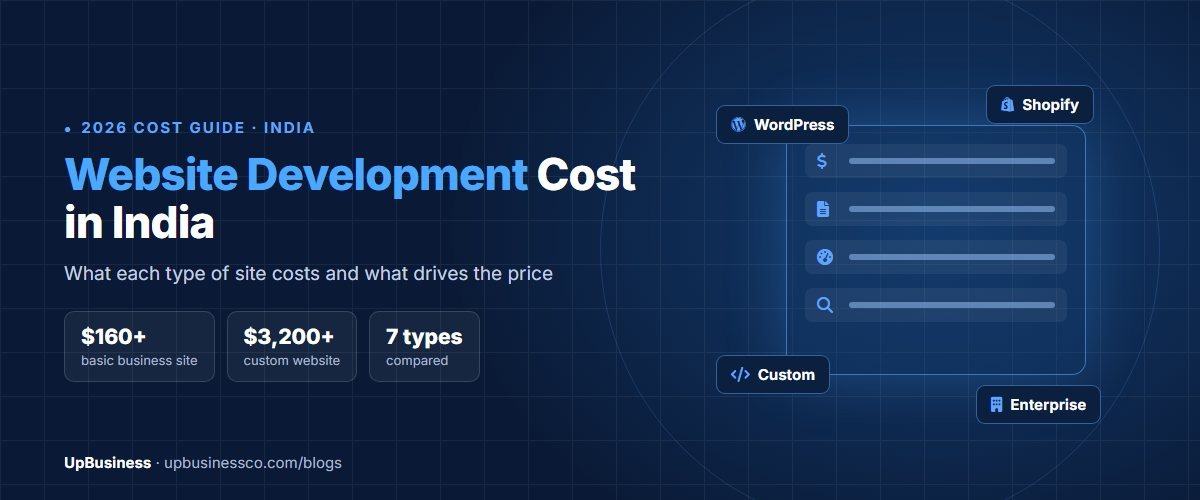

Website Development Cost in India
A website used to be an online brochure. For most businesses now, it's the first salesperson a prospect meets, the support desk that answers questions at 11pm and the thing that makes a stranger trust you before they've spoken to anyone.
That's why "how much does a website cost" doesn't have a one-line answer, because the price depends on what the site has to do. The honest range runs from about $20 a year for a site you build yourself to well over $100,000 for an enterprise platform. The businesses that get burned are usually the ones that picked a price without knowing what it bought, whether the number was high or low.
Below we break down what a website costs in India in 2026 by how it's built and what type it is, what pushes the price up or down, the costs people forget, and how to tell whether a quote is fair before you commit.
Also Read, Best Web Development Services 2026
What Determines the Final Price
How it's built
Building it yourself, hiring a freelancer and hiring an agency are three different ways of paying, not three points on one price scale. They also produce different results.
Number of pages and design complexity
A five-page information site obviously costs less than a fully custom, animated brand site. What surprises people is how big the gap gets once custom design work is in the quote.
Functionality
A contact form is easy. A booking system, a customer portal, online payments or a CRM connection each add real development time. This is usually where quotes for the "same" kind of site split furthest apart.
Content readiness
Businesses regularly underestimate how long copy, photos and product details take to prepare. A site that's finished from a coding point of view can sit for weeks waiting for content nobody got ready.
Ongoing maintenance needs
You pay for the build once. Security patches, updates and content changes keep coming, and skipping them is how a good website turns into a problem within a couple of years.
Website Pricing Models: DIY, Freelancer, or Agency
DIY / website builder
Tools such as Wix or managed WordPress hosting let you launch a working site yourself for roughly $21–530 a year, usually as an annual subscription rather than a project fee. It's the right choice when money is tight, the site only has to do something simple (a page, a contact form, basic details) and someone on your team has time to build and look after it.
Freelancer
Freelancers usually charge by the hour, typically $5–21/hour, or a flat fee starting at around $110–530 for a basic brochure site. That works for small, clearly defined jobs. The catch is that everything depends on one person being available.
Agency
Agency projects generally start at around $530 and can reach several thousand dollars depending on scope. You're paying for a team (designer, developer, SEO specialist) instead of one person's time, and that starts to matter once the site has to do more than just exist.
Website Types and What They Actually Cost
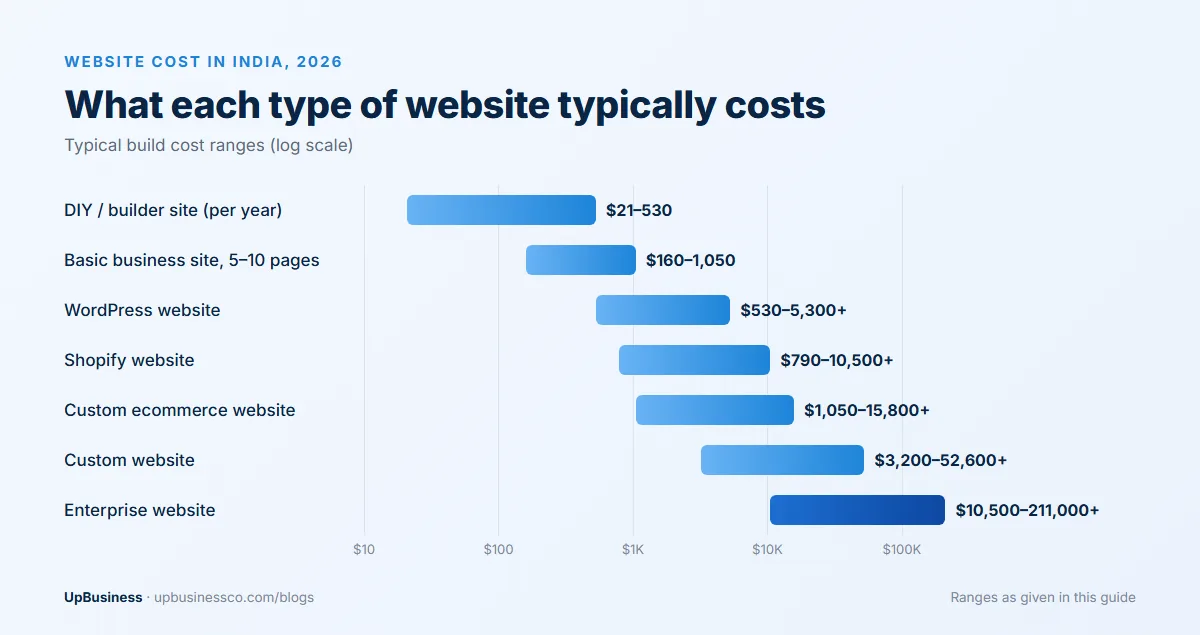
| Website Type | Typical Cost (India, 2026) | Best For |
|---|---|---|
| DIY / builder site | $21–530/year | Very simple sites, tight budgets, someone available to maintain it |
| Basic business website (freelancer or small agency, 5–10 pages) | $160–1,050 | Local businesses, consultants, small service providers |
| WordPress website (CMS-powered) | $530–5,300+ | SMEs and content-driven businesses that will update the site regularly |
| Shopify website | $790–10,500+ | Fast-growing ecommerce brands wanting a quicker launch |
| Ecommerce website (custom-built) | $1,050–15,800+, with serious D2C builds often landing in the $4,200–18,900 range | Retail, D2C brands, and manufacturers needing full store functionality |
| Custom website development | $3,200–52,600+ | Enterprises, SaaS companies, and marketplaces needing unique functionality |
| Enterprise website | $10,500–211,000+ | Large, multi-location, or government/corporate platforms |
Here's a quick check for any quote. If an agency (not a builder subscription) quotes well under $160 for a "basic business website," ask exactly what's included. That price rarely covers real design work, and it's where corners get cut on things you won't notice until after launch.
Also Read, Best AI Development Companies in India (2026)
What the Data Shows
On UpBusiness, 18 verified companies list web development among their services. Their minimum project sizes range from $53 to $10,500, and the typical project sizes they report range from $110 to $26,300 (UpBusiness data, October 2026).
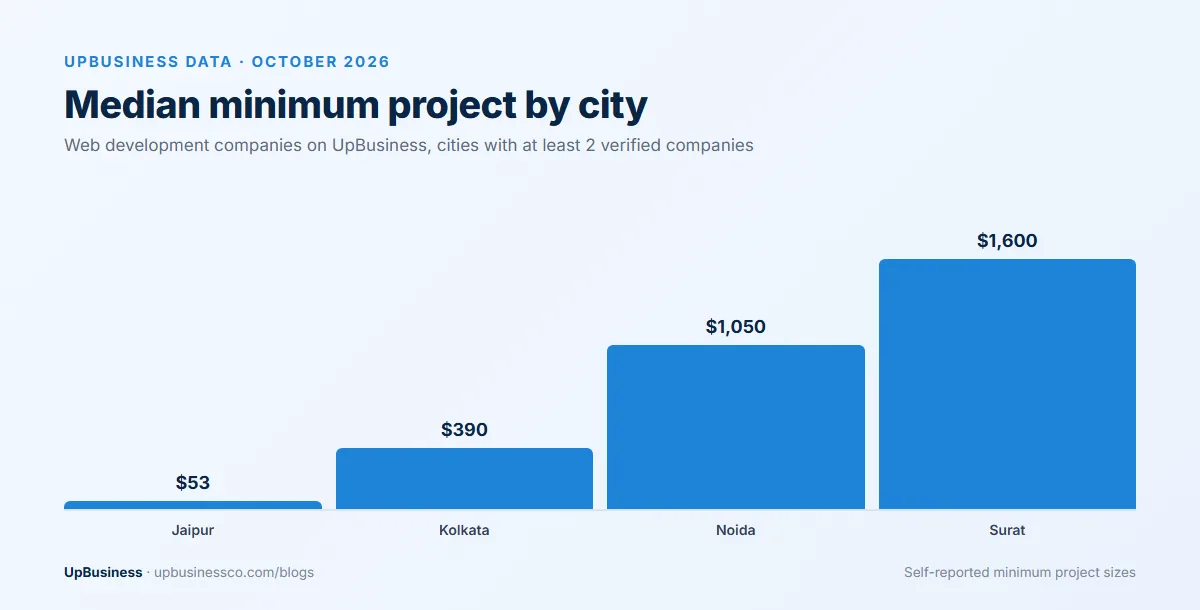
Minimum project sizes by city, for cities with at least 2 verified companies:
| City | Verified companies | Lowest minimum project | Median minimum project |
|---|---|---|---|
| Jaipur | 3 | $53 | $53 |
| Noida | 3 | $260 | $1,050 |
| Kolkata | 2 | $260 | $390 |
| Surat | 2 | $530 | $1,600 |
Speed matters as much as design. In Portent’s study of over 100 million page views, ecommerce sites that loaded in 1 second converted 2.5 times better than sites that loaded in 5 seconds.

Browse our curated list of Top Web Development Companies
Recurring Costs Most Businesses Forget to Budget For
The build price is rarely the whole bill. Budget for these every year, on top of the project itself:
- Domain registration: $8–32/year
- Hosting: $32–1,050+/year, depending on traffic and speed needs
- SSL certificate: often free with modern hosting, up to $210/year for premium options
- Maintenance: $110–5,300+/year, depending on how complex the site is and how often it changes
- Premium plugins or apps: $53–1,050+/year
Skipping any of them catches up with you, because a site with no maintenance budget slowly gets slower, less secure and harder to rank while it still looks fine on the surface.
The Real Cost of Choosing the Cheapest Option
Underspending tends to hurt more than overspending when the site has to bring in leads or sales.
A poorly built site loses leads it should have won, because visitors don't give a slow or confusing page a second chance. Old, cheaply built sites are also easier to attack, and once a breach or long outage damages trust, winning it back is expensive. Sites built without SEO basics end up leaning on paid ads to make up for it, and that bill comes every month, unlike the one-time cost of doing it properly. Cheap template sites also tend to need replacing within a couple of years, so the "savings" disappear into a second build.
Picture two businesses (an illustration, not a case study). One spends $420 on a low-cost template site. The other spends $3,700 on a professionally built site with SEO, CRM integration and conversion work included. If the cheaper site needs replacing within two years, as template builds often do, its real cost is the $420 plus a second build, along with the leads it lost in the meantime. Working with a verified web development partner from the start avoids that gap.
Where the Investment Actually Pays Off
Lead generation and revenue
A site built to convert, with clear calls to action, lead forms that work and a quick checkout or contact flow, beats a purely informational site on the numbers the business cares about.
Customer experience
Fast pages and a site that works well on a phone are now the minimum visitors expect. Fall short and you lose people before they've even seen your offer.
Operational efficiency
A good site can handle appointment booking, lead collection and simple customer questions on its own, which is work someone would otherwise have to do by hand.
Scalability
A well-structured site can take on new features and integrations as the business grows, instead of needing a rebuild from scratch every time the requirements change.
Here's an illustrative example, using assumed numbers rather than a benchmark. A consulting company spends $2,600 on a professionally built site. In a typical month it gets something like 5,000 visitors converting at roughly 3%, which is around 150 enquiries and 20 new clients. At that rate the site pays for itself quickly, though only your own numbers can tell you by how much. Track your own visitors, conversion rate and enquiries to see what your site really returns.
Website Builder vs. Custom Development
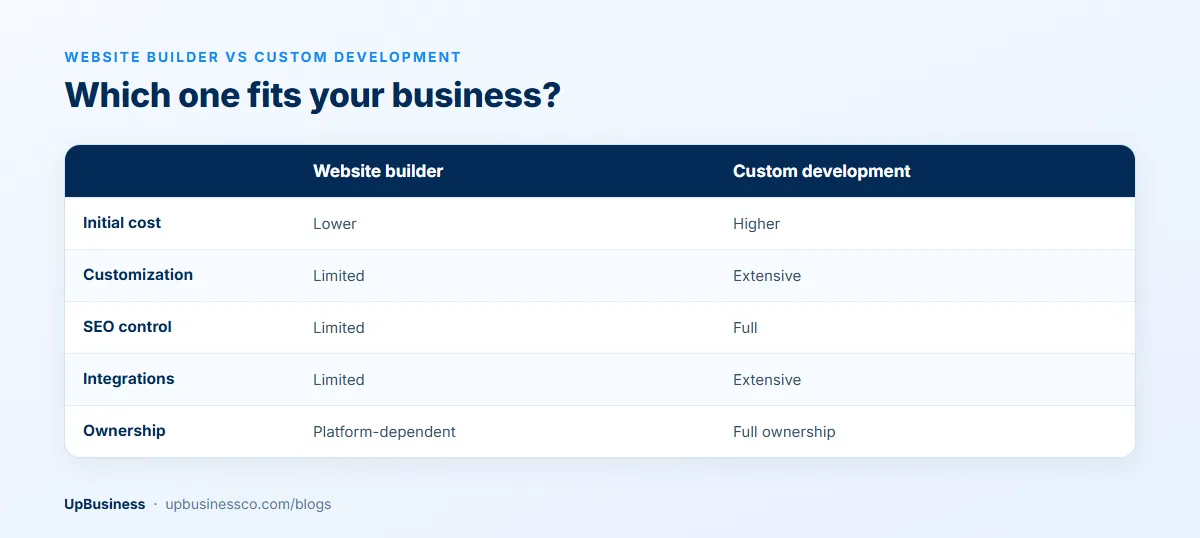
| Factor | Website Builder | Custom Development |
|---|---|---|
| Initial cost | Lower | Higher |
| Customization | Limited | Extensive |
| SEO control | Limited | Full |
| Integrations | Limited | Extensive |
| Ownership | Platform-dependent | Full ownership |
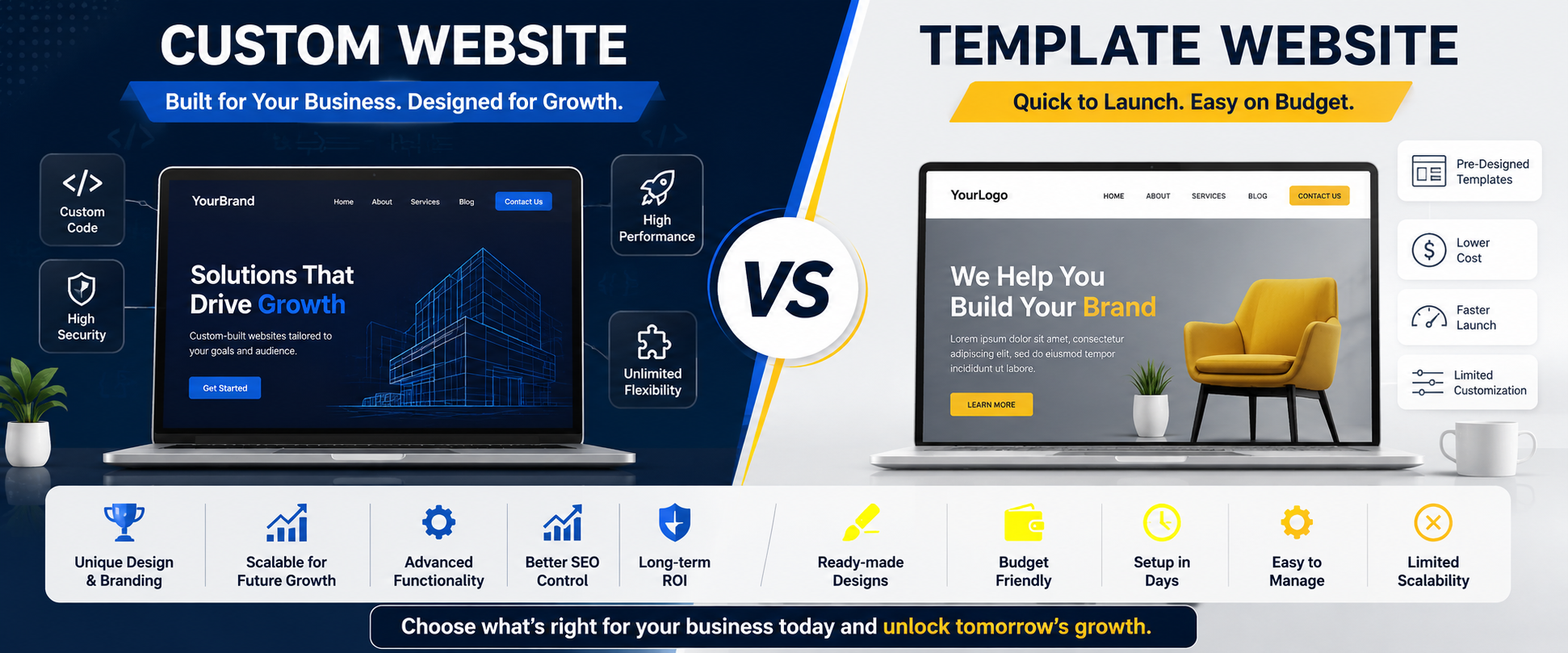
Choose a builder when the budget is tight, you need to launch fast and the site only has to do simple things. Go custom when growth is the priority, SEO is a main channel rather than an afterthought, or you need features no template offers. The deciding factor is usually where you want the business to be in a few years, not only what you can afford today.
How to Choose the Right Development Partner
Look past how pretty the portfolio is. Ask about experience in your industry and the results their sites produced.
Get them to walk you through their process (discovery, design, development, testing, launch and support) instead of accepting vague reassurance. Check that they understand technical SEO, Core Web Vitals and site structure, because a site that looks good but can't rank won't bring in visitors on its own.
Ask plainly what happens after launch: who handles updates, what support is included and what it costs when something breaks. And compare their technology experience with what your project needs. A team that's strong in WordPress isn't automatically right for a React or headless CMS build, and that mismatch shows up later as rework.
Ready to Build a High-Performance Website?
At UpBusiness, you can compare verified web development partner companies by project size, city and TrustScore, then shortlist the ones that fit. If you'd rather they came to you, post your project and we'll match you with companies whose typical work fits your budget.
Website Development Cost in India: Conclusion
Getting website cost right is about matching the spend to what the site has to do for your business, and the lowest number is rarely that match. A $420 template site and a $3,700 conversion-focused platform are built for different jobs, so decide what the site has to do for the business first and the ranges in the table above will narrow quickly.
Browse our curated list of Top Web Development Companies