

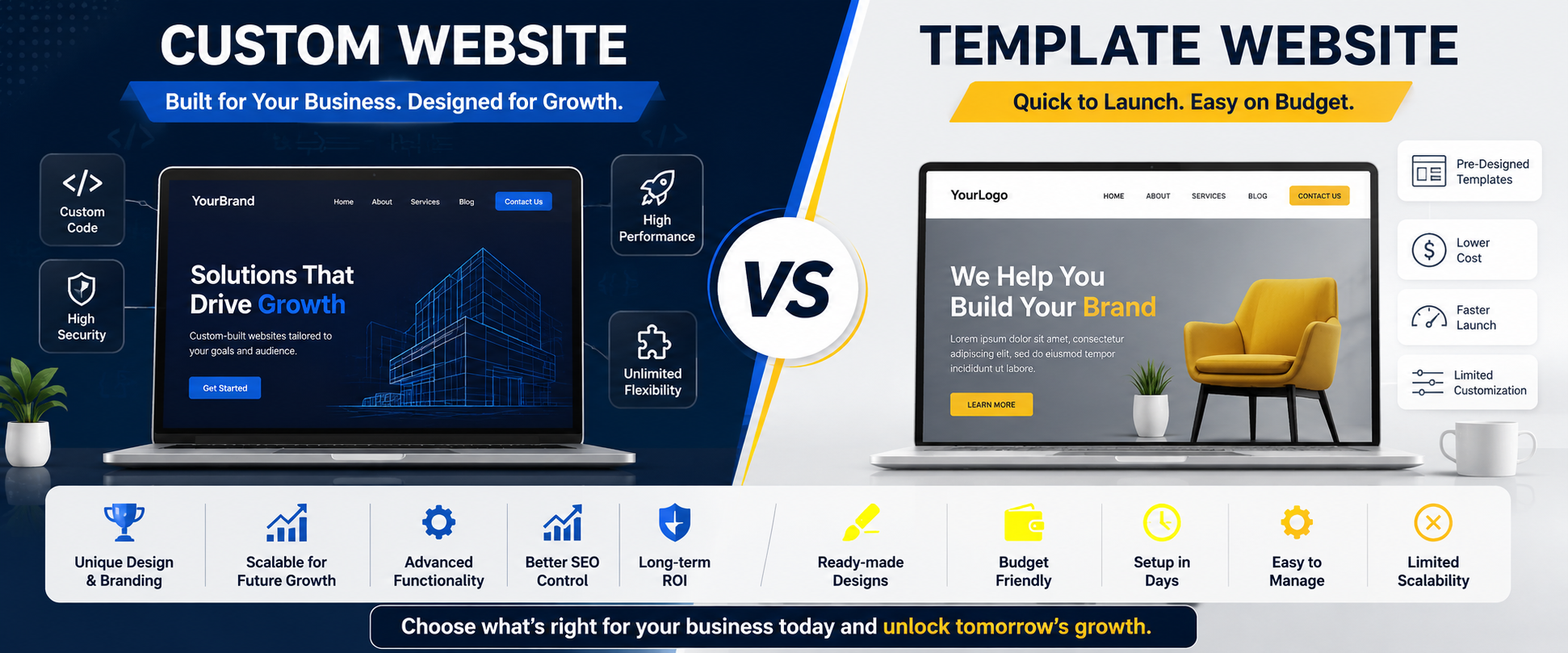
Custom Website vs Template Website in India 2026
Key Takeaways
43.6% of all websites globally run on WordPress, making template-based websites the dominant approach for small businesses.
Website builder software is forecast to grow at over 16% CAGR through 2031, showing continued demand for DIY and template solutions.
Custom websites typically cost 5–20x more upfront than template websites but often deliver better scalability and long-term ROI.
Performance, SEO flexibility, integrations, and branding are the biggest reasons growing businesses move from templates to custom development.
Introduction
When I say "custom website," most business owners immediately think expensive.
When I say "template website," they think affordable.
The reality is more complicated.
A template website can absolutely launch a business. In fact, WordPress powers more than 43.6% of all websites globally, and most of those sites use pre-built themes. At the same time, many fast-growing businesses eventually outgrow templates because they need better performance, unique functionality, and stronger brand differentiation.
The question isn't whether custom websites are better.
The question is whether they're better for your stage of business.
This guide covers costs, benefits, growth drivers, website trends, ROI considerations, and how to choose the right website partner.
No Jargon, Only Numbers That Matter
WordPress powers 43.6% of all websites globally and controls over 61% of the CMS market, making template-based websites the most widely adopted website solution.
The global website builder market is projected to reach approximately $7.67 billion by 2031, growing at over 16% CAGR, indicating strong demand for low-cost website creation tools.
More than 18 million websites currently use DIY website builders such as Wix, Squarespace, and Webflow.
Google research consistently shows that users expect websites to load in under 3 seconds, making website performance a critical business metric rather than a technical concern.
Studies from multiple UX organizations suggest that website credibility is heavily influenced by design quality, which is one reason companies increasingly invest in custom web design as they scale.
Why the India Website Development Market?
1. Digital-First Businesses Are Growing Rapidly
India continues to experience rapid digital adoption. Businesses across retail, healthcare, SaaS, education, and financial services increasingly rely on websites as primary customer acquisition channels.
2. Affordable Development Talent
India remains one of the world's largest technology talent hubs. Companies can access highly skilled developers at significantly lower costs compared to North America or Western Europe.
3. SEO Has Become a Competitive Advantage
Businesses now view websites as revenue-generating assets rather than digital brochures. Better SEO performance often requires custom architecture, structured data implementation, and optimized code.
4. Customer Expectations Have Changed
Modern buyers expect fast, personalized, mobile-friendly experiences. Generic templates often struggle to meet advanced customer expectations as businesses scale.
India Website Development Trends in 2026
AI-Assisted Website Development
AI tools are accelerating design and development workflows. While templates are becoming smarter, businesses still require custom development for unique business logic and integrations.
Performance-First Development
Core Web Vitals continue influencing user experience and SEO. Businesses increasingly prioritize page speed, lightweight code, and optimized user journeys.
Headless Architecture Adoption
Growing SaaS and enterprise businesses are moving toward headless CMS solutions for greater flexibility and scalability.
Conversion-Focused Design
The conversation is shifting from aesthetics to business outcomes. Companies now evaluate websites based on lead generation, conversions, and customer acquisition cost.
Who's Actually Spending? Industries Driving Demand
SaaS Companies
SaaS businesses require highly customized user journeys, product pages, integrations, and conversion optimization.

Browse our curated list of top companies on UpBusiness
Healthcare
Healthcare providers need compliance, appointment systems, patient portals, and secure data handling.
E-Commerce
Retail businesses often start with Shopify templates but move toward custom solutions as product catalogs and integrations become more complex.
Professional Services
Consultants, agencies, law firms, and financial advisors increasingly invest in premium websites to build trust and generate qualified leads.
What Does Website Development Cost in India?
The biggest difference between a custom website and a template website is not technology.
It's investment.
Cost by Project Complexity
| Complexity Level | Features | Estimated Cost (₹) | Development Timeline |
|---|---|---|---|
| Low | Template Website, Basic Pages, Contact Form | ₹20,000 – ₹75,000 | 1–3 Weeks |
| Medium | Custom Design, CMS, SEO Setup | ₹1,00,000 – ₹5,00,000 | 4–10 Weeks |
| High | Custom Development, Integrations, Advanced Features | ₹5,00,000 – ₹25,00,000+ | 2–6 Months |
How Developer/Provider Rates Influence Cost
| Seniority Level | Hourly Rate (₹) | Responsibilities |
|---|---|---|
| Junior | ₹500 – ₹1,000 | Basic Development Tasks |
| Mid-Level | ₹1,000 – ₹2,500 | Feature Development, CMS Setup |
| Senior | ₹2,500 – ₹5,000 | Architecture, Optimization |
| Lead | ₹5,000 – ₹10,000+ | Strategy, Technical Leadership |
For additional pricing insights, businesses should review related development cost guides and project estimation frameworks before finalizing budgets.
In-House vs Freelancers vs Outsourcing
| Engagement Model | Cost Range (₹) | Best For |
|---|---|---|
| Freelancer | ₹20,000 – ₹2,00,000 | Small Projects |
| Agency Outsourcing | ₹1,00,000 – ₹25,00,000+ | Business Growth Projects |
| In-House Team | ₹15,00,000+ Annual Cost | Continuous Product Development |
Cost Beyond Development
Many buyers underestimate total ownership costs.
Beyond development, businesses should budget for:
-
Hosting
-
Maintenance
-
Security updates
-
Feature enhancements
-
Third-party software subscriptions
-
Performance monitoring
A cheap website often becomes expensive if it requires constant fixes or redesigns.
Custom Website vs Template Website: Direct Comparison
| Factor | Custom Website | Template Website |
|---|---|---|
| Initial Cost | High | Low |
| Design Flexibility | Unlimited | Limited |
| SEO Control | Excellent | Moderate |
| Scalability | Excellent | Limited |
| Performance Optimization | Full Control | Theme Dependent |
| Unique Branding | High | Low |
| Maintenance | Higher | Lower |
| Time to Launch | Longer | Faster |
Custom Website vs WordPress Template
WordPress templates work well for startups and local businesses. Custom WordPress development is often better for businesses requiring advanced functionality.
Custom Website vs Wix Website
Wix offers convenience and speed. Custom websites offer flexibility and long-term scalability.
Custom Website vs Shopify Template
Shopify templates are excellent for standard e-commerce stores. Growing brands often require custom Shopify development for advanced workflows and integrations.
Custom Coded Website vs Website Builder
Website builders prioritize simplicity. Custom-coded websites prioritize performance, flexibility, and business-specific functionality.
Ready to Build? Start With the Right Partner
A template website is often the right starting point.
A custom website is often the right growth strategy.
The mistake many businesses make is choosing based solely on today's budget rather than tomorrow's requirements.
Businesses should evaluate providers based on industry experience, technical expertise, project portfolio, pricing transparency, and long-term support.