


Browse our curated list of Landing Page Development Companies
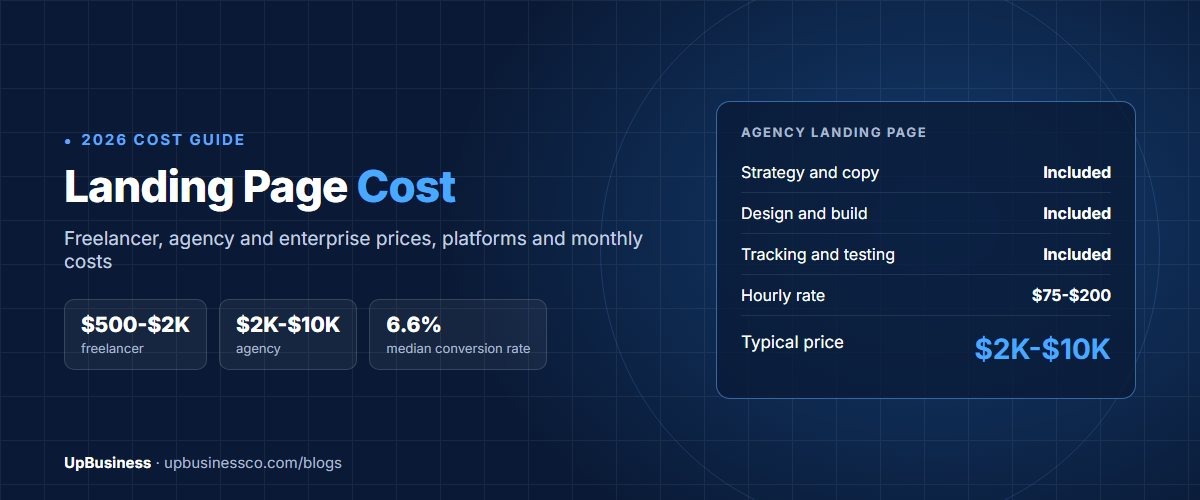
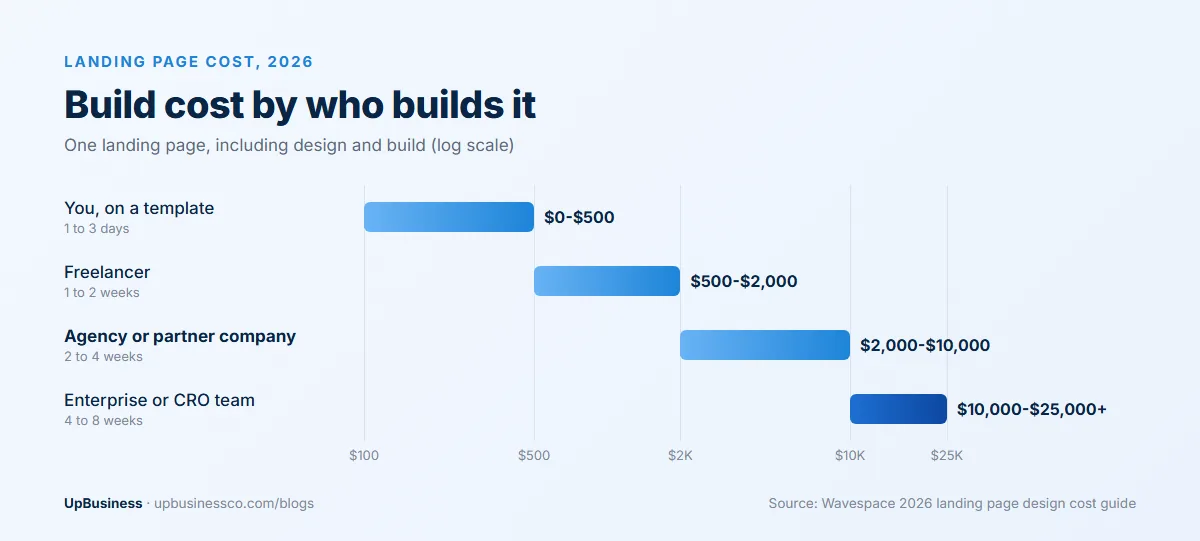
Landing page cost in 2026 ranges from almost nothing for a template you build yourself to $500 to $2,000 with a freelancer and $2,000 to $10,000 with an agency. An enterprise page with research and testing runs $10,000 to $25,000 or more. This guide is for founders and marketing leads hiring a partner company to build a landing page for an ad campaign, product launch or lead offer. It explains what you pay for, how platform choice changes the price, what you'll pay each month after launch, and how to tell whether a more expensive page will earn its money back.
Key takeaways
- Published 2026 guides price a freelancer-built landing page at $500 to $2,000 and an agency page at $2,000 to $10,000, with enterprise pages from $10,000 to $25,000 or more.
- Agencies that bill by the hour typically charge $75 to $200 an hour and spend 15 to 40 hours on one page.
- The median landing page converts 6.6% of visitors across industries in Unbounce's benchmark, with a range of 3.8% to 12.3% by industry.
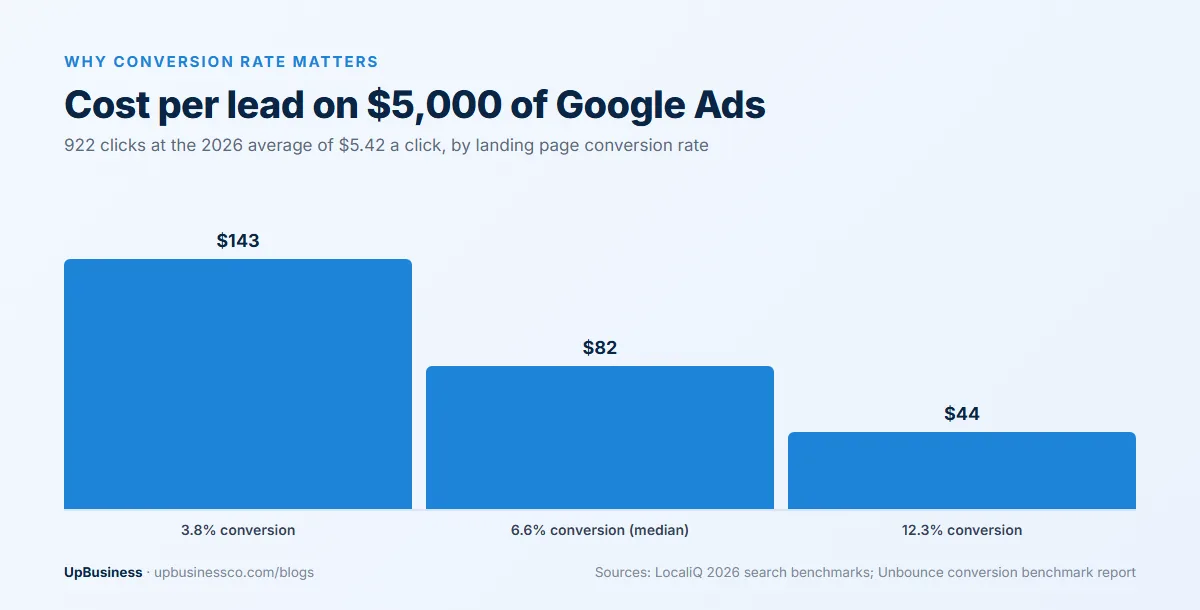
- On $5,000 of Google Ads spend at the 2026 average of $5.42 a click, moving from a 3.8% to a 6.6% conversion rate cuts the cost per lead from about $143 to about $82.
How Much Does a Landing Page Cost?
A landing page costs $0 to $500 if you build it yourself on a template, $500 to $2,000 from a freelancer and $2,000 to $10,000 from an agency. An enterprise build with research, test variants and full integrations runs $10,000 to $25,000 or more[1]. The price follows the thinking that goes into the page more than the design itself.
| Who builds it | Typical cost | Timeline | What's usually included |
|---|---|---|---|
| You, with a builder or AI tool | $0 to $500 | 1 to 3 days | Template, your own copy and edits |
| Freelancer | $500 to $2,000 | 1 to 2 weeks | Custom design, some copywriting, basic tracking |
| Agency or partner company | $2,000 to $10,000 | 2 to 4 weeks | Strategy, copy, custom design, build, testing, tracking |
| Enterprise or specialist CRO team | $10,000 to $25,000+ | 4 to 8 weeks | Research, A/B variants, conversion work, full integrations |
Ranges and timelines are from Wavespace's 2026 landing page pricing guide[1]. A $300 page and a $5,000 page can look similar in a screenshot. The difference usually sits in the message, the offer, the form and the tracking behind it, which is what decides how many visitors turn into leads.
Landing Page Cost by Type of Page
What the page has to do matters as much as who builds it. A waitlist page that collects emails is a small job. A B2B page that has to win over several decision-makers needs more research, proof and design.
| Type of landing page | Typical cost | Why |
|---|---|---|
| App launch or waitlist | $500 to $5,000 | Few sections, built to collect emails quickly |
| Local service (calls and form fills) | $500 to $3,000 | Simple offer, local competition, short page |
| Ecommerce or product launch | $2,000 to $10,000+ | Product photography, persuasive copy, reviews |
| SaaS sign-up or demo | $3,000 to $15,000 | Senior UX work to explain features and build trust |
| B2B or enterprise | $8,000 to $25,000+ | Long sales cycles, heavy social proof, several audiences |
Ranges are from Wavespace's 2026 guide[1]. If your page sits between two types, quote against the higher one and ask the partner company which sections it would cut to reach the lower price.
Landing Page Cost by Platform
The platform changes both the build price and what you pay every month after launch. It also decides whether your marketing team can edit the page without a developer.
| Platform | Typical build cost | Monthly platform cost | Best for |
|---|---|---|---|
| Webflow | $1,500 to $8,000 | $14 to $39 | Marketing teams who edit pages often |
| Framer | $1,000 to $6,000 | $10 to $30 | Startups that need a page live quickly |
| WordPress | $1,000 to $5,000 | $10 to $50 | Businesses already running WordPress |
| Shopify | $1,000 to $5,000 | $29 to $299 | Product launches and store promotions |
| Custom code (for example Next.js) | $5,000 to $25,000 | $0 to $100 | High-traffic or complex pages with a developer on hand |
Figures are from the same Wavespace guide[1]. Dedicated landing page builders are another route: Leadpages, for example, starts at $29 a month to build and publish pages, with testing features from $99 a month[2]. If most of your pages will be built from one template, a builder plus a few days of a designer's time can be cheaper than a custom build each time.
What You're Paying For in a Landing Page
Agencies that bill hourly typically charge $75 to $200 an hour and spend 15 to 40 hours on a single landing page[3]. That time is split across a handful of jobs, and a cheap quote usually drops one or two of them.
| Part of the work | What it covers | What pushes the cost up |
|---|---|---|
| Strategy and offer | Who the page is for, the one action you want, the offer and the message from the ad | Several audiences, a new product, no clear offer yet |
| Copywriting | Headline, benefits, proof, objections, form and button text | Technical or regulated products, several languages |
| Design | Layout for desktop and mobile, images, icons, brand style | Custom illustration, video, animation |
| Build | Turning the design into a fast, working page on your platform | Custom code, interactive calculators, multi-step forms |
| Tracking and integrations | Analytics, ad pixels, conversion events, CRM or email tool connection | Several tools, offline conversion tracking, consent setup |
| Testing | Checks across devices and browsers, speed, form delivery | A/B variants, heatmaps, ongoing optimisation |
Copy is the part buyers most often try to save on, by writing it themselves. That works if you know your customer's objections well. If you don't, a copywriter or an agency that writes and designs together usually earns back the fee faster than a better-looking layout.
For context, the median US web developer earned $92,650 in May 2025[4], about $44.54 an hour in wages alone. Agency rates sit well above that because they cover benefits, tools, project management and profit. Partner companies outside the US often quote far lower hourly rates for the same work, which is worth comparing on a clear brief.
Fixed price, hourly or retainer
Most partner companies quote a single landing page as a fixed fee, which is the easiest to compare. Smaller shops and freelancers sometimes bill hourly, typically at $75 to $200 an hour[3], which suits work where the scope isn't settled yet. Monthly retainers make sense once a page is live and getting traffic, because the work shifts to testing new headlines, offers and forms. If you're offered a fixed fee, ask how many rounds of changes it covers and what an extra round costs, since that's where fixed-price projects tend to grow.
Monthly Costs After Launch
The build is a one-off. These costs continue while the page runs:
- Platform or builder subscription, from about $10 to $50 a month on most site platforms and from $29 a month on a dedicated builder like Leadpages.
- Testing tools, if your builder doesn't include them; Leadpages prices its testing features from $99 a month[2].
- Changes as the campaign evolves, such as new offers, prices or seasonal versions, often billed at the agency's hourly rate.
- Optional optimisation retainers, where a team runs A/B tests and reports each month.
What the first year really costs
Wavespace estimates the running costs in year one, on top of the build, like this[1]:
| Item | Year-one cost |
|---|---|
| Hosting (custom code) | $0 to $300 |
| Site or builder plan (Webflow, Shopify and similar) | $100 to $500 |
| Domain | $10 to $20 |
| SSL certificate | Usually free |
| Tracking tools (optional) | $0 to $600 |
| Maintenance and copy updates | $300 to $2,000 |
| Conversion optimisation retainer (optional) | $1,000 to $6,000 |
| Year-one total | $410 to $9,420 |
Ask for these in the proposal. A page priced at $1,500 with $300 a month of tools and changes costs more over a year than a $3,000 page on a platform your own team can edit.
Is a More Expensive Landing Page Worth It?
Usually, if you're paying for traffic. Across Unbounce's benchmark data, the median landing page converts 6.6% of visitors, and median rates by industry range from 3.8% to 12.3%[5]. Small changes in that rate move your cost per lead a lot.
Here's a simple example. Google search ads cost an average of $5.42 a click in 2026[6]. A $5,000 monthly budget buys roughly 922 clicks.
| Landing page conversion rate | Leads from 922 clicks | Cost per lead |
|---|---|---|
| 3.8% (lowest industry median) | About 35 | About $143 |
| 6.6% (median across industries) | About 61 | About $82 |
| 12.3% (highest industry median) | About 113 | About $44 |
Going from the bottom to the middle of that range brings in about 26 more leads a month on the same ad spend. If a better page costs $3,000 more to build, it pays for itself within the first month or two for most businesses that value a lead at $100 or more. Without paid traffic, the maths changes, and a simpler page is often enough.
What Makes a Landing Page Convert
Unbounce's benchmark report, built on more than 57 million conversions, points to a few things worth putting in your brief, because they change results more than visual polish[5]:
- Design for phones first. In Unbounce's sample, 83% of landing page visits came from mobile devices, even though desktop visitors converted 8% better. A page designed on a large screen and squeezed onto a phone loses the bigger audience.
- Write simply. Pages written at a 5th to 7th grade reading level converted at 11.1%, 56% higher than pages at an 8th to 9th grade level. That's more than twice the 5.3% of pages written at a professional level.
- Cut difficult words and length. The number of words with three or more syllables had the strongest negative link with conversion rate, ahead of reading time and word count.
- Match the page to the channel. Email traffic converted best at 19.3% on average, ahead of paid social at 12% and paid search at 10.9%. A page built for email subscribers can be shorter and more direct than one for cold ad traffic.
None of these need an expensive design. They need someone who understands your customer and writes plainly, which is worth asking about in every proposal.
How to Lower Landing Page Cost Without Hurting Results
- Pay for the copy and the first design, then build later pages from the same template. Variants for new campaigns cost far less than new designs.
- Send everything up front: logos, photos, testimonials, product details and any legal wording. Waiting for assets is a common reason projects run over.
- Choose a platform your team can edit, so small text and price changes don't need a paid request.
- Agree a fixed scope and a set number of revision rounds before work starts.
- Test one change at a time once the page is live, starting with the headline and the form, rather than paying for a full redesign.
The one place not to save is tracking. Without working conversion tracking you can't tell whether the page is earning its cost, and fixing it later usually means paying someone to retrace the setup.
Landing Page vs Website: Which Do You Need?
A landing page has one job: getting a specific visitor to take one action, such as booking a demo, downloading a guide or buying one product. A website has many pages and serves many visitors with different questions. If you're running ads, you usually want both: the website for people who look you up, and a landing page that matches each ad so visitors see exactly what they clicked on.
| Landing page | Website | |
|---|---|---|
| Purpose | One action from one audience | Explain the business to everyone |
| Navigation | Usually none, to keep focus | Full menu and many pages |
| Typical build cost | $500 to $10,000 with a freelancer or agency | Usually several thousand dollars or more |
| Best used for | Ads, launches, lead offers, events | Brand, search traffic, ongoing sales |
Can your homepage do the job instead? Sometimes, for a small business with one service and one audience. Once you run ads for different services, cities or offers, separate landing pages almost always work better, because each one can repeat the exact words from the ad and remove links that pull visitors away. Building three or four pages from one template keeps that affordable.
Our website development cost guide covers full site budgets, and our custom vs template website guide helps if you're deciding how much to build from scratch.
How Long Does a Landing Page Take?
A template page can go live in an afternoon. A freelancer usually needs one to two weeks from the first call to delivery, and an agency two to four weeks, covering discovery, wireframes, copy, design, review and launch[1]. Most delays come from slow feedback and missing material, such as product photos, testimonials or legal approval of claims. Have those ready before the project starts and you can often save a week.
What to Put in a Landing Page Brief
A one-page brief gets you comparable quotes and a faster project. Include:
- The goal and the one action you want visitors to take.
- Who the visitors are and where they come from, such as Google search ads, LinkedIn or email.
- The offer, price and any deadline.
- Proof you can share: customer logos, testimonials, numbers, awards.
- Your platform, or whether you want a recommendation.
- Tools to connect: analytics, ad accounts, CRM, email platform.
- Whether you need copywriting, and in how many languages.
- Your budget range and launch date.
Questions to ask before you hire
- Will the same team write the copy and design the page, or is copy extra?
- How will conversions be tracked, and will you test that tracking before launch?
- How many rounds of changes are included?
- Can our team edit the page later without a developer?
- What is the page's load time target on mobile?
- Who owns the design files, the code and the builder account?
Red flags in a landing page quote
- A price with no mention of copy, tracking or mobile testing.
- Only portfolio screenshots, with no conversion results from past pages.
- The builder account or domain set up in the agency's name.
- Unlimited revisions promised at a very low price, which usually means little thought goes into the first version.
- No plan to check that form submissions reach your inbox or CRM.
What UpBusiness Landing Page Partners Look Like
We looked at the 6 verified partner companies on our landing page development page and the 3 on our landing page optimization page on 22 October 2026.
| Page | Partner companies | Average project size range | TrustScore range |
|---|---|---|---|
| Landing page development | 6 | $500 to $25,000 (median $10,000) | 70.24 to 75.85 |
| Landing page optimization | 3 | $500 to $5,000 | 70.33 to 75.33 |
The development companies are mostly full-service software and web firms, so their average project figures cover whole websites and apps rather than a single page. That's useful if your landing page is part of a larger launch, because the same team can build the page, connect it to your systems and support it afterwards. The optimization agencies are smaller marketing firms whose averages sit closer to a single landing page project. For a page tied to ad campaigns, it's also worth talking to PPC agencies, since many build and test landing pages as part of campaign management. Our Google Ads management cost guide explains how they charge.
When you're ready, post your project with your goal, traffic source, platform and budget, and verified partner companies can quote against the same brief. Or compare verified landing page development companies by TrustScore and project size.