

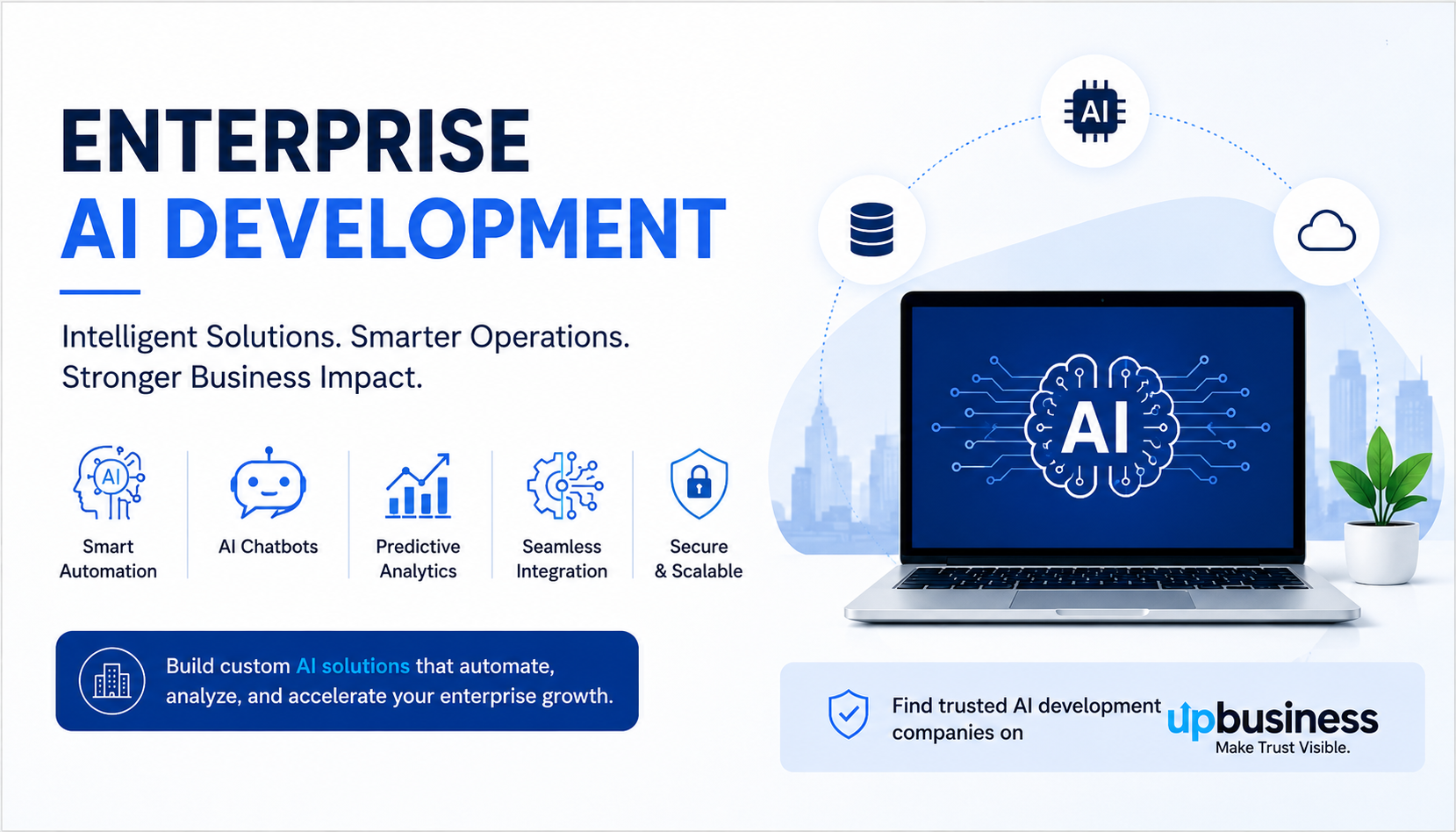
Enterprise AI Development: Complete Guide for Modern Businesses in 2026
Enterprise AI development helps businesses automate repetitive work, analyze data, improve customer experiences, and make faster decisions. But implementing AI at an enterprise level requires more than simply adopting an AI tool.
Enterprise AI solutions need to work with existing systems, business data, security policies, workflows, and compliance requirements. Businesses therefore need a clear AI strategy, suitable technology, reliable data, strong integrations, and the right development partner.
This guide explains enterprise AI development, including its services, benefits, use cases, implementation process, challenges, costs, and how to choose the right enterprise AI development company.
What Is Enterprise AI Development?
Enterprise AI development focuses on building AI systems that can operate within complex business environments.
Enterprise applications often need to process large amounts of data, connect with multiple software platforms, support many users, and meet strict security and governance requirements.
A typical enterprise AI project may involve:
- Identifying a business problem
- Assessing data and infrastructure
- Selecting the appropriate AI technology
- Designing the solution architecture
- Developing and testing the AI system
- Integrating it with existing applications
- Deploying it into production
- Monitoring and continuously improving performance
This makes enterprise AI development a combination of AI engineering, software development, data engineering, integration, security, and business strategy.
Enterprise AI Development Services
Businesses can use different enterprise AI development services depending on their objectives and technical requirements.
| Service | What It Does | Common Applications |
| AI Consulting | Identifies AI opportunities and creates a strategy | AI roadmap, use-case discovery |
| Custom AI Development | Builds solutions around business requirements | Intelligent applications |
| Generative AI | Generates and analyzes content and documents | Summaries, reports, knowledge systems |
| AI Agent Development | Automates multi-step tasks | Research, support, operations |
| AI Chatbot Development | Provides automated conversations | Customer and employee support |
| Machine Learning | Finds patterns and generates predictions | Forecasting, risk analysis |
| AI Integration | Connects AI with existing systems | CRM, ERP, databases |
| AI Automation | Automates repetitive workflows | Finance, HR, operations |
Enterprise AI Consulting
AI consulting helps businesses determine where artificial intelligence can create measurable value.
A consulting process may include AI readiness assessments, business-use-case discovery, data evaluation, technology planning, architecture design, and implementation roadmaps.
Custom Enterprise AI Development
Custom AI development creates solutions around a company's specific processes, data, applications, and requirements.
It can be useful when existing AI products cannot provide the required customization, integrations, flexibility, or control.
Generative AI Development
Generative AI can support enterprise workflows involving documents, content, knowledge, and communication.
Common applications include document summarization, report generation, content assistance, knowledge management, and internal AI assistants.
AI Agent Development
AI agents can combine AI models with business data, APIs, tools, and defined workflows to complete multi-step tasks.
Potential applications include research, customer support, internal operations, and workflow automation.
Enterprise AI Integration
AI integration connects intelligent applications with existing CRM systems, ERP platforms, databases, cloud infrastructure, analytics tools, and internal applications.
Strong integration allows AI to become part of existing workflows rather than operating as an isolated tool.
Benefits of Enterprise AI Development
Enterprise AI can create value across multiple areas of an organization.
| Benefit | Business Impact |
| Automation | Reduces repetitive manual work |
| Productivity | Helps employees focus on higher-value tasks |
| Data Analysis | Converts large datasets into useful insights |
| Decision-Making | Supports faster, data-driven decisions |
| Customer Experience | Enables faster and more personalized support |
| Scalability | Helps businesses manage growing workloads |
| Accuracy | Reduces certain types of manual errors |
Improved Operational Efficiency
AI can automate repetitive processes such as document processing, data entry, support-ticket routing, and workflow approvals.
Reducing manual intervention can help teams save time and focus on more strategic activities.
Better Decision-Making
AI systems can analyze large volumes of structured and unstructured data to identify patterns and generate insights.
Businesses can apply these capabilities to demand forecasting, sales forecasting, risk assessment, inventory planning, and customer analysis.
Improved Customer Experience
AI chatbots and virtual assistants can provide faster responses and support customers around the clock.
Businesses can use AI for automated query resolution, personalized recommendations, customer-service assistance, and omnichannel engagement.
Scalability
AI-powered workflows can help organizations handle increasing workloads without requiring every process to scale at the same rate as manual operations.
Common Enterprise AI Use Cases
Enterprise AI can support almost every major business function.
| Department | Enterprise AI Use Case |
| Customer Support | AI chatbots and automated ticket handling |
| Sales | Lead scoring and sales forecasting |
| Marketing | Personalization and customer analysis |
| HR | Candidate screening and employee assistants |
| Finance | Fraud detection and document processing |
| Operations | Workflow automation and predictive maintenance |
| IT | AI assistants and knowledge management |
| Procurement | Vendor analysis and document processing |
| Analytics | Predictive insights and anomaly detection |
| Management | Decision-support systems |
The most suitable use case depends on the company's business objectives, available data, existing systems, and operational requirements.
How to Implement Enterprise AI
A structured implementation process can reduce technical and business risks.
| Stage | Key Activity | Outcome |
| Discovery | Identify business problems | Prioritized AI use cases |
| Assessment | Evaluate data and infrastructure | AI readiness |
| Strategy | Define technology and roadmap | Implementation plan |
| Development | Build a proof of concept | Tested solution |
| Integration | Connect business systems | Production-ready workflow |
| Deployment | Launch the solution | Business adoption |
| Optimization | Monitor and improve | Long-term performance |
1. Identify the Business Problem
Start with a specific business challenge rather than the AI technology itself.
Ask what process takes too much time, where employees perform repetitive tasks, or where better data could improve decision-making.
2. Assess Data and Infrastructure
Evaluate the availability, quality, accessibility, and security of the data required for the AI solution.
Existing databases, cloud infrastructure, APIs, and business applications should also be reviewed.
3. Create an AI Roadmap
Define the priority use cases, technology requirements, integrations, security considerations, expected outcomes, and implementation milestones.
4. Build a Proof of Concept
A proof of concept allows the organization to test an AI solution before investing in a larger production system.
The pilot should have measurable goals and clear success criteria.
5. Integrate and Deploy
Once the solution demonstrates value, integrate it with relevant business systems and deploy it in the appropriate production environment.
6. Monitor and Optimize
Enterprise AI requires ongoing monitoring. Models, data, business processes, and user requirements can change over time.
Continuous optimization helps maintain system performance and business value.
Challenges of Enterprise AI Development
Although enterprise AI offers significant opportunities, organizations may face several implementation challenges.
Data Quality
AI systems depend on reliable data. Inaccurate, incomplete, outdated, or inconsistent data can negatively affect results.

Browse our curated list of Top Companies on UpBusiness
Common mistake: Underestimating the time and resources required for data cleaning, preparation, and governance.
Integration Complexity
Enterprises often operate multiple software platforms and legacy systems.
Common mistake: Selecting an AI solution without evaluating compatibility with existing CRM, ERP, databases, APIs, and cloud infrastructure.
Security and Compliance
Enterprise AI may process sensitive business, employee, or customer information.
Organizations should consider access controls, authentication, encryption, monitoring, data governance, and applicable compliance requirements.
Common mistake: Treating security as a final-stage requirement instead of addressing it during solution design.
Unrealistic Expectations
AI is not a universal solution for every business problem.
Organizations should establish realistic objectives, measurable outcomes, testing processes, and adoption plans before implementation.
Vendor Selection
Choosing the wrong development partner can lead to delays, additional costs, integration problems, or a solution that fails to meet business requirements.
Custom Enterprise AI vs Off-the-Shelf AI
Businesses can either use an existing AI product or develop a custom enterprise AI solution.
| Factor | Custom Enterprise AI | Off-the-Shelf AI |
| Customization | High | Limited |
| Integration | Extensive | Usually predefined |
| Flexibility | High | Moderate to limited |
| Implementation | More complex | Usually faster |
| Business-specific workflows | Strong | Varies |
| Control | Greater | Provider dependent |
| Scalability | Can be designed for specific needs | Depends on provider |
Off-the-shelf tools can work well for common requirements, while custom AI may be more appropriate when businesses need specialized workflows, deeper integrations, or greater control.
Enterprise AI Development Cost
There is no fixed price for enterprise AI development because every project has different requirements.
The overall cost can depend on:
- Project complexity
- AI model requirements
- Data preparation
- Number of integrations
- Security requirements
- Infrastructure
- Development team
- Testing
- Deployment
- Ongoing maintenance
| Enterprise AI Service | Pricing Approach | Typical Purpose |
| AI Consulting | Custom Quote | Strategy and planning |
| AI Chatbot | Custom Quote | Customer or employee support |
| Generative AI | Custom Quote | Content and knowledge workflows |
| Machine Learning | Custom Quote | Prediction and analytics |
| AI Integration | Custom Quote | Connecting existing systems |
| AI Automation | Custom Quote | Workflow automation |
| Enterprise AI Platform | Custom Quote | Large-scale business applications |
Businesses should request a project-specific proposal instead of relying on a generic AI development cost estimate.
How to Choose an Enterprise AI Development Company
Choosing the right enterprise AI development company can have a significant impact on project success.
Consider these factors before selecting a provider:
| Evaluation Factor | What to Check |
| Technical Expertise | AI, ML, generative AI, agents, cloud |
| Industry Experience | Relevant projects and domain knowledge |
| Integration Skills | CRM, ERP, APIs, databases |
| Security | Data protection and access controls |
| Reviews | Verified client feedback |
| Scalability | Ability to support future growth |
| Support | Maintenance and post-launch services |
Evaluate Technical Expertise
Check whether the company has experience with the technologies required for your project, including machine learning, generative AI, AI agents, data engineering, cloud infrastructure, and enterprise integrations.
Check Industry Experience
A provider familiar with your industry may better understand its workflows, terminology, business requirements, and regulatory environment.
Review Security Practices
Ask how the provider handles sensitive data, authentication, access control, encryption, monitoring, and compliance requirements.
Verify Integration Capabilities
Make sure the company can integrate AI with your existing CRM, ERP, databases, APIs, cloud systems, and internal applications.
Check Reviews and Case Studies
Independent and verified reviews can provide useful insight into project quality, communication, reliability, and customer satisfaction.
Evaluate Post-Launch Support
Ask whether the provider offers monitoring, maintenance, model optimization, technical support, and ongoing improvements after deployment.
Why Use UpBusiness to Find an Enterprise AI Company?
Finding the right AI development partner can be difficult when businesses have to compare multiple providers and determine which companies and reviews they can trust.
UpBusiness takes a quality-over-quantity approach to B2B service discovery.
Every company is verified, every review is verified, and only trusted companies qualify to be listed. This helps businesses discover potential partners with greater confidence.
Through UpBusiness, businesses can:
- Discover verified AI service providers
- Compare potential partners
- Review verified business feedback
- Explore specialized AI expertise
- Reduce vendor-selection risk
- Find technology and development partners
Businesses can explore verified Artificial Intelligence companies on UpBusiness when looking for potential AI development partners.
For broader digital transformation requirements, businesses can also explore Technology Development and Digital Marketing providers.
Enterprise AI Trends in 2026
Enterprise AI is continuing to evolve as organizations move from experimentation toward practical business applications.
AI Agents
AI agents are becoming increasingly relevant for multi-step enterprise workflows. They can combine AI models with tools, APIs, business rules, and business data to complete defined tasks.
Multimodal AI
Multimodal AI can process different types of information, including text, images, audio, video, and structured data.
This creates opportunities for more advanced enterprise applications across documents, customer interactions, and operational workflows.
Generative AI
Generative AI adoption is expanding into knowledge management, document processing, software development assistance, customer support, report generation, and internal business assistants.
AI Governance
As organizations adopt AI at scale, governance, security, transparency, data protection, monitoring, and accountability are becoming increasingly important.
Conclusion
Enterprise AI development can help businesses improve efficiency, automate workflows, analyze data, enhance customer experiences, and support better decision-making.
However, successful implementation requires more than selecting an AI model. Organizations need clear objectives, reliable data, suitable infrastructure, secure integrations, realistic expectations, and the right development expertise.
When evaluating an enterprise AI development company, focus on technical capabilities, relevant experience, integration skills, security, verified client feedback, scalability, and ongoing support.
For businesses searching for potential AI development partners, UpBusiness provides a trust-first approach to B2B service discovery, helping buyers explore verified companies and verified reviews with a focus on quality over quantity.
If you are planning an enterprise AI initiative, start by defining the business problem, identifying the right use case, assessing your technology and data readiness, and evaluating qualified development partners.
Browse our curated list of Top Companies on UpBusiness