

Browse our curated list of Software Outsourcing Companies
Hiring a software development team in India can be a sound decision if you need your product built but can't yet afford an in-house engineering team.
The harder part comes after you've decided to outsource. One company may quote a lower price but leave testing and maintenance out of it, while another has a higher hourly rate and includes a dedicated project manager, QA engineers, and support and updates after launch. The two proposals can look almost identical at first glance, and the differences only show up when you read them line by line.
This guide covers what to look for when you choose a software development company in India, how to estimate the budget, the mistakes that turn a cheap project into an expensive one, and how to work with an offshore team once the contract is signed.
If you only have a minute
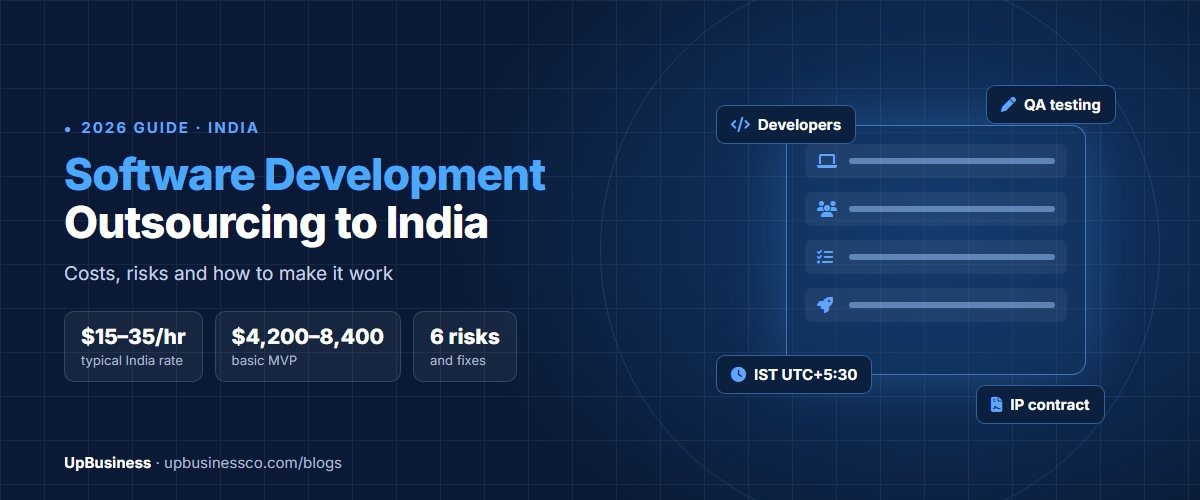
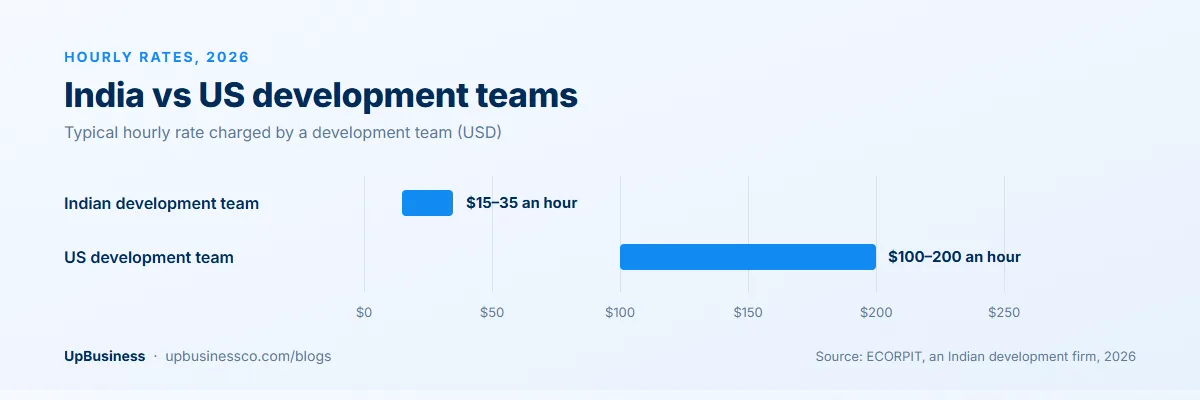
- Indian teams typically bill about $15–35 an hour, against $100–200 for US teams[1].
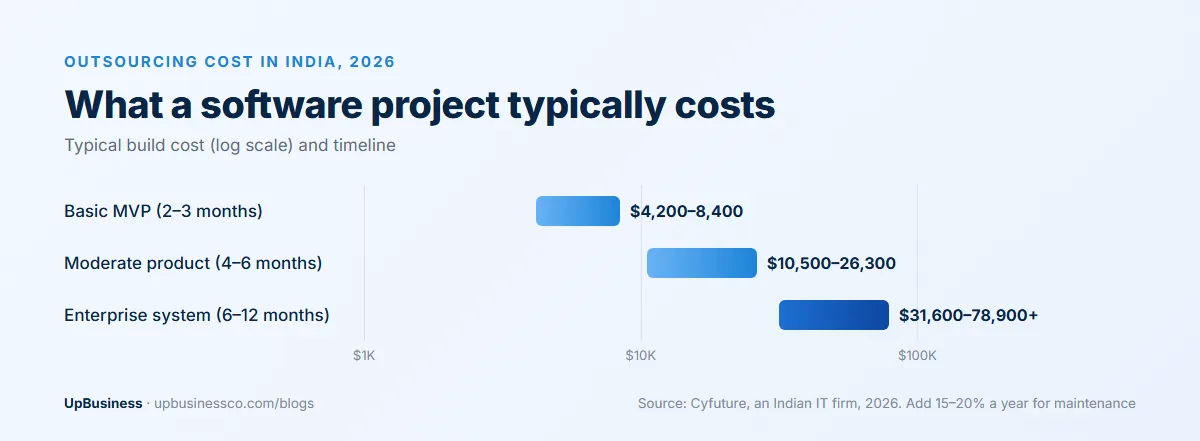
- A basic MVP usually costs $4,200–8,400 and takes 2–3 months, and a product with third-party APIs and payments $10,500–26,300 over 4–6 months[2].
- Budget 15–20% of the build cost every year for maintenance, and 25–30% above the first quote for year one[1].
- Paying for the code doesn't make it yours. Under Indian copyright law, ownership moves to you only through a signed written assignment[3].
What Is Software Development Outsourcing to India?
Software development outsourcing is when you hire an outside company for its software development expertise and have it do at least part of the work for you. You don't directly hire developers, designers, testers and project managers. Instead, you go to a company that already has these people on its team.
Say you want to build a new SaaS product. You'll need frontend and backend developers and a UI/UX designer to create an MVP, and probably someone to manage testing and deployment. Instead of hiring each of them, you can turn to an outsourcing company that puts a team together and has it work on your product. You tell them what you want, agree on the scope, terms and price, and then follow the build through regular demos.
There are three common ways to work with an outsourcing company, and the right one depends on how much of the work you want to manage yourself.
| Model | How it works | Usually suits |
|---|---|---|
| Project-based | The company builds a defined product or feature for an agreed price or estimate, and manages its own team | A first product or MVP with a clear scope |
| Dedicated team | A team works only on your product month after month, usually with its own project manager | A product that will keep growing after launch |
| Staff augmentation | You add one or more developers to your existing team and manage them yourself | Companies that already have a tech lead and need extra hands |
The key to a good outsourcing experience is knowing what you need before you talk to any company. A team that builds a product from scratch for you will ask for very different inputs (a product brief, user flows, a rough budget) than a company that supplies developers to work on an app you already have. If you want the second, partner companies that offer IT staff augmentation are a better fit than full-service agencies.
Why Do Businesses Outsource Software Development to India?
There isn't one reason every company chooses India. For some it's access to technical expertise they can't find or afford locally, and for others it's a way to build capability without adding to headcount.
Cost is usually the first thing people mention, and the gap is real. Indian teams typically bill about $15–35 an hour, while US teams charge $100–200[1]. Even after you add project management, testing and a bit of rework, the total often comes to a fraction of what an in-house team in the US or UK would cost, although a quote at the very bottom of that range usually means a junior team.
The size of the talent pool matters just as much. India's tech industry is expected to reach $315 billion in revenue in FY26, with 5.95 million people working in it[4]. That depth means you can find people who have built products like yours before, whether it's a payments app, a logistics dashboard or a SaaS platform, rather than training a generalist on your money.
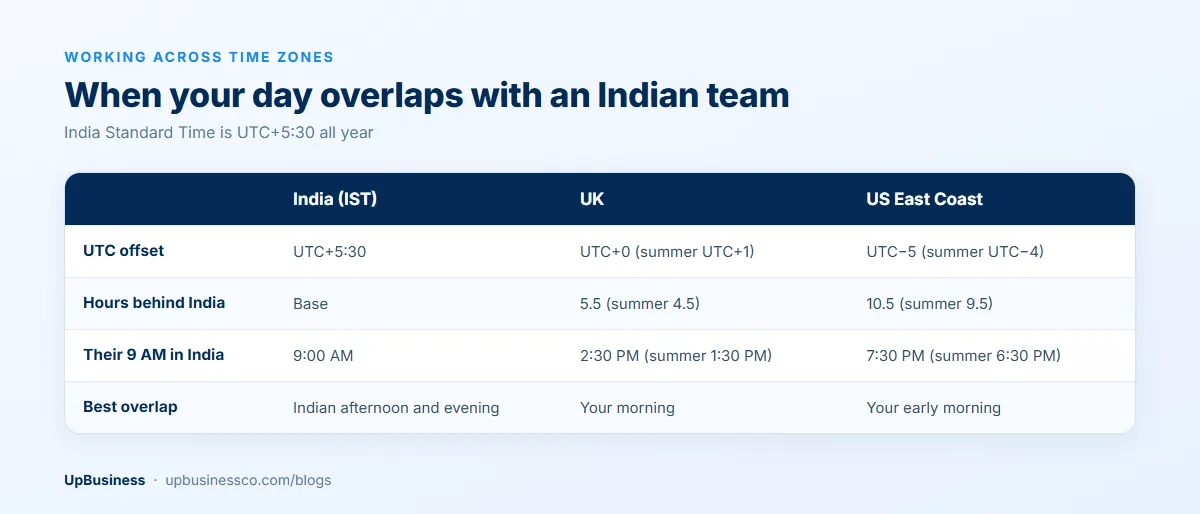
Time zones help more than people expect. India Standard Time is UTC+5:30, so Indian teams are 4.5–5.5 hours ahead of the UK and 9.5–10.5 hours ahead of the US East Coast. Teams that plan around this get a few hours of overlap for calls each day, and then work continues while you're offline, so a bug you report in the evening can be fixed by the next morning.
Flexibility is the last reason, and for startups it's often the deciding one. You can start with two developers for an MVP, add a QA engineer before launch and scale down once the product is stable, without hiring and then letting people go.
What Outsourcing to India Costs in 2026
The project bands below come from a 2026 pricing guide by Indian IT firm Cyfuture[2], so treat them as one firm's view of the market. They're useful for a first budget and for spotting quotes that are far off.
| Project type | Typical cost | Typical timeline |
|---|---|---|
| Basic MVP (simple UI, 5–8 screens, basic database) | $4,200–8,400 | 2–3 months |
| Moderate product (third-party APIs, payment gateway) | $10,500–26,300 | 4–6 months |
| Enterprise system (ERP sync, AI features, high security) | $31,600–78,900+ | 6–12 months |
The build is only part of the bill. Hosting usually runs $21–260 a month depending on traffic, maintenance takes 15–20% of the build cost every year, and for the first year it's sensible to budget 25–30% above the initial quote[1]. On a $21,100 build, that's $3,200–4,200 a year just to keep the software updated and working.
When you compare quotes, put them side by side on the same lines: who is on the team and how senior they are, how many hours of testing are included, whether project management is billed separately, how many rounds of changes are covered, and what support looks like after launch. A quote that's 30% cheaper often turns out to be missing one of these, which is the gap the opening example described. For a deeper look at build costs, our guide to custom software development companies in India breaks them down further.
Fixed Price or Time and Materials?
| Pricing model | Works well when | Watch out for |
|---|---|---|
| Fixed price | The scope is small, clear and unlikely to change | Every change becomes a paid change request, and some teams cut testing to protect their margin |
| Time and materials | Requirements will change as you learn from users | You need to track hours against delivered features every week |
| Dedicated team (monthly) | You have a long roadmap and want the same people on it | You pay for the team's time even in slow weeks, so keep the backlog full |
For most first products, a small fixed-price discovery phase followed by time and materials works better than a single large fixed quote. The discovery phase gives you wireframes, a feature list and an estimate you can check before you commit to the full build.
The Risks, and How to Avoid Them
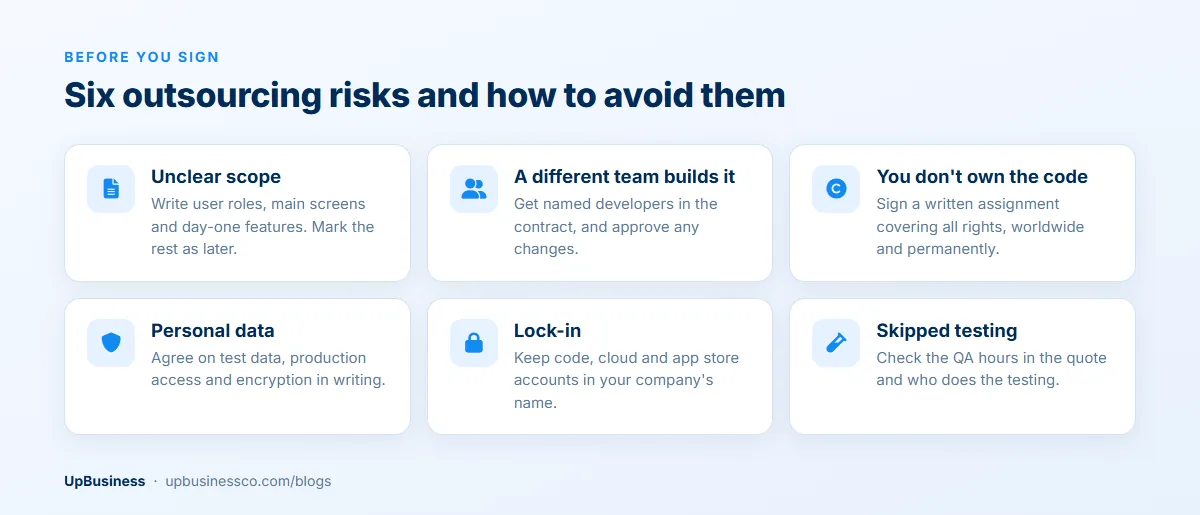
Most outsourcing projects that go wrong don't fail because of the developers' skill. They fail because of unclear scope, poor communication or a contract that left out something important.
Unclear Scope
If your brief says "a doctor booking app", every company will picture something different and price it differently. Write down the user roles, the main screens and what has to work on day one, and mark everything else as "later". It's the single cheapest way to get comparable quotes and to avoid arguments over what was included.
The Team You Meet Isn't the Team That Builds
Senior people often run the sales calls, and then the work goes to someone with a year of experience. Ask for the names and profiles of the developers who will actually work on your product, and write into the contract that changes to key team members need your approval.
Who Owns the Code
This clause gets less attention than price, and it matters more. Under India's Copyright Act, the author of a work is its first owner[3]. When an outside company writes your software, its developers work for that company, not for you, so paying the invoice doesn't by itself transfer the copyright.
A transfer (an assignment) is valid only if it's in writing and signed, and it has to identify the work and state the rights, the duration and the territory. If the duration isn't stated, the law treats it as five years, and if the territory isn't stated, it's presumed to cover India only[3]. Ask for an assignment that covers all rights, worldwide and permanently, and have a lawyer read it before you sign.
Data Protection
The government notified the Digital Personal Data Protection Rules on 14 November 2025, with an 18-month period for phased compliance[5]. If your software stores personal data of people in India, your business is the Data Fiduciary and the development company that handles that data for you is a Data Processor[5]. The responsibility stays with you, and the highest penalty, up to $26.3 million, applies to failing to keep reasonable security safeguards[5]. Ask how the team handles test data, access to production and encryption, and put the answers in the contract.
Lock-in
Some agencies keep the code repository, cloud hosting and app store accounts in their own name. That works fine until you want to switch teams, and then getting your own product back can take weeks. Create these accounts in your company's name from day one and give the team access, not the other way round.
Skipped Testing
When budgets get tight, testing is usually the first thing to go, and the bugs then reach your users instead. Check how many hours of QA the quote includes and who does it. If the company doesn't have its own testers, a separate quality assurance partner company can test releases independently.
How to Choose a Software Development Company in India
Shortlist three to five companies and send all of them the same written brief, so the quotes can be compared fairly. Then ask each one:
- Can you show us two or three products you've built that are similar to ours, and can we speak to one of those clients?
- Who exactly will work on our project, and how many years of experience does each person have?
- What's included in the price, and what would count as a paid change?
- How much testing is included, and who does it?
- How often will we see working software, and on which tools will we track progress?
- Will the code, cloud and app store accounts be in our name from the start?
- What does support cost after launch, and how fast do you respond to a critical bug?
Pay attention to the questions they ask you, too. A team that pushes back on unclear parts of your brief, or suggests cutting a feature from the first release, is usually more reliable than one that agrees to everything on the first call.
A paid trial is the most honest test. A two-to-four-week piece of real work, such as one feature or a clickable prototype, shows you how the team writes code, communicates and handles feedback before you commit the whole budget.
How to Make It Work After You Sign
Most of what makes offshore development succeed happens in the weekly routine, not in the contract.
- Agree on two or three hours of overlap each working day for calls and quick questions, and keep everything else in writing so nobody has to wait for the next call.
- Have one person on your side who can make product decisions. Teams slow down badly when every answer needs three approvals.
- Ask for a demo of working software every one or two weeks. Status reports can say a feature is 80% done for a month, but a demo shows you what actually works.
- Write acceptance criteria for each feature (what a user should be able to do, and what should happen when something goes wrong), so "done" means the same thing to both sides.
- Tie payments to milestones you can test, such as a working login, a completed checkout or an app approved in the store, rather than to calendar dates.
- Get the code into your repository at least weekly, along with the setup instructions, so another team could pick it up if you ever had to switch.
None of this needs a large internal team. A founder or product manager who spends a few hours a week reviewing demos and answering questions is usually enough for a small project, and it's far cheaper than fixing a product that was built on wrong assumptions.
Find a Software Outsourcing Partner Company
Every company in our software outsourcing category goes through verification, and you can compare their TrustScores and profiles before you shortlist anyone. If you're starting with a first version, look at teams that focus on MVP development or custom software development. If you'd rather have companies come to you, post your project and get matched with verified teams.