

Browse our curated list of DevOps Companies
When a company’s application is taking longer to deploy, costing more in cloud bills or frequently crashing in production, the problem often isn’t the application itself. It’s usually the environment around it: how code gets deployed, how the servers are set up and how the team runs production.
For a SaaS or product company that lives on its software, that shows up as slower releases, nervous updates and a lot of time spent chasing deployment problems.
A good DevOps consultant can fix those three things: infrastructure, deployment pipelines and day-to-day operations. Choosing one is harder than comparing hourly rates or counting the tools listed on a company’s website. You need to know what work you’re actually buying, whether the cost will stay predictable, what you’ll have at the end and how you’ll tell whether it worked.
This guide explains what DevOps consultants actually do, what they charge in India in 2026 and how to check a partner before you hire one.
What Are DevOps Consulting Services?
DevOps consulting services improve how your software is built, tested, deployed and run. The work usually mixes infrastructure engineering, deployment pipelines, monitoring, security and the habits that let developers and operations people work as one team.
The work a consultant performs depends on the company’s current infrastructure, operations and objectives. A start-up preparing its first application for production may need help with deployment pipelines and cloud infrastructure. An established business may want fewer production incidents, or confidence that its infrastructure will keep up as users grow.
Most engagements start the same way: the consultant reviews your current setup, finds what is slowing you down and recommends a short list of fixes.
DevOps consulting vs. DevOps implementation
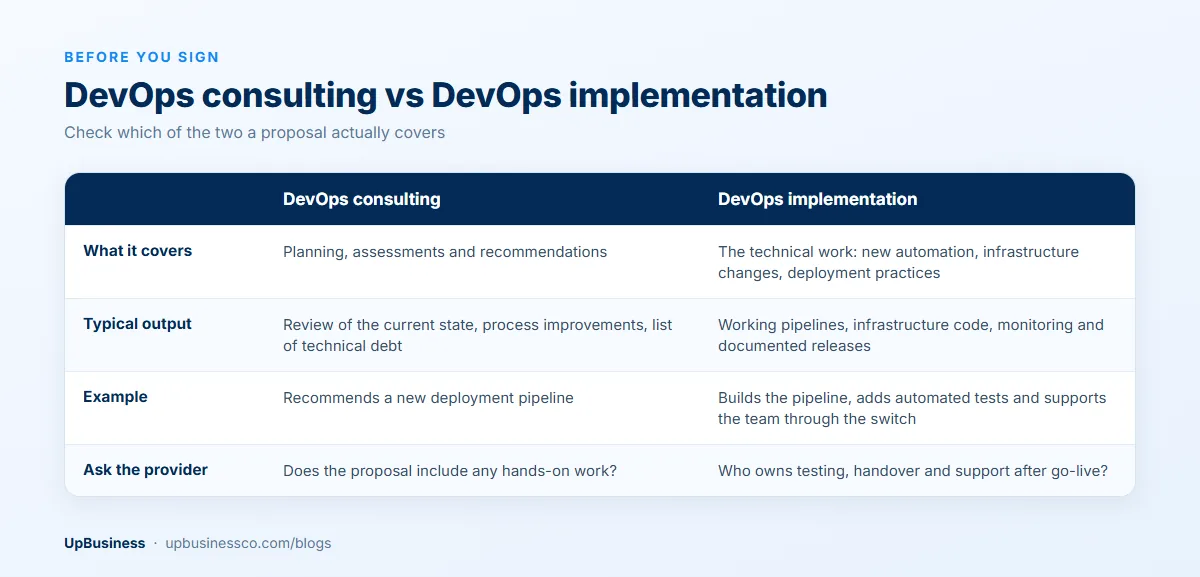
DevOps consulting is the advice side: assessments, plans and recommendations. A consultant reviews where you are today, points out the technical debt and suggests what to change in your infrastructure, deployments, pipelines, security and monitoring.
DevOps implementation is the hands-on part: reconfiguring systems, writing the automation, changing the infrastructure and keeping it all stable once it’s live.
Some firms do both, and some only do one. Before you sign, check whether the proposal covers advice only or also the technical work, testing and handover.
For example, a proposal that recommends a new deployment pipeline is very different from one that assumes responsibility for implementing it, adding automated tests, documenting the process and supporting the team through the transition.
When does a business need a DevOps consultant?
These are the situations where outside DevOps help usually pays for itself:
- Developers deploy applications manually and face frequent configuration-related failures.
- Software releases are complicated, require heavy coordination, have long lead times or cause unplanned outages.
- The cloud bill keeps climbing because the infrastructure was set up in a hurry or misconfigured.
- Incident investigations take too long to complete or fail to capture relevant context.
- The development, testing and production environments are inconsistent, making it easy to deploy faulty code.
- A team lacks the experience or knowledge to implement or operate an infrastructure-as-code (IaC) solution.
- A big launch or migration is coming up and nobody in-house has planned one before.
- Outages are happening often enough to hurt the business.
You don’t need a DevOps consultant on call forever. A simple application on simple infrastructure can usually be looked after by your own engineers. Bring in a consultant when the work is complex, risky or needs skills your team doesn’t have yet.
What Does a DevOps Consulting Partner Actually Do?
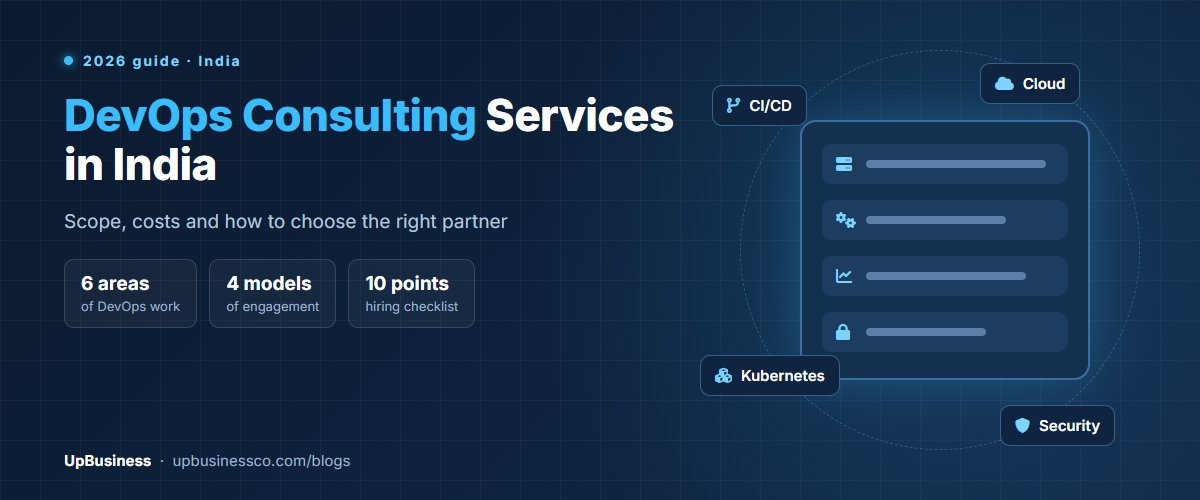
Good DevOps work starts from a business problem, not a tool. Projects usually touch some mix of the six areas below.
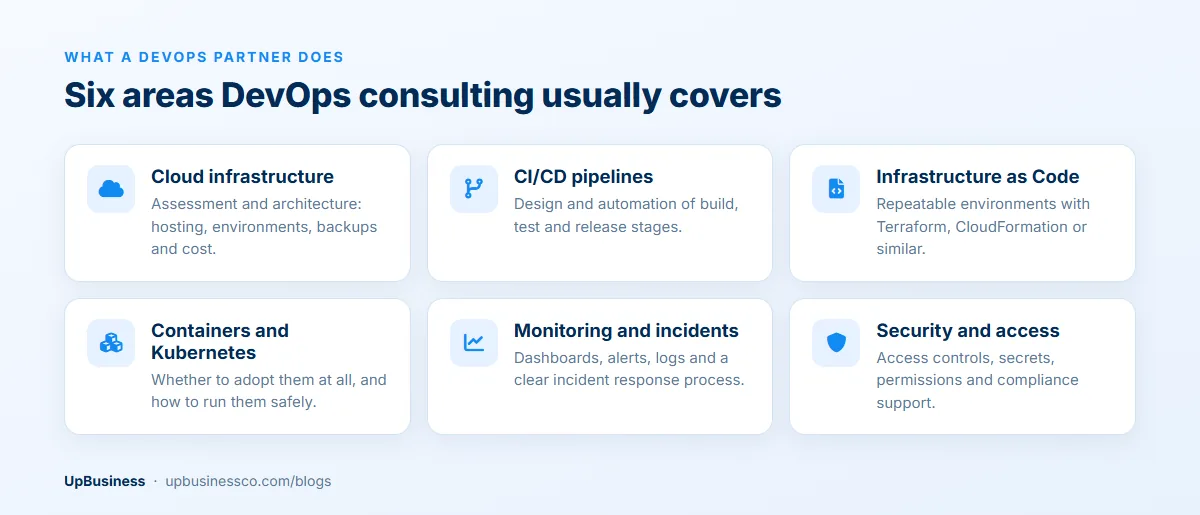
Cloud infrastructure assessment and architecture
Consultants usually start by reviewing what you already run. Expect questions about how the applications are hosted, how environments are split and how the network is set up, along with your uptime targets, backups, disaster recovery and which systems depend on which.
The findings turn into a list of specific changes, ordered by whatever matters most to you, whether that’s capacity, reliability, speed, security or cost.
If the application slows down regularly, for example, the review should look at how resources are allocated, how scaling is configured and how the architecture handles load. Adding more servers without fixing these usually just makes the same problem more expensive.
CI/CD pipeline design and automation
Continuous integration and continuous delivery (CI/CD) is often the first thing teams want fixed, because a good pipeline removes manual steps and makes frequent releases routine.
The consultant’s job is to design or improve the pipeline itself, the tests that run in it and the hand-offs between developers, operations and QA. They decide which stages to automate and how to keep every release repeatable, so a deployment on Friday evening behaves the same way as one on Monday morning.
How good a pipeline is comes down to which stages it covers, how much it tests, how reliable the deployment scripts are and how quickly you can roll back when something breaks.
When reviewing a proposal for such a project, ask what stages will be automated, what testing and verification will take place and how the pipeline will demonstrate it can support the intended release schedule. Partner companies that focus on CI/CD pipeline setup handle this kind of work.
Infrastructure as Code and environment management
Infrastructure as Code (IaC) means your servers, networks and settings are defined in files you can version and rerun, so every environment is built the same way.
A consultant can write that infrastructure code, so creating a new environment becomes a script you run rather than a day of manual clicking in the cloud console. Terraform and AWS CloudFormation are the usual tools, depending on your cloud and stack.
The payoff is fewer manual mistakes, faster new environments, and development, testing and production setups that actually match.
Ask them to leave the code in your own repository with a short guide, so your team can change it later without calling them back.
Containerization and Kubernetes implementation
Containers package an application with everything it needs, so it runs the same way on a laptop, a test server and production.
A partner should tell you whether containers are worth it for you at all, which orchestration platform to use if they are, and what changes for your developers and operations team.
They should also look at resource limits, health checks and how incidents will be handled once containers are in production.
Kubernetes is often the hardest call, because it depends on your requirements, how much your team can take on, your budget for running it and how complex the application is. For a small application with a handful of services it is often overkill, and a managed container service is simpler to run.
Ask the consultant to spell out the benefits and the risks before recommending tools. If you have already decided on Kubernetes, look at teams that offer Kubernetes management.
Monitoring, logging and incident response
Without monitoring, you usually hear about an outage from your customers first.
Expect them to set up the dashboards, alerts, logs and incident procedures that let you spot and contain problems. They should decide what to watch and set alert thresholds so the team hears about real problems quickly without being woken up by false alarms.
Ask what will happen when an alert fires, not only what the dashboard will show. Good incident management needs named owners, an escalation path and a short review after each incident.
Cloud security, access controls and compliance support
Security work in a DevOps engagement can run from secure coding habits to hardening servers, managing secrets and handling incidents.
Expect a review of who can access what, how secrets are stored, how the network is locked down and how third-party packages are kept up to date. The controls they recommend should match your application and any compliance rules your business follows.
Tell the provider which regulations apply to you, and if the stakes are high, ask for a review by a cloud security specialist.
The engagement should also specify who owns cloud accounts and production systems, who has access to them, and who will revoke access at the end of the engagement.
When Should You Hire a DevOps Consulting Company?
Companies usually bring in outside DevOps help for a specific problem, not because a growing business is supposed to have a DevOps team.
Your releases are slow or unreliable
If your release process requires too much manual effort and causes frequent deployment failures, a consultant can help, especially if releases regularly need late-night fixes or cause downtime.
A consultant should find out why releases go wrong and fix the pipeline, tests and deployment checks behind them. The aim is releases you can trust, not a new set of tools.
Infrastructure costs are difficult to control
Cloud bills creep up as projects, environments and forgotten resources pile up, and it’s often hard to say where the money is going.
An outside review can trace the spend and point out what you don’t need. Before you approve the work, make sure it starts with a baseline of today’s costs and a savings target you both agree on.
Your application needs to scale
An application built for a small user base can struggle as numbers grow, new features get used and background jobs pile up.
The first job is finding the real bottleneck, whether that’s the database, caching, bandwidth, load balancing or server capacity, then load-testing the fix against normal and peak traffic before you rely on it.
Base scaling decisions on those test results rather than guesses.
Your team lacks specialized cloud or automation expertise
Plenty of teams build a good product but haven’t run cloud infrastructure, automation or pipelines at scale before.
A consultant can set these up and then hand them over, as long as the contract says exactly how your team will be trained.
If your team still can’t run things without the consultant once the contract ends, the engagement hasn’t done its job.
You need to improve deployment reliability and security
If nobody can say who changed production and when, passwords are shared around the team, or incidents get handled without looking at the monitoring data, you have a security problem as well as a DevOps one.
Controls on production changes, access and secrets, with an audit trail for each step, usually fix this.
The proposal should clarify what deployment and security risks the project will address and establish completion criteria.
How Much Do DevOps Consulting Services Cost in India?
There’s no standard rate for DevOps consulting in India. Each firm prices on the work requested, the seniority of its people, how complex and well documented your infrastructure is, and the overall scope.
An architecture review and migrating a company to a new cloud platform with automation are completely different jobs, so ask for a description of the work rather than just an hourly rate or a headcount.
When you compare quotes, put them in the same currency and period, and check what each one leaves out.
Typical DevOps consulting prices in India (2026)
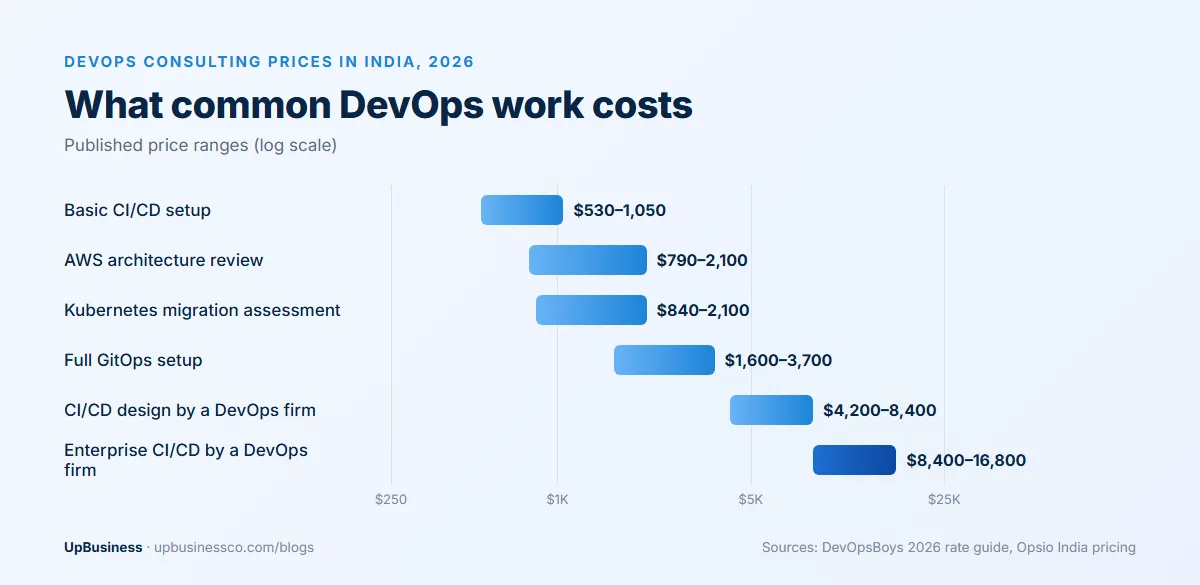
Published prices are a useful starting point, as long as you remember they come from individual firms and consultants rather than a market survey. Independent DevOps consultants working with Indian clients charge roughly $84–130 a day with 2–4 years of experience, $130–210 at AWS or GCP architect level and $260–530 for principal architects with more than 9 years[1].
| Work | Typical price | Quoted by |
|---|---|---|
| Basic CI/CD setup (GitHub Actions, Docker, container registry) | $530–1,050 | Independent consultant[1] |
| Full GitOps setup (ArgoCD, Helm, several environments) | $1,600–3,700 | Independent consultant[1] |
| AWS architecture review with a written report | $790–2,100 | Independent consultant[1] |
| Kubernetes migration assessment and architecture document | $840–2,100 | Independent consultant[1] |
| CI/CD pipeline design for one application | $4,200–8,400 | DevOps firm[2] |
| Enterprise CI/CD with GitOps and security gates | $8,400–16,800 | DevOps firm[2] |
| 24-hour incident response retainer | $1,600–3,200 a month | Independent consultant[1] |
| Pipeline optimization retainer | From $1,300 a month | DevOps firm[2] |
The gap between the two kinds of quote is mostly scope. A firm’s $4,200–8,400 pipeline project includes architecture work and a team behind it, while a $530 freelance setup usually covers a single pipeline for one application. When two quotes differ by five times or more, check that they cover the same work before you compare the price.
Factors that affect DevOps consulting costs
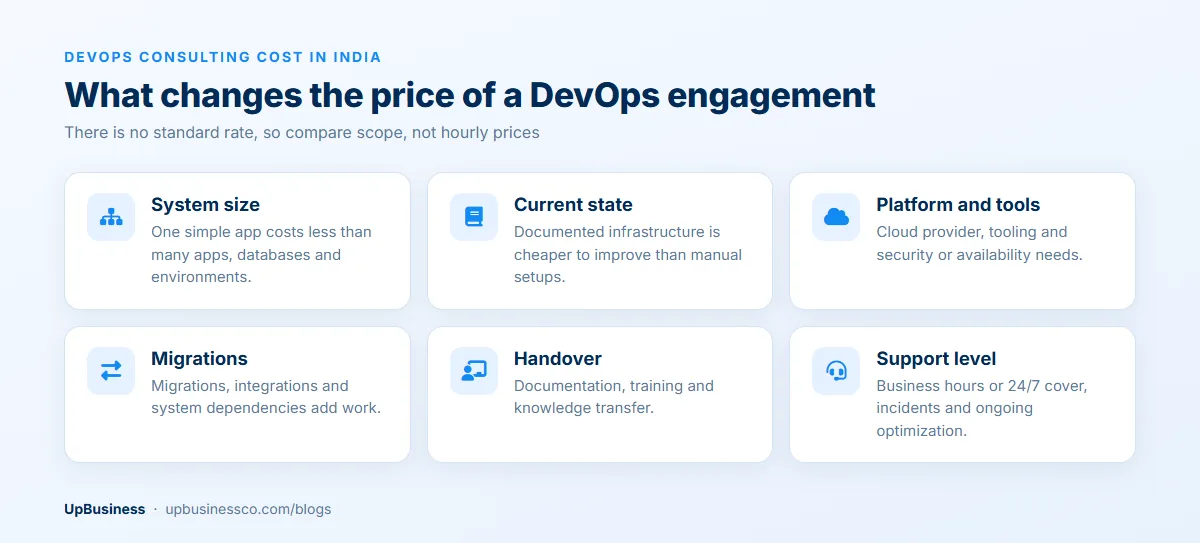
A few things move the price more than anything else.
One application with a simple deployment costs far less to work on than a system of many applications, databases and environments.
Documented infrastructure built on standard patterns is cheaper to improve than one held together by manual steps.
Your cloud provider and tools matter too, and so do any extra security, uptime or availability requirements.
Migrations, integrations and systems that depend on each other add work, as do documentation and training.
Support is the last big lever. Business-hours cover costs far less than 24/7, and keeping incident response and ongoing tuning with your own team lowers the price further.
A good proposal names these factors and states its assumptions, so you can see what would change the budget.
Hourly consulting vs. fixed-scope projects vs. ongoing retainers
DevOps work is usually sold in one of four ways.
| Engagement model | Best suited for | What to clarify |
|---|---|---|
| Hourly or time-based | Short-term advisory sessions, investigations and scope definition | Estimated hours, billing increments, rate changes and spending limits |
| Fixed-scope project | A well-defined task, such as assessment or pipeline implementation | Deliverables, assumptions, exclusions, acceptance criteria and change requests |
| Ongoing retainer | Recurring optimization, advice and maintenance | Included capacity, response times, rollover rules and additional charges |
| Managed service | Day-to-day operations under an agreed service model | Monitoring coverage, escalation, availability commitments and responsibility boundaries |
Hourly billing suits short investigations, or working out the scope before there’s a plan. Fixed scope is usually cheaper once the deliverables are written down and agreed.
A retainer makes sense for steady tuning and advice, provided the agreement says what’s included, how fast they respond and what extra work costs.
A managed service is for when you want someone else to run day-to-day operations, usually under its own contract.
Compare the cost of each option against what you get and what stays your responsibility.
How infrastructure and cloud bills affect the total budget
A DevOps consulting project will usually incur separate costs for the application’s cloud infrastructure, software licenses, monitoring and related expenses. Some of these will continue to accrue after the engagement ends, depending on the contract terms.
Get an estimate of the monthly or yearly cost of infrastructure, monitoring, databases and software as part of the scope, with the implementation fee shown separately and any usage-based costs marked as such.
A much lower consulting fee can hide a bigger cloud bill after the engagement ends.
How to compare two DevOps proposals fairly
Before you compare proposals, check that every company was quoting for the same requirements.
Review the proposals against a common set of criteria, such as the applications and environments included, specific deliverables, implementation timeline, security requirements, documentation and testing, cloud and software costs, post-implementation responsibilities, and excluded activities.
A simple spreadsheet that scores each proposal on the same criteria makes the differences obvious. A higher price can mean more work done for you, and a cheaper one can mean more left for your team.
Pick the one that gives you the most for the money at a level of risk you’re comfortable with.
What Should a DevOps Consulting Proposal Include?
A DevOps proposal should say what you’ll get, how the work will be done, who does what and when, and how you’ll know it’s finished.
Scope of work and measurable deliverables
The scope should list the applications, environments and systems the work will touch, and separate advice from hands-on changes.
A proposal that states, “The provider will optimize DevOps practices,” is unlikely to be as helpful as one that specifies, “The provider will configure a deployment pipeline for the X application, including automated Y checks and documented release procedures.”
If you can’t check a deliverable on the last day, it isn’t written specifically enough.
Implementation timeline and dependencies
The timeline should show each phase with dates and owners, plus what the provider needs from you, such as access to cloud accounts, code repositories, test environments and documentation.
Ask what assumptions sit behind the dates and what happens to them if the scope changes.
Security, access permissions and documentation
The proposal should explain how the provider will access your systems and data. Look for least-privilege access, no personal accounts and a clear way of handling secrets.
It should also list the documentation you’ll get and confirm that you keep access to every system and configuration.
Testing, handover and knowledge transfer
Every change should be tested before it’s called done, whether that’s a pipeline stage, an infrastructure change, a recovery procedure or a dashboard.
The handover should leave your team able to run the system alone. Ask for walkthroughs and a support period while you take over.
Post-implementation support and service-level agreements
If support continues after the project, the proposal should state the response times, who does what and what out-of-scope requests cost.
If an SLA is offered, clarify what it covers and how its requirements will be measured.
How to Evaluate a DevOps Consulting Partner
A DevOps engagement works when the consultants are technically strong, explain things clearly, follow a sensible method and genuinely want your team to learn.
Check experience with your cloud platform and technology stack
Ask what they’ve done on your cloud platform and stack, with examples of similar applications, infrastructure, automation and compliance requirements.
A long list of tools on a website matters less than experience with systems like yours.
Ask for relevant case studies and verifiable references
Ask for case studies and references from similar companies. A good case study explains the goal, the scope, what went wrong and the result, without overstating the provider’s part in it.
If a case study quotes numbers, ask how they were measured and over what period. A provider bound by confidentiality should still be able to share an anonymised example or a reference with permission.
Assess security practices and operational ownership
Find out how the provider handles production access, secrets, code changes, permissions and sensitive data.
Ask questions about who approves proposed changes, how access is audited and what happens to credentials once the engagement ends.
Agree who owns and runs the infrastructure after the project, because a production incident is the worst time to find out nobody does.
Compare the deliverables, not hourly rates
Compare what each provider will actually do and how they’ll prove it’s done. A complete proposal covers the work, testing, documentation, handover and support.
A much lower quote usually means less work or fewer hours, so check it still gets you to the same result.
Confirm documentation, access ownership and exit requirements
Make sure the contract says that your business owns the cloud accounts, source code, deployment configuration and documentation.
The agreement should also clarify the handover, access revocation and support obligations in case of early termination.
These requirements apply even if the initial project was small, as the lack of such provisions may cause unnecessary reliance on the outsourced provider for simple production changes or emergency support. Our guide to software development outsourcing to India covers the same ownership questions for wider software projects.
Common Mistakes to Avoid When Hiring a DevOps Consultant
Even a well-scoped engagement can go wrong when the two sides expect different things.
Choosing the lowest quote without understanding the scope
Two providers’ prices can be far apart simply because one includes implementation, testing and training and the other doesn’t.
Compare what each provider will actually deliver, including the work that will be done, and what they will exclude.
Treating tool installation as a complete DevOps strategy
Installing a CI/CD platform, Kubernetes or a monitoring stack doesn’t make production reliable on its own.
The tools have to fit how your team builds and ships software, and they need configuring, testing, securing and maintaining like anything else.
Overlooking monitoring, security and maintenance
The ability to deploy code reliably is only one aspect of production software operations.
Put monitoring, disaster recovery, security and maintenance in the scope, because they need engineering time long after the first deployment.
Failing to document and understand the knowledge transfer
When an outside provider runs your infrastructure, your own team can lose sight of the technical debt and quirks building up underneath, and later changes get harder.
Write into the contract that the provider documents the production environment and walks your team through deployment, debugging, access rules and escalation.
DevOps Consulting Checklist for Businesses
Use this checklist to evaluate providers and review the contract terms before hiring a DevOps consultant.
- Business objectives: have we clarified the problems that the engagement is supposed to solve?
- Technical scope: is the software, infrastructure, and environment well-defined?
- Relevant experience: has the provider demonstrated experience with similar software and infrastructure?
- Pricing and deliverables: are costs, assumptions, exclusions, and acceptance criteria clear?
- Security and access: are permissions, credentials, and approval processes well-defined?
- Monitoring and incident response: are we aware of the critical components and response playbooks?
- Testing and recovery: are validation, rollback, and recovery requirements stipulated where applicable?
- Documentation and handover: will we receive the necessary runbooks and configurations?
- Support terms: are the coverage hours, response levels, and additional costs defined?
- Ownership and exit: will we retain control of our accounts, repositories, configurations, and documentation?
If several of these points are unclear, request more information before finalizing the engagement.
Choose a DevOps Partner Based on Scope, Reliability and Long-Term Fit
Choosing a DevOps consulting partner is really a decision about how your software will run for the next few years.
Be clear about what needs fixing, write down the scope and estimate the running costs, and the right partner gets much easier to spot.
A good engagement leaves your own engineering team running production better than before, with a clear view of the environment and the documentation to keep it that way.
When searching for DevOps partners, review the verified DevOps partner companies on UpBusiness. Take a look at their expertise, fit for your proposed project, and the suggested scope prior to reaching out, or post your project and let matching teams come to you.
Judge partners on what they’ll take responsibility for and how they’ve handled similar work, rather than on their tool list or their price.