

Browse our curated list of AWS Consulting Companies
Plenty of Indian companies call themselves AWS consulting partners. Some have dozens of certified architects and years of migration work behind them. Others resell AWS credits, have two certified engineers and take on whatever comes in. From the outside, their websites look almost the same.
This guide shows how to tell them apart. It covers what an AWS consulting partner actually does, what the AWS partner tiers and competencies mean, what AWS consulting costs in India in 2026, and the questions that reveal whether a partner can handle your project.
If you only have a minute
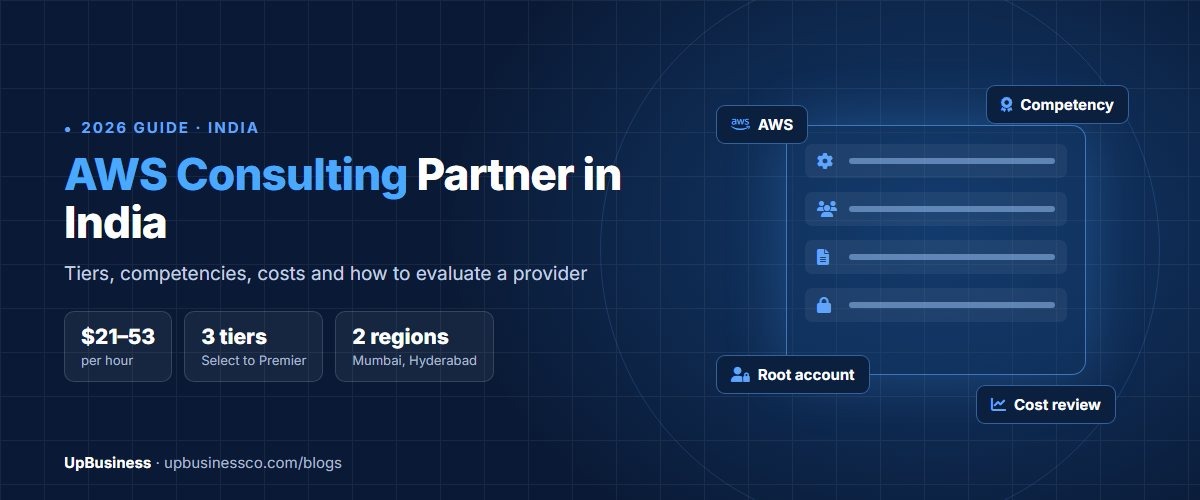
- AWS ranks services partners in three tiers: Select, Advanced and Premier. A Premier partner needs 25 technical certifications and 50 launched customer opportunities, against 2 and 3 for Select[1].
- For your specific project, an AWS Competency in that area (migration, security, data and so on) tells you more than the tier, because it requires a technical review and customer case examples[2].
- India-based cloud and DevOps consulting typically costs $21–53 an hour, and monthly support retainers range from $530 to $10,500 or more depending on scope[3].
- Whoever you hire, the AWS account and its root user should belong to your company, not the partner.
What an AWS Consulting Partner Does
An AWS consulting partner designs, builds, moves or runs workloads on Amazon Web Services for you. In practice, most engagements fall into one of five types, and it helps to know which one you’re buying before you start comparing companies.
| Engagement | What you get | How it’s usually priced |
|---|---|---|
| Architecture and new builds | A design for a new application or platform on AWS, often with the build itself | Fixed price per phase, or hourly |
| Migration | Moving servers, databases and applications from your own hardware or another cloud | Fixed price after an assessment |
| Cost optimisation | A review of your AWS bill, right-sizing, reserved capacity and clean-up | One-off fee, sometimes a share of savings |
| Security and compliance | Account structure, access controls, logging and audit readiness | Fixed price per review or project |
| Managed services | Monitoring, patching, backups and incident response after go-live | Monthly retainer |
Many partners do all five, but very few are equally strong at all of them. A team that builds great serverless applications isn’t necessarily the team you want running a 24x7 production environment for a bank. If your project is mainly a migration, our guide to cloud migration services in India goes deeper on that process, and if you need ongoing pipelines and releases, the DevOps consulting guide covers that side.
AWS Partner Tiers: What They Tell You
AWS places consulting companies on its services path in one of three tiers, based on certifications, launched customer projects and, at the top tier, specialist designations[1].
| Requirement | Select | Advanced | Premier |
|---|---|---|---|
| Technical certifications | 2 | 6 (at least 3 Professional or Specialty) | 25 (at least 10 Professional or Specialty) |
| Accredited individuals | 4 | 8 | 20 |
| Launched customer opportunities | 3 | 20 | 50 |
| Monthly revenue from those launches | $1,500+ | $10,000+ | $50,000+ |
| Specialist designations | None | None | 3, including MSP, DevOps or CloudOps |
Source: AWS Services Partner Tiers page[1].
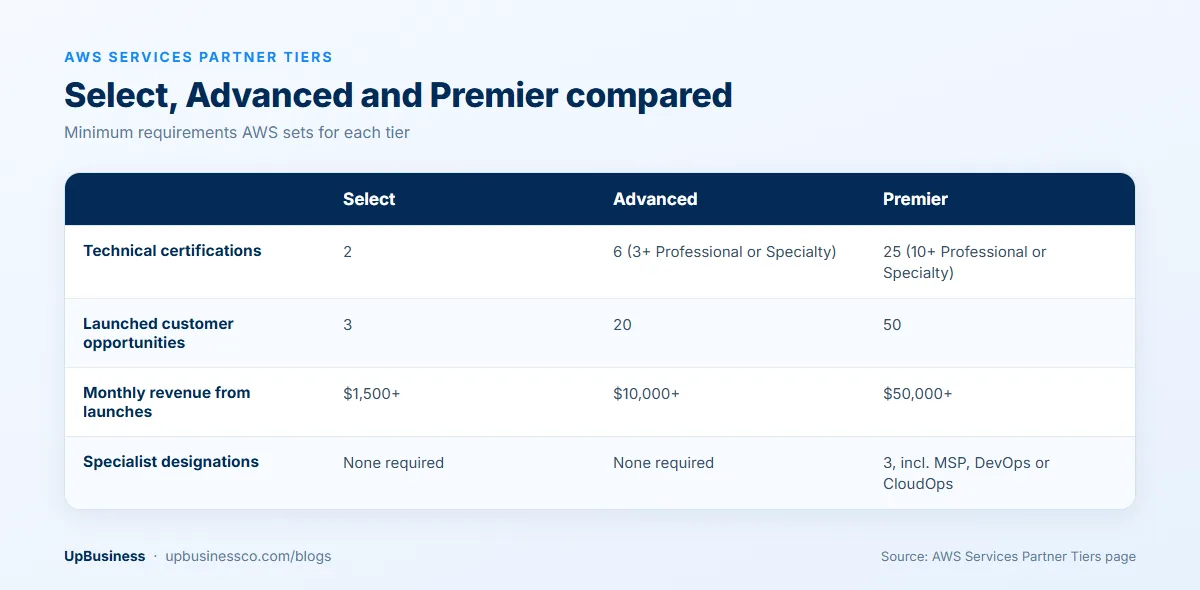
The tier is a reasonable signal of size and AWS experience, but it isn’t a quality score. Select needs only two technically certified people, so a Select partner could be a strong five-person specialist or a reseller with one project behind it. And a Premier partner may put junior engineers on a small account. Use the tier to filter, then judge the team you’ll actually get.
Competencies Matter More Than the Tier
An AWS Competency is a narrower badge that says a partner has proven skill in one industry, use case or workload, and earning it means passing a technical assessment that reviews several customer success examples[2]. AWS runs dozens of these, covering areas like security, AI and specific workloads.
So match the competency to your project. If you’re moving a data centre, a migration-focused partner with the relevant competency is a better bet than a Premier partner whose strength is machine learning products. If you want someone to run your environment after go-live, the AWS Managed Service Provider (MSP) programme is the designation to look for[4].
You don’t have to take a website’s word for any of this. AWS lists partners and their designations in its Partner Solutions Finder[5], so search for the company by name and check the tier and competencies yourself before the first call.
What AWS Consulting Costs in India (2026)
Pricing depends heavily on the type of work. These are published Indian figures from 2026, from firms that sell these services, so read them as a starting range rather than a quote.
| Type of work | Typical cost in India | Source |
|---|---|---|
| Hourly consulting, India-based providers | $21–53 an hour | DevOps consultancy guide[3] |
| Senior certified architect (8+ years) | $32–53 an hour | DevOps consultancy guide[3] |
| Basic monthly support (monitoring, pipelines, on-call) | $530–1,600 a month | DevOps consultancy guide[3] |
| Advanced support (multi-cloud, security, compliance) | $1,600–4,200 a month | DevOps consultancy guide[3] |
| Full managed operations, 24x7 | $4,200–10,500+ a month | DevOps consultancy guide[3] |
| Small migration to AWS, 5–20 servers | $2,100–15,800 (project) | AWS partner guide[6] |
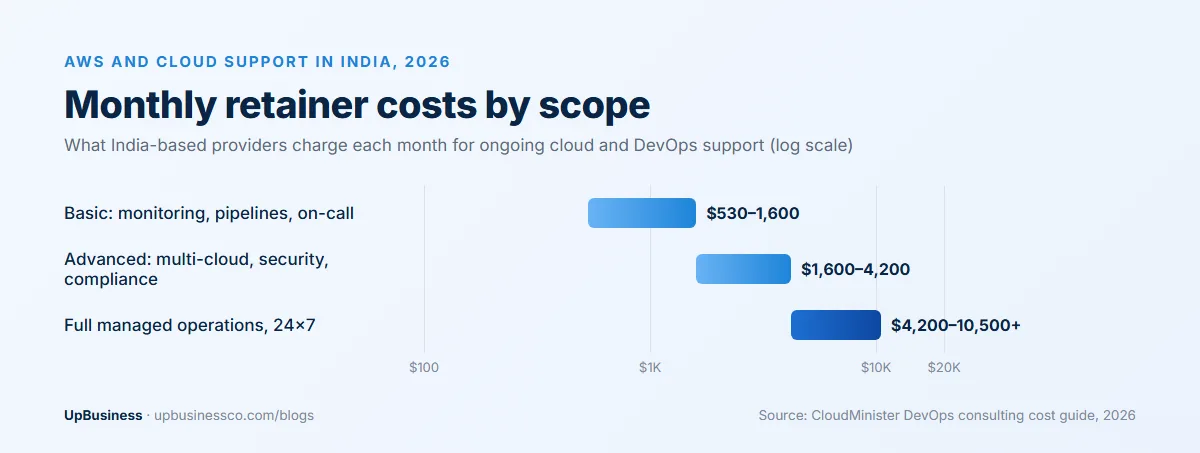
The same 2026 guide says AWS certifications carry a 20–35% premium over uncertified engineers[3]. That premium is often worth paying for architecture and security work, where one design mistake can cost more than the whole engagement. For routine monitoring or patching, it matters less.
Remember that the AWS bill itself is separate from the consulting fee. A partner who designs your setup well should be able to show you the expected monthly AWS cost before anything is built, and explain how they’ll keep it from creeping up.
AWS Programmes a Good Partner Will Mention
For migrations, AWS runs the Migration Acceleration Program (MAP). It works in three phases (assess, mobilize, then migrate and modernize), is delivered through AWS Professional Services and AWS Migration Competency Partners, and includes financial investment that helps offset the initial cost of migrating[7]. AWS doesn’t publish a fixed amount, so ask each partner whether your project is likely to qualify and what it would cover.
For existing workloads, a Well-Architected review is a sensible first engagement. It checks your setup against AWS’s six pillars: operational excellence, security, reliability, performance efficiency, cost optimization and sustainability[8]. Many partners offer it as a low-cost or free starting point, which gives you a chance to see how they work before committing to a bigger project.
Data location is usually straightforward. AWS runs two regions in India, Mumbai and Hyderabad[9], so most Indian businesses can keep data in the country. If you’re in payments or another regulated sector, give the partner your compliance requirements on day one.
Keep Your AWS Account in Your Own Name
This is the point most often skipped, and it causes the worst problems later. Some partners set up the AWS account under their own email or company, bill you for usage and keep the master login. That works until you want to change partners, at which point you discover you don’t control your own infrastructure.
AWS’s own guidance helps here. It recommends using an email address managed by your business for the root user, protecting it with multi-factor authentication, and creating separate administrative users for everyday work instead of using the root login[10]. Ask the partner to follow that setup: the account and root user in your company’s name, and their engineers given their own access that you can remove.
If the partner also resells AWS billing (common with smaller Indian firms), get in writing who the account belongs to and how a handover would work if the contract ends.
How to Evaluate an AWS Consulting Partner
Give each shortlisted partner the same brief and score them against the same criteria. These are the areas that separate strong partners from the rest.
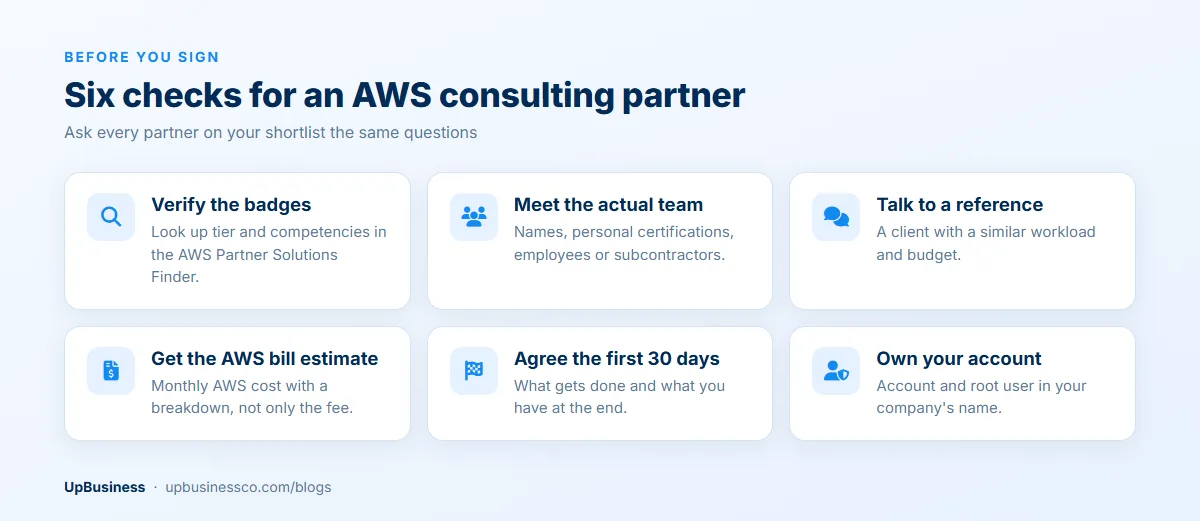
- Check the tier and competencies in the AWS Partner Solutions Finder, and make sure at least one competency matches your project.
- Ask who will work on your account, what certifications they personally hold, and whether they’re employees or subcontractors.
- Ask for a reference client with a similar workload and a similar budget, and ask that client what went wrong as well as what went right.
- Ask for an estimate of your monthly AWS bill along with the consulting fee, and how they arrived at it.
- Ask what they’d do in the first 30 days, and what you’d have at the end of it.
- Confirm account ownership, access removal and handover terms before signing.
When the proposals come in, our guide to comparing software development proposals shows how to score them with fixed weights so the lowest price doesn’t decide everything on its own.
Red Flags When Hiring an AWS Partner
- They can’t name the people who’ll work on your account, or the named people don’t hold the certifications the sales deck mentions.
- They want the AWS account under their company, or they’re vague about who holds the root login.
- They quote a migration or build at a fixed price without looking at your environment first.
- They can’t estimate your monthly AWS cost, or the estimate has no breakdown.
- Every answer ends in a bigger managed-services contract, even for a small one-off job.
None of these is unusual on its own, and most can be fixed with a direct question. A partner that dodges them anyway is showing you how the project will be run.
UpBusiness Data: AWS Consulting Project Sizes
The 6 approved AWS consulting companies on UpBusiness are mostly mid-sized firms: four of the six have between 11 and 200 employees. They report a median average project size of $10,500, with minimum projects starting at a median of about $4,000, and the typical company has been in business for around 12 years.
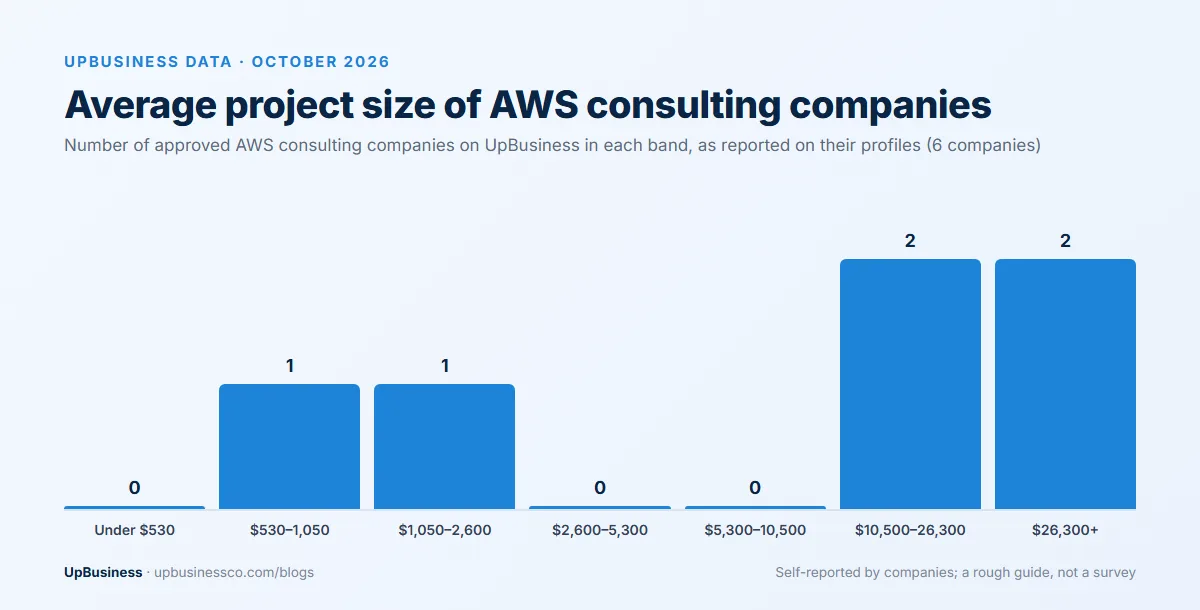
The numbers are self-reported on company profiles and the group is small, so treat them as a rough guide rather than a price list.
Finding AWS Consulting Partners on UpBusiness
On UpBusiness you can compare verified AWS consulting companies by TrustScore, project size and profile before you contact anyone. For specific work, you can also browse cloud migration companies, DevOps service providers and cloud security specialists. Or post your project once and let verified partner companies respond to the same brief.